While customer acquisition often captures the headlines, the real engine of SaaS profitability is retention. Sustainable growth isn't just about getting new users; it's about keeping the ones you have engaged, successful, and loyal. A leaky bucket, no matter how much water you pour into it, will never be full. The same is true for your Monthly Recurring Revenue (MRR).
This article moves beyond generic advice and theory. We've compiled 10 concrete customer retention examples specifically for subscription businesses using Stripe. Each example is a mini-playbook, breaking down the exact tactics used to solve a specific churn problem. We’ll dissect everything from using predictive churn tools to trigger early interventions, to structuring win-back campaigns that actually convert. A critical first step in this journey is ensuring customers find value from day one. To drive the real engine of SaaS profitability and ensure long-term customer value, implementing effective SaaS onboarding best practices is paramount.
Forget surface-level success stories. Instead, you'll get a detailed breakdown for each strategy, including:
- The Problem: The specific churn driver being addressed.
- The Tactic: The precise retention play implemented.
- Implementation: Actionable steps to replicate the strategy.
- Key Metrics: What to track to measure success.
This guide provides a replicable framework to protect your revenue, reduce customer churn, and build a more resilient and profitable business. Let’s dive into the examples.
1. Predictive Churn Analytics & Early Warning Systems
Predictive churn analytics is a powerful customer retention strategy that shifts businesses from being reactive to proactive. Instead of waiting for a customer to cancel, these systems use AI and machine learning to analyze user behavior, payment history from platforms like Stripe, and engagement metrics. The goal is to identify at-risk customers before they decide to leave, generating a "health score" that flags them for early intervention.
This approach is one of the most effective customer retention examples because it addresses the root causes of churn. By flagging declining product usage, missed payments, or a drop in support ticket submissions, teams can trigger targeted retention campaigns while there is still time to make a difference.
How It Works & Key Benefits
Tools like LowChurn and Gainsight connect directly to your data sources, including Stripe billing and product analytics. They process thousands of data points to build a predictive model that assigns each customer a churn risk score. This enables a data-driven retention workflow.
- Early Intervention: Get alerts 7-30 days before a customer is likely to churn, giving your team a crucial window to act.
- Targeted Outreach: Segment at-risk customers into tiers (e.g., critical, high, medium risk) to prioritize outreach and tailor your messaging.
- Resource Efficiency: Focus your customer success team's efforts on the accounts that need the most attention, maximizing impact without scaling headcount.
Strategic Insight: The true power of predictive analytics is its ability to transform retention from a gut-feel exercise into a precise, data-backed science. It allows you to intervene with the right message at the exact moment a customer begins to disengage.
For businesses looking to implement this, the first step is ensuring clean, consistent event tracking. To go deeper on the technical side, you can learn more about building a predictive churn model and the data required. Ultimately, this system provides the foundational intelligence for nearly all other retention tactics.
2. Personalized Retention Campaigns with Behavioral Triggers
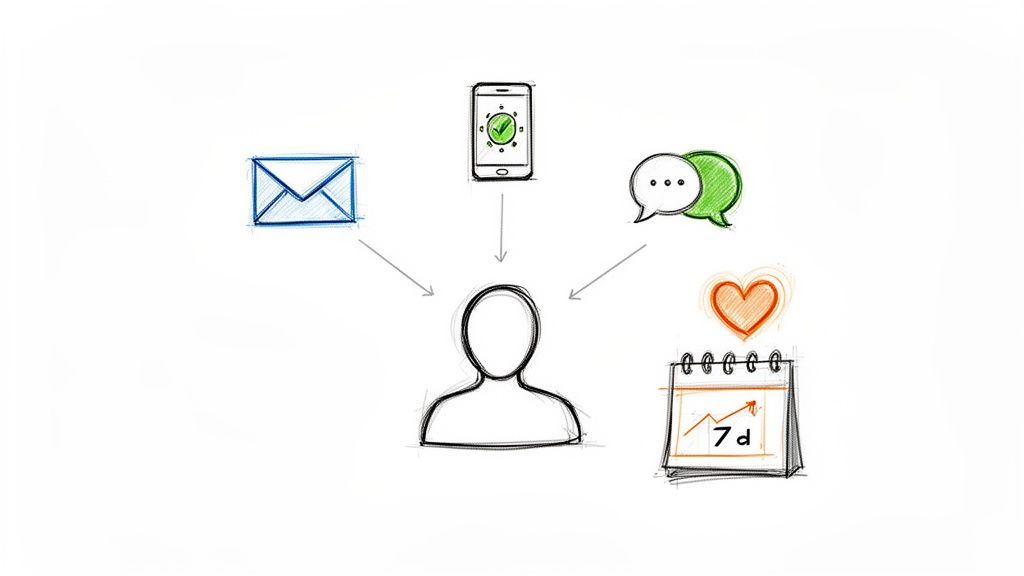
Personalized retention campaigns move beyond generic "we miss you" emails by using specific user actions (or inactions) to trigger timely, relevant outreach. Instead of mass-messaging, this strategy uses marketing automation to send targeted communications based on behavioral data, such as a drop in feature usage, a series of failed payments in Stripe, or ignoring a key workflow for several weeks.
This method is one of the most practical customer retention examples because it connects your message directly to a user's recent experience. For instance, a user who hasn't used a core feature in 14 days receives a different message than a user whose credit card just expired, making the intervention feel helpful rather than intrusive.
How It Works & Key Benefits
Tools like Intercom, Customer.io, and HubSpot connect your product analytics and CRM data to create automated workflows. When a user's behavior matches a predefined trigger (e.g., "login count drops by 50% in 7 days"), a pre-built email or in-app message sequence is activated to re-engage them.
- Contextual Relevance: Messages resonate more strongly because they directly address a user's specific pain point or disengagement reason.
- Scalable Personalization: Automate one-to-one style communication for thousands of users without manual effort from your customer success team.
- Proactive Problem Solving: Intervene with helpful resources, like a tutorial video or a support chat link, at the exact moment a customer is struggling.
Strategic Insight: The effectiveness of behavioral triggers lies in their timing and context. A well-timed message that solves an immediate problem or reminds a user of untapped value is infinitely more powerful than a generic discount offer sent weeks after they've already mentally churned.
For SaaS businesses, a great starting point is to create a workflow for users who complete onboarding but fail to adopt a "sticky" secondary feature. You can learn more about setting up these behavioral campaigns from Intercom's guides on the topic. This approach turns your product and billing data into an automated, proactive retention engine.
3. Win-Back & Reactivation Campaigns for Churned Customers
A win-back campaign is a final, targeted effort to re-engage customers who have already decided to cancel. Instead of simply letting them go, this strategy uses incentives, product updates, and personalized outreach to reverse the cancellation decision, often during the off-boarding process or shortly after their subscription ends. It's one of the most direct customer retention examples, turning a lost account into a saved one.
This approach acknowledges that churn is not always permanent. By understanding why a customer left, often through a cancellation survey, businesses like Slack and Zoom can tailor offers that directly address their pain points. Whether it's a discount for a budget-conscious user or a demo of a newly-released feature they previously requested, win-back campaigns give customers a compelling reason to reconsider.
How It Works & Key Benefits
Effective win-back campaigns are triggered the moment a customer clicks "cancel." By collecting cancellation reasons, you can segment your outreach for maximum impact. A customer who left due to price should receive a different offer than one who found a competitor or was missing a key feature. This personalization is crucial for success.
- Segmented Offers: Create tailored campaigns based on cancellation reasons, such as offering a temporary discount for price sensitivity or a free month to explore new features.
- Demonstrate Value: Highlight specific product improvements and updates that have been released since the customer left, showing you've listened to their feedback.
- Provide Alternatives: Offer a "pause subscription" option as a less drastic alternative to full cancellation, keeping the door open for their return.
Strategic Insight: A successful win-back campaign is not about begging a customer to stay; it's about demonstrating that the value proposition has changed in their favor. It’s a humble, data-driven conversation that shows you understand their reasons for leaving and have a solution.
To effectively implement this, segmenting churned users by their exit survey responses is the first step. For a deeper dive into the tactics, you can explore detailed customer win-back strategies that cover everything from email copy to offer structures. Ultimately, winning back a customer is often more cost-effective than acquiring a new one.
4. Usage-Based Pricing & Feature-Tiered Plans
Usage-based pricing is a retention-focused strategy that directly links the cost of a service to the value a customer receives. Instead of a fixed monthly fee, customers pay based on consumption, like API calls (Stripe), data processed (Datadog), or messages sent (Twilio). This model inherently reduces friction and prevents churn by allowing customers to scale their costs up or down with their needs.
This is a cornerstone among customer retention examples because it eliminates the "shelfware" problem, where customers pay for unused capacity. By ensuring the price always aligns with perceived value, it fosters a healthier, more transparent relationship and makes it difficult for customers to justify leaving due to cost, especially if they are getting significant value from the service.
How It Works & Key Benefits
Companies like Stripe and AWS have popularized this model by billing customers for specific actions or resource consumption. This is often paired with feature-tiered plans (like Slack's model), where higher tiers unlock advanced functionality alongside increased usage limits. This creates a flexible framework that supports customers at every stage of their growth.
- Aligns Cost with Value: Customers only pay for what they use, making the service feel fair and justifiable at any scale.
- Reduces Price-Based Churn: Small or inactive customers can remain on a low-cost or free plan without churning, preserving the opportunity for future expansion.
- Automates Expansion Revenue: As a customer's business grows, their usage naturally increases, driving account expansion without sales intervention.
Strategic Insight: Flexible pricing models transform the customer relationship from a static transaction into a dynamic partnership. When your revenue grows only when your customers succeed and grow, your incentives are perfectly aligned, creating a powerful, built-in retention mechanism.
To implement this, it's crucial to provide customers with a real-time usage dashboard and proactive alerts as they approach plan limits. Clearly communicating upgrade paths within the product prevents surprise overages and turns potential billing disputes into smooth, predictable expansion opportunities.
5. Proactive Customer Success & Health Management
Proactive customer success is a strategic function designed to ensure customers achieve their desired outcomes while using your product. Unlike reactive support, which solves problems as they arise, a customer success team anticipates needs, monitors health indicators, and engages with accounts to maximize value and drive long-term loyalty.
This strategy is one of the most fundamental customer retention examples because it directly aligns your business's success with your customers' success. By tracking engagement, feature adoption, and business goals, companies like Salesforce and HubSpot use dedicated Customer Success Managers (CSMs) to build strong relationships, prevent churn, and identify expansion opportunities.
How It Works & Key Benefits
Customer success platforms like Gainsight or Vitally aggregate user data to create a comprehensive "health score" for each account. This score helps CSMs prioritize their efforts, focusing on high-value accounts that are showing signs of risk or, conversely, are primed for growth. This system turns relationship management into a scalable, data-driven operation.
- Guided Onboarding: Implement structured 30-60-90 day plans to ensure new users reach their "first value" milestone quickly and effectively.
- Segmented Engagement: Apply different levels of engagement based on customer tiers. Use high-touch CSMs for enterprise accounts and automated, tech-touch sequences for smaller customers.
- Risk Mitigation: Use declining health scores as a trigger for proactive outreach, such as offering additional training, a strategic review, or a check-in call.
Strategic Insight: Proactive customer success isn't just about making customers happy; it's about making them successful. When customers consistently achieve their goals with your product, retention becomes a natural byproduct, and churn becomes far less likely.
To effectively implement this, start by defining what a "healthy" customer looks like for your business. You can learn more about creating a customer health score to build a foundation for your CS team's playbooks. This approach provides the human touch needed to turn data-driven insights into lasting customer relationships.
6. Community Building & User Advocacy Programs
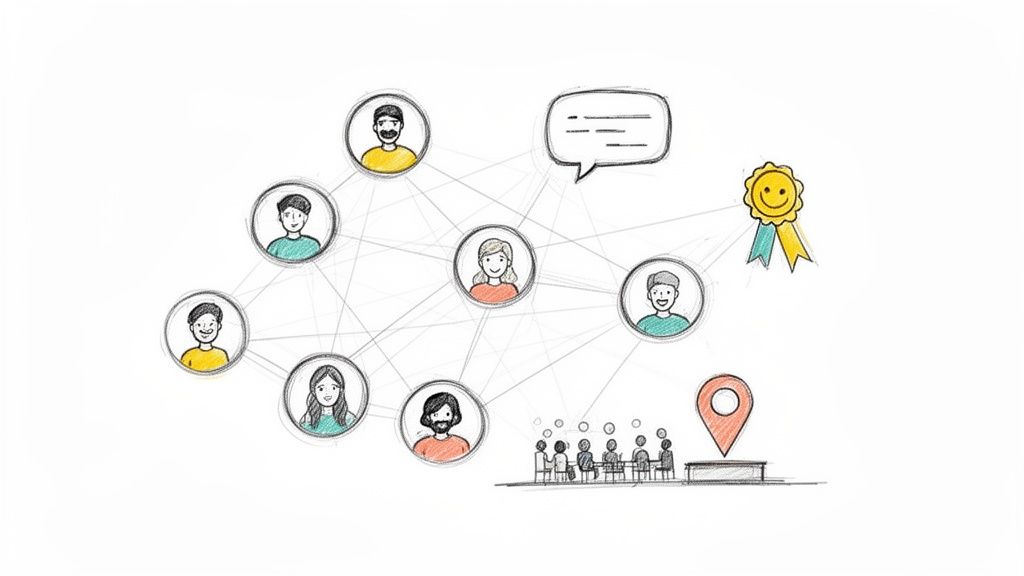
Community building and user advocacy programs are customer retention examples that focus on creating a sense of belonging and shared identity around a product. Instead of viewing customers as transactional users, this strategy nurtures them into active participants and brand advocates. By building forums, user groups, and exclusive events, companies like Figma and Notion increase stickiness by making their product a hub for professional connection and learning.
This approach creates powerful social moats that are difficult for competitors to replicate. When a customer's professional network, knowledge base, and reputation are tied to a specific platform's ecosystem, the perceived cost and effort of switching to a rival service increase dramatically. These programs transform passive users into a powerful, self-sustaining marketing and retention engine.
How It Works & Key Benefits
Platforms like HubSpot's User Groups or Slack's community channels provide spaces for customers to connect, share best practices, and solve problems together. This offloads some support burden while simultaneously deepening user engagement. These initiatives are often gamified with badges, certifications, and exclusive access to reward the most active and helpful members.
- Increased Stickiness: Social and professional connections built within the community create high switching costs, making customers less likely to churn.
- Organic Advocacy: Engaged community members become your most authentic and effective marketers, driving word-of-mouth referrals and user-generated content.
- Product Feedback Loop: A dedicated community provides a direct, unfiltered channel for gathering product feedback and identifying power users for beta testing new features.
Strategic Insight: A strong community transforms your product from a simple utility into a career-enhancing ecosystem. When customers can build their professional brand, skills, and network through your platform, their loyalty extends far beyond feature sets and pricing.
For businesses starting out, a "power user" or ambassador program is a great first step before launching a broad community. Use your CRM and product analytics data to identify your most engaged users and invite them to an exclusive group. This allows you to test content, gather feedback, and build a core group of advocates who will help champion a wider community launch later on.
7. MRR Health Dashboards & Real-Time Business Intelligence
Real-time business intelligence dashboards centralize critical metrics, transforming raw data into a clear, actionable view of customer health and revenue trends. Instead of digging through spreadsheets or multiple systems, leaders can instantly see Monthly Recurring Revenue (MRR) health, churn rates, and at-risk accounts. These dashboards serve as the command center for retention efforts.
This strategy is one of the most fundamental customer retention examples because it creates a single source of truth for the entire organization. By visualizing data from Stripe, product analytics, and support systems, these tools empower teams to understand why churn is happening and track the immediate impact of their retention initiatives on the business's bottom line.
How It Works & Key Benefits
Platforms like LowChurn, ChartMogul, and Stripe’s own analytics dashboard connect your data sources to generate live, interactive dashboards. They surface trends, segment customers, and provide both predictive (what will happen) and diagnostic (why it happened) insights, enabling a culture of proactive, data-driven decision-making.
- Unified View of Health: Consolidate billing, usage, and support data to create holistic customer health scores and MRR trends.
- Action-Oriented Insights: Instantly identify which customers to contact today with prioritized lists of at-risk accounts.
- Strategic Alignment: Create custom dashboards for different roles, so founders can monitor high-level MRR while customer success teams focus on individual user engagement.
Strategic Insight: A real-time dashboard shifts your culture from reacting to historical reports to acting on live intelligence. When everyone from the CEO to the customer success manager is looking at the same live data, your entire company becomes a more effective retention machine.
For teams implementing this, the key is to ensure the dashboard drives action, not just analysis. Start by surfacing a simple "Top 10 At-Risk Accounts" list and review it in weekly team meetings. This operational rhythm turns passive data consumption into an active, high-impact retention workflow.
8. Payment Failure Recovery & Billing Optimization
Payment failure recovery is one of the most direct and high-impact customer retention examples, as it targets involuntary churn. This type of churn happens not because a customer is unhappy, but because a technical billing issue, like an expired credit card or insufficient funds, prevents a successful payment. Automated systems recover this revenue before it’s lost.
This strategy is crucial because it plugs a significant, often overlooked, leak in the revenue bucket. Instead of letting these customers accidentally churn, billing optimization systems use intelligent retry logic and automated dunning (payment reminder) communications to resolve the issue, preserving both the customer relationship and the recurring revenue. For many SaaS businesses, this can account for 20-40% of their total churn.
How It Works & Key Benefits
Tools like Stripe Billing, Recurly, and Chargify automate the entire recovery process. When a payment fails, the system triggers a pre-defined workflow of card retries and customer notifications designed to maximize the chances of a successful payment on a subsequent attempt. This turns a potential crisis into a routine, automated fix.
- Reduce Involuntary Churn: Directly recover customers who would have otherwise churned due to simple payment errors, immediately boosting net revenue retention.
- Automate Dunning: Eliminate the manual effort of chasing failed payments with automated, customizable email and in-app notification sequences.
- Improve Customer Experience: Provide customers with a simple, frictionless way to update their payment information with a single click, preventing service interruptions.
Strategic Insight: Involuntary churn is low-hanging fruit. Fixing it requires no product changes or complex customer success plays, only robust billing infrastructure. Optimizing your dunning process is often the highest ROI retention activity a subscription business can undertake.
To implement this, start by configuring your payment processor's smart retry and dunning settings. For instance, set up a retry schedule that attempts payment again after 3, 5, and 7 days while sending corresponding reminder emails. Integrating payment failure data into a churn prediction tool like LowChurn can also flag these accounts for proactive outreach from your team.
9. Feature Discovery & Product Education Programs
Feature discovery and product education programs are systematic strategies designed to prevent churn by ensuring customers find and use the full range of a product's capabilities. Customers often churn not because a product is bad, but because they are unaware of features that could solve their evolving problems. This strategy directly combats that by actively guiding users toward greater value realization.
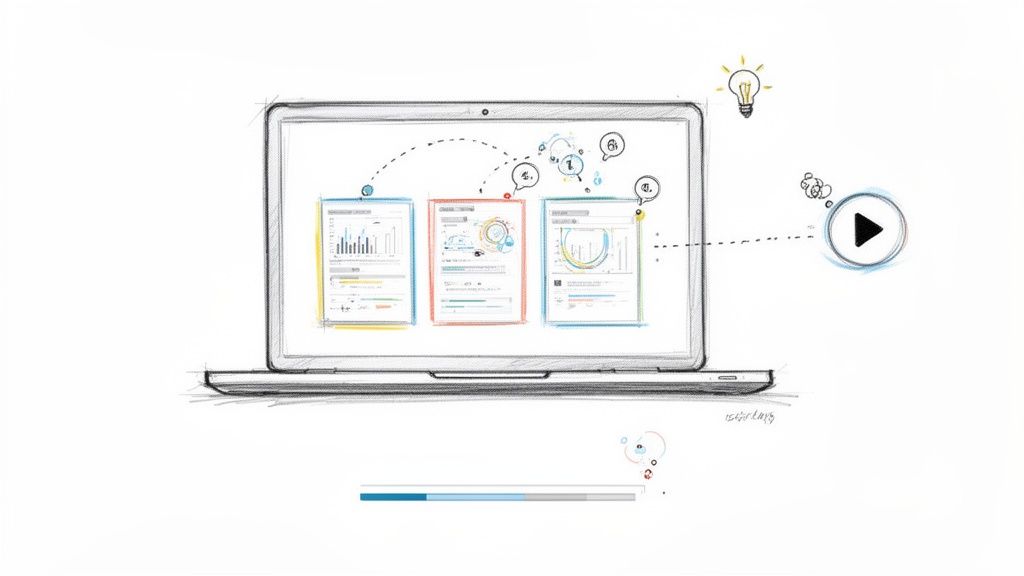
This is one of the most fundamental customer retention examples because it addresses "silent churn," where a customer's needs outgrow their perceived value of your product. By proactively showcasing relevant features through in-app tours, tutorials, and academies like Salesforce's Trailhead or HubSpot Academy, you turn a potential churn risk into a power user.
How It Works & Key Benefits
Companies like Notion and Figma excel at this by building vast template galleries and tutorial libraries organized by user goals, not just product functions. This reframes feature education from a technical "how-to" into a strategic "how you can achieve." The goal is to continuously reveal new layers of value, making your product stickier over time.
- Boost Feature Adoption: Trigger in-app guides for new capabilities or when a user reaches a certain milestone, increasing the likelihood of adoption.
- Prevent "Silent Churn": Actively educate users on advanced functionality, ensuring they don't outgrow the product without realizing its full potential.
- Scale Customer Success: Create self-service educational resources like knowledge bases and video tutorials that reduce the support team's burden while empowering users.
Strategic Insight: Effective product education is not about listing features; it's about mapping capabilities to customer jobs-to-be-done. When a customer sees how a specific feature solves their exact business problem, its value becomes undeniable.
To implement this, start by mapping your key features to specific customer use cases. From there, you can develop targeted educational content, like monthly webinars on "advanced workflows" or short video tutorials showing a feature in a real-world context. Measuring feature adoption rates will reveal which parts of your product need better educational support.
10. NPS & Data-Driven Churn Cohort Analysis
This strategy combines qualitative feedback with quantitative analysis, creating a comprehensive view of customer health. By systematically collecting Net Promoter Score (NPS) and CSAT feedback, businesses can identify dissatisfied customers. Simultaneously, cohort analysis dissects historical churn data to reveal which customer segments, acquisition channels, or product plans are most vulnerable.
This dual approach is one of the most fundamental customer retention examples because it connects customer sentiment directly to business outcomes. You're not just guessing why people leave; you're using feedback from detractors like those identified in Slack's outreach programs to understand the "why" and using cohort data from tools like ChartMogul to pinpoint the "who" and "when."
How It Works & Key Benefits
NPS surveys ask customers how likely they are to recommend your product, segmenting them into Promoters, Passives, and Detractors. Cohort analysis groups customers by their signup month and tracks their retention over time. Combining these reveals patterns, such as a drop in NPS from a specific cohort that later shows a high churn rate.
- Surface Root Causes: Use detractor feedback to identify specific product gaps, bugs, or onboarding issues that are driving customers away.
- Validate Product-Market Fit: Analyze retention curves by plan type, company size, and use case to see where your product resonates most strongly and where it's failing.
- Measure Initiative Impact: Track monthly cohorts to see how retention improves after you launch a new feature or update your pricing, providing clear ROI on development efforts.
Strategic Insight: Relying on NPS alone is a vanity metric. The real power comes from correlating sentiment data with actual behavior. When a cohort's NPS score drops and its retention curve flattens a month later, you have a direct, actionable signal to investigate.
For businesses looking to implement this, start by sending NPS surveys quarterly to avoid fatigue, and always ask a follow-up question like, "What's one thing we could improve?" Then, use a tool like LowChurn or Mixpanel to build baseline retention curves for your key segments. This provides the historical context needed to understand if your retention efforts are truly working.
10-Point Customer Retention Strategy Comparison
| Title | 🔄 Implementation complexity | ⚡ Resource requirements | 📊 Expected outcomes | 💡 Ideal use cases | ⭐ Key advantages |
|---|---|---|---|---|---|
| Predictive Churn Analytics & Early Warning Systems | High — advanced ML, realtime scoring | High — data engineering, integrations, models | Reduces churn ~10–25% when acted on; 85%+ model accuracy reported | SaaS with rich usage/billing data; mid-market & enterprise | Proactive detection; prioritizes risk; privacy-first processing |
| Personalized Retention Campaigns with Behavioral Triggers | Medium–High — workflow + personalization logic | Medium — automation platform, content, CRM sync | Recovers ~15–30% of flagged at-risk users; higher engagement | High-volume products needing multi-channel outreach | Scales personalized outreach; timely, data-driven messaging |
| Win-Back & Reactivation Campaigns for Churned Customers | Low–Medium — workflows and incentives | Low–Medium — marketing, offer budget, timing | Recovers ~5–15% of canceled customers if timely | Recent cancels or accounts in notice/grace period | Lower acquisition cost than new; uses exit data for targeting |
| Usage-Based Pricing & Feature-Tiered Plans | High — billing, metering, pricing design | Medium–High — billing systems, analytics, legal | Reduces price-driven churn 20–40%; increases revenue per customer | Products with measurable consumption or varied usage patterns | Aligns cost with value; drives upgrades and trust |
| Proactive Customer Success & Health Management | High — processes, playbooks, staffing | High — skilled CSMs, enablement tools, training | Reduces churn 15–30% for engaged accounts; upsell +20–40% | High-LTV enterprise/mid-market accounts | Deep relationships; increases adoption and advocacy |
| Community Building & User Advocacy Programs | Medium — platform + ongoing moderation | Medium — community managers, events, content | Reduces churn 10–25% long-term; can drive 30–50% referrals | Product-led or network-effect businesses seeking organic growth | Creates network effects; peer support; long-term loyalty |
| MRR Health Dashboards & Real-Time Business Intelligence | Medium–High — data integration & dashboarding | Medium — analytics stack, data engineers, BI tools | 25–35% faster response to at-risk customers; better insight tracking | Revenue leaders needing realtime visibility across systems | Centralizes metrics; ties diagnostics to action |
| Payment Failure Recovery & Billing Optimization | Low–Medium — retry logic + dunning flows | Low–Medium — billing API integration, templates | Recovers 20–35% of billing-related revenue; 3–10x ROI common | Subscription businesses with card payments and involuntary churn | High ROI; prevents technical involuntary churn quickly |
| Feature Discovery & Product Education Programs | Medium — in-app guides & content programs | Medium — content creators, UX, analytics | Increases feature adoption 30–50%; net retention +10–20% | Feature-rich products with low discoverability | Raises perceived value; reduces churn from underuse |
| NPS & Data-Driven Churn Cohort Analysis | High — surveys, analytics, cohort modeling | Medium–High — analytics expertise, feedback ops | Detractor recovery 15–25%; improves retention ROI 40–60% | Companies needing diagnostic insights and prioritization | Identifies churn drivers; targets high-impact retention efforts |
From Examples to Action: Building Your Retention Flywheel
We've explored a wide range of powerful customer retention examples, moving from predictive analytics and behavioral triggers to proactive customer success and community building. Each case study, whether focused on win-back campaigns, dunning management, or feature adoption, reinforces a single, foundational principle: sustainable growth is built on retention, not just acquisition.
The strategies detailed in this article are not isolated tactics. They are interconnected components of a holistic retention system. Treating them as a simple checklist misses the point. The real power emerges when these examples are integrated into a cohesive, data-driven flywheel where each action informs and strengthens the next.
Synthesizing the Core Retention Principles
Across all the diverse examples, three core themes consistently emerge as non-negotiable for modern SaaS businesses using platforms like Stripe:
Proactivity Over Reactivity: The most effective retention strategies don't wait for a cancellation request. They leverage predictive tools to identify at-risk customers based on subtle shifts in behavior, such as declining product usage, missed feature adoption milestones, or changes in login frequency. This is the difference between saving an account and simply processing its churn.
Personalization at Scale: Generic, one-size-fits-all emails have a diminishing return. The best customer retention examples show that success hinges on delivering the right message to the right user at the right time. This is achieved by segmenting users based on their health scores, usage patterns, subscription tier, and lifecycle stage, then triggering automated yet personalized interventions.
Value as the Ultimate Hook: Every retention effort, from a pricing nudge to a customer success call, must be anchored in delivering or reminding the customer of your product's value. A win-back offer isn't just about a discount; it's about re-engaging the user with a feature they missed or a new use case that solves a pressing problem for them. Retention is a direct byproduct of the value you consistently provide.
Putting These Examples into Practice
Moving from theory to implementation can feel daunting, but it doesn't require a complete overhaul of your operations overnight. The key is to start small, measure meticulously, and iterate.
Your Actionable Next Steps:
- Identify Your Biggest Leak: Begin by analyzing your churn data. Is the primary driver payment failures, early-stage onboarding drop-offs, or post-renewal inactivity? Choose the one strategy from our list that directly addresses your most significant point of churn.
- Implement a Single, Measurable Campaign: Don't try to launch a win-back campaign, an onboarding sequence, and a dunning solution all at once. Pick one. For instance, if payment failures are high, implement a pre-dunning email sequence and track its impact on your involuntary churn rate for one month.
- Leverage Predictive Signals: Connect a tool that provides predictive churn insights. Use this data to build your first proactive segment of "at-risk" customers. Your initial goal is simple: trigger a manual check-in from your customer success team for the top 10 highest-risk accounts and see if you can change their trajectory.
By focusing on one area at a time, you can build momentum and prove the ROI of retention efforts, creating a strong case for further investment. This methodical approach transforms a long list of customer retention examples from an interesting read into a practical growth playbook. For those looking for a diverse range of inspiration, an extensive examples list can provide valuable insights into successful retention strategies. Ultimately, the goal is to build a system where customer value and business growth are mutually reinforcing, creating a powerful flywheel that propels your company forward.
Ready to stop reacting to churn and start preventing it? The examples in this article are most effective when powered by predictive data. LowChurn integrates directly with your Stripe account to give you the early-warning signals and customer health scores you need to implement these strategies before customers are lost. Try LowChurn today and turn your churn data into your greatest retention asset.