In the world of subscription revenue, growth isn't just about acquiring new customers; it's about keeping the ones you have. Customer churn is a persistent threat to Monthly Recurring Revenue (MRR), quietly eroding growth and forcing you to run faster just to stay in the same place. While a certain level of churn is inevitable, a significant portion is preventable. The key is to shift from a reactive mindset, where you only address problems after a customer cancels, to a proactive one that anticipates needs and resolves issues before they escalate.
This guide moves beyond generic advice to provide a prioritized, actionable list of 10 proven methods to decrease customer churn. We will cover everything from leveraging predictive analytics and early warning systems to structuring smarter win-back campaigns and refining your onboarding process. These are the specific playbooks that top-performing SaaS companies use to protect their revenue and build a loyal, long-term customer base. For a comprehensive guide on transforming your approach, consider exploring proven tactics on how to reduce churn rate and boost retention. Let's dive into the strategies that will help you turn at-risk accounts into your most valuable advocates.
1. Predictive Churn Analytics & Early Warning Systems
Predictive analytics uses machine learning to identify customers likely to churn before they actually cancel. This forward-looking approach analyzes real-time customer behavior, product usage patterns, and subscription signals to generate a “health score” for each user. Instead of reacting to a cancellation, your team can proactively intervene 7-30 days in advance, armed with data-driven insights about why a customer is at risk.
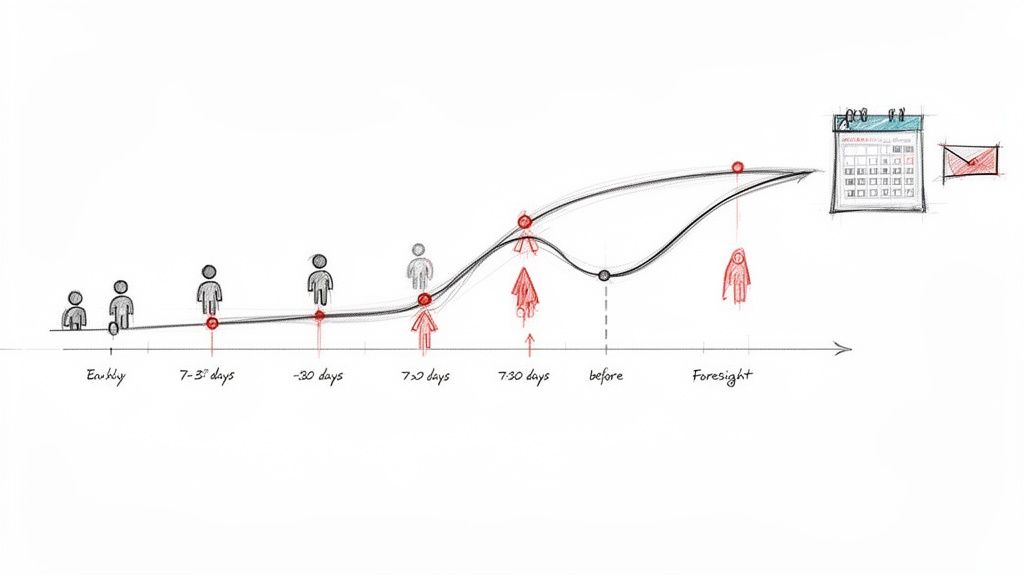
This method is crucial for any SaaS business looking to decrease customer churn systematically. For example, platforms like LowChurn analyze Stripe subscription metadata and engagement signals to deliver predictions with over 85% accuracy, helping startups reduce their MRR churn by up to 40% within weeks of implementation.
How to Implement Predictive Analytics
- Integrate Early: Connect a predictive tool to your Stripe account and product analytics. The sooner you start collecting data, the more accurate and valuable the insights will become over time.
- Segment Outreach: Use the generated customer health scores to segment your outreach. Focus your most intensive retention efforts on high-value customers who are flagged as high-risk.
- Automate Alerts: Set up automated notifications for your customer success team when a customer’s health score drops below a critical threshold. This enables immediate, targeted intervention.
This strategy shifts retention from a reactive process to a proactive one, directly impacting your bottom line. You can explore a deeper dive into how to use predictive analytics for customer retention.
2. Personalized Win-Back Campaigns
Personalized win-back campaigns are targeted re-engagement efforts aimed at customers who have recently canceled or are showing clear churn signals. Instead of generic "we miss you" emails, this strategy uses customer data like usage patterns, account history, and identified pain points to deliver a highly relevant message. The goal is to address the specific reason for churn with a tailored solution, whether it's pricing, feature gaps, or underutilization.
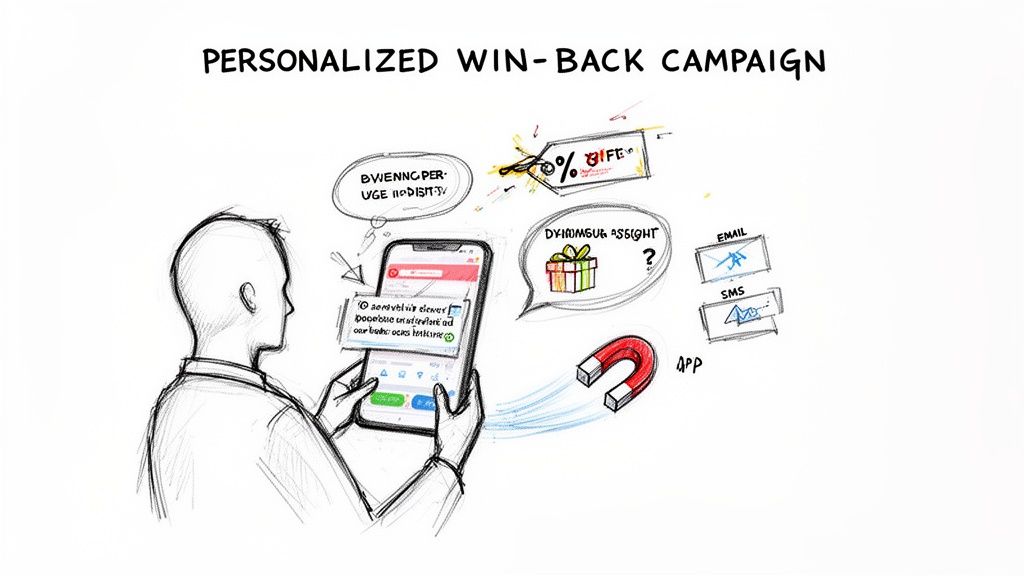
This tactic is a powerful way to decrease customer churn by demonstrating you understand a user's unique needs. For example, Netflix often offers a free month to lapsed subscribers, while Dropbox targets users with low storage usage with specific upgrade incentives and guidance. By personalizing the offer, you significantly increase the chances of winning back valuable customers and reviving lost MRR.
How to Implement Personalized Win-Back Campaigns
- Segment by Churn Reason: Group churning customers based on why they are leaving. Categories could include price sensitivity, low product adoption, or switching to a competitor. Tailor your offer to address each segment’s core issue.
- Trigger Campaigns Proactively: Use churn signals like a drop in logins or feature usage to trigger your win-back campaign before the final cancellation. This proactive outreach can intercept churn when the customer is still engaged.
- Test and Personalize Offers: Experiment with different incentives like a temporary discount, a free feature unlock, or a one-on-one session with a product expert. Personalize the email copy with specific data, such as "We noticed you haven't used [Feature X] lately."
By strategically re-engaging at-risk users with relevant solutions, you transform a potential loss into a retention opportunity. You can find more templates and strategies for these campaigns from platforms like Customer.io.
3. Usage-Based Pricing & Flexible Billing Models
Usage-based pricing aligns cost directly with the value a customer extracts from your product. Instead of a fixed monthly fee, customers pay based on their consumption, such as transaction volume, API calls, or data storage. This model inherently reduces friction for new users and minimizes churn caused by customers feeling overcharged for features they don't use. It’s a powerful strategy to decrease customer churn because it creates a fairer, more transparent value exchange.
This model is a cornerstone for many industry leaders. For example, Twilio charges per SMS or call minute, and AWS bills for compute hours. By linking cost to value, this approach ensures that customers only pay for what they need, which builds trust and can lead to higher long-term retention rates as their usage naturally scales with their own growth.
How to Implement Usage-Based Pricing
- Align Metrics to Value: Choose a usage metric that directly correlates with the primary value your customers receive. For an email marketing platform, this might be contacts or emails sent.
- Provide Transparent Dashboards: Give customers a clear, real-time view of their consumption and estimated costs. This transparency prevents billing surprises, a common driver of churn.
- Offer Hybrid Models: Combine usage-based pricing with a stable base subscription fee. This provides revenue predictability for you while offering flexibility for your customers.
- Automate Billing Integration: Ensure your Stripe or other billing system is tightly integrated to accurately track and bill for metered usage without manual intervention.
This strategy transforms your pricing into a growth lever, creating natural upsell paths and aligning your success with that of your customers.
4. Proactive Customer Success & Health Monitoring
Proactive customer success is the practice of actively monitoring customer health and engaging customers to ensure they achieve their desired outcomes with your product. Instead of waiting for a support ticket or a negative survey, this strategy uses data to identify early signs of struggle or disengagement. By tracking metrics like feature adoption, login frequency, and support interactions, you can create a real-time health score for each account.
This approach is fundamental to decrease customer churn because it addresses friction before it escalates into a cancellation reason. Platforms like Gainsight and Vitally automate this process, enabling customer success managers (CSMs) to focus on value-driven conversations rather than manual data-checking. For instance, a CSM might receive an alert that a high-value account's usage of a key feature has dropped, prompting a targeted outreach call to offer training or strategic guidance.
How to Implement Proactive Customer Success
- Define Health Score Components: Create a clear, data-backed customer health score. Key inputs should include product adoption rates, frequency of use, support ticket volume and sentiment, and recent survey responses (like NPS).
- Automate Proactive Alerts: Configure your customer success platform to send automated alerts to the responsible CSM when an account’s health score falls below a predefined threshold. This ensures timely intervention.
- Develop Engagement Playbooks: Create standardized playbooks for common risk scenarios. For example, have a specific sequence of emails and calls for customers with low feature adoption or those who haven't logged in for 14 days.
By systematizing health monitoring and intervention, you transform your customer success team from a reactive support function into a proactive revenue-retention engine.
5. Transparent Communication & Regular Business Reviews
Proactive, structured dialogue is a powerful tool to reinforce the value your product delivers. Regular Business Reviews (QBRs or EBRs) transform your relationship from a simple vendor-client dynamic into a strategic partnership. These meetings focus on demonstrating ROI, aligning on future goals, and addressing concerns before they escalate into churn risks.
This strategy is fundamental for B2B SaaS companies looking to decrease customer churn by embedding themselves into a client's success framework. For instance, Atlassian shares product roadmaps with key accounts to gather feedback and build buy-in, while Salesforce conducts executive business reviews to ensure C-level stakeholders see tangible business value, securing long-term loyalty and contract renewals.
How to Implement Regular Business Reviews
- Prepare with Data: Come to the meeting armed with specific customer usage data, success metrics, and ROI calculations. Highlight how your platform has saved time, enabled revenue, or improved efficiency.
- Involve Key Stakeholders: Ensure that decision-makers and executive sponsors attend, not just daily users. This is your chance to prove value to the people who control the budget.
- Create a Two-Way Dialogue: Share relevant upcoming roadmap items and actively solicit feedback on priorities. This makes customers feel heard and invested in your product’s future.
- Document and Follow Up: End every review with clear, documented action items assigned to specific owners with deadlines. This demonstrates accountability and ensures that customer concerns are resolved.
6. Comprehensive Onboarding & Activation Programs
A strategic onboarding program ensures new customers quickly reach their "aha moment" and achieve initial success, which is critical for retention. The highest churn rates often occur within the first 90 days, making this initial period vital. Effective onboarding guides users with hands-on setup, targeted training, and clear milestones to maximize their time-to-value and solidify their decision to use your product.
This process is a foundational strategy to decrease customer churn by building early momentum and user confidence. For example, Slack’s interactive setup wizard helps teams create channels and invite members immediately, while Notion provides a rich template library to get users started on meaningful projects right away. These companies transform a potentially complex setup into a guided, value-driven experience. To foster loyalty and drive growth within your community, explore these powerful community engagement strategies alongside your onboarding efforts.
How to Implement Comprehensive Onboarding
- Create Role-Based Paths: Tailor the onboarding experience for different user types, such as admins, end-users, or stakeholders. Each role has unique goals and needs a distinct path to activation.
- Track Success Milestones: Use product analytics to identify key activation events (e.g., creating the first project, inviting a team member). Automate in-app messages or emails to celebrate these achievements.
- Offer On-Demand Resources: Make onboarding content like video walkthroughs, checklists, and guides continuously available within your app or help center, not just during the initial sign-up flow.
By focusing on activation, you turn new sign-ups into engaged, long-term customers. You can learn more about how to design effective customer onboarding strategies.
7. Community Building & User Advocacy Programs
Creating a thriving user community builds a powerful moat around your product by fostering a sense of belonging and shared expertise. Engaged customers who feel connected to your brand and each other are far less likely to churn, as they see value beyond just the software itself. This strategy transforms customers into advocates who provide peer support, share best practices, and contribute to your product’s ecosystem.
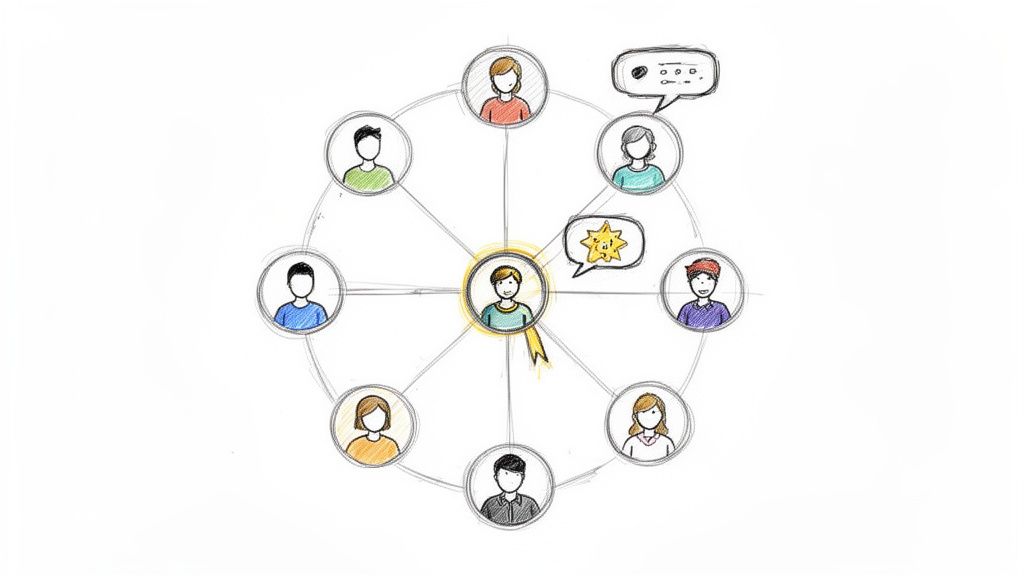
This approach is highly effective for any business looking to decrease customer churn by increasing user investment and loyalty. For instance, HubSpot’s community forums and user groups provide immense value by connecting users with peers, while Figma's community plugin library turns its user base into a core part of its product innovation engine. This creates strong networking effects and significantly raises the switching costs for active members.
How to Implement Community Programs
- Start with a Core Group: Begin by creating a customer advisory board with your most engaged power users. Use their feedback to shape the product and community direction before expanding.
- Host Regular Events: Organize virtual workshops, Q&A sessions with your team, or in-person meetups. Consistent events keep engagement high and reinforce the community's value.
- Recognize Top Contributors: Implement recognition programs like badges, special access, or features for users who actively help others. This encourages positive participation and creates role models within the community.
Building a community turns your customer base into a self-sustaining asset, directly improving retention and providing invaluable feedback for your product roadmap.
8. Competitive Win-Back Intelligence & Switching Pause Offers
This strategy involves proactively identifying customers at risk of switching to a competitor and using targeted incentives or "pause" offers to retain them. By monitoring signals like competitor mentions in support tickets or feature requests that align with a rival’s strengths, you can intervene before a customer fully commits to leaving. It’s a surgical approach to decrease customer churn by addressing the specific reasons a customer is looking elsewhere.
This method turns a potential loss into a valuable learning opportunity. For example, a CRM company might notice a cluster of users requesting a feature specific to a major competitor. Instead of waiting for cancellations, the customer success team can reach out with a roadmap update or offer a temporary discount while the feature is in development. Similarly, offering to pause a subscription for 30-60 days at a reduced rate gives customers a cooling-off period and you a chance to re-engage them.
How to Implement Competitive Intelligence & Pause Offers
- Create Competitor Playbooks: Develop pre-approved responses and offers for your most common competitors. Equip your customer success team with talking points that highlight your unique value proposition and address competitor weaknesses.
- Monitor for Signals: Use automation to flag competitor names mentioned in support tickets, cancellation surveys, or community forums. Treat these as high-priority churn alerts for your retention team.
- Empower Your Team: Give your customer-facing teams the authority to offer strategic incentives, such as a one-month pause or a temporary discount, without needing multiple layers of approval. This allows for swift, effective intervention.
This tactic directly counters competitor threats and provides critical insights into market gaps, helping you build a more defensible product over time.
9. Segmented Retention Strategies Based on Customer Cohorts
Not all customers are the same, so your retention strategy shouldn’t be one-size-fits-all. Segmenting customers into distinct cohorts based on attributes like company size, industry, or use case allows you to tailor your retention efforts. This approach acknowledges that churn drivers differ significantly across groups, enabling you to allocate resources more effectively and deliver highly relevant interventions.
This targeted method is a cornerstone for SaaS leaders like HubSpot and Salesforce, who develop unique playbooks for SMBs versus enterprise clients. By understanding the specific needs and pain points of each segment, you can create customized onboarding flows, messaging, and support models that resonate deeply and decrease customer churn. This prevents wasting resources on generic campaigns that fail to address the core reasons a specific cohort might leave.
How to Implement Segmented Retention Strategies
- Define Key Segments: Start by identifying 3-5 clear customer segments based on high-impact data such as MRR, strategic value, or product usage patterns. For instance, separate high-touch enterprise accounts from self-serve SMBs.
- Create Segment-Specific Playbooks: Develop tailored retention plans for each cohort. A playbook for a high-value enterprise segment might involve a dedicated account manager and quarterly business reviews, while a low-touch segment could receive automated, triggered email campaigns.
- Allocate Resources Proportionally: Focus your most intensive retention efforts, such as direct outreach from your customer success team, on the segments with the highest customer lifetime value (CLV) and strategic importance.
- Monitor Cohort Health Separately: Track churn rates and engagement metrics for each segment independently. This helps you quickly spot emerging issues within a specific group before they impact your overall churn rate.
By segmenting your approach, you move from a broad, often inefficient strategy to a precise, data-driven one. You can learn more about how to use cohort analysis to better understand your customer base.
10. Product Roadmap Transparency & Customer-Driven Prioritization
Sharing your product direction and involving customers in prioritization builds investment and shows them you are listening. When users see their feedback directly influencing development, they feel valued and are more likely to stick around, knowing the product is evolving to meet their needs. This transparency transforms customers from passive users into active partners, which is a powerful way to decrease customer churn.
This strategy reassures customers that the product isn't stagnating and that their pain points are being addressed. Tools like Canny.io and Hellonext make it easy to create public roadmaps and feature voting systems. For example, Notion’s community-driven roadmap allows users to see what’s being worked on and contribute ideas, fostering a strong sense of loyalty and shared progress.
How to Implement a Customer-Driven Roadmap
- Publish a Simple Roadmap: Create a public-facing roadmap showing committed features for the next 1-2 quarters. Focus on clarity and direction over exhaustive detail.
- Implement Feature Voting: Use a simple tool to allow customers to vote on feature requests. This provides clear, quantitative data on what your user base wants most.
- Communicate Proactively: Share quarterly updates on roadmap progress, including wins and delays. When deprioritizing a requested feature, explain the strategic reasoning to maintain trust.
- Highlight Customer Impact: In release notes and announcements, prominently feature which updates came directly from customer feedback. This closes the loop and reinforces that their voice matters.
This approach ensures your development resources are aligned with what customers actually need, directly linking product strategy to retention.
10-Strategy Comparison: Reducing Customer Churn
| Strategy | Implementation 🔄 | Resources ⚡ | Expected outcomes 📊⭐ | Ideal use cases 💡 | Key advantages ⭐ |
|---|---|---|---|---|---|
| Predictive Churn Analytics & Early Warning Systems | Low install; medium setup for model training and tuning 🔄 | Data access, ML models, integration with Stripe; vendor or data science support ⚡ | High accuracy (85%+); early 7–30 day warnings; improved MRR retention 📊⭐ | SaaS on Stripe needing proactive alerts and prioritization 💡 | Proactive intervention, quick ROI, prioritized outreach ⭐ |
| Personalized Win-Back Campaigns | Medium: segmentation, messaging flows, A/B testing 🔄 | Marketing ops, multi-channel tooling, creative resources ⚡ | Higher reactivation rates; insight into churn reasons; cost-effective recoveries 📊⭐ | Customers showing churn signals before renewal or cancellation 💡 | Targeted recovery, addresses specific pain points, better response rates ⭐ |
| Usage-Based Pricing & Flexible Billing Models | High: redesign billing, metering, caps, and legal terms 🔄 | Billing engineers, metering infra, dashboards, product alignment ⚡ | Reduces price-driven churn; starts small → natural upsells; less predictable revenue 📊⭐ | Products with variable consumption or outcome-based value (APIs, infra) 💡 | Fair pricing, lower entry barrier, aligns value with cost ⭐ |
| Proactive Customer Success & Health Monitoring | Medium: health score logic, dashboards, playbooks 🔄 | CS managers or automation, CRM/analytics integration ⚡ | Fewer churns, improved customer outcomes and LTV; earlier issue detection 📊⭐ | High-MRR and outcome-driven customers needing continuous engagement 💡 | Catches problems early, strengthens relationships, informs product ⭐ |
| Transparent Communication & Regular Business Reviews | Low–medium: set cadence, prepare ROI materials, train staff 🔄 | CSMs/exec time, reporting decks, stakeholder coordination ⚡ | Increased trust, clearer ROI, surfacing issues before renewal 📊⭐ | Enterprise/strategic accounts where executive alignment matters 💡 | Builds trust, demonstrates value, creates switching friction ⭐ |
| Comprehensive Onboarding & Activation Programs | Medium–high: build flows, content, in-app guides, specialists 🔄 | Onboarding specialists, UX/content teams, analytics tooling ⚡ | Dramatic reduction in early churn; faster time-to-value; higher activation 📊⭐ | New customers and products with a steep learning curve (first 90 days) 💡 | Improves activation, reduces downstream support, boosts NPS ⭐ |
| Community Building & User Advocacy Programs | Medium: platform setup, seeding, moderation, events 🔄 | Community managers, events budget, content and moderation resources ⚡ | Greater engagement, organic advocacy, reduced churn for active participants 📊⭐ | Collaborative products or those benefiting from peer support/network effects 💡 | Peer support, organic growth, increased switching costs ⭐ |
| Competitive Win-Back Intelligence & Switching Pause Offers | High: detection systems, playbooks, CI processes 🔄 | Competitive analysts, empowered CS, tracking of competitor signals ⚡ | Can prevent imminent switches; yields market intelligence; often temporary wins 📊⭐ | Accounts showing competitor usage or cancellation mentions; high-value renewals 💡 | Recovers at-risk accounts, informs roadmap, enables executive saves ⭐ |
| Segmented Retention Strategies Based on Customer Cohorts | Medium–high: define segments, build segment-specific playbooks 🔄 | Data engineers, segment-tailored CS resources, analytics ⚡ | Higher retention ROI via targeted interventions; scalable prioritization 📊⭐ | Diverse customer bases by ARR, industry, use case or tenure 💡 | Efficient resource allocation, personalized retention, better metrics ⭐ |
| Product Roadmap Transparency & Customer-Driven Prioritization | Low–medium: public roadmap process, feedback channels 🔄 | Product team time, roadmap tooling, advisory board coordination ⚡ | Reduced feature-gap churn; increased customer investment and advocacy 📊⭐ | Feature-driven customers and those worried about product direction 💡 | Builds trust, aligns product to customer needs, drives engagement ⭐ |
Building a Retention Engine for Sustainable Growth
Navigating the complexities of customer retention can feel overwhelming, but the path to significantly decrease customer churn is paved with intentional, data-driven actions. Throughout this guide, we've explored ten powerful strategies, moving from reactive fixes to proactive, culture-defining initiatives. The core lesson is clear: retention isn't the responsibility of a single team; it's the outcome of an organization-wide commitment to delivering continuous value.
The journey begins with understanding not just that customers are leaving, but who is at risk and why. This is where predictive analytics and proactive health monitoring become your foundational pillars. From there, every other strategy gains potency. Your personalized win-back campaigns become more relevant, your onboarding programs more targeted, and your customer success interventions more timely. You stop guessing and start acting with precision, transforming your approach from a scattered collection of tactics into a cohesive and powerful retention engine.
Key Takeaways for Immediate Action
To truly make progress, you must translate these concepts into tangible next steps. Here are the most critical takeaways to focus on this quarter:
- Prioritize Proactive Intervention: Don't wait for the cancellation email. The most effective way to decrease customer churn is to identify at-risk signals early. Low product engagement, missed payments, or a sudden drop in support tickets can all be leading indicators. Implement a system to flag these accounts and trigger a proactive outreach playbook.
- Embrace Segmentation: A one-size-fits-all retention strategy is destined to fail. Your high-value enterprise clients have different needs and churn triggers than your self-serve SMB customers. Use cohort analysis and customer segmentation to tailor your communication, offers, and success plans, ensuring maximum relevance and impact.
- Integrate Feedback into Your Product: Retention is ultimately a product function. Use the insights from competitive intelligence, customer reviews, and churn surveys to directly inform your product roadmap. When customers see their feedback being acted upon, they become invested partners in your growth, not just passive users.
Moving from Tactics to a Retention-First Culture
Ultimately, the strategies outlined here are building blocks for a larger cultural shift. A retention-first mindset means every team, from product to marketing to finance, understands their role in the customer lifecycle. It's about celebrating a saved account with the same enthusiasm as a new sale and viewing customer loyalty as the ultimate metric for sustainable, profitable growth. By implementing even a few of these targeted strategies, you are not just plugging a leaky bucket; you are reinforcing the entire foundation of your business for the long term.
Ready to move from theory to action? The first step is gaining visibility into at-risk customers before they leave. LowChurn connects directly to your Stripe account to provide predictive churn analytics and actionable alerts, empowering your team to decrease customer churn with precision. Start saving your customers today with LowChurn.