For a long time, SaaS growth was all about acquisition. The focus was squarely on landing the next new customer, the next big logo. But the game has changed. The real secret to sustainable growth isn't just about filling the top of the funnel; it's about making sure you're not losing customers out the back door just as fast.
This means shifting your mindset. It's about delivering undeniable value day in and day out, building real relationships, and getting ahead of problems before a customer even thinks about canceling.
Why Retention Is Your Most Powerful Growth Engine
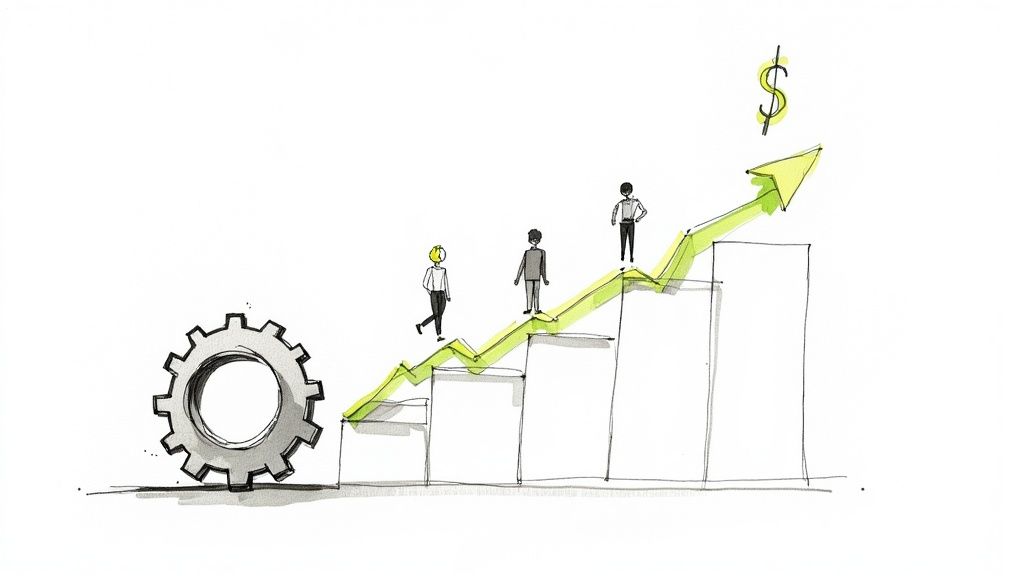
In SaaS, it's easy to get caught up in the thrill of the chase for new customers. But while a new logo feels like a win, the quiet, compounding power of a loyal user base is what builds a business that lasts.
Think of it this way: acquisition fills your bucket, but retention plugs the leaks. Without a solid plan to keep customers around, you're just spending a ton of money to run in place.
The numbers don't lie. A foundational study from Bain & Company showed that even a small 5% increase in customer retention can boost profits anywhere from 25% to 95%. The reason is simple: existing customers are just more efficient. You don't have to spend a fortune on marketing to win them over, they tend to spend more over time, and their lifetime value grows exponentially. If you want to dig deeper, these customer retention statistics paint a very clear picture.
The True Cost of Neglecting Retention
Too many SaaS companies treat churn as an unavoidable cost of doing business. They see a 3% monthly churn and figure they just need to sign up 3% more new users to stay flat. This thinking is a trap, and it completely misses the long-term damage being done.
High churn is a silent killer of momentum. It eats away at your monthly recurring revenue (MRR), makes your customer acquisition cost (CAC) payback period painfully long, and forces your sales team to sprint just to stand still.
This creates a treadmill effect where real growth feels impossible. On the flip side, high retention creates a powerful flywheel.
- Compounding Revenue: Every customer you keep adds to your MRR, building a stable, predictable foundation you can grow from.
- Expansion Opportunities: Happy customers are the perfect audience for upgrades and new features. This is how you drive net revenue retention (NRR) past the 100% mark.
- Powerful Social Proof: Your best customers become your most passionate advocates, bringing in high-quality referrals that cost you next to nothing.
Learning how to improve customer retention isn't just about damage control. It's about building a fundamentally healthier, more valuable, and faster-growing company. Before we jump into the tactics, getting this "retention-first" mindset locked in is the most important step you can take.
Nailing the First 90 Days with a Smarter Onboarding Experience
The first 90 days are make-or-break. This is when a new customer’s initial excitement slams into the reality of using your product. If that reality is a mess of confusion or frustration, they’re gone. The fastest way to lose someone who was genuinely excited to sign up? A generic, one-size-fits-all onboarding flow.
To get customer retention right, you have to do more than just send a "welcome" email. The real goal is to get each new user to their first "aha!" moment as fast as possible. That's the magical point where they truly get the value of your product because they've experienced it firsthand. It's not about a feature tour; it’s about helping them achieve something meaningful.
From Welcome Email to First Win
Think about onboarding as a guided journey, not a single event. It kicks off the second someone signs up and doesn't stop until your tool is a natural part of their daily work. A great process blends different channels and types of guidance to keep users moving forward.
What really works is designing an experience that feels like it’s responding directly to what the user is trying to do. This personal touch is what builds that crucial early momentum and proves your product’s value right out of the gate.
- In-App Guided Tours: Ditch the long, boring tour of every single button. Instead, use interactive walkthroughs that push users to complete one critical task. For a project management tool, that could be creating their first project and inviting a colleague.
- Behavior-Based Email Drips: Stop sending generic tips. Your emails should be triggered by what users do (or don't do). If a user creates a project but doesn't invite anyone, send a quick email highlighting the power of collaboration with a direct link to the "invite team" page.
- Proactive Support Check-ins: Use your data to find people who are getting stuck. Has a user been MIA for three days after signing up? An automated, friendly message from a customer success manager asking if they need a hand can work wonders.
The real purpose of onboarding isn’t to teach people how to use your software—it’s to help them become better at their jobs. When you see it like that, every tutorial, email, and tooltip becomes a chance to deliver real value, not just instructions.
This simple shift in perspective is what separates an onboarding flow that just checks a box from one that actually hooks users for the long haul.
Mapping the Path to Value
You can't guide users if you don't know where they're trying to go. What specific problem did they "hire" your product to solve? A marketing agency using your social media scheduler has completely different goals than a solo creator, and their onboarding needs to reflect that.
First, figure out the key actions that are directly linked to long-term retention. These are your activation milestones.
Example Activation Milestones for a Fictional SaaS:
| User Goal | First Milestone | Second Milestone |
|---|---|---|
| Schedule Content | Connect a social media account. | Schedule the first post. |
| Analyze Performance | Set up a new analytics dashboard. | Export the first report. |
| Collaborate with Team | Invite one team member. | Assign a task to that team member. |
Once you've nailed down these milestones, you can start building out personalized onboarding tracks for each key user segment. This makes sure every single user gets a relevant experience that speaks to their specific needs.
And don't forget to celebrate those small wins! A little in-app congratulations or a fun confetti animation after they complete a milestone builds their confidence. It creates a positive feedback loop that reinforces their decision to choose you and sets the stage for a long, happy relationship.
Predicting Churn with a Customer Health Score
If you're waiting for a cancellation email to pop into your inbox, you've already lost. By the time a customer formally decides to leave, their mind was likely made up weeks, or even months, ago. They’ve been quietly disengaging, getting frustrated, and looking for alternatives.
But here’s the good news: your customers are constantly giving you signals about their experience through their actions—or their inaction. The real secret to improving retention is learning how to listen to this behavioral data.
A customer health score is what translates all that complex user behavior into a simple, straightforward signal. Think of it as an early-warning system that empowers your team to stop fighting fires and start preventing them. Instead of guessing who might be a churn risk, you can use data to focus your attention where it will make the biggest difference.
Identifying the Data Points That Matter
The goal of a health score isn't to track every single click. It's about tracking the right things. A truly predictive score blends several different types of data to paint a complete picture of an account’s relationship with your product.
You'll want to pull data from a few key areas:
- Product Usage Depth: Don't just track logins. Are they using the "sticky" features that you know correlate with long-term success? If you run a project management tool, this might mean creating recurring tasks or building out custom dashboards—not just logging in to view things.
- Usage Frequency: This one is simple but powerful. How often are they actually in the app? A user who was active daily and suddenly drops to weekly is a massive red flag.
- Support Interactions: How many support tickets are they filing, and what's the general tone? A sudden spike in bug reports or frustrated messages is an obvious sign of trouble. On the flip side, zero support tickets could also signal disengagement; they aren't using the product enough to even run into problems.
- Account and Billing Information: Sometimes the first signs of churn are administrative. Are they keeping their payment information up to date? Are they late on payments? These signals can often show up before a drop in usage.
By combining these different signals, you move from isolated data points to a holistic understanding of account health. It’s the difference between seeing a single puzzle piece and seeing the full picture of their journey with your product.
This journey—from their initial "aha!" moment to achieving real, tangible wins with your product—is what fundamentally drives their health score and their likelihood to stick around.
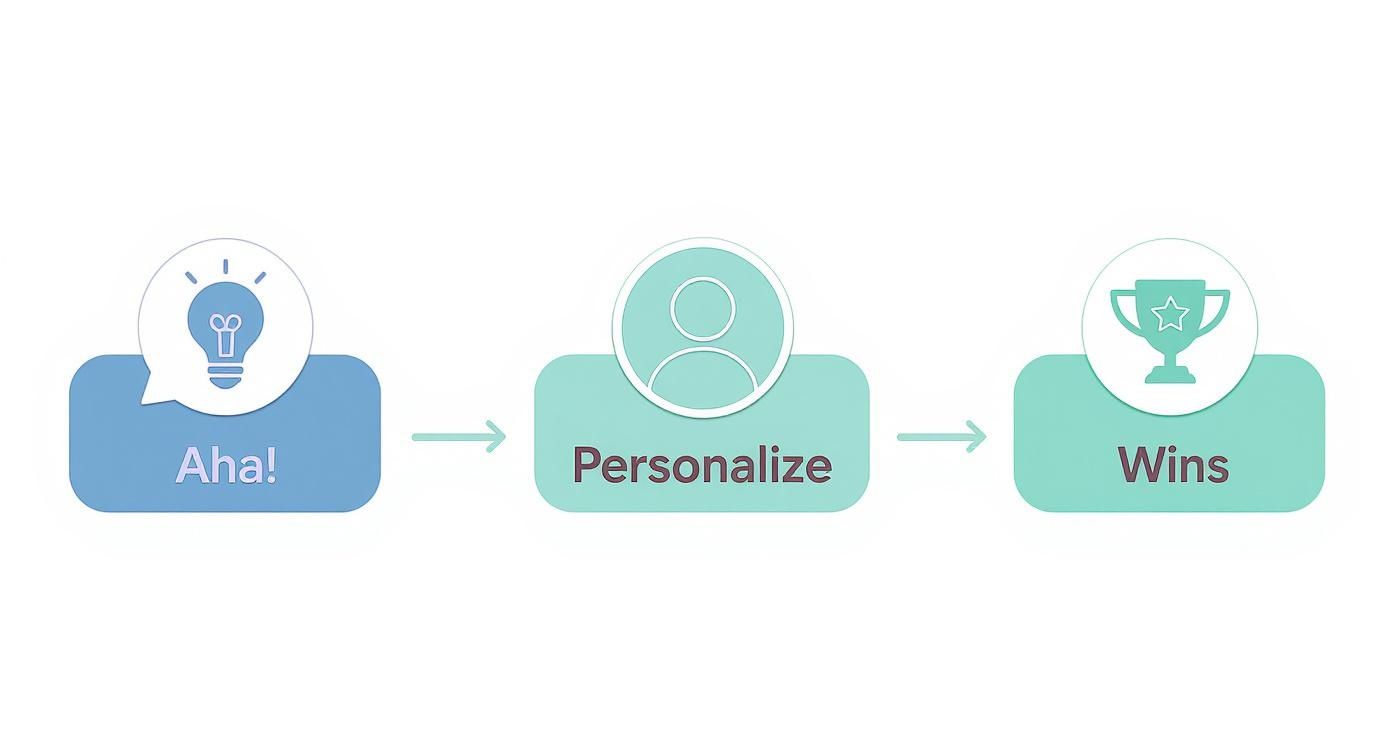
If a customer never gets that first win, they’re a high-risk account from day one, no matter what their initial login numbers look like.
Key Metrics for a SaaS Customer Health Score
Building a health score starts with identifying the right ingredients. The table below breaks down the essential data points you should consider for a robust and predictive model.
| Metric Category | Specific Metric Examples | Why It Matters for Retention |
|---|---|---|
| Product Adoption | % of key features used, setup completion, user invites sent | Shows if they are deeply integrated into the product or just scratching the surface. Deep adoption creates high switching costs. |
| Usage Frequency | Logins per week, daily/monthly active users (DAU/MAU) | A direct measure of habit-formation. A sudden drop is one of the strongest and earliest predictors of churn. |
| Account Growth | Plan upgrades, add-on purchases, increased seat count | Expansion MRR is a clear sign of a healthy, growing account that sees increasing value in your service. |
| Support & Sentiment | Number of tickets, ticket resolution time, NPS/CSAT scores | High ticket volume can signal friction, while low satisfaction scores are a direct warning of unhappiness. |
| Billing & Admin | Overdue invoices, failed payments, credit card expiry | Financial issues are often a leading indicator that a company is deprioritizing your tool or facing internal challenges. |
By combining metrics from each of these categories, you create a balanced score that isn't overly influenced by a single behavior, giving you a much more reliable signal.
From Score to Action with Automated Playbooks
A health score is just a number until you do something with it. The real power comes from creating automated playbooks that trigger specific, targeted actions when an account’s health changes. For a deeper dive into the technical side, our guide on customer churn prediction explains how these predictive models are built.
Here’s a practical way to put your scores into action:
Green to Yellow (First Sign of Slipping): When a healthy account’s score dips into the "at-risk" zone, trigger a low-touch, automated outreach. This could be an email from their account manager highlighting a new feature relevant to their past usage or sharing a helpful case study. The goal is a gentle re-engagement nudge.
Stays Yellow (Persistent Risk): If an account hangs around in the yellow zone for more than a couple of weeks, it’s time to escalate. This playbook should automatically create a task in your CRM for a Customer Success Manager (CSM) to make a personal check-in call. It's time to find out what's going on and offer direct help.
Drops to Red (Critical Risk): This is the all-hands-on-deck moment. A drop to "critical" should trigger an immediate, high-priority alert for the assigned CSM and maybe even their manager. The playbook should prompt an urgent internal strategy session to build a personalized recovery plan for that specific account.
By linking health scores to predefined actions, you build a scalable, proactive system for retention. You stop waiting for customers to tell you they’re leaving and start reaching out at the very first sign of trouble with exactly the right intervention to get them back on track.
Use Personalized Communication to Build Real Loyalty
Let's be honest. Nobody likes getting a generic, one-size-fits-all email blast. It’s the fastest way to get your message ignored, archived, or worse, marked as spam. If you're serious about customer retention, it's time to stop broadcasting company news and start having meaningful conversations.
The trick is to make your communication feel like it was crafted for one person, arriving at the exact moment they need it. When your emails and in-app messages genuinely help customers get their job done, they stop feeling like marketing. They become a core part of a great product experience. This goes way beyond just dropping a {{first_name}} tag in the subject line. It’s about using real data to provide timely value, building loyalty one helpful message at a time.
From Broadcast to Bespoke Engagement
The foundation of great communication is knowing who you're talking to and what they're trying to accomplish. This all starts with segmentation. Grouping users by their job role, industry, or the specific features they use allows you to ditch the generic updates and deliver content that actually resonates.
This is where your customer health scores and usage data become your secret weapons. Instead of blasting your entire user base about a new feature, why not send a targeted note only to the power users who would actually get the most out of it?
Here are a few data-driven campaigns you can get started with right away:
- Celebrate Their Wins: Set up an automatic message when a user hits a key milestone—like creating their 100th project or exporting their 10th report. It’s a simple acknowledgment of their success that reinforces the value they’re getting from your product.
- Nudge Them Towards More Value: Find users who are crushing it with one feature but have completely missed a complementary one. Send them a quick, helpful tip showing how the two features work together to solve a bigger problem.
- Share Relevant Stories: Did you just publish a case study on how a marketing agency got incredible results with your tool? Don't just toss it on your blog. Email it directly to all your other users in the marketing industry to show them what's possible.
The Power of Personalization in Practice
Making your interactions personal isn't just a nice-to-have; it's a direct driver of loyalty and revenue. Research shows that a whopping 71% of consumers now expect personalized interactions. Even more telling, a significant 60% say that personalization is what motivates them to buy again.
This expectation is so strong that customers are often willing to pay more for it. Some studies even show they’ll pay up to a 16% price premium for a better, more personalized experience. You can dig into more of these stats on customer loyalty and personalization on thesalescollective.com.
This creates a clear opportunity. When you personalize your communication, you’re not just making the customer feel seen; you are directly influencing their decision to stick around and even grow with you.
The best communication feels less like a message from a company and more like a helpful piece of advice from a trusted expert. The goal is to be consistently useful, proving you understand their world and are invested in their success.
By focusing every message on the user's context, you slowly build a powerful moat of loyalty that competitors will find nearly impossible to cross. Your communication transforms from a potential annoyance into an indispensable part of your product.
Crafting Messages That Actually Work
Every message you send needs a clear purpose and one obvious call to action. Want them to try a new feature? Make the button to that feature impossible to miss. Sharing a best practice? Link directly to a short video tutorial that shows them how.
Imagine a user whose health score just slipped from "Green" to "Yellow" because their login frequency dropped. A generic "We miss you!" email is lazy and ineffective. A much better approach is an automated, personalized message that offers real, tangible value.
Here’s an example of an email for a slipping user:
- Subject: A quick tip for your [Project Name] dashboard
- Body: "Hi [First Name], I noticed you're working on [Project Name] and wanted to share a quick tip. A lot of our top users set up custom notifications to track progress without having to log in every day. Here’s a 30-second guide on how to do it. Let me know if you have any questions!"
This message works because it’s specific, helpful, and doesn't feel needy. It acknowledges their context, offers a smart solution to a potential problem (feeling overwhelmed), and gently encourages them to re-engage by showing them a better way to use the product. This is the kind of thoughtful communication that truly keeps customers around.
Turning Customer Feedback into Your Retention Flywheel
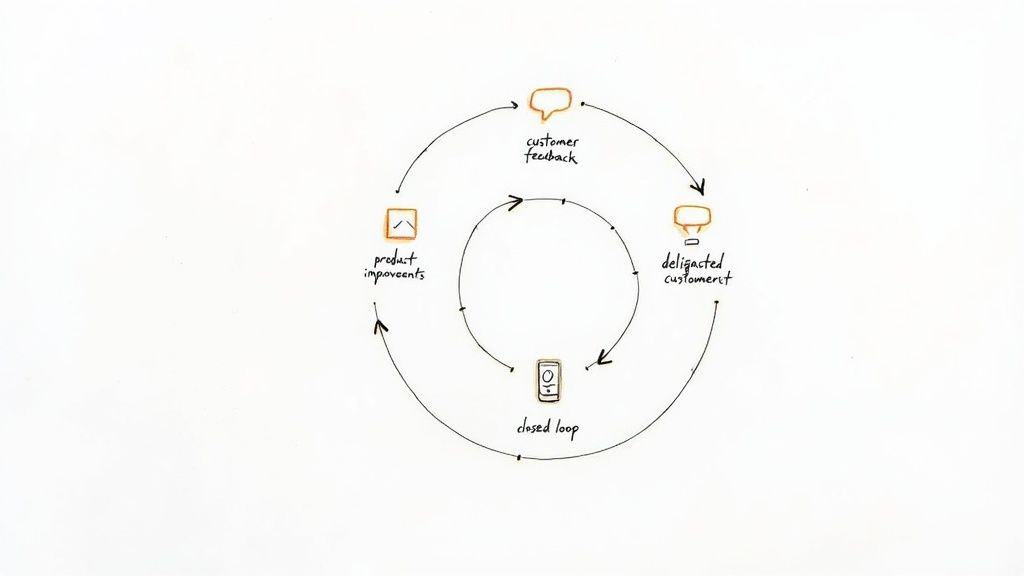
Your customers are holding the roadmap to a stickier, more valuable product. It's true. They know exactly what's frustrating, what’s missing, and what could be miles better. The real question is, are you actually listening?
Building a system to collect, analyze, and act on their insights isn't just a nice-to-have. It’s a powerful engine for improving customer retention. When you actively solicit and then respond to feedback, you do more than just fix bugs. You show your customers their voice matters, transforming them from passive users into partners who are genuinely invested in your success.
Creating Channels for Honest Feedback
To get the full picture, you need to hear from customers at multiple points in their journey. Relying on a single annual survey just gives you a stale snapshot in time. An effective feedback system is always on, capturing insights right when they happen.
Here are a few ways I’ve seen this work incredibly well:
- In-App NPS and CSAT Surveys: These are perfect for quick pulse checks. Think about triggering a Net Promoter Score (NPS) survey after a user has been active for 30 days, or a Customer Satisfaction (CSAT) survey right after they've talked with your support team.
- Targeted Microsurveys: Wondering what users think of that new feature you just shipped? Don't guess. A simple one-question survey that pops up after they’ve used it a few times gives you immediate, contextual feedback.
- Deep-Dive Exit Interviews: When a customer cancels, it’s a tough but crucial learning opportunity. Instead of an automated survey, try to get them on a brief 15-minute call. The candid insights you get from a real conversation are pure gold.
The goal isn’t just to collect data points; it’s to understand the story behind the numbers. A low NPS score is a signal, but a conversation with that user is where you find the solution.
This proactive approach is essential because the stakes have never been higher. Research shows that 70% of customers will ditch a brand after just two bad experiences, and a massive 91% are more likely to buy again after a single great service interaction. It just goes to show how every single touchpoint can either push a customer away or pull them closer. You can dig into more of these eye-opening customer experience statistics on Webex.com.
The Magic Is in Closing the Loop
Collecting feedback is only half the battle. The real magic, and the step most companies totally miss, happens when you "close the loop"—when you follow up with customers to let them know how you used their feedback. This is a massive missed opportunity for improving customer retention.
Imagine reporting a frustrating bug. A week later, you get a personal email: "Hey, remember that issue you told us about? We fixed it. Thanks to you." How would that make you feel? It’s an incredibly powerful experience that proves you weren't just shouting into the void.
And don't worry, closing the loop doesn't have to be a manual, one-by-one process. You can build a scalable system for it.
- First, tag and categorize all feedback as it comes in. Use simple themes like "UI confusion," "feature request: integrations," or "billing issue."
- Next, link those feedback tags to user profiles in your CRM or customer success platform.
- Finally, when your product team ships an update, notify the people who asked for it. Just pull up the list of everyone who requested that feature and send them a targeted email announcing the update they specifically wanted.
This simple act of following up shows you value their input and are actively working to make their life easier. It builds immense trust and goodwill, turning potential complainers into your most vocal advocates. It’s that kind of responsive relationship that makes your product incredibly difficult to leave.
Tracking the SaaS Retention Metrics That Actually Matter
So, are your retention strategies actually working? To know for sure, you have to look beyond a simple churn rate. Proving the ROI of your customer success team means tracking the KPIs that paint the real picture of your company's financial health and customer loyalty.
Let's be honest: if you can’t measure it, you can’t improve it. Vague feelings about "customer happiness" don't fly in a boardroom meeting—hard numbers do. Tracking the right data helps you build a compelling retention dashboard that clearly shows how your customer-focused work directly impacts the bottom line.
Key Metrics for Your Retention Dashboard
Several core metrics tell a much deeper story than basic churn. Each one gives you a different lens for looking at customer behavior and its financial impact. Getting a handle on these will give you a complete view of how well you're really doing at keeping customers around.
Here are the essentials you should start tracking today:
Customer Retention Rate (CRR): This is your foundational metric. It shows the percentage of customers who stick with you over a specific time. For a deep dive, you can learn more about the retention ratio formula and its nuances in our guide.
Customer Lifetime Value (CLV): CLV forecasts the total revenue you can expect from a single customer over the entire time they're with you. A rising CLV is a fantastic sign that your retention efforts are creating more valuable, long-term partnerships.
Net Revenue Retention (NRR): This might be the most powerful metric in all of SaaS. NRR measures your recurring revenue after you factor in both churn (lost revenue) and expansion (upgrades, cross-sells). When your NRR is over 100%, it means your growth from existing customers is more than making up for the revenue you lose from churn.
When your Net Revenue Retention is consistently above 100%, you’ve built a business that can grow even if you don't acquire a single new customer. This is the ultimate sign of a sticky product and a powerful retention engine.
Using Cohort Analysis to See What Works
While those top-line metrics give you a great 30,000-foot view, cohort analysis is where you find the really juicy, actionable insights.
It's all about grouping customers who signed up in the same period (like the "January 2024 Cohort") and then watching how they behave over time.
This is how you see the direct impact of your strategies. Did the retention rate for the cohort you onboarded with that new interactive guide actually improve compared to last month's cohort? Cohort analysis answers those kinds of specific questions with real data, helping you double down on what’s working and quickly fix what isn’t.
Your Top Customer Retention Questions, Answered
Even the most seasoned SaaS leaders run into the same questions when they double down on retention. Let's clear up a few of the most common ones I hear.
What’s a “Good” Customer Retention Rate, Really?
Honestly, there’s no magic number, and "good" can vary wildly. In SaaS, you’ll often hear 90-95% annually thrown around as a solid benchmark. But for an early-stage startup still nailing its product-market fit, that might be out of reach.
Instead of getting hung up on an industry average, focus on your own trajectory. Are you seeing consistent, month-over-month improvement? That's a much healthier sign than simply hitting a generic target.
The metric that truly matters isn't just your overall retention; it's the retention rate of your ideal, highest-value customers. If those folks are sticking around, you're doing something right.
Should I Focus on Retention or Acquisition?
It’s the classic chicken-or-the-egg debate, but the truth is you always need both. The real question is where you should invest the most energy right now. For a brand-new company, acquisition is everything—you need to get your first users in the door.
But once you have a real customer base, the math shifts dramatically. Retention becomes a powerful growth engine because keeping a customer is 5 to 25 times cheaper than finding a new one. Plus, happy, long-term customers are your best source of expansion revenue and word-of-mouth marketing, which makes your acquisition efforts cheaper over time.
How Fast Will I See Results from New Retention Efforts?
You can spot positive signs almost right away. For instance, if you roll out a new proactive support playbook for at-risk accounts, you might see their engagement metrics tick up within a few weeks. Those are your leading indicators.
Actually moving the needle on your overall retention rate, however, takes a bit more time—think a quarter or two. Building loyalty is a long game. It’s the result of consistent, positive experiences across the entire customer journey, from onboarding to support. For more ideas on what those consistent efforts look like, the LowChurn blog is packed with practical strategies.
Don’t get discouraged if your MRR churn doesn't drop overnight. Lasting relationships aren't built in a day.
Ready to stop guessing which customers are at risk? LowChurn uses AI to predict churn before it happens, giving you the early-warning system and actionable playbooks needed to protect your MRR. Get started in under a minute.