Think of Annual Recurring Revenue (ARR) as the yearly salary of your subscription business. It's the predictable, recurring revenue you can reliably count on from your customers over a twelve-month period.
Why Annual Recurring Revenue Is Your North Star
For any subscription company, ARR is so much more than a number on a spreadsheet; it's the financial heartbeat of your entire operation. It paints a clear picture of your company's health and trajectory, making it an indispensable metric for strategic planning, forecasting, and making decisions with confidence.
Without a firm handle on your ARR, you’re essentially flying blind. You can't budget for growth, hire new people, or invest in your product with any real certainty.
The Foundation of SaaS Growth
ARR is a powerful signal of your business's stability and potential to scale. It’s exactly why investors look at it so closely—it proves you have a predictable stream of income and shows you're building a business for the long haul. A healthy, growing ARR tells a powerful story about customer satisfaction and product-market fit.
For a deeper dive into all aspects of ARR, from understanding its importance to strategies for growth, explore this comprehensive guide on Mastering Annual Recurring Revenue for Scalable Growth.
ARR isn't just about tracking what you've earned; it's about predicting what you will earn. This predictability is the cornerstone of sustainable growth in the subscription economy.
The subscription model has truly changed the game. In fact, subscription-based businesses have grown 4.6 times faster than the S&P 500, a testament to the market's shift toward predictable income and stronger customer relationships.
Ultimately, mastering your ARR is the key to building a resilient business. It's also critical to know how it differs from other financial terms. For instance, ARR gives you a long-term view, which is very different from bookings—a metric that only represents a customer's commitment to spend money with you. You can check out our guide on the key https://www.lowchurn.com/blog/revenue-vs-bookings to make sure your financial reporting is spot-on.
How to Calculate Annual Recurring Revenue Accurately
Getting your Annual Recurring Revenue calculation right is a non-negotiable for understanding the health of your subscription business. While it might seem a bit intimidating at first, the math actually boils down to a couple of straightforward formulas that tell a powerful story about your momentum.
The quickest way to get a baseline is to simply annualize your Monthly Recurring Revenue (MRR). This gives you a snapshot of where you'd land if things continued on their current path for a full year.
Basic ARR Formula:
- Total MRR x 12 = Annual Recurring Revenue
Let's say your MRR is currently $50,000. Multiplying that by 12 gives you a basic ARR of $600,000. It's a solid starting point, but it's a bit like taking a photo—it captures a single moment and doesn't show the movement from customer upgrades, downgrades, and cancellations that happen over time.
The Complete ARR Formula
For a view that’s more like a movie than a snapshot, you need a formula that accounts for all the moving parts of your revenue. The complete ARR calculation shows you exactly how your revenue has evolved over a period, usually a year.
You start with your ARR at the beginning of the year, add all the new revenue you’ve gained, and subtract all the revenue you’ve lost. Simple as that.
(Starting ARR) + (New ARR) + (Expansion ARR) - (Churned ARR) = Ending ARR
Let’s walk through this with a real-world example. Imagine a SaaS company called "ConnectSphere" that started the year with $1,000,000 in ARR.
- New ARR: This is all the predictable, recurring revenue from brand new customers you signed during the year. Let's say ConnectSphere’s sales team had a great year and brought in $250,000 in new annual contracts.
- Expansion ARR: This is where things get interesting. It’s the extra revenue from your existing customers—think upgrades to higher plans, buying more user seats, or adding new features. ConnectSphere's customer success team crushed it, generating $100,000 in expansion revenue.
- Churned ARR: The painful part. This is the recurring revenue you lost from customers who cancelled their subscriptions or downgraded to a lower-priced plan. Unfortunately, ConnectSphere lost a few accounts, resulting in $50,000 in churned ARR.
Now, let's plug ConnectSphere’s numbers into the formula:
- $1,000,000 (Starting) + $250,000 (New) + $100,000 (Expansion) - $50,000 (Churn) = $1,300,000 (Ending ARR)
This more detailed calculation tells a much richer story about the company's growth engine. If you want to run these numbers without breaking out the spreadsheets, a good ARR Calculator can do the heavy lifting for you.
To make sure your calculations are clean, it’s crucial to know what revenue to include and what to leave out.
What to Include and Exclude in Your ARR Calculation
Not all revenue is created equal. One-time fees and variable charges can muddy the waters, so it's vital to only include predictable, recurring income. This table breaks it down.
| Revenue Type | Include in ARR? | Reasoning |
|---|---|---|
| Recurring Subscription Fees | Yes | This is the core of ARR—the predictable revenue from your subscriptions. |
| Recurring Add-on Fees | Yes | If a customer pays a fixed fee for an extra feature every month or year, it's recurring. |
| Expansion Revenue | Yes | Revenue from upgrades and cross-sells is a key part of ARR growth. |
| One-Time Setup/Implementation Fees | No | These are not recurring and would artificially inflate your ARR for a single period. |
| Consulting or Professional Services | No | This is non-recurring revenue that doesn't reflect the subscription's value. |
| Usage-Based Fees/Overages | No | These are variable and unpredictable, so they don't belong in ARR. |
Getting this right ensures your ARR is a true reflection of your company's stable, ongoing revenue stream.
This infographic really drives home the strategic power of tracking ARR—it's not just a vanity metric, but a critical tool for forecasting, planning, and proving your company's value.
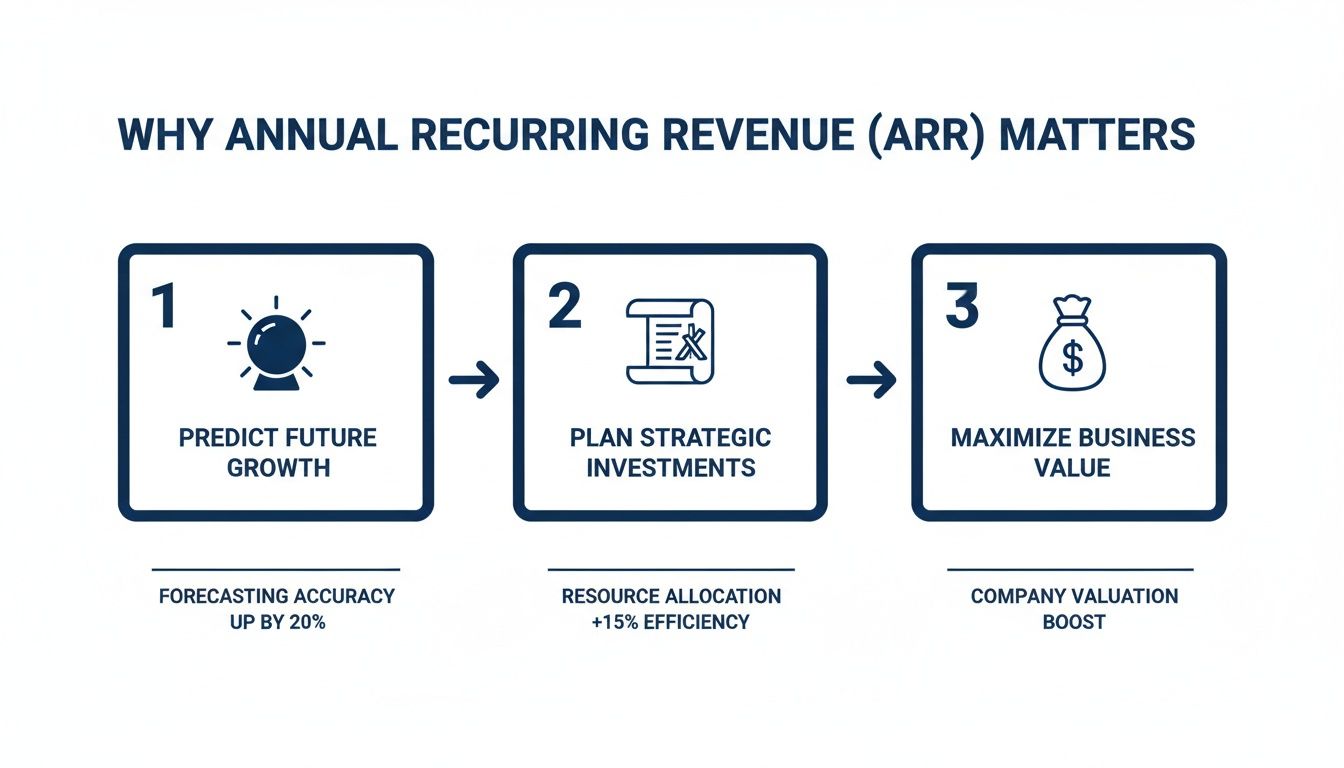
When you consistently track each component, you don't just see if you're growing—you understand exactly how and why you're growing. That’s the kind of insight that lets you make smarter decisions.
ARR vs. MRR: Decoding the Right Metric for the Moment
Choosing between Annual Recurring Revenue (ARR) and Monthly Recurring Revenue (MRR) isn't about picking a "better" metric. It’s about choosing the right lens to view your business through at a specific moment. Think of it this way: MRR is your microscope, and ARR is your telescope. You need both to get the full picture.
MRR gives you that high-resolution, ground-level view of your business's health, month by month. It's the pulse you check daily. Your sales and marketing teams live and breathe this number because it shows the immediate impact of new campaigns, pricing experiments, or recent churn. It’s the metric for tactical, in-the-trenches decisions.
On the other hand, annual recurring revenue provides the long-term, strategic vision. It zooms out, smoothing over the monthly fluctuations to reveal your company's true growth trajectory. This makes it the go-to metric for annual budgeting, long-range forecasting, and talking to investors who are focused on the big picture.
When to Use Each Metric
The right metric often boils down to your business model and who you're talking to. For B2B SaaS companies that primarily sell annual contracts, ARR is the native tongue. It directly reflects the value of those larger, multi-year deals and aligns perfectly with how enterprise customers think and budget.
Conversely, B2C subscription businesses or any SaaS with a heavy focus on monthly plans tend to lean on MRR. Their customer base is often more fluid, so tracking those monthly swings is absolutely critical for managing cash flow and fine-tuning retention strategies.
Your internal teams might obsess over MRR to hit their quarterly targets, but your board and potential investors will almost always anchor their conversations around ARR to gauge long-term viability and valuation.
Understanding the context for each metric helps you tell a much smarter financial story. For example, a dip in MRR one month might look alarming on its own. But if your ARR is still climbing steadily, it tells a story of underlying resilience, not a five-alarm fire.
Here’s a simple cheat sheet for when to use each:
- For short-term analysis: Use MRR to measure the monthly performance of your sales team, see if that new marketing campaign is working, or manage operational cash flow.
- For long-term strategy: Use ARR for your annual financial planning, communicating growth to investors, and setting those big, ambitious company goals.
Ultimately, mastering both allows you to switch seamlessly between the granular details and the grand vision. They aren't competing metrics; they're two sides of the same coin, giving you a complete view of your company's health and momentum.
The Four Levers That Control Your ARR Growth
Your Annual Recurring Revenue is never a flat line. It’s always in motion, getting pulled in different directions by four key forces. I like to think of them as the main levers on your company's growth engine. If you want to scale your subscription business, you have to know what each one does and how to use it.
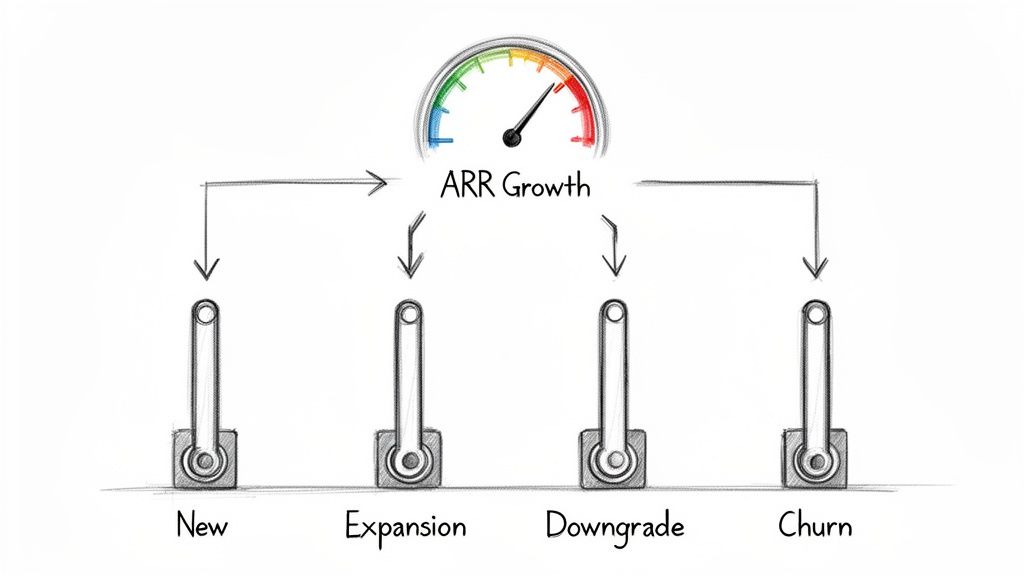
Together, these four drivers give you the full story of your company's health, showing you exactly where your net revenue growth is coming from.
1. New ARR
This one’s the most obvious: revenue from brand-new customers. New ARR is a direct reflection of your sales and marketing machine's ability to bring in fresh logos. While it’s absolutely essential for growth, focusing only on new business can be expensive and often masks deeper problems with your product or customer experience.
2. Expansion ARR
For my money, Expansion ARR is where the real, efficient growth comes from. This is the extra recurring revenue you earn from the customers you already have.
It typically breaks down into a few categories:
- Upsells: A customer upgrades to a more powerful (and more expensive) plan.
- Cross-sells: They buy a different product or feature you offer.
- Add-ons: They add more seats, users, or other resources to their current plan.
This is where the magic happens. When you have strong expansion revenue—often called "negative churn"—it means your customers are getting so much value that they’re actively choosing to spend more with you.
Strong expansion revenue is the ultimate sign of product-market fit. It proves your product is not just a tool but an indispensable part of your customers' workflow, creating a powerful, self-fueling growth engine.
3. Downgrade ARR
On the flip side, you have Downgrade ARR, also known as contraction. This is the revenue you lose when existing customers move to a cheaper plan, remove users, or scale back their usage. It's a huge red flag. A downgrade often signals that a customer’s needs are changing or, worse, they aren't getting the value they expected. It's often the last step before they cancel completely.
4. Churned ARR
And finally, there's Churned ARR. This is the total revenue lost when customers cancel their subscriptions for good. Churn is a direct hit to your bottom line and the biggest anchor dragging down your growth. Keeping this number as low as humanly possible is critical for any healthy SaaS business.
If you want to dig deeper into this metric, we have a complete guide on how to calculate churn rate and understand its impact.
When you start breaking down your ARR into these four parts, you get so much more than a single growth number. You get a strategic map that shows you why your revenue is changing—and it quickly becomes clear that keeping and growing your existing accounts is just as important, if not more so, than simply signing new ones.
Using ARR to Understand and Increase Your Company Valuation
When you're running a SaaS business, Annual Recurring Revenue is more than just a number on a spreadsheet—it's the language investors use to talk about your company's worth. Think of your ARR as the foundation upon which your entire valuation is built. Investors lean on a simple but powerful idea called an ARR multiple to figure out what your business is worth.
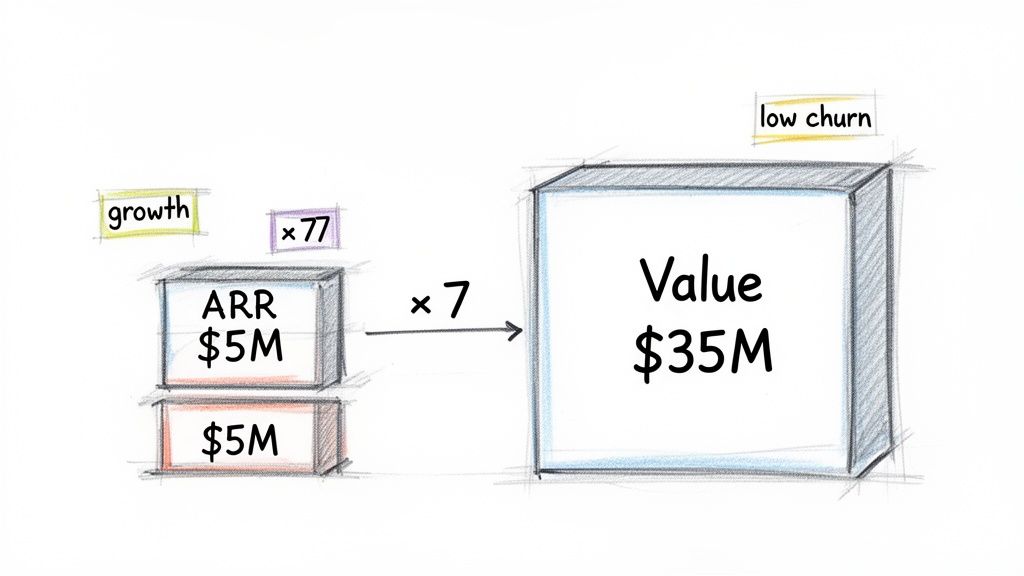
This multiple is exactly what it sounds like: a number they multiply your ARR by. For instance, if your company has $5 million in ARR and an investor assigns it a 7x multiple, your valuation is $35 million. It's a quick way to put a concrete price tag on your business. But what really drives that all-important multiple?
What Drives a Higher ARR Multiple
Here’s the thing: not all ARR is created equal. A business that's barely growing and losing customers left and right will get a much lower multiple than a company that's expanding quickly with a loyal customer base. Investors will always pay a premium for momentum and predictability.
So, what factors get you into that higher valuation territory?
- Rapid Growth Rate: If you're growing at 50%+ year-over-year, you're going to catch an investor's eye.
- Low Customer Churn: A low churn rate is hard proof that your product is essential and that customers are in it for the long haul.
- High Gross Margins: This shows that your business is fundamentally profitable and can scale efficiently.
- Large Total Addressable Market (TAM): A massive market tells investors there's plenty of room for you to grow into.
A strong ARR multiple tells a story of a healthy, scalable business with a bright future. It signals that your revenue is not only predictable but also resilient and poised for expansion.
The multiples themselves can swing wildly depending on these factors, the current market climate, and even where you're located. SaaS companies typically see valuations between 3x to 10x ARR, but geography plays a big role. North American companies often command higher multiples in the 8x to 15x range, while their European peers might average 5x to 10x. You can find more up-to-date insights on SaaS valuations on Flippa.com.
At the end of the day, every move you make to strengthen your core SaaS metrics—from fighting churn to driving expansion revenue—directly boosts your valuation. This is why metrics like Customer Lifetime Value are so intertwined with ARR; they paint a picture of long-term health that justifies a premium. To see how it all connects, take a look at our guide on what is CLTV and its powerful impact. By nailing the fundamentals, you're not just growing revenue; you're building a fundamentally more valuable company.
Actionable Playbooks to Increase Annual Recurring Revenue
Knowing your numbers is one thing; making them grow is another. Once you've got a handle on what drives your ARR, it's time to roll up your sleeves and take action.
Let's move from theory to practice with four proven playbooks. Each one gives you a different lever to pull to protect and expand your revenue. While new customers are always great, the fastest and most efficient growth almost always comes from the customers you already have.
Playbook 1: Fortify Customer Retention
You can't fill a leaky bucket. Churn is the silent killer of ARR, slowly draining your revenue month after month. The single most effective way to grow your ARR is simply to stop losing it.
This means getting proactive. Instead of waiting for the cancellation email, you need to spot at-risk customers before they've mentally checked out.
This is where churn prediction tools are a game-changer. For example, a platform like LowChurn plugs into your Stripe data, analyzes how customers are using your product, and flags accounts that are likely to churn 7–30 days in advance. This gives your team a critical window to reach out, solve a problem, and save an account that would have otherwise slipped away.
Playbook 2: Drive Expansion Revenue
Your best customers are also your biggest growth opportunity. Expansion revenue—revenue from existing customers upgrading, buying add-ons, or adding more seats—is a powerful engine for ARR growth.
The key is to stop thinking about it as an "upsell" and start thinking about it as helping them succeed.
"When people feel understood and appreciated, they spend more, stay longer, and tell their friends. That’s how you build a valuable brand, and an even more valuable business."
Your Customer Success team should be having regular conversations with your power users. Are they bumping up against usage limits? Is there a premium feature that would solve a new headache for their team? When you frame these conversations around their goals, you transform a sales pitch into a genuine partnership.
Playbook 3: Optimize Your Pricing Strategy
Your pricing shouldn't be set in stone. As your product gets better and delivers more value, your pricing needs to keep pace. One of the most common mistakes SaaS companies make is undervaluing their product and leaving money on the table.
Look at shifting to a value-based pricing model. This means your pricing tiers are directly tied to the outcomes or ROI your customers get from using your product. You could tier by features, key usage metrics, or the number of users.
Make a habit of reviewing your pricing every year. See how the value you provide has increased and what your competitors are doing. You might be surprised at how much you're undercutting your own growth.
Playbook 4: Perfect the Onboarding Process
The first 90 days make or break a customer relationship. A clunky, confusing onboarding is a fast track to churn. If customers can't find that "aha!" moment quickly, they'll lose motivation and start looking for an alternative.
Think of your onboarding as a guided tour to their first win. It should be simple, intuitive, and focused on getting them to value as fast as humanly possible.
Create a clear checklist, build in-app tutorials, and have your support team proactively check in. The faster your product becomes an essential part of their daily workflow, the stickier it becomes, setting the stage for a long and profitable partnership.
Your ARR Questions, Answered
Getting a handle on SaaS metrics can feel like learning a new language. Let's clear up some of the most common questions that pop up when talking about annual recurring revenue.
What’s a Good ARR for a SaaS Company?
Honestly, there’s no magic number. A "good" ARR depends entirely on where you are in your journey. An early-stage startup popping champagne for hitting $1 million in ARR has a very different benchmark than a growth-stage company shooting for $10 million.
The more important question is, "What's a good ARR growth rate?" Early on, investors love to see companies doubling or even tripling their ARR each year. As you get bigger, a strong, healthy growth rate often lands somewhere between 40-60% annually.
Can Annual Recurring Revenue Actually Go Down?
You bet it can. ARR isn't a one-way street. It's a living, breathing metric that drops anytime your losses from cancellations (Churned ARR) and downgrades (Downgrade ARR) are more than the new revenue you're bringing in.
A dip in ARR is often the first real alarm bell, signaling that something might be off with your customer retention strategy or the value your product is delivering.
Think of ARR as a real-time reflection of your company's momentum. It climbs when you're making customers happy and falls when you're not living up to your promises.
How Is ARR Different from Revenue?
The biggest difference comes down to one word: predictability.
Revenue, in the traditional accounting sense, lumps everything together—one-time setup fees, consulting projects, and any other variable income. It gives you a picture of all the money that came in, but it can be choppy and unpredictable.
Annual recurring revenue cuts through that noise. It focuses only on the predictable, repeatable income from your subscriptions. By stripping out the one-off charges, ARR gives you a much cleaner view of your company's core financial health, which is exactly why it's the go-to metric for valuing SaaS businesses.
Ready to protect your ARR from the silent killer of churn? LowChurn uses AI to predict which customers are at risk of canceling, giving you the chance to step in and save them. Find out how it works.