So, what exactly is a customer health score? Think of it as a vital sign for your customer relationships. It’s a single, predictive metric that tells you how likely a customer is to stick around, grow with you, or—more importantly—churn. It pulls together all sorts of complex behaviors, from product usage to payment history, and boils them down into an early warning system. This isn't just a "nice-to-have" metric; it's essential for protecting your revenue.
Your Early Warning System for Customer Churn
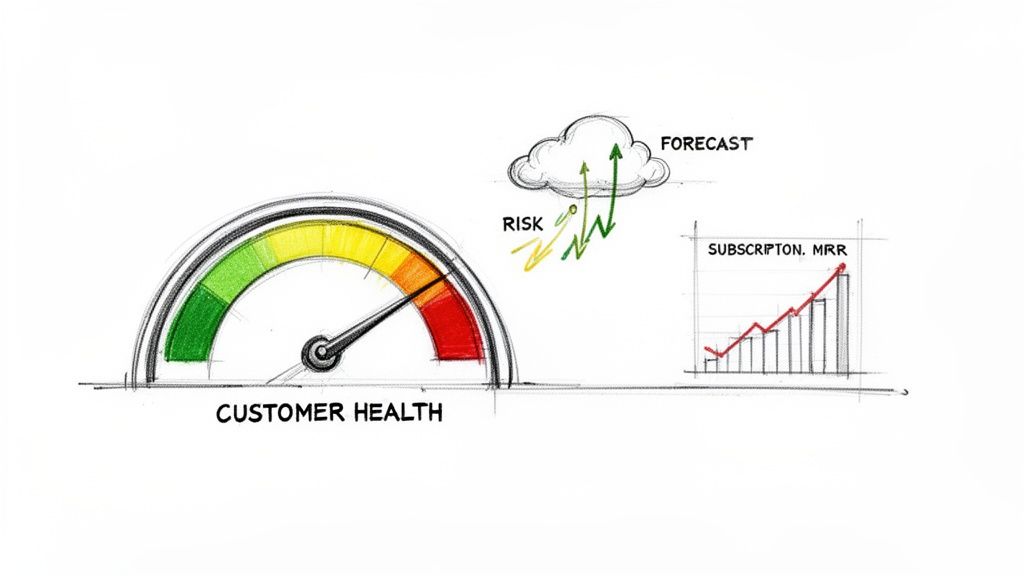
Relying on monthly churn reports is like driving while only looking in the rearview mirror. You see the damage—the lost Monthly Recurring Revenue (MRR)—but by then, it’s already happened. You’re left wondering why good customers left, and that reactive cycle is a huge headache for any subscription business.
Customer health scores completely flip that script. Instead of just analyzing past failures, you get a real-time, forward-looking view of your entire customer base. It’s the difference between reading an autopsy report and using a heart rate monitor.
From Reactive to Proactive Retention
The whole point is to shift your focus from lagging indicators (like a cancellation email) to leading indicators that signal trouble long before a customer decides to leave. A health score isn't just a number; it's a powerful trigger for action. It helps your customer success team stop firefighting and start building a proactive, data-driven retention machine. For a closer look at strategies for keeping customers, check out this guide on reducing customer attrition.
When you can spot at-risk accounts early, you can step in with targeted support, helpful content, or just a quick personal check-in. That’s how you protect your revenue streams before they dry up.
Making Sophisticated Analysis Simple
Not too long ago, building a predictive health score meant you needed a team of data scientists and months of work. For most SaaS founders and smaller teams, it was totally out of reach. Thankfully, that’s not the case anymore. Modern tools have put this power in everyone's hands.
A well-defined customer health score helps teams make informed decisions, reduce churn, and drive customer success. It's not just a best practice—it’s a necessity for businesses that rely on long-term relationships.
Platforms like LowChurn, for example, can connect directly to your payment processor (like Stripe) and automatically make sense of the signals that actually matter. They turn all that raw data into a clear, actionable score, no coding required. This lets you do three crucial things:
- Identify Churn Risk: See exactly which customers are quietly disengaging before they hit the cancel button.
- Prioritize Efforts: Help your customer success team focus their limited time on the accounts that need them most.
- Uncover Growth Opportunities: Spot your happiest, most engaged customers—the perfect candidates for an upsell or a referral.
In this guide, we'll walk you through a practical roadmap for getting customer health scores up and running in your own business. We’ll cover how to find the right signals, build automated playbooks, and make this early warning system your best tool for long-term, sustainable growth.
What Are Customer Health Scores Exactly?
Let's think about this like a car's dashboard. You don't wait for the engine to smoke and seize before checking the oil or noticing the temperature gauge creeping into the red. Your dashboard gives you a constant stream of simple, real-time indicators—fuel level, engine temp, tire pressure—that signal trouble long before you’re stranded on the side of the road.
A customer health score does the exact same thing for your subscription business. It’s a single, predictive metric that acts as your business’s dashboard. It pulls together a bunch of different data points—like how often a customer actually uses your product, their payment history, and whether they're interacting with your team—and boils it all down into one easy-to-read score.
But this score isn't just a static number; it's a forecast of where that customer is headed. A high score tells you they're happy, getting value, and will almost certainly renew. A low score? That’s your check-engine light flashing, warning you they're a serious churn risk.
Shifting from Reactive to Proactive
The real magic of a customer health score is how it flips your entire retention strategy on its head. Most companies are stuck in reactive mode, scrambling after they get a cancellation email or reading through exit surveys. That’s like trying to figure out why your car broke down after you’re already waiting for a tow truck.
By keeping an eye on these scores, your team can spot a customer whose engagement is starting to slip and step in before they get frustrated enough to even think about leaving. For a SaaS business, where everything is built on long-term relationships, this proactive approach is a total game-changer.
A customer health score translates messy, complex behavioral data into a simple, actionable signal. It tells you which customers need help now, which are ready for an upsell, and which are quietly packing their bags.
For instance, a score might dip because a user hasn't logged in for two weeks or recently had a payment fail. Armed with that insight, you can trigger an automated email with a helpful tutorial or flag a customer success manager to reach out with a personal touch. You’re solving problems before your customer even knows they have one.
The Critical Role of Accuracy
Of course, a dashboard is only useful if its gauges are telling you the truth. A faulty oil light gives you a false sense of security, which is arguably worse than no light at all. It's the same deal with customer health scores; their entire value depends on how accurately they can predict the future.
This is where modern AI-powered systems have a massive advantage. They can spot subtle patterns across thousands of data points that a human would never catch, leading to incredibly precise predictions. That's why these tools have become standard practice in the SaaS world. Good AI-powered health scores can predict churn three to six months out with 85% or greater accuracy, giving your team a huge head start. You can learn more about the impact of AI on churn prediction.
Ultimately, a customer health score is so much more than data. It’s your early warning system, your guide for prioritizing your time, and your roadmap for building a more resilient, customer-obsessed business. It gives you the foresight to act, protect your MRR, and turn at-risk accounts into loyal fans.
The Four Signals That Define Customer Health
A customer health score isn't some arbitrary number you pull out of thin air. It's a carefully calculated metric, built on clear, measurable signals that tell the real story of your customer relationships. To get it right, you have to look beyond a single data point, like how often someone logs in, and analyze their behavior across several key dimensions.
Think of it like a doctor giving a check-up. They don't just take your temperature and call it a day. They check your blood pressure, listen to your heart, and ask about your symptoms. Each signal provides a crucial piece of the puzzle, and only together do they form a complete picture of your overall health. It’s the exact same principle here.
We can group these vital signs into four primary categories. Each one answers a different but equally important question about where a customer is in their journey and whether they're likely to stick around for the long haul.
Signal One: Product Usage
This is where the rubber meets the road. Are customers actually using your product to solve the problem they hired it to fix? Low or dwindling usage is one of the most reliable predictors of churn. After all, if they aren't getting value, why would they keep paying?
You need to track metrics that show both the breadth and depth of their engagement with your tool:
- Feature Adoption Rate: Are they using the "sticky" features that deliver the most value, or are they just scratching the surface?
- Session Frequency and Duration: How often do they log in, and how long do they stay? A sudden drop-off is a massive red flag.
- Key Action Completion: Are they completing the core workflows your product was built for? For a project management tool, this could be creating a new project or assigning a task.
This infographic gives a great visual of how these different signals combine to create a single, actionable health score.
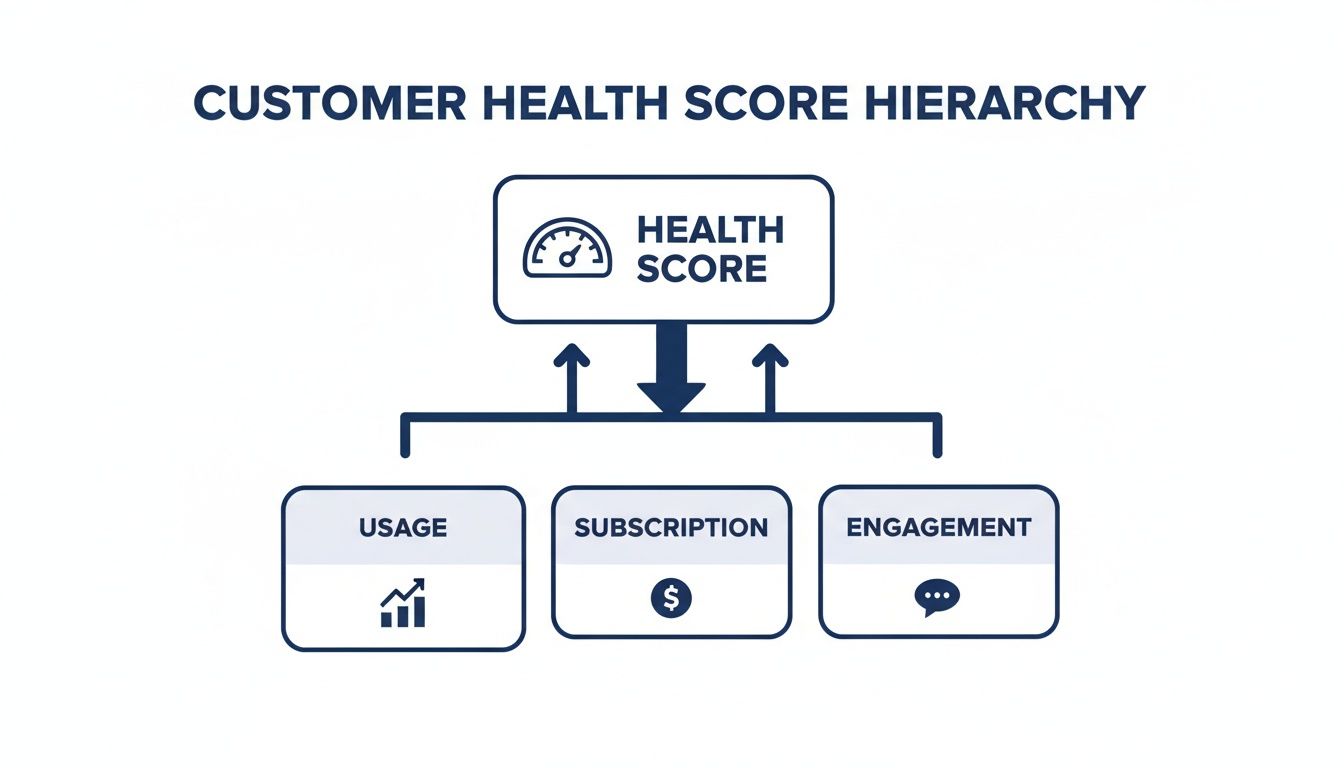
As you can see, a reliable health score is a composite metric. This design prevents any single signal from giving you a false sense of security (or panic) about a customer's true status.
Signal Two: Subscription Health
This signal zeros in on the financial side of the customer relationship. Billing and subscription data offer hard evidence of a customer's commitment and can often flag issues long before they escalate. A customer who consistently fails payments is sending a very clear, very loud message.
A few key metrics to keep a close eye on include:
- Payment History: Are payments consistently on time, or are you seeing frequent failures and delinquencies? This is a direct signal of financial stability and intent.
- Plan Changes: Have they recently downgraded their plan or removed seats? These are direct indicators that their perceived value of your product is shrinking.
- Time to Arrears: How long does an account stay past-due before they finally pay up? If that cycle is getting longer, it points to growing friction.
Signal Three: Engagement Level
Engagement goes way beyond just using the product; it reflects the entire relationship a customer has with your company. It’s a measure of their willingness to interact, learn, and communicate. A highly engaged customer is invested in your success just as much as their own.
This is a broad category, but it’s absolutely essential for understanding the human side of the business relationship. Our guide on how to measure customer engagement digs much deeper into specific strategies here.
A silent customer isn't always a happy customer. Sometimes, silence is a sign of quiet disengagement that precedes churn. Tracking engagement signals helps you hear what they aren't saying.
Metrics in this area often include:
- Support Ticket Volume: A sudden spike in tickets could mean they’re struggling with the product. On the other hand, zero tickets might mean they’ve already given up.
- Email Interaction: Do they open your newsletters? Click on feature announcements? Reply to your check-in emails?
- Community and Webinar Participation: When a customer actively joins your educational content, it shows they’re motivated to get more value from your platform.
Signal Four: Customer Sentiment
Finally, customer sentiment captures what your customers are explicitly telling you about their experience. This qualitative feedback is the secret ingredient that adds context to all the quantitative data from the other three signals. It answers the simple question: "How do they feel about us?"
While a bit harder to scale, these metrics provide invaluable, unfiltered insight. The most common sources for this data are:
- Net Promoter Score (NPS): This classic metric gets straight to the point, asking how likely a customer is to recommend your product.
- Customer Satisfaction (CSAT) Surveys: These are usually sent after a specific interaction, like a support ticket resolution, to gauge satisfaction at key touchpoints.
- Direct Feedback and Reviews: Don't underestimate the power of unsolicited feedback from review sites, social media, or direct emails. It’s a goldmine of honest opinions.
By pulling these four signals together, you can create a robust, multi-faceted customer health score that is far more predictive than any single metric could ever be on its own.
Key Signals for Calculating Customer Health Scores
To build an effective model, you need to know what to track and how to weigh it. The table below breaks down the four signal categories, their typical weight in a health score, and a few examples of metrics for each.
| Signal Category | Typical Weighting | Key Metrics Examples | What It Indicates |
|---|---|---|---|
| Product Usage | 40-50% | Feature adoption, session frequency/duration, key action completion | The core value the customer is getting directly from your product. |
| Engagement | 20-25% | Support tickets, email open/click rates, webinar attendance | The customer's overall relationship and investment with your brand. |
| Subscription | 15-20% | Payment history, plan upgrades/downgrades, time to arrears | The financial health and commitment of the account. |
| Sentiment | 10-15% | NPS, CSAT, survey responses, online reviews | The customer's expressed feelings and satisfaction with their experience. |
This structure provides a balanced view, ensuring your score reflects both what customers do (usage, billing) and what they say (sentiment, engagement). This blend of quantitative and qualitative data is what makes a health score truly powerful.
How to Automate Your Health Scoring System
When you only have a handful of customers, you can probably get by with a spreadsheet. You know who’s using the product, who filed a support ticket last week, and who’s having trouble with billing. But that system breaks down, and it breaks down fast.
Trying to track customer health manually is like trying to bail out a boat with a teaspoon. It’s slow, messy, and you’re guaranteed to miss something important. A subtle drop in feature usage or a single failed payment can easily get lost in the noise, leaving you completely blindsided when a customer churns. To get ahead of churn, you need an automated early-warning system. It’s simply not optional.
The Power of Automated Integrations
The good news is that modern churn prevention tools don’t require a data science degree to set up. The whole idea is to plug in your key data sources and let an intelligent system do the heavy lifting for you.
For nearly every SaaS business, the most valuable information lives in two places: your payment processor and your product itself. Platforms like Stripe are a goldmine of billing and subscription data, while your product analytics tell the real story of how—and if—customers are finding value.
Automation is what turns a customer health score from a good idea into a powerful, real-time intelligence stream. It connects all the dots, giving you the full picture of every customer relationship, around the clock.
Tools like LowChurn are built for this. They can integrate with Stripe in a single click. By granting secure, read-only access, the platform starts pulling in vital subscription data without ever touching sensitive financial details or personally identifiable information (PII).
How the Automation Process Works
Once everything is connected, the system kicks off a continuous cycle of collecting, analyzing, and scoring. It’s a completely hands-off process that feeds your team a constant stream of up-to-date insights.
Here’s a look at what happens behind the scenes:
- Subscription Data Sync: The tool automatically pulls all the important subscription metadata from Stripe. This includes things like plan levels, renewal dates, and critical billing events like successful charges, failed payments, and downgrades.
- Product Usage Tracking: You add a lightweight JavaScript snippet to your app. This snippet safely tracks key user behaviors—login frequency, which features they use, how long they stay—all without compromising user privacy.
- AI-Powered Analysis: The system takes both the subscription and usage data and runs it through a predictive AI model. This model has been trained to spot the subtle patterns that signal a customer is about to churn. It learns what "healthy" and "at-risk" look like for your specific product.
- Real-Time Score Generation: Based on this analysis, the platform assigns a dynamic health score to every single customer. These scores are updated in real-time as new data comes in, so your dashboard always shows the most current reality.
From Setup to Insight in Minutes
The best part of this automated approach is how fast it is. Instead of spending months building custom data pipelines, you can have a powerful churn prediction engine up and running in less time than it takes to drink your morning coffee.
This is a massive change from the old days, when this kind of predictive power was reserved for enterprises with huge budgets and teams of developers. Integrating data from platforms used in CRM Inside Sales can add even more depth, but modern automated tools focus on delivering immediate value from the most critical signals.
For SaaS founders and lean teams, this is a game-changer. You get access to the same kind of powerful insights that used to be out of reach, helping you protect your MRR and stay focused on growth. If you want to dig deeper, you can learn more about predictive analytics for customer retention and how it works. Ultimately, the goal is to stop guessing and start knowing. Automation is what gets you there.
Building Playbooks to Act on Health Scores
Let’s be honest: a perfect customer health score is completely useless if you don't do anything with it. Knowing a customer is a churn risk is one thing, but taking swift, effective action to save them is what actually protects your MRR.
This is exactly where you move from just looking at data to actively recovering revenue by building automated playbooks.
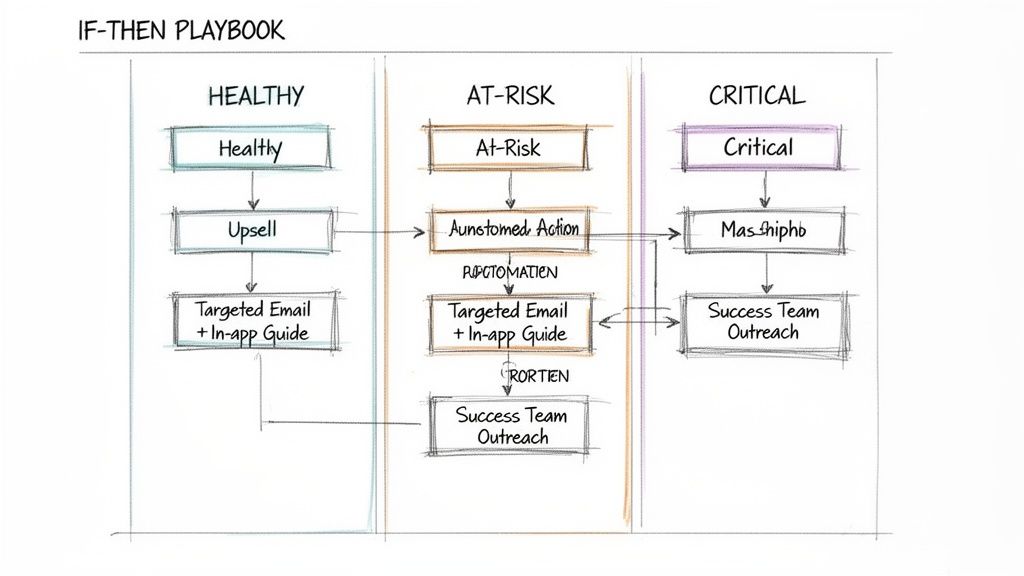
Think of a playbook as a simple "if-this-then-that" recipe for your customer success team. It's a pre-planned set of actions that kicks off automatically the moment a customer’s health score hits a certain threshold. Instead of your team manually checking a dashboard and debating what to do, the system gets the ball rolling immediately.
This proactive approach turns your health scores from a passive metric into a powerful engine for retention. You can design different playbooks for every customer segment—healthy, at-risk, and critical—to make sure every account gets the right kind of attention without burning out your team.
The Playbook for At-Risk Customers
When a customer's health score starts to dip, they need immediate, targeted help. They aren't a lost cause yet; they're sending up flares, signaling they need guidance. The whole point of this playbook is to re-engage them, solve their problems, and get them back to seeing value in your product.
An effective "at-risk" playbook is all about a smart sequence of automated actions:
- Trigger a personalized email campaign: This is not a generic marketing blast. It could be an email highlighting a specific feature they haven’t touched, complete with a quick video tutorial showing them how it works.
- Launch an in-app guide: The next time they log in, a targeted pop-up could offer a walkthrough of a valuable workflow they seem to be ignoring, based on their usage data.
- Notify the Customer Success Manager (CSM): If the score keeps dropping despite the automated outreach, the system should automatically create a task for a CSM to place a personal call or send a one-to-one email.
This multi-layered approach lets you use automation for efficiency while saving your team's precious time for the high-touch moments that really matter.
The Playbook for Critical Customers
Once a customer's health score plummets into the "critical" red zone, the response has to be fast and direct. These accounts are teetering on the edge of churning, and automated emails just won't cut it anymore. This playbook is about sounding the alarm and getting all hands on deck.
A critical health score is a five-alarm fire. The playbook for this segment isn't about gentle nudges; it's about immediate, direct, and human-led intervention to understand the problem and offer a solution.
The workflow for a critical account needs to be more aggressive and personal. It’s the perfect example of how blending automated alerts with human action can pull an account back from the brink.
- Instant CSM Alert: The second a score drops into the critical range, a notification should hit the account owner’s inbox with a summary of the red flags (e.g., two failed payments, zero logins for 30 days).
- Internal Team Huddle: The CSM might pull in a product specialist or a support lead to quickly diagnose the root cause of the customer’s frustration.
- Direct Executive Outreach: For high-value accounts, the playbook might even trigger a personal email from a founder or executive to show the customer just how seriously you take their business.
The Playbook for Healthy Customers
Don't make the mistake of ignoring your happiest customers. Healthy accounts are your biggest opportunities for growth and advocacy, and your playbook should treat them that way. The goal here isn't just to keep them happy—it's to turn them into your best champions and a new source of expansion revenue.
For customers with glowing health scores, your playbook could automatically trigger:
- Upsell and cross-sell offers: If they’re constantly using every feature in their current plan, it’s the perfect time to introduce them to the next tier up.
- Requests for testimonials or case studies: Strike while the iron is hot. A satisfied customer is far more likely to share their success story.
- Invitations to beta programs: Make them feel like true insiders by giving them early access to new features before anyone else.
By building clear, automated playbooks, you finally connect insight to action. You create a system that doesn't just warn you about churn risk but actively helps you fight it. For more ideas on structuring these workflows, check out these proven customer success strategies.
Common Mistakes to Avoid With Customer Health Scores
It’s exciting to finally get a customer health scoring system up and running. But let's be honest, just having the dashboard doesn't mean you've solved churn. Many SaaS teams stumble into the same traps, turning what should be a powerful early-warning system into just another metric nobody trusts.
Knowing what not to do is just as important as following the best practices. If you can sidestep these common pitfalls, you’ll build a retention engine that actually works, saving you a ton of time and frustration down the road.
Mistake 1: Set It and Forget It
This is probably the biggest mistake I see. A team spends a month building the perfect health score model, launches it, and then doesn't touch it for two years. The problem is, your business isn't static. Your product evolves, your ideal customers change, and the market shifts. A model that was dead-on accurate last year might be completely useless today.
A Smarter Approach: Treat your health score like a living, breathing system. You have to revisit and fine-tune it regularly. Put a quarterly review on the calendar and ask the tough questions. Are these metrics still the best predictors of churn? Do we need to account for that major new feature we launched? Your scoring model has to evolve right alongside your company.
Mistake 2: Relying on a Single Signal
Another classic trap is getting fixated on one obvious metric, usually login frequency. Sure, it feels important, but it rarely tells the whole story. I've seen customers who log in every single day but only use one minor feature, getting almost no real value from the platform. On paper, they look great. In reality, they're one foot out the door.
Over-reliance on a single data point creates dangerous blind spots. A truly predictive health score is a composite, blending multiple signals to paint a complete picture of the customer relationship.
A Smarter Approach: Your score needs balance. Pull in a mix of signals from all four key areas: product usage, subscription health, engagement, and customer sentiment. A customer who logs in infrequently but always pays on time and gives you a 9/10 on your NPS survey is probably in a much better place than someone who logs in daily but has three failed payments and a support ticket queue a mile long.
Mistake 3: Ignoring Qualitative Feedback
It’s so easy to get lost in the spreadsheets—usage data, payment histories, and open rates. But all that quantitative data only tells you what is happening. It never tells you why. If you ignore the human element, the actual words coming from your customers, you’re flying blind.
A Smarter Approach: You have to find a way to weave qualitative feedback into your health scoring. A low NPS score, a frustrated comment on a CSAT survey, or a scathing G2 review are all massive red flags. Combining these gut-punch insights with your quantitative data gives you the context you need to understand the story behind the numbers.
Mistake 4: Scoring Without a Plan
This is the most frustrating mistake because it wastes everyone's time. You can build the most elegant, accurate health score in the world, but if your team doesn't know what to do when a score changes, it's completely useless. All you've done is create a pretty dashboard of red, yellow, and green dots that leads to analysis paralysis. Risks get flagged, but nobody ever does anything about them.
A Smarter Approach: Every score and every threshold needs a playbook. When a customer's score drops from "Healthy" to "At-Risk," that should automatically trigger a specific action—maybe a re-engagement email campaign or an in-app tour of a sticky feature. If it plummets to "Critical," that needs to be an instant, high-priority alert for a Customer Success Manager to pick up the phone. Action is what turns data into saved revenue.
Got Questions About Customer Health Scores? We've Got Answers.
As you start working with customer health scores, you're bound to have some questions. It’s a new way of looking at your business, after all. Let's tackle some of the most common ones that pop up.
How Often Should I Update My Customer Health Scores?
The short answer? As close to real-time as you can get.
Think about it: customer behavior can change in an instant. A failed payment, a sudden nosedive in product usage—these are critical signals. If your data is a week old, you've already lost precious time to step in and help. The goal is to catch problems the moment they happen, not a week later when you're reading a report.
This is why automated systems are so powerful. When your health scoring tool connects directly to sources like Stripe and your product analytics, the scores update continuously. Your dashboard becomes a live view of your customer base, not a stale snapshot.
What About Brand-New Customers? They Don't Have a History.
That’s a fantastic point. A customer who signed up yesterday won't have the rich history of usage or payment data that a one-year-old account has. So, how do you score them?
Most teams create a special "onboarding" status for the first 30-60 days. During this crucial window, you're not looking for deep feature adoption. Instead, you're tracking progress against key activation milestones.
For a new customer, "healthy" means they're hitting their first-run checkpoints. Did they complete the setup wizard? Invite a colleague? Perform their first core action? These early wins are the best predictors of long-term success.
This approach recognizes that a new user's journey is unique and focuses on what truly matters in those first few weeks.
What’s the Big Deal About Leading vs. Lagging Indicators?
Getting this right is the difference between being proactive and just reacting.
Lagging Indicators: These are your rearview mirror. They tell you what already happened. Churn rate, for example, is the ultimate lagging indicator. It confirms you lost a customer, but it’s too late to do anything about it.
Leading Indicators: These are your headlights. They signal what’s likely to happen next. A dip in weekly logins, a low NPS score, or a drop-off in a key feature are all leading indicators. They're your early-warning system, giving you a chance to intervene before someone cancels.
A truly effective customer health score is built almost entirely on leading indicators. Its job isn't to report on the past, but to give you a clear, actionable forecast of the future so you can change the outcome.
Ready to stop reacting to churn and start preventing it? LowChurn gives you the AI-powered early-warning system you need to protect your MRR. Connect Stripe, add our privacy-safe snippet, and see actionable customer health scores in minutes. See how it works.