In the competitive SaaS landscape, proactive retention is no longer a luxury; it's the engine of sustainable growth. The old model of waiting for customers to complain before taking action is a direct path to revenue leakage and a surefire way to lose ground to competitors. Today's most successful teams are leveraging data, automation, and intelligent workflows to anticipate customer needs and prevent churn before it even has a chance to materialize. This shift from reactive support to proactive success is fundamental, as forward-thinking leaders understand how to boost growth with customer retention and customer loyalty rather than just plugging holes in a leaky bucket.
This guide moves beyond generic advice to provide a prioritized, actionable playbook. We will outline 10 proven customer success strategies that modern SaaS teams are using to protect their MRR and build long-term, profitable relationships. Each strategy is a building block for creating a resilient, customer-centric business, showing you not just what to do, but exactly how to implement it for maximum impact.
We'll explore how to implement predictive analytics, create real-time health score dashboards, and automate retention campaigns with one-click playbooks. You will learn to map the customer lifecycle, manage renewals with data-driven insights, and track feature adoption to drive proactive engagement. By the end of this article, you will have a clear roadmap for transforming your customer success function from a cost center into a powerful, predictable revenue driver. Let’s dive into the specific tactics that will help you get ahead and stay there.
1. Predictive Churn Analytics & Early Warning Systems
Predictive churn analytics is a powerful customer success strategy that shifts your team from a reactive to a proactive stance. Instead of waiting for a cancellation email, this approach uses AI and machine learning to analyze customer data in real-time, identifying accounts at high risk of churning 7 to 30 days in advance. By examining product usage patterns, subscription signals, and behavioral data, you can build an early warning system that flags subtle signs of disengagement before they become critical issues.
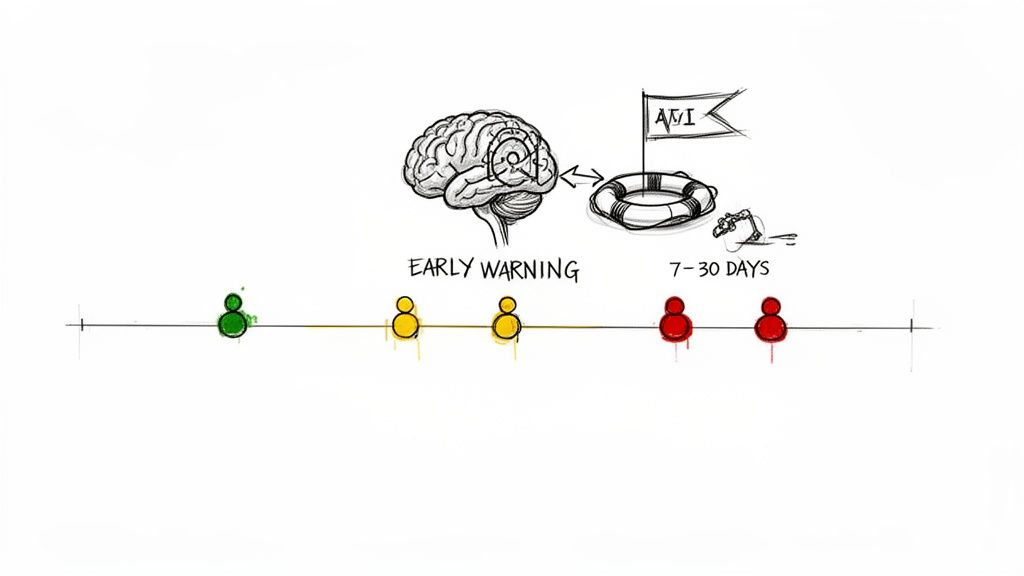
This method allows your team to intervene with targeted, personalized outreach when it matters most, rather than scrambling to save an account that has already decided to leave.
Why It Matters
Predictive analytics gives your team the critical gift of time. By identifying at-risk customers early, you can prioritize high-value accounts for intervention, test different retention tactics, and gather valuable feedback. This not only helps reduce revenue churn but also provides insights to improve the overall customer experience, preventing future churn events before they even begin.
Key Metrics to Track
- Churn Prediction Accuracy: The percentage of accounts flagged as "at-risk" that actually churn within the predicted window.
- Intervention Success Rate: The percentage of at-risk customers who are successfully retained after a targeted intervention.
- Time-to-Intervention: The average time it takes for your team to act on an early warning alert.
Implementation Playbook
- Integrate Key Data Sources: Connect your product analytics (e.g., Amplitude) and billing data (e.g., Stripe) to a central platform like LowChurn. This combines behavioral data like feature adoption and login frequency with subscription signals like failed payments or plan downgrades.
- Define Your Prediction Window: Start with a shorter, more actionable window, such as 7-14 days. This allows for faster feedback loops to refine your model's accuracy.
- Automate Alerts & Create Playbooks: Set up automated alerts for your CSMs when a customer's health score drops below a certain threshold. Create specific intervention playbooks for different risk signals, such as a personalized email for low product usage or a support call for repeated billing issues. For a deeper look into the mechanics, you can learn more about how predictive analytics can drive customer retention.
- Prioritize & Intervene: Focus initial efforts on high-MRR or strategically important accounts that are flagged as at-risk to maximize the impact of your retention campaigns.
2. Health Score Dashboards & Real-Time Account Monitoring
Health score dashboards are centralized, visual hubs that distill complex customer data into a simple, actionable score. This customer success strategy moves teams beyond siloed spreadsheets and provides a real-time, at-a-glance view of the entire customer base. By aggregating metrics like product adoption, support tickets, and subscription data into a single health score, CSMs can instantly identify which accounts are thriving and which need immediate attention.
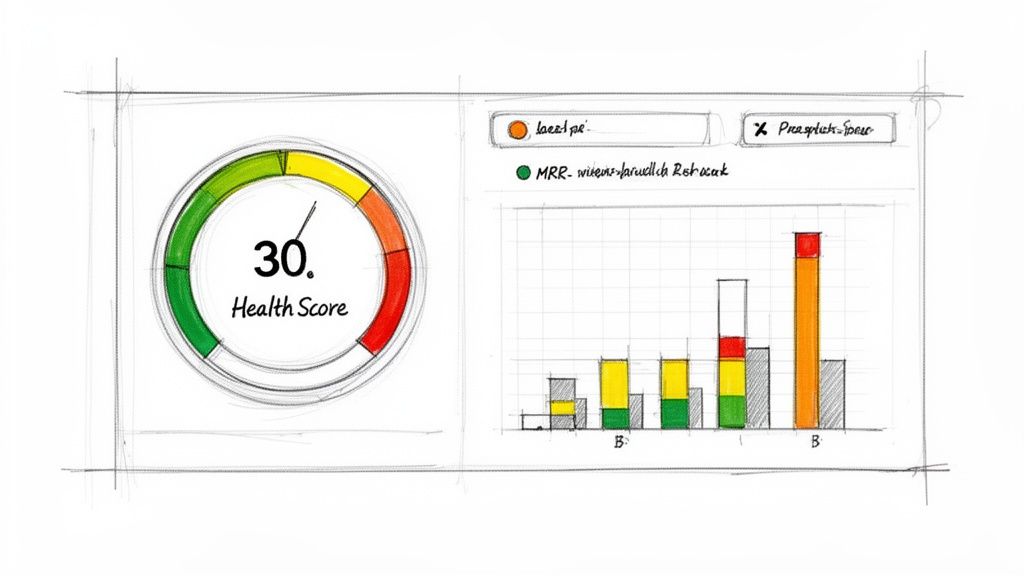
This approach transforms raw data into clear, color-coded indicators (typically red, yellow, and green), allowing teams to prioritize their efforts efficiently. Real-time updates ensure that the information is always current, enabling proactive engagement rather than reactive problem-solving.
Why It Matters
A real-time dashboard is the command center for your customer success team. It eliminates guesswork and empowers CSMs to make data-driven decisions on where to focus their time and resources. By visualizing health trends across segments or for individual accounts, you can spot systemic issues, identify expansion opportunities, and manage risk at scale, directly protecting and growing your MRR.
Key Metrics to Track
- Customer Health Score Distribution: The percentage of customers in each health category (e.g., Healthy, At-Risk, Poor).
- MRR at Risk: The total monthly recurring revenue associated with accounts in the "At-Risk" or "Poor" health categories.
- Health Trend Velocity: The rate at which an account's health score is improving or declining over a specific period (e.g., 30 days).
Implementation Playbook
- Define Your Health Score Components: Combine leading indicators (product usage, feature adoption) with lagging indicators (NPS scores, payment failures). Weight each component based on its predictive power for retention in your business.
- Centralize Data Sources: Connect your CRM, billing system (e.g., Stripe), and product analytics to a central platform like LowChurn. This creates a single source of truth for all customer health data.
- Configure Your Dashboard: Use color-coding for quick visual scanning (red/yellow/green). Create different dashboard views for specific roles, like a high-level MRR health view for executives and a detailed account list for CSMs. To get started, you can find a comprehensive guide on building your first customer health score dashboard.
- Establish Actionable Thresholds: Define clear triggers for when a CSM should intervene. For example, a score dropping from 85 to 65 in one week might trigger an automated alert and a task to schedule a check-in call.
3. Automated Retention Campaigns & One-Click Playbooks
Automated retention campaigns transform proactive churn management from a manual effort into a scalable system. This strategy involves using pre-built, best-practice outreach sequences that trigger automatically based on specific churn risk signals, such as a drop in product usage or a failed payment. Instead of Customer Success Managers (CSMs) crafting one-off emails for every at-risk account, they can deploy standardized, proven playbooks with a single click or have them run entirely in the background.
This approach ensures a swift, consistent response to signs of disengagement, significantly reducing the time between identifying a problem and acting on it. Platforms like LowChurn enable teams to launch one-click retention campaigns directly from their dashboard when an account is flagged, while tools like Intercom can trigger automated message series based on custom churn segments. This blend of automation and targeted intervention is a cornerstone of modern customer success strategies.
Why It Matters
Automation eliminates human delay and ensures no at-risk customer slips through the cracks. It frees up your CSMs to focus on high-value, strategic conversations rather than repetitive administrative tasks. By standardizing your response to common churn signals, you can test, measure, and refine your outreach at scale, systematically improving your retention rates over time.
Key Metrics to Track
- Campaign Conversion Rate: The percentage of at-risk customers who re-engage (e.g., log back in, use a key feature) after receiving an automated campaign.
- Playbook Engagement Rate: Open and click-through rates for automated emails or in-app messages.
- Time-to-Resolution: The average time it takes for an at-risk customer's health score to improve after a playbook is triggered.
Implementation Playbook
- Identify High-Impact Triggers: Start by building automated campaigns around clear, high-confidence churn signals. Focus on behavioral indicators like a 14-day login absence or transactional signals like a credit card expiring soon.
- Develop Templated Playbooks: Create a library of pre-written email and in-app message sequences for your most common risk factors. Each playbook should remind users of the value they're missing and offer a clear call-to-action, like booking a call or trying a specific feature.
- Integrate and Automate: Connect your churn prediction tool (e.g., LowChurn) to your customer messaging platform (e.g., Intercom). Set up rules that automatically enroll customers into the appropriate playbook when their health score drops or a specific risk flag is raised.
- A/B Test and Refine: Continuously test different subject lines, messaging, and offers within your playbooks. Use the performance data to refine your triggers and content, ensuring your customer success strategies are always optimized for maximum impact.
4. Customer Lifecycle Stage Mapping & Segment-Based Strategies
Customer lifecycle mapping is a core customer success strategy that segments your audience into distinct stages based on their journey with your product. Rather than treating all users the same, this approach acknowledges that an onboarding customer has vastly different needs from a mature, power user. By creating tailored playbooks for each stage, you can deliver the right support and value at the right time, guiding customers from initial adoption to long-term advocacy.
This method organizes your engagement efforts around key milestones like onboarding, adoption, expansion, and renewal. It allows you to anticipate customer needs, proactively address common friction points at each phase, and align your team’s actions to maximize retention and growth across the entire customer journey.
Why It Matters
Lifecycle mapping turns broad customer success goals into a precise, actionable framework. It prevents valuable customers from slipping through the cracks due to misaligned communication or a one-size-fits-all approach. By understanding where a customer is in their journey, you can focus on stage-specific goals, such as driving feature adoption for new users or identifying upsell opportunities for mature accounts, ultimately improving health scores and reducing churn.
Key Metrics to Track
- Stage Conversion Rate: The percentage of customers successfully moving from one lifecycle stage to the next (e.g., Onboarding to Adopted).
- Time in Stage: The average duration customers spend in each stage. A prolonged time in early stages can be a churn indicator.
- Stage-Specific Churn Rate: The churn rate calculated for each individual lifecycle stage, highlighting the most vulnerable points in the customer journey.
Implementation Playbook
- Define 4-6 Clear Lifecycle Stages: Map out the key phases of your customer journey. A common SaaS model is: Onboarding → Adopted → Expanding → Mature → At-Risk. Align these stages with key product usage milestones and subscription events.
- Automate Stage Assignment with Data: Connect product analytics and subscription data to automatically assign and update customer lifecycle stages. Use triggers like "completed onboarding checklist" or "used X core features" to move customers forward.
- Create Stage-Specific CSM Playbooks: Develop targeted action plans for each stage. For "Onboarding," the playbook might focus on setup assistance and educational content. For "Expanding," it could involve introducing advanced features or scheduling a business review to discuss new use cases. You can explore how to build these out by learning more about customer lifecycle management.
- Monitor Stage Velocity & Identify Bottlenecks: Track how quickly customers progress through the stages. If a significant number of users stall in the "Adopted" phase without moving to "Expanding," it signals a potential value gap or a need for better education on advanced functionality.
5. Data-Driven Renewal & Expansion Revenue Management
Managing renewals and expansions is one of the most critical customer success strategies for sustainable growth, yet many teams approach it reactively. A data-driven approach transforms this process by using predictive models to forecast revenue outcomes. It analyzes customer usage, subscription data, and health scores to identify which accounts are prime for expansion, which are likely to renew as-is, and which are at risk of churning or downgrading.
This strategy allows you to segment your customer base and apply the right resources at the right time. Instead of treating every upcoming renewal the same, your teams can focus high-touch sales efforts on promising expansion opportunities while deploying targeted retention campaigns for at-risk accounts, maximizing both revenue protection and growth.
Why It Matters
Proactively managing the renewal and expansion lifecycle directly impacts your most important SaaS metric: Net Revenue Retention (NRR). By identifying and acting on both risks and opportunities well before the contract end date, you shift from simply preventing churn to actively growing revenue from your existing customer base. This creates a more efficient growth engine, as retaining and expanding accounts is far more cost-effective than acquiring new ones.
Key Metrics to Track
- Net Revenue Retention (NRR): The ultimate measure of your ability to retain and grow revenue from existing customers.
- Gross Revenue Retention (GRR): Measures revenue retention before accounting for upsells or expansion, highlighting your core product stickiness.
- Renewal Rate: The percentage of customers who renew their contracts at the end of their term.
- Expansion MRR Rate: The percentage of monthly recurring revenue growth from existing customers through upsells and cross-sells.
Implementation Playbook
- Centralize Revenue & Usage Data: Integrate your billing platform (e.g., Stripe) with product analytics and a central customer data platform. This allows you to connect subscription signals like plan type and payment history with behavioral data like feature adoption and user engagement.
- Segment Accounts by Revenue Potential: Create dynamic segments 90 days before renewal. Use a tool like LowChurn to automatically flag accounts as "Likely to Expand," "Stable Renewal," or "At-Risk Churn" based on predictive health scores and product usage trends.
- Develop Targeted Playbooks: Create distinct playbooks for each segment. For "Likely to Expand," assign a sales representative to explore upsell opportunities. For "At-Risk Churn," trigger a CSM-led retention campaign focused on demonstrating value and resolving pain points.
- Align Sales and CS Teams: Establish clear rules of engagement for renewal and expansion conversations. Ensure CSMs are focused on value realization while sales representatives handle the commercial aspects of upgrades, preventing confusion and creating a seamless customer experience.
6. Proactive In-App Engagement & Feature Adoption Tracking
Proactive in-app engagement is a customer success strategy focused on guiding users and encouraging feature adoption directly within your product. Instead of relying solely on external communication, this approach uses in-app messaging, tooltips, and interactive walkthroughs to help customers discover value and master core functionality. This strategy not only addresses a primary driver of churn, which is product under-utilization, but also generates rich behavioral data that strengthens your churn prediction models.
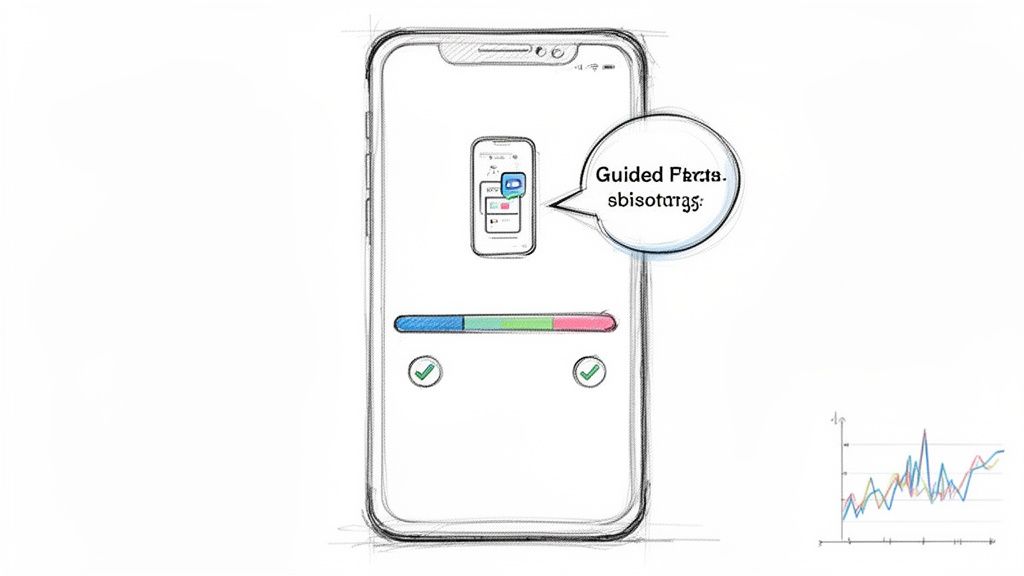
By tracking feature adoption, your team can pinpoint where users are succeeding or struggling, allowing for timely, contextual interventions that improve the user experience and drive deeper engagement.
Why It Matters
In-app engagement creates a direct line of communication with users at the most relevant moment: when they are actively using your product. It helps bridge the gap between a customer signing up and achieving their desired outcome, a critical part of the journey. Tracking which features are adopted (or ignored) provides powerful signals about customer health, allowing your team to identify accounts that are not realizing the full value of your platform and are therefore at a higher risk of churning.
Key Metrics to Track
- Feature Adoption Rate: The percentage of active users who have used a specific feature within a given timeframe.
- Time-to-Value (TTV): The average time it takes for a new user to activate and use a key "aha moment" feature.
- In-App Message Engagement: The click-through rate or completion rate of your guided tours, tooltips, and announcements.
Implementation Playbook
- Identify Core "Sticky" Features: Analyze your most retained customer cohorts to identify the top 3-5 features that correlate with long-term success. These are your primary targets for adoption campaigns.
- Segment Users for Targeted Messaging: Use a platform like Pendo or Appcues to create user segments based on behavior, role, or plan type. Send targeted in-app messages to users who have not yet adopted a key feature relevant to their use case.
- Deploy Contextual Guidance: Use simple tooltips to explain specific UI elements and reserve multi-step guided tours for more complex workflows. For example, trigger a tour for a new reporting feature only for users who have generated data to report on.
- Analyze Adoption Funnels & Risk Signals: Integrate product analytics from tools like Amplitude or Mixpanel with your churn prediction platform. Low feature adoption rates should be configured as a key risk signal in LowChurn, automatically lowering a customer's health score and triggering alerts for your CSMs.
7. Customer Communication Playbooks & Win-Back Strategies
Developing standardized communication playbooks gives your customer success team a consistent and effective framework for handling common churn scenarios. This strategy involves creating pre-defined sequences of actions and messages tailored to specific risk signals, such as pricing concerns, low product usage, or competitive threats. It equips your team to respond swiftly and appropriately, ensuring no at-risk customer slips through the cracks.
A critical component of this is a well-defined win-back strategy, which specifically targets customers who are actively churning or have recently churned. These playbooks go beyond generic discounts, using targeted offers, highlighting recent feature updates relevant to their needs, or suggesting alternative plans to demonstrate ongoing value and a commitment to their success.
Why It Matters
Standardized playbooks eliminate guesswork and ensure a high-quality, consistent response to every customer risk. This structured approach allows you to scale your customer success efforts without sacrificing personalization. By documenting and refining these strategies, you create a powerful knowledge base that improves team efficiency, reduces response times, and systematically increases retention rates by addressing the root cause of potential churn with proven solutions.
Key Metrics to Track
- Playbook Success Rate: The percentage of at-risk customers who are retained after a specific playbook is executed.
- Win-Back Conversion Rate: The percentage of recently churned customers who reactivate their subscription in response to a win-back campaign.
- Engagement Rate: The open and click-through rates of emails or in-app messages used within your communication playbooks.
Implementation Playbook
- Segment Churn Reasons: Identify the top 3-5 reasons customers churn (e.g., price, missing features, poor onboarding). Use this data to create a dedicated playbook for each scenario. For example, a "price sensitivity" playbook might involve offering an annual discount, while a "feature gap" playbook could involve sharing the product roadmap.
- Map Out Communication Sequences: For each playbook, define a multi-step sequence. A low-usage playbook might start with a feature education email, followed by an in-app guide, and escalate to a personalized offer for a strategy call.
- Lead with Value, Not Discounts: Frame your outreach around understanding the customer's challenges and providing solutions. Instead of immediately offering a discount, first, try to re-engage them with content or support that reinforces your product's value proposition.
- Automate & Trigger Playbooks: Use a platform like LowChurn to trigger these playbooks automatically when a customer's health score drops or a specific churn signal (like a cancellation click) is detected. This ensures timely intervention. For instance, you can set up a rule where a customer visiting the cancellation page automatically receives an email with a link to book a call with their CSM.
8. Privacy-First Data Integration & Compliance-Safe Analytics
Building effective churn prediction requires data, but one of the most forward-thinking customer success strategies is to achieve this without compromising user privacy. A privacy-first approach to analytics means you can derive powerful, actionable insights by focusing on subscription metadata and aggregate behavioral signals, all while avoiding the collection of Personally Identifiable Information (PII) and maintaining regulatory compliance (GDPR, CCPA, SOC 2). This method builds deep customer trust by default.
This strategy uses anonymized or non-personal data points like subscription history, plan changes, and feature usage frequency to model churn risk. Instead of tracking who a customer is, you track what their subscription is doing. This not only safeguards user data but also simplifies your compliance overhead, making it a smarter, more sustainable way to grow.
Why It Matters
In an era of increasing data scrutiny, proving you are a responsible steward of customer data is a competitive advantage. This approach mitigates the risk of costly data breaches and regulatory fines. It also demonstrates a commitment to user privacy that can attract and retain security-conscious customers, turning your compliance posture from a defensive necessity into a proactive selling point.
Key Metrics to Track
- PII Exposure Rate: The percentage of your analytics data that contains PII. The goal is 0%.
- Compliance Audit Pass Rate: Successful completion of internal or external audits for regulations like GDPR or SOC 2.
- Time-to-Insight (without PII): The speed at which your team can derive actionable insights using only privacy-safe data.
Implementation Playbook
- Adopt Privacy-First Tools: Choose platforms designed for compliance. For instance, LowChurn integrates with Stripe using a read-only API key and is architected to never access, store, or process PII like customer names or emails, focusing solely on subscription metadata.
- Rely on Subscription & Usage Signals: Base your churn models on anonymous data. Track invoice history, plan MRR, failed payments, and feature adoption rates. These signals are highly predictive of churn without ever needing to know an individual's identity.
- Document Your Data Handling Policies: Be transparent with customers about what data you collect and why. A clear, public-facing privacy policy that explains your PII-free analytics approach builds significant trust and can be a differentiator.
- Conduct Regular Audits: Implement a recurring process to scan your data stores and analytics pipelines to ensure no PII has accidentally crept in. This ensures ongoing compliance and data hygiene.
9. Cohort Analysis & Churn Pattern Identification
Cohort analysis is a behavioral analytics strategy that groups customers into segments with common characteristics to track their actions over time. Instead of viewing your entire customer base as a monolith, this approach segments users by factors like acquisition date, subscription plan, industry, or geography. This allows you to uncover specific churn patterns unique to different customer groups, revealing why certain segments stay loyal while others leave.
By analyzing time-based cohorts, you can see how retention evolves as customers mature. For instance, you might discover that users acquired in Q2 have a higher 90-day churn rate than those from Q1, prompting an investigation into onboarding changes during that period. This granular view moves you beyond a simple overall churn rate, providing actionable insights to refine your customer success strategies for specific segments.
Why It Matters
Different customer segments churn for different reasons. A small business might churn due to price sensitivity, while an enterprise client might leave because a key feature is missing. Cohort analysis exposes these hidden patterns, enabling you to create targeted, segment-specific retention campaigns instead of using a one-size-fits-all approach. It helps you understand which acquisition channels bring in the most loyal customers and how product updates impact long-term retention.
Key Metrics to Track
- Cohort Retention Rate: The percentage of customers from a specific cohort who are still active after a certain period (e.g., Month 1, Month 6).
- Cohort-Specific Net Revenue Retention (NRR): Tracks the recurring revenue from a specific cohort, including expansions, downgrades, and churn.
- Time-to-Churn by Cohort: The average time it takes for a customer within a specific cohort to churn.
Implementation Playbook
- Establish Baseline Cohorts: Start by grouping customers based on their acquisition month. Use tools like ChartMogul or Amplitude to visualize retention curves for each monthly cohort. This creates a baseline to measure future performance against.
- Apply Secondary Segmentation: Once you have a baseline, add secondary layers like subscription plan or industry. This will help you pinpoint which specific segments are driving down your overall retention numbers.
- Analyze Retention Curve Shapes: Look for changes in the shape of the retention curves. A steep initial drop-off may indicate an onboarding problem, while a steady decline after six months could signal a lack of long-term value or competitive pressure.
- Connect Insights to Actions: If you notice a cohort of customers on your "Basic" plan churns at a high rate after three months, create a targeted upgrade campaign for that specific group at the 60-day mark, highlighting features in the "Pro" plan that solve their next-level challenges.
10. Integration-Driven Workflows & Closed-Loop Feedback
Integration-driven workflows are about making your customer success data actionable by embedding it directly into the tools your team already uses. Instead of CSMs manually checking a separate dashboard for health scores, this strategy connects your churn prediction platform with your CRM, communication tools, and help desk. At-risk alerts automatically trigger tasks, update CRM records, or send notifications, ensuring no critical signal gets missed.
This approach creates a seamless operational flow, transforming raw data into timely, context-rich actions. It also establishes a closed-loop feedback system where the outcomes of interventions are tracked and fed back into your prediction models, continuously improving their accuracy and refining your retention strategies over time.
Why It Matters
Disconnected tools create data silos and operational friction, slowing down your team’s response time to at-risk customers. By integrating systems, you eliminate manual data entry, reduce the chance of human error, and ensure that crucial customer insights are visible right where your team works. A closed-loop system means your retention efforts get smarter with every interaction, as you learn which playbooks are most effective for different churn signals.
Key Metrics to Track
- Alert-to-Action Time: The time elapsed from when an at-risk alert is generated to when the first action is taken by a CSM.
- Data Sync Accuracy: The percentage of customer records that are correctly and consistently updated across all integrated platforms.
- Intervention Outcome Capture Rate: The percentage of interventions where the final outcome (e.g., "Retained," "Churned") is successfully logged back into the system.
Implementation Playbook
- Map Your Core Tool Stack: Identify your primary systems of record and action, such as your CRM (Salesforce, HubSpot), communication platform (Slack, Intercom), and CS platform (Gainsight).
- Start with One-Way Notifications: Begin with a simple integration, like sending real-time churn alerts from a platform like LowChurn to a dedicated Slack channel. This provides immediate visibility for the team without complex setup.
- Establish Two-Way Sync with Your CRM: Connect your churn prediction tool to your CRM to automatically create tasks or update a custom "Customer Health" field on the contact record when an account is flagged. This puts the data directly into your CSM's primary workflow.
- Implement Outcome Tracking: Configure your CRM so that when a CSM resolves a task related to a churn alert, they can log the outcome. This outcome data should then be synced back to your analytics platform to refine future churn predictions, closing the feedback loop.
10-Point Customer Success Strategy Comparison
| Item | 🔄 Implementation Complexity | 💡 Resource Requirements & Skills | ⭐ Expected Outcomes / Effectiveness | ⚡ Speed / Time-to-Value | 📊 Ideal Use Cases & Key Advantages |
|---|---|---|---|---|---|
| Predictive Churn Analytics & Early Warning Systems | 🔄🔄🔄🔄 (advanced ML + payment integration) | Data engineering, ML modeling, product usage data, payment API access | ⭐⭐⭐⭐⭐ — high accuracy (85%+ typical) for early detection | ⚡⚡ (requires historical data & iteration) | Predicting at-risk accounts 7–30 days out; prioritizes high-MRR interventions |
| Health Score Dashboards & Real-Time Account Monitoring | 🔄🔄🔄 (data aggregation + real-time feeds) | BI/dashboarding, CRM integration, UX for CSMs | ⭐⭐⭐⭐ — strong visibility into account health | ⚡⚡⚡ (dashboards deliver quick operational value) | At-a-glance prioritization, MRR-weighted views, team coordination |
| Automated Retention Campaigns & One-Click Playbooks | 🔄🔄 (automation & templates) | Campaign tooling, messaging templates, basic segmentation | ⭐⭐⭐⭐ — consistent, scalable interventions | ⚡⚡⚡⚡ (fast deployment; immediate outreach) | Scale responses to risky cohorts, reduces time-to-first-touch |
| Customer Lifecycle Stage Mapping & Segment-Based Strategies | 🔄🔄 (segment logic + playbooks) | Product analytics, lifecycle definitions, CSM playbooks | ⭐⭐⭐ — improves relevance of engagement | ⚡⚡⚡ (moderate setup, clear ROI after staging) | Tailored playbooks per stage, reduces over/under-nurturing |
| Data-Driven Renewal & Expansion Revenue Management | 🔄🔄🔄 (cross-source scoring & forecasting) | Revenue analytics, sales/CS alignment, contract data | ⭐⭐⭐⭐ — protects renewals and finds upsell | ⚡⚡ (requires timing & coordination before renewals) | Forecasting renewals, prioritizing expansion opportunities |
| Proactive In-App Engagement & Feature Adoption Tracking | 🔄🔄 (product instrumenting + messaging) | Product team coordination, in-app tooling, event tracking | ⭐⭐⭐⭐ — increases adoption, reduces under-utilization churn | ⚡⚡⚡ (can show results quickly if well targeted) | Drive feature activation, feed behavioral signals to models |
| Customer Communication Playbooks & Win-Back Strategies | 🔄🔄 (templating + escalation rules) | Content design, CS training, negotiation frameworks | ⭐⭐⭐ — consistent outreach and recoveries | ⚡⚡⚡⚡ (templates allow rapid execution) | Standardized responses for pricing/feature issues, win-back offers |
| Privacy-First Data Integration & Compliance-Safe Analytics | 🔄🔄🔄 (privacy engineering & legal) | Compliance expertise, read-only integrations, secure architecture | ⭐⭐⭐⭐ — builds trust; enables regulated deployments | ⚡⚡ (longer due to audits/legal reviews) | Deploy in regulated markets, minimize PII risk while preserving insight |
| Cohort Analysis & Churn Pattern Identification | 🔄🔄 (analytics & segmentation) | Analytics tooling, sufficient data volume, statistical understanding | ⭐⭐⭐⭐ — reveals root causes and cohort-specific drivers | ⚡⚡ (depends on data maturity) | Identify segment-specific churn drivers, validate product changes |
| Integration-Driven Workflows & Closed-Loop Feedback | 🔄🔄🔄🔄 (two-way sync + attribution) | API integrations, CRM/CS automation, outcome-tracking processes | ⭐⭐⭐⭐ — closes loop between insight and action | ⚡⚡ (integration setup can be time-consuming) | Ensure alerts reach owners, track outcomes to improve models |
Start Building Your Proactive Retention Engine Today
The journey through these ten customer success strategies reveals a powerful, unifying theme: the era of reactive, ticket-based customer support is over. Modern SaaS success is built on a foundation of proactive, data-driven engagement. We've moved beyond simply solving problems as they arise and into a new paradigm of anticipating needs, predicting risks, and systematically engineering value for every customer segment.
This proactive approach isn't just a "nice-to-have." It's a strategic imperative for sustainable growth. By implementing predictive churn analytics, you transform uncertainty into foresight. By leveraging real-time health score dashboards, you replace gut feelings with actionable data. And by deploying automated retention playbooks, you scale personalized interventions that would be impossible to manage manually, especially for lean teams. The ultimate goal is to create a predictable retention engine that runs in the background, protecting your MRR and identifying expansion opportunities before they become obvious.
From Disparate Tactics to a Cohesive System
Individually, each strategy we've covered, from lifecycle mapping to cohort analysis, offers significant value. However, their true power is unlocked when they are integrated into a single, cohesive system. Think of it as building a central nervous system for your customer base.
- Data Integration is the Backbone: Privacy-first data integration (Strategy #8) ensures you have a compliant, 360-degree view of the customer without compromising trust.
- Analytics are the Brains: Predictive churn models and cohort analysis (Strategies #1 & #9) process this data to identify patterns and generate early warnings.
- Workflows are the Muscle: Automated playbooks and targeted campaigns (Strategies #3, #5, & #7) translate those insights into immediate, effective action.
This integrated model creates a closed-loop feedback system where you are constantly learning from customer behavior and refining your approach. It moves your team from being firefighters to architects, actively designing a customer experience that fosters loyalty and drives long-term value. To kickstart your efforts in building a proactive retention engine, explore these 10 actionable customer success strategies for B2B revenue teams.
The First Step is the Most Important
Adopting these advanced customer success strategies may seem daunting, but the key is to start with a single, high-impact area. You don't need to boil the ocean. Begin by connecting your Stripe data to a tool that can instantly provide health scores and churn predictions. This one action gives you immediate visibility into which customers are at risk and, more importantly, why. From there, you can layer on automated communication, segment-based engagement, and more sophisticated playbooks.
The future of customer success is proactive, data-informed, and deeply integrated into the revenue lifecycle. By embracing these principles, you are not just reducing churn; you are building a more resilient, efficient, and profitable subscription business. The tools and methodologies are now more accessible than ever, empowering even bootstrapped startups to compete with established players on the battlefield of customer retention. The time to build your proactive engine is now.
Ready to turn these strategies into reality without the complexity? LowChurn connects directly to your Stripe data in minutes, providing predictive churn analytics, real-time health scores, and one-click retention playbooks designed for SaaS teams. Stop guessing and start acting with the data-driven insights you need to protect your MRR today.