
Think of Customer Lifecycle Management (CLM) as your master plan for guiding a customer from the moment they first hear about you to the day they become a raving fan. It’s how you intentionally and systematically nurture that relationship, making sure every user finds real value in your product and sticks around for the long haul.
Why CLM Is a SaaS Growth Engine
In the subscription world, signing up a new customer isn’t the finish line—it's the starting gun. Unlike a one-off purchase, your success hinges on building relationships that deliver value month after month. This is exactly where a structured approach to customer lifecycle management becomes a game-changer. Flying blind and just hoping users "get" your product is a recipe for churn.
Imagine your customer's journey as a well-marked path. CLM provides the map, the signposts, and the helpful guide who shows up at just the right moment with a crucial tip. It ensures your customers don't get lost, feel supported through the tricky parts, and ultimately reach their goals—becoming successful, loyal partners.
Moving from Reactive to Proactive
Too many SaaS teams are stuck in a reactive loop. A frustrated customer sends an angry support ticket, and the team scrambles. A big account cancels, and customer success jumps into a last-ditch effort to save them. This constant firefighting is exhausting and expensive.
CLM flips that script entirely. It’s about getting ahead of problems before they even start.
A formal CLM strategy transforms reactive problem-solving into a systematic framework for creating successful, long-term customer relationships. It’s about anticipating needs, not just responding to complaints.
This shift from defense to offense has a direct and powerful impact on your bottom line. By methodically guiding users at every step, you can:
- Boost Predictable Revenue: When you understand and manage each stage of the journey, you create a much more stable and reliable stream of monthly recurring revenue (MRR).
- Increase Customer Lifetime Value (LTV): Happy, engaged customers don't just stay longer—they're also far more likely to upgrade. This dramatically increases the total revenue you earn from each one.
- Reduce Customer Churn: By spotting early warning signs and intervening with the right help or message, you can stop customers from walking out the door.
In the end, customer lifecycle management isn't just a "customer success" thing; it's a core growth strategy for the entire business. It gets your product, marketing, and success teams all pulling in the same direction with a single, shared mission: deliver continuous value. That alignment is what separates the fast-growing SaaS leaders from the companies stuck with a leaky bucket.
Mapping the SaaS Customer Journey Stages
To really get a handle on the customer lifecycle, you first need a clear map of the terrain. The SaaS customer journey isn't a one-and-done event; it's a series of distinct stages, each with its own goals, challenges, and chances to shine. Nailing this progression is the foundational step to building a CLM strategy that actually works.
Think of it like being a city guide for a new resident. First, they have to find your city (Acquisition). Then, they need a hand moving in and getting the lights turned on (Activation). Once they're settled, you'd show them the best coffee shops and parks to keep them happy and plugged into the community (Engagement and Retention). Before you know it, they love it so much they buy a bigger house (Expansion) and start telling all their friends to move in, too (Advocacy).
Each phase demands a different playbook. For a deeper look at structuring this whole process, this guide to customer journey optimization offers some great frameworks.
The First Encounter: Acquisition
The Acquisition stage is all about that first impression. It’s where someone out there, wrestling with a problem, first learns that you might have the solution. The goal isn't just to get noticed, but to attract the right kind of customer—the one whose problem is a perfect match for the value your product delivers.
This is home turf for your marketing and sales teams. They're using content, ads, and outreach to connect with that ideal customer profile. The main objective here is to turn a curious visitor into a qualified lead who signs up for a trial or freemium plan, officially kicking off their journey with you.
The Spark of Value: Activation and Onboarding
As soon as a user signs up, the clock is ticking. The Activation stage is, without a doubt, one of the most make-or-break moments in the entire lifecycle. Your number one job is to get that new user to their "aha moment" as fast as humanly possible—that instant where they truly get the core value of your product.
This isn't about giving them a tour of every single feature you’ve built. It's about guiding them to a quick win that solves an immediate pain. A successful activation means the user clearly sees how your product makes their life better, which radically boosts the odds they'll stick around for the long haul. This is often driven by in-app onboarding flows, handy checklists, and welcome emails from the product and customer success teams.
Building Habits: Engagement
With that first win under their belt, the focus shifts to making your product a staple in the user's workflow. The Engagement stage is all about building habits and proving your value over and over again. An engaged customer is someone who logs in regularly, uses key features, and weaves your tool into their daily routine.
Healthy engagement isn't just about high usage numbers; it's about meaningful interactions that drive positive results for the customer. Low engagement is one of the earliest and most reliable warning signs of future churn.
This diagram shows the high-level flow, from a curious visitor to a powerful advocate for your brand.
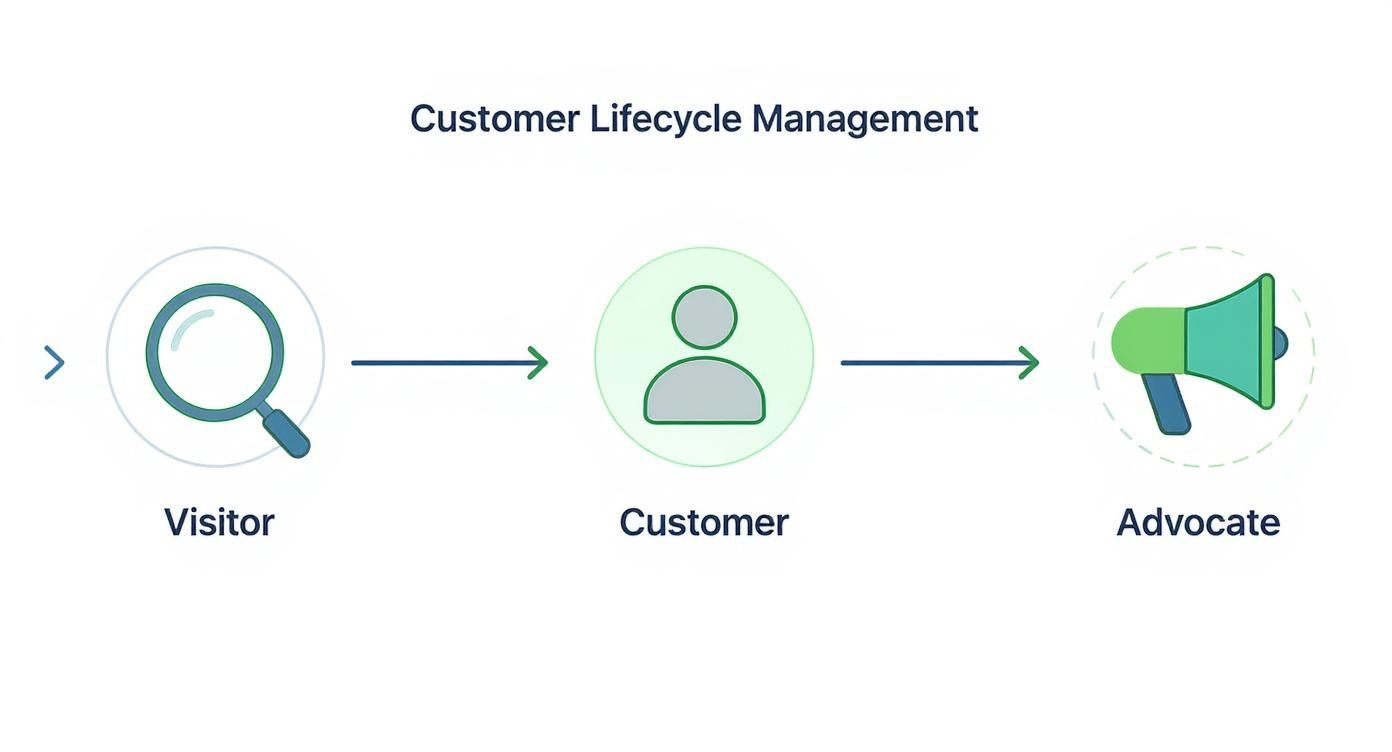
This simple visual nails the core progression every SaaS business has to manage: turning initial interest into active use and, ultimately, into genuine enthusiasm.
Earning Loyalty: Retention and Expansion
The Retention phase is where you prove you’re in it for the long haul. The customer is activated and engaged, but the relationship still needs continuous care. The goal is simple, but it’s not easy: keep them happy, successful, and subscribed. This takes proactive support, sharing best practices, and consistently delivering on your product's core promise.
Running parallel to retention is Expansion. This is where a happy customer gets so much value that they're ready to invest more. That could mean upgrading to a higher plan, adding more seats for their team, or buying a new add-on. For any SaaS business, expansion is a massive growth lever—it's far cheaper and easier to grow revenue from your existing base than it is to constantly acquire new customers.
Creating Champions: Advocacy
Finally, you reach the peak of the customer lifecycle: Advocacy. This is the magic moment when your happiest customers become your most powerful marketing channel. An advocate doesn't just renew their subscription; they actively champion your brand to others.
They're the ones who will:
- Leave glowing reviews on sites like G2 or Capterra.
- Refer new customers through your referral program.
- Happily agree to be featured in a case study.
- Sing your praises on LinkedIn or Twitter.
Turning customers into advocates is the ultimate goal of CLM. It creates a powerful, self-sustaining growth loop where your best customers help you acquire your next wave of users, bringing the entire journey full circle.
Monitoring Your Customer Lifecycle Health
Mapping out the customer journey is a great first step, but how do you know if it's actually working? A solid customer lifecycle management strategy isn't built on gut feelings; it runs on hard data. To really understand how customers are moving through each stage, you need to track the vital signs of their journey with a clear set of metrics.
Think of it like a car's dashboard. You have the speedometer showing your current progress (your KPIs), but you also have the check-engine light and oil-pressure warnings (your leading signals). You need both to get where you're going safely.
These metrics give you an objective, real-time look at what's clicking and where the friction is. This lets you step in and help before a small snag turns into a lost customer.
The Right Metrics for the Right Moment
To effectively manage the customer lifecycle, it's crucial to connect specific Key Performance Indicators (KPIs) and their predictive signals to each distinct stage. Focusing on the right numbers at the right time ensures every team—from marketing to product to customer success—knows exactly what they're aiming for and how their work contributes to the bigger picture.
The table below breaks down the most essential KPIs and leading signals for each phase of the journey.
| Lifecycle Stage | Primary KPI | Leading Signal/Metric |
|---|---|---|
| Acquisition | Customer Acquisition Cost (CAC) | Marketing Qualified Leads (MQLs) |
| Activation | Time to Value (TTV) | Onboarding completion rate |
| Engagement | Product Adoption Rate | Weekly active users (WAU) |
| Retention | Net Revenue Retention (NRR) | Customer Health Score |
| Expansion | Lifetime Value (LTV) | Feature adoption/upsell interest |
| Renewal/Churn | MRR Churn Rate | Support ticket volume |
By focusing on these specific metrics, teams gain clarity and can take targeted action where it matters most, rather than getting lost in a sea of irrelevant data.
Spotting Trouble Before It Starts
KPIs are great, but they often tell you what already happened. They’re lagging indicators. The real secret to proactive retention is spotting the leading indicators—the subtle behavioral clues that predict what’s coming next.
These are the quiet whispers of trouble that show up long before a customer clicks "cancel."
A dip in weekly logins or a new support ticket from a once-quiet account might seem minor. But these are often the first tremors before an earthquake. Acting on these early signals is infinitely more effective than trying to win back a customer who has already made up their mind.
Here are a few classic early warning signs to watch for:
- Usage Dips: A customer’s login frequency or use of core features suddenly drops off a cliff. This is a massive red flag.
- Support Ticket Pile-Up: A growing backlog of unresolved tickets points directly to user frustration.
- Bad Survey Scores: A low NPS or CSAT score is a customer literally telling you they're unhappy. Listen to them!
- Champion Leaves: Your main contact or internal champion at a company quits. That account is now officially at risk.
Putting It All Together: The Customer Health Score
So, how do you consolidate all these different data points into something your team can actually use?
This is where the Customer Health Score comes in. It’s a single, weighted score that blends your big-picture KPIs and subtle leading indicators into a simple, actionable rating (like red, yellow, or green) for every account. This gives your team a prioritized list of who needs attention right now.
For a complete walkthrough, check out our guide on how to build a powerful customer health score.
By tracking health scores, your CSMs can instantly spot at-risk accounts, focus their energy where it will have the biggest impact, and turn a potential churn situation into a story of a customer saved.
Actionable Plays for Each Lifecycle Stage
Knowing the stages of the customer lifecycle is one thing, but actually managing them is where the real work begins. This is where theory gets its hands dirty. To turn your CLM framework into a growth machine, you need specific, repeatable playbooks your teams can run at every critical moment.
Think of these playbooks less like complex strategies and more like simple recipes: they define a trigger, an action, and who owns it. This clarity means that when a customer needs a nudge, a helping hand, or a reason to stick around, your team can respond instantly and effectively.
Let's break down some battle-tested plays your teams can start using today.
Activation Playbook: Driving the First "Aha!" Moment
The entire goal during activation is to get a new user to that "aha!" moment—the point where they truly get your product's value. This playbook uses a simple, automated email sequence to guide them toward that first crucial win.
- Trigger: A new user signs up for a trial account.
- Ownership: Marketing Automation & Product Marketing.
- Action: Kick off a 5-day automated onboarding email series.
A Simple Email Sequence That Works:
- Day 1 (Immediately): Welcome & The One Thing. The first email is all about focus. It warmly welcomes the user and points them toward completing the single most important setup task. You're not trying to show off every feature; you just want to deliver a quick, tangible win.
- Day 3: Social Proof & The Next Step. This email is about building confidence. Share a short case study or a testimonial from a similar customer, highlighting the value they found. Then, gently introduce the next logical step they should take in the product.
- Day 5: Offer Help & Share Resources. The final email in this initial sequence is a proactive offer to help. Link to a key tutorial video, a helpful article, or an invitation to a live webinar. It shows you're invested in their success right from the start.
Engagement Playbook: Highlighting New Value
Once a customer is activated, the game shifts to building habits. You need to make sure they're discovering the full breadth of what your product can do. This playbook focuses on driving the adoption of secondary features that make your product stickier.
- Trigger: A user has been active for 30+ days but hasn't touched a key secondary feature (like 'Advanced Reporting').
- Ownership: Product Marketing & Customer Success.
- Action: Display a targeted in-app tooltip or modal that highlights the feature.
Sample In-App Message:
"Did you know you can build custom reports?
It looks like you're a pro at managing projects. Take it to the next level by creating a custom performance dashboard for your team. Click here to build your first report in under 60 seconds!"
This kind of contextual message meets users exactly where they are. It offers relevant value without being disruptive and turns feature discovery from a happy accident into a guided experience.
Retention Playbook: Responding to a Dropping Health Score
Great retention is about spotting trouble before it becomes a cancellation email. This playbook is a rapid-response plan for when a customer's health score dips, signaling they're at risk of churning.
- Trigger: A customer's health score drops from 'Green' to 'Yellow' or 'Red'.
- Ownership: Customer Success Manager (CSM).
- Action: Launch a multi-step outreach and investigation workflow.
A Step-by-Step Workflow:
- Investigate (First 24 Hours): The CSM immediately dives into the account dashboard. Why did the score drop? Was it a slump in product usage, a failed payment, or a string of frustrating support tickets?
- Personal Outreach (48 Hours): The CSM sends a personalized, non-automated email. The goal isn't to sound an alarm but simply to be helpful. Something like, "Hey, just checking in to see how things are going with [Product Feature]. Let me know if you'd like to schedule a quick 15-minute call to review your workflow," can open the door.
- Offer Value (72 Hours): If there’s no reply, the CSM follows up with a genuinely useful resource—maybe a link to a new feature webinar or a best-practice guide relevant to how they use the product.
- Escalate (5 Days): If the account is still unresponsive and at risk, the CSM escalates internally to discuss what other strategies might work.
To keep the lifecycle healthy, using proactive churn marketing strategies is crucial for getting ahead of potential customer loss. For more ideas on keeping your subscribers on board, check out our detailed guide on https://www.lowchurn.com/blog/how-to-improve-customer-retention.
These practical tactics are what make a CLM program work. They provide a clear, structured way to turn customer data into meaningful actions that drive adoption, prevent churn, and ultimately build a more loyal customer base.
Using Modern Tools and AI for Your CLM
Getting a handle on your customer lifecycle doesn't mean you need to kick off a massive, custom-built software project. The modern approach is much smarter. You can build a powerful CLM system simply by layering intelligent tools on top of the data you already have.
For most SaaS companies, the core data comes from your payment platform. A system like Stripe is so much more than a way to process transactions; it’s a goldmine of customer lifecycle events. It tracks everything from trial sign-ups and conversions to plan upgrades and, yes, cancellations. This is your foundation.
But raw subscription data is like a rearview mirror—it only shows you what's already happened. To actually get ahead of the curve, you need a layer of intelligence that can analyze that history and predict what’s coming next.
The Rise of AI-Powered CLM Platforms
This is where AI-driven platforms change the game, turning your reactive, look-in-the-past CLM efforts into a proactive engine for growth. These tools plug directly into your data sources like Stripe, crunch the numbers, and find patterns that are nearly impossible for a human to spot.
The impact here is real. Studies show that companies using AI for predictive modeling see a 25% increase in customer retention and a 30% boost in lifetime value. It's no wonder that 88% of marketers are already using AI to get a leg up, a move that can increase retention by around 15%.
These platforms aren't just fancy dashboards. They deliver actionable intelligence. They can automatically:
- Create dynamic customer health scores by looking at both subscription events and product usage.
- Flag accounts that are showing early signs of churn, long before they hit the cancel button.
- Spot expansion opportunities by identifying customers who are starting to outgrow their current plan.
Here’s a look at the LowChurn dashboard, which instantly shows how AI can surface and prioritize at-risk accounts for your customer success team.
The dashboard cuts through the noise. It immediately points out which customers need attention, their current health, and the potential MRR at risk, turning a mountain of data into a simple, clear to-do list.
From Firefighting to Proactive Growth
The real beauty of this setup is how it transforms the day-to-day work of your customer-facing teams. Instead of spending their days reacting to angry support tickets and surprise cancellations, your CSMs get a prioritized list of accounts that need their attention before things go sideways.
AI-driven CLM transforms a CSM from a reactive firefighter into a proactive growth driver. It gives them the foresight to act on opportunities and risks, fundamentally changing their impact on the business.
For instance, a platform like LowChurn can analyze user behavior and subscription data to predict which customers are likely to cancel in the next 7-30 days. Armed with that knowledge, a CSM can reach out with a targeted offer, a helpful resource, or just a personal check-in to get that customer back on the right track. For a deeper look at the tech behind this, check out our complete guide on customer churn prediction.
This modern stack also respects customer privacy by design. A tool like LowChurn uses a read-only connection to Stripe, focusing only on subscription status and metadata. It never needs to touch sensitive financial details or PII to deliver its powerful predictions.
By combining your foundational data with a smart AI layer on top, you can build a highly effective CLM system that saves revenue, drives expansion, and scales right alongside your business.
Building a Culture of Continuous Improvement
Customer lifecycle management isn't a one-and-done project. You can't just set it up and forget it. Think of it as a core part of your business operations—something that needs constant care and feeding. To get it right, CLM has to become part of your company's DNA, creating a constant cycle of measuring, learning, and improving.
The first step? Tear down the silos. The customer journey isn't just marketing's problem or customer success's responsibility. It's everyone's. The best SaaS companies I've seen create a cross-functional team, sometimes called a "growth squad" or "customer experience council," pulling in dedicated people from Product, Marketing, and Customer Success.
Establishing a Rhythm of Review and Action
This cross-functional team needs a regular, predictable rhythm to get anything done. Their mission is to own the entire customer journey, and that means getting together consistently to look at the data. The whole point is to have a structured time and place to analyze what’s working and what’s not, then decide what to do next.
A good cadence usually looks something like this:
- Bi-weekly Standups: A quick check-in to review key lifecycle metrics (think activation rates or new churn signals) and clear any immediate hurdles.
- Monthly Deep Dives: A longer meeting focused on one specific lifecycle stage. Here, the team can share insights from recent experiments and brainstorm new campaigns.
- Quarterly Strategic Reviews: A big-picture session to see how the whole program is tracking against company goals and set the priorities for the next quarter.
This kind of structured rhythm turns CLM from a messy list of tasks into a coordinated, company-wide effort. It forces accountability and makes sure that when one team learns something valuable, everyone else benefits.
A true culture of continuous improvement runs on a powerful feedback loop. Customer data shouldn't just shape your success playbooks—it needs to directly influence the product roadmap, your marketing copy, and even major business decisions.
Driving Real-World Results
When you commit to CLM across the entire company, the results are very real. For example, financial institutions that rolled out a unified platform saw their onboarding process efficiency jump by at least 50%. This systematic approach cut onboarding time for asset managers by 43% in EMEA and 51% in the U.S. These numbers prove that a coordinated strategy delivers a serious business impact. You can read more about the research behind CLM's efficiency gains.
Ultimately, making customer lifecycle management a core part of your culture means making customer success everyone's job. When your teams are all on the same page, fueled by a continuous feedback loop, your CLM program stops being just another strategy—it becomes your most powerful engine for growth.
Common Questions About Customer Lifecycle Management
Even with a solid plan in place, a few common questions always pop up when teams start putting a CLM program into action. Let's tackle them head-on.
What's the Difference Between CRM and CLM?
Think of your CRM as a really smart address book. It’s a database—a place where you store all the critical information about your customers: who they are, their contact details, and a log of every interaction you've had. It's the "what."
Customer Lifecycle Management (CLM) is the game plan for using that data. It’s the "how" and the "when"—the active strategy for guiding customers through their entire journey with you, from the moment they sign up to the day they renew. The CRM is the library of information; CLM is the story you write with it.
When Should a SaaS Startup Start Focusing on CLM?
Honestly? From day one. Even if you're just manually onboarding your first handful of users, you're already practicing the basics of CLM.
But a more structured, scalable CLM program becomes absolutely critical the moment you hit product-market fit. As soon as you have a reliable way to bring new customers in the door, your priority has to pivot to keeping them happy and growing with you. This is the exact point where a real CLM strategy stops you from leaking customers and starts building sustainable growth.
How Do You Measure the ROI of a CLM Program?
You measure the return on your CLM investment by looking straight at your core SaaS metrics. The proof is right there in the numbers.
The most direct signs of a winning CLM program are a real, measurable jump in Customer Lifetime Value (LTV), a drop in revenue churn, and a healthy increase in Net Revenue Retention (NRR).
To put a dollar figure on it, you simply weigh the financial gains from these improved metrics against what you've spent on the tools and people powering your CLM efforts.
Ready to stop churn before it happens? LowChurn uses AI to predict which customers are at risk, giving your team the early warning system needed to protect revenue and drive growth. Learn more and see how it works.