Customer churn is an unavoidable reality in SaaS, but it doesn't have to be the end of the story. While acquiring new customers costs up to five times more than retaining existing ones, winning back a churned customer can be one of the most cost-effective growth levers you have. They already know your product, their data is in your system, and you often know exactly why they left. The challenge isn't finding them; it's re-engaging them with a compelling reason to return.
Traditional, one-size-fits-all 'we miss you' emails are no longer enough. To succeed, you need a proactive, data-driven approach that addresses the specific reasons for churn. This requires a sophisticated playbook that goes beyond generic offers and focuses on rebuilding value and trust. An effective system for implementing customer win back strategies can significantly reduce net revenue churn and create a powerful, sustainable growth loop for your business.
This comprehensive listicle breaks down 10 modern customer win back strategies designed for SaaS companies. We will move from reactive tactics to proactive, automated systems that predict churn and re-engage users with precision. You will learn how to:
- Segment churned customers based on their value and cancellation reason.
- Craft personalized messaging and tailored offers that resonate.
- Implement automated campaigns to recover revenue efficiently.
- Leverage tools to prioritize at-risk and recently churned accounts for recovery.
We'll explore actionable playbooks that turn churn data into recovered MRR, helping you build a more resilient subscription business.
1. Predictive Churn Analysis & Early Intervention
The most effective customer win-back strategies often start before the customer officially leaves. Predictive churn analysis uses machine learning models to identify at-risk customers 7 to 30 days before they are likely to cancel. This proactive approach allows you to intervene while the relationship is still salvageable, transforming a potential loss into a retention opportunity. By analyzing behavioral data like product usage, support ticket frequency, and subscription signals, you can pinpoint accounts showing early signs of disengagement.
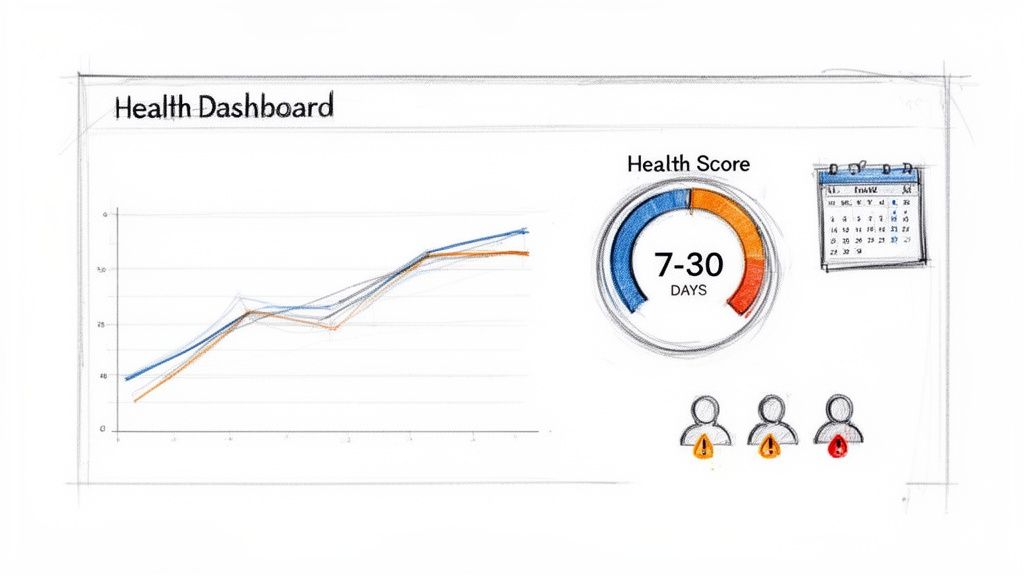
This strategy moves your team from a reactive "fire-fighting" mode to a proactive, data-driven retention model. Before diving into interventions, a clear understanding of customer loss metrics is vital, which includes learning how to define attrition rate and how to reduce it. With a solid grasp of your baseline metrics, you can more effectively measure the impact of your predictive efforts.
How It Works in Practice
SaaS platforms leveraging tools like LowChurn can detect subtle churn indicators weeks in advance. For example, a B2B company might see a pattern of declining license utilization across a specific team, or a Stripe integration might flag a drop in feature adoption that historically correlates with cancellation. These signals trigger alerts for your Customer Success team, enabling them to reach out with targeted support or a value-driven conversation. You can learn more about how these models work by exploring detailed resources on customer churn prediction.
Key Insight: Early intervention isn't about winning back a lost customer; it's about preventing the loss in the first place. The cost and effort are significantly lower, and the success rate is exponentially higher.
Actionable Tips for Implementation
- Segment by Risk Score: Prioritize outreach by segmenting at-risk customers based on their churn probability score and customer lifetime value (CLV). Focus your high-touch efforts on high-value, high-risk accounts.
- Create Tiered Playbooks: Develop specific intervention plans based on the risk level. A low-risk account might receive an automated educational email, while a high-risk account triggers a direct call from a dedicated Customer Success Manager.
- Combine Data Sources: Integrate predictive signals with qualitative feedback from surveys or support interactions. This combination provides the "what" (data) and the "why" (customer sentiment) behind potential churn.
- Monitor and Retrain: Continuously monitor the accuracy of your predictive models. Retrain them monthly or quarterly with new data to ensure they adapt to evolving customer behaviors and product changes.
2. Personalized Win-Back Campaigns via Email & In-App Messaging
Generic "we miss you" emails rarely work because they fail to address the specific reason a customer is disengaging. Personalized win-back campaigns, delivered through email and in-app messages, use behavioral and subscription data to create highly relevant, one-to-one outreach. Instead of a bland discount, these campaigns reference the exact features a customer used (or didn't use), acknowledge their recent activity drop, and offer a tailored solution.
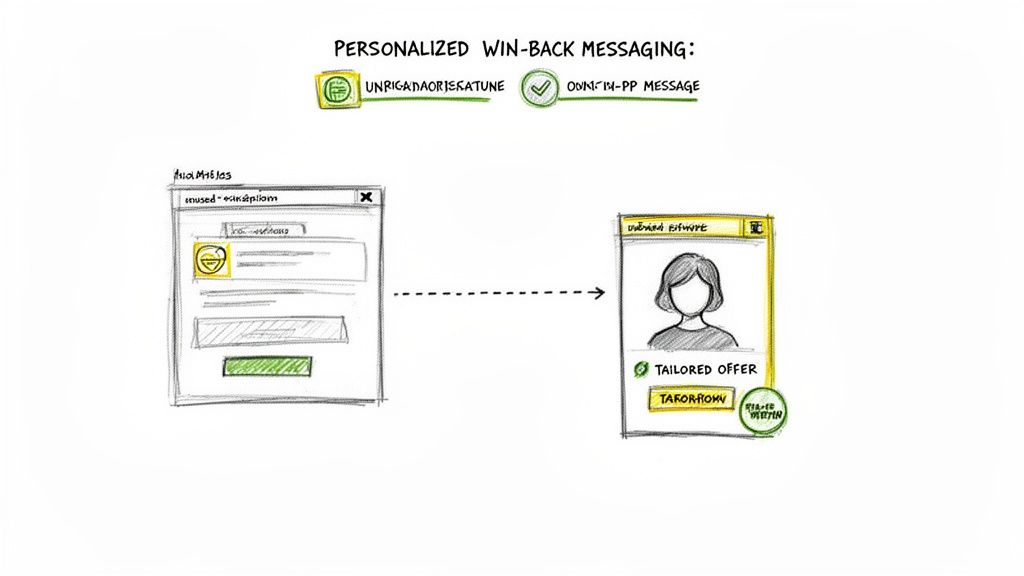
This approach transforms a generic marketing blast into a genuine conversation that demonstrates you understand the customer's unique journey. It’s a powerful customer win-back strategy because it shows you've been paying attention, not just to their absence, but to their previous engagement, making the offer to return feel consultative rather than desperate.
How It Works in Practice
Modern messaging platforms like Intercom or Customer.io allow you to build automated workflows based on user behavior. For instance, if a user who frequently used your "Reporting" feature hasn't logged in for 14 days, you can trigger an email with the subject line, "Your latest reports are waiting." The message could highlight a new reporting template or offer a brief tutorial, directly addressing their established interest and reminding them of the value they were receiving.
Key Insight: Personalization is about context, not just using a first name. Acknowledging a customer's specific usage patterns and pain points is what makes a win-back message resonate and drive action.
Actionable Tips for Implementation
- Reference Underutilized Features: Send messages that highlight valuable features the customer has never used. Frame it as a way to help them get more value, such as, "We noticed you haven't tried our scheduling tool yet; here's how it can save you 5 hours a week."
- Acknowledge the Problem: Test subject lines and CTAs that are direct and empathetic. Instead of just pushing a discount, try messaging that shows you understand they've disengaged and want to help, like "Is our platform still the right fit for you?"
- Time Campaigns for Early Signals: Launch your automated campaigns when the first churn signals appear (e.g., 7-14 days of inactivity), not after the account has been dormant for months. Early intervention is far more effective.
- Provide a Clear Next Step: Every message should have a single, clear call to action. Prompt them to book a quick health-check call, watch a targeted webinar, or simply reply with their questions.
3. Strategic Discount & Pricing Incentives
While often seen as a last resort, strategic discounts can be a powerful tool in your customer win-back strategies, particularly for price-sensitive accounts. The key is to move beyond blanket offers that devalue your product and erode margins. Instead, use data to deploy targeted pricing incentives that address a specific customer pain point: cost. This approach is most effective when used surgically, not as a broad-spectrum antibiotic for all types of churn.
This strategy hinges on understanding the "why" behind a customer's disengagement. If churn signals point to price sensitivity or budget constraints, a well-timed discount can be the bridge that keeps them on your platform. It acknowledges their financial reality while giving you an opportunity to re-demonstrate your product's value, turning a potential cancellation into a renewed commitment.
How It Works in Practice
Imagine a SaaS company using Stripe billing notices that a mid-sized business, previously a consistent user, has had two consecutive failed payments and their usage has dropped. This combination signals potential budget issues. Instead of immediately cutting off access, the win-back playbook could trigger an automated email offering a 25% discount for the next three months if they update their payment information within 48 hours. This provides immediate relief and opens a window for the Customer Success team to re-engage.
Key Insight: A strategic discount isn't just a price cut; it's a value-based conversation starter. It tells the customer, "We value your business and are willing to be flexible to keep it," shifting the dynamic from a transactional cancellation to a relational negotiation.
Actionable Tips for Implementation
- Segment by Churn Reason: Use churn signals and survey feedback to identify which customers are leaving due to price versus feature gaps or poor service. Reserve discounts exclusively for the price-sensitive cohort.
- Tie Incentives to Commitment: Frame discounts as a partnership. Offer a reduced rate in exchange for a longer-term commitment, like switching from a monthly to an annual plan, or require them to attend a product training session to maximize value.
- Create Tiered Offers: Don't offer the same discount to everyone. Base the incentive on the customer's lifetime value (CLV) and their strategic importance. A high-CLV account might receive a more generous offer than a smaller one.
- Set Clear Expiration Dates: All discounts should be temporary and have a clear end date. This creates urgency and sets the expectation that the customer will return to standard pricing once their situation stabilizes or the promotional period ends.
4. Proactive Account Management & Personal Outreach
While automated campaigns scale, high-value relationships often require a human touch to be saved. Proactive account management involves direct, high-touch outreach from customer success managers, sales leaders, or even founders to at-risk accounts. This strategy uses predictive churn signals as a trigger for personal intervention, allowing your team to understand the root cause of disengagement, solve underlying problems collaboratively, and rebuild trust by demonstrating your commitment.
This hands-on approach is one of the most powerful customer win back strategies for B2B SaaS, especially for enterprise or high-MRR accounts where the cost of churn is significant. Instead of waiting for a cancellation notice, your team initiates a conversation to show you are invested in their success, turning a negative sentiment into a constructive dialogue. This method is fundamental to building lasting partnerships and is a core component of effective customer success strategies.
How It Works in Practice
When a high-value account's health score drops below a certain threshold or usage data shows a steep decline, an alert is sent directly to the designated account manager. For example, a CSM might schedule a 30-minute business review with an account showing declining license utilization. In a more critical scenario, a founder might personally call their top 20 at-risk customers each month to gather direct feedback and reinforce the partnership, showing an unparalleled level of commitment.
Key Insight: Personal outreach communicates that a customer is more than just a number on a dashboard. It’s a powerful, relationship-building gesture that automation can't replicate, often uncovering deep-seated issues that surveys miss.
Actionable Tips for Implementation
- Prioritize by Impact: Segment at-risk accounts by MRR and churn probability. Focus your high-touch, manual outreach efforts on customers where the potential revenue loss is greatest.
- Prepare with Data: Before making a call, arm your team with talking points derived from customer health scores, recent support tickets, and specific usage data. Know their story before you ask them to tell it.
- Ask Open-Ended Questions: Instead of asking leading questions like "Are you unhappy?", ask "What challenges are you facing that our platform isn't solving right now?". This encourages honest, detailed feedback.
- Document and Track Outcomes: Log every interaction and its outcome in your CRM. Track the "save rate" by CSM to identify effective tactics and provide targeted coaching to the team.
- Establish a Re-Engagement Plan: Follow up every call with a summary of action items and a clear timeline for resolution. Schedule a three-month check-in to ensure the customer has successfully re-stabilized and is seeing value.
5. Win-Back Webinars & Product Education
Sometimes, customers drift away not because of a bad experience, but because they never fully unlocked the product's value. Win-back webinars and targeted product education campaigns directly address this root cause of churn. Instead of offering discounts, this strategy reinvests in the customer's success by teaching them how to solve their problems more effectively with your tool, reigniting their engagement and demonstrating your commitment to their goals.
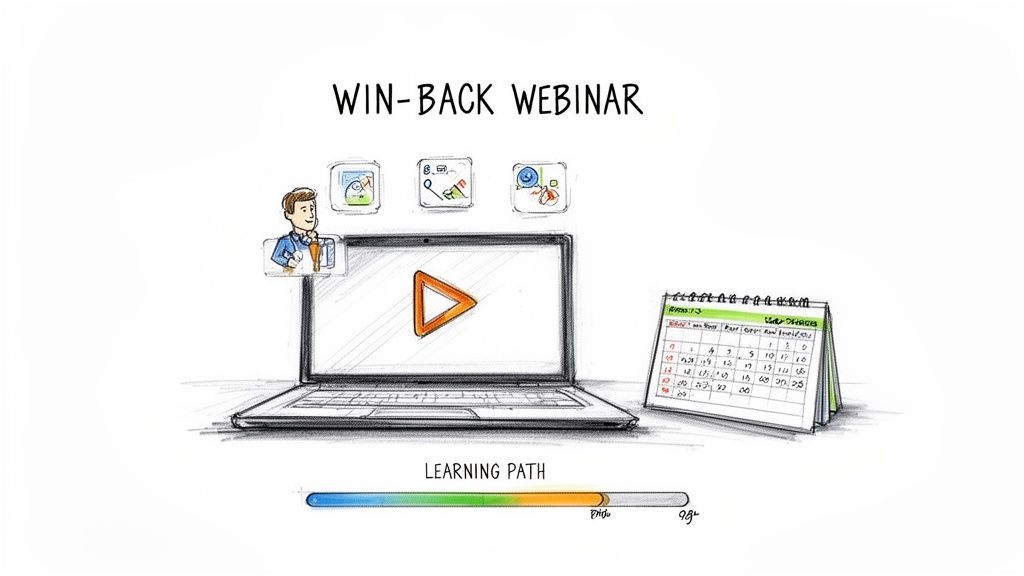
This approach is one of the most powerful customer win back strategies because it reframes the conversation from "please stay" to "let us show you what you're missing." By focusing on value realization, you treat churned or at-risk customers as an opportunity for re-onboarding. This educational approach helps them achieve the outcomes they originally signed up for, making retention a natural byproduct of their success.
How It Works in Practice
A SaaS company can use product analytics to identify a segment of churned users who never adopted a key feature, like automated reporting. The company can then launch a targeted email campaign inviting this specific cohort to an exclusive webinar titled "Mastering Automated Reports: Save 10 Hours a Week." This session wouldn't be a generic product tour but a deep-dive workshop focused on a specific, high-value outcome. Other examples include industry-specific use case workshops or annual product roadmap sessions exclusively for at-risk accounts.
Key Insight: Value-driven education is a sustainable retention lever. Unlike a one-time discount, the skills and workflows a customer learns in a webinar deliver ongoing value, creating a much stickier product experience.
Actionable Tips for Implementation
- Target by Adoption Gaps: Don't run generic webinars. Use product usage data to invite specific customer segments to sessions focused on the exact features they are underutilizing.
- Involve Product Experts: Boost credibility and provide deeper insights by having a product manager or engineer co-host the webinar. This shows a company-wide commitment to customer success.
- Incentivize Attendance: Offer a "Product Power User" certification or badge upon completion. This gamifies the learning process and gives attendees a tangible takeaway.
- Track Post-Webinar Lift: Measure success by tracking the subsequent product usage of attendees. Did they adopt the feature you showcased? Did their overall health score improve?
- Follow Up with No-Shows: Don't let a missed webinar be the end of the interaction. Send a recording and schedule a brief 1-on-1 call with a Customer Success Manager to personally walk them through the key takeaways.
6. Win-Back Offers with Service Upgrades (Not Just Discounts)
While a discount can be a tempting quick fix, it often devalues your product and attracts customers who will churn again once the discount expires. A more sustainable and value-driven approach is to offer service upgrades. This strategy addresses the root causes of churn by enhancing the customer’s experience and demonstrating a genuine commitment to their success, preserving your margins in the process. Instead of simply lowering the price, you increase the value they receive.
This method is one of the most effective customer win-back strategies because it rebuilds the relationship on a foundation of support and partnership. It shifts the conversation from price to outcomes, reinforcing the idea that your service is a crucial part of their success. It's about solving the underlying problems that led to disengagement, not just offering a temporary financial incentive.
How It Works in Practice
Imagine a B2B SaaS company identifies a churned customer who struggled with initial adoption. Instead of a 20% discount, they offer a "Re-Onboarding Success Package" at no extra cost. This package could include two hours of dedicated training with a product specialist, priority access to the support queue for 90 days, and a personalized quarterly business review to ensure they are meeting their goals. Another example is offering high-potential accounts that have churned due to a missing feature an invitation to your beta program or a seat on your customer advisory board, making them feel valued and heard.
Key Insight: Service-based offers solve the "why" behind churn. A discount addresses a symptom (cost), but a service upgrade addresses the disease (lack of value, poor support, or difficult implementation).
Actionable Tips for Implementation
- Quantify the Value: Clearly communicate the monetary value of the service upgrade. For example, "You'll receive a complimentary Success Package, which includes 3 hours of dedicated consulting, a $750 value."
- Assign a Named Contact: Personalize the offer by assigning a real, named person (e.g., "Sarah from our Success Team will be your dedicated point of contact") rather than a generic team. This builds accountability and a human connection.
- Set Clear Expectations: Define the scope, frequency, and response times for the service upgrade. This prevents scope creep and ensures the customer understands exactly what they are receiving.
- Bridge to Product Gaps: Use the service interaction as an opportunity to gather direct feedback on product gaps or usability issues. This intelligence is invaluable for long-term product improvement and retention.
7. Customer Data Analysis & Exit Interview Insights
One of the most valuable, yet often overlooked, customer win-back strategies involves learning from the customers you've already lost. A systematic approach to collecting and analyzing feedback from churned accounts provides a treasure trove of data that can prevent future churn and refine your outreach. By understanding the root causes of cancellation, you can create a powerful feedback loop that informs product development, messaging, and retention playbooks.
This strategy shifts the focus from guesswork to data-driven action. Instead of assuming why customers leave, you get direct, unfiltered reasons. This intelligence is crucial for building more effective, long-term retention efforts and ensuring your product roadmap aligns with customer needs.
How It Works in Practice
When a customer cancels, the process shouldn't end there. An automated email survey or a personal call from a Customer Success Manager can capture critical information. For example, by analyzing exit feedback, a SaaS company might discover that 40% of its churned enterprise accounts left due to a single missing integration. Another might find that its fastest-churning cohort consistently cited "poor ROI communication" during exit interviews, signaling a need to improve value demonstration during onboarding and quarterly business reviews.
Key Insight: Churned customers are your most honest critics. Their feedback, when systemically collected and analyzed, is a direct roadmap for improving both your product and your retention processes.
Actionable Tips for Implementation
- Combine Qualitative and Quantitative Data: Use a mix of collection methods like automated email surveys, personal phone calls, or in-app messages. Start with open-ended questions like, "What was the primary reason for your cancellation?" before diving into specifics.
- Incentivize Feedback: Boost response rates by offering a small incentive, such as a $25 gift card or platform credit, in exchange for a 15-minute feedback call. The insights gained are well worth the small investment.
- Tag and Categorize Reasons: Systematically tag churn reasons in your CRM (e.g., price sensitivity, competitor switch, feature gap). Cross-reference these tags with customer health scores to validate the accuracy of your predictive models.
- Share Learnings Across Departments: Create a monthly or quarterly churn report and share key findings with product, marketing, and sales teams. This alignment ensures the entire organization benefits from customer insights, leading to more robust customer win-back strategies.
8. Competitive Win-Back & Differentiation Messaging
When a customer churns to a competitor, the battle isn't over; it's just entered a new phase. A competitive win-back strategy focuses on re-engaging these customers by highlighting your unique value proposition and directly addressing the reasons they switched. It requires a deep understanding of your product's strengths, your competitors' weaknesses, and the specific pain points that led the customer to leave. This approach transforms a competitive loss into a long-term strategic advantage.
This strategy is highly targeted and relies on precise intelligence gathered from churn surveys and win/loss analysis. By understanding exactly which competitor a customer moved to and why, you can craft messaging that neutralizes their perceived advantages and reminds former users of the unique value only your solution provides. It’s a crucial component of any robust set of customer win back strategies, especially in crowded SaaS markets.
How It Works in Practice
Imagine a customer churns from your project management tool to Competitor X, citing a lower price point. Six months later, your competitive intelligence reveals that Competitor X lacks robust API access and advanced reporting features, issues that typically surface after initial adoption. Your win-back campaign can now target this specific segment with an offer like, "Come back and get our advanced reporting and API access add-ons for free for six months." This message directly addresses a known competitive gap and reinforces your superior functionality.
Key Insight: Winning back a customer from a competitor isn't about attacking the other company; it's about re-demonstrating your superior value and making the return journey frictionless.
Actionable Tips for Implementation
- Segment by Competitor: Use churn data to identify which competitors are winning the most customers. Create specific messaging and offers tailored to the known weaknesses of each one.
- Create Comparison Sheets: Develop internal, fact-based comparison documents that highlight your strengths, not competitor flaws. Focus on areas like better security, superior integrations, or more efficient workflows.
- Offer Seamless Migration: Reduce the friction of switching back by offering a "migration concierge" service. Provide dedicated resources to help import data from the competitor’s platform, making the decision to return much easier.
- Time Your Outreach: Follow up with customers 3 to 6 months after they switch. This is often when the honeymoon period with the new tool ends and its limitations become apparent, making them more receptive to your message.
9. Segmented Retention Strategies by Churn Reason & Customer Type
Recognizing that not all churn is created equal is the cornerstone of effective customer win-back strategies. A one-size-fits-all approach fails because the reason an enterprise account churns over a missing feature is fundamentally different from why a small business churns over price. This strategy involves tailoring win-back approaches based on identified churn reasons (e.g., price, product gaps, poor onboarding) and customer segments (e.g., SMB, enterprise, industry vertical).
By dissecting the "why" behind churn, you can craft highly relevant and resonant outreach that addresses the customer's specific pain point. This personalized approach dramatically increases the likelihood of reactivation by showing you've listened to their feedback and are offering a genuine solution, not just a generic discount. Understanding these patterns is easier when you group customers into meaningful groups, which is a core principle you can explore further by learning about what is cohort analysis and its applications.
How It Works in Practice
Imagine a SaaS company identifies two primary churn drivers. For price-sensitive SMBs, the win-back playbook might offer a plan downgrade combined with a temporary three-month discount. In contrast, for an enterprise account that left due to a missing feature, the playbook would involve a call from a product manager to discuss their roadmap and offer beta access to the upcoming feature. Different problems require completely different solutions and messaging.
Key Insight: The most successful win-back campaigns don't just offer a discount; they offer a solution. Segmenting by churn reason allows you to diagnose the core issue and prescribe the right fix.
Actionable Tips for Implementation
- Start with 2-3 Core Playbooks: Don't overcomplicate it. Begin by creating distinct win-back playbooks for your most common churn reasons, such as price, competition, and low product engagement.
- Automate Playbook Routing: Use segmentation tools and health scores to automatically route churned customers to the correct win-back campaign. For example, a low health score could trigger the "re-onboarding" playbook.
- Track Outcomes Per Playbook: Measure the success rate (reactivation percentage) of each distinct playbook. This data will validate your assumptions and show which offers and messages are most effective for each segment.
- Share Learnings Across Teams: The insights from your win-back playbooks are invaluable. Share success rates and customer feedback with product, marketing, and sales to address root causes of churn proactively.
10. Engagement Loops & Feature Incentive Programs
Sometimes, customers churn not because of a specific problem, but because they never fully integrated your product into their daily workflow. Engagement loops and feature incentive programs are powerful customer win-back strategies designed to build product habits. By rewarding consistent usage and celebrating progress, you can re-engage lapsed users and demonstrate the ongoing value they're missing. This approach transforms product interaction from a task into a rewarding, goal-oriented experience.
This strategy is particularly effective for customers who showed initial interest but whose usage declined over time. Instead of just asking them to come back, you're inviting them into an experience that actively guides them toward success and value realization. By making the path to product mastery clear and rewarding, you create a compelling reason for them to give your platform another chance.
How It Works in Practice
A project management tool might implement a "7-day streak" badge for users who log in and complete a task every day, triggering a celebratory email. Similarly, an analytics platform could unlock an advanced reporting feature for free for one month after a user runs five reports. These incentives create positive feedback loops that encourage deeper, more frequent product interaction, making the tool indispensable. These strategies can be supported by proactive engagement tools; for instance, understanding How AI Chatbots Increase Customer Retention in SaaS Companies can help guide users toward these rewarding milestones before they even think of leaving.
Key Insight: Habit formation is the ultimate form of customer retention. Incentivizing the small, consistent actions that lead to long-term value is more effective than one-off, large-scale promotions.
Actionable Tips for Implementation
- Tie Rewards to Value: Link incentives to actions that deliver real value, such as "Tracked $10,000 in revenue" or "Sent 5 marketing campaigns," not just vanity metrics like login counts.
- Celebrate Progress: Use in-app notifications and emails to celebrate user milestones and highlight the tangible business impact they've achieved with your tool.
- Offer Progressive Unlocks: Create a tiered system where users unlock more powerful features as their engagement deepens. This gamifies the user journey and provides a constant sense of forward momentum.
- Combine with Win-Back Offers: Target churned customers with a campaign that says, "Come back and instantly unlock our new [Premium Feature] by completing this 3-step challenge." This gives them a clear, immediate goal upon reactivation.
Top 10 Customer Win-Back Strategies Comparison
| Strategy | 🔄 Implementation Complexity | ⚡ Resource Requirements | 📊 Expected Outcomes | 💡 Ideal Use Cases | ⭐ Key Advantages |
|---|---|---|---|---|---|
| Predictive Churn Analysis & Early Intervention | Low–Moderate — quick setup but needs clean tracking | Moderate — analytics/ML + integration with billing | High — early detection; 85%+ accuracy; better MRR preservation | SaaS teams wanting proactive retention and automated prioritization | Early catch of churn; data-driven risk prioritization |
| Personalized Win-Back Campaigns (Email & In‑App) | Moderate — templates, triggers, and segmentation | Low–Moderate — marketing automation + usage data | Medium–High — +20–40% engagement lift; scalable | SMB/mid‑market CS & marketing teams using behavioral data | Scalable one‑to‑one personalization; complements predictive signals |
| Strategic Discount & Pricing Incentives | Low — billing/pricing changes are simple to deploy | Low — finance approval and policy admin | Short‑term — immediate cancellation prevention; margin erosion risk | Last‑resort retention; teams with margin headroom | Fast, direct impact on cancellations |
| Proactive Account Management & Personal Outreach | High — coordinated high‑touch processes and timing critical | High — CSM/sales time, CRM integration, training | High — 40–60%+ save rates for targeted accounts | Founder-led or mid‑market with dedicated CS teams | Uncovers root causes; rebuilds trust and reveals new use cases |
| Win‑Back Webinars & Product Education | Moderate — requires content creation and scheduling | Moderate — presenters, production, promotion | Medium — adoption and value realization uplift over time | Product‑led SaaS with complex features | Teaches value without discounting; reusable at scale |
| Win‑Back Offers with Service Upgrades (Not Just Discounts) | Moderate — define and deliver upgraded services | Moderate–High — dedicated support/CS/engineering capacity | Medium — preserves margins; slower-to-measure ROI | Mid‑market/high‑touch models with support capacity | Preserves unit economics; addresses value gaps via service |
| Customer Data Analysis & Exit Interview Insights | Moderate — set up surveys, coding, and cohort analysis | Moderate — survey tools, analysts, CRM/data warehouse | Medium — systemic insights that reduce future churn | Data-driven teams focused on product improvements | Identifies root causes; informs roadmap and messaging |
| Competitive Win‑Back & Differentiation Messaging | High — needs deep competitive intel and tailored collateral | Moderate–High — research + sales enablement materials | Medium — effective vs. specific competitors; timing‑dependent | Mature markets with clear competitive alternatives | Directly addresses competitor objections; supports migrations |
| Segmented Retention Strategies by Churn Reason & Customer Type | High — playbooks, routing, and governance required | High — data infra, playbook owners, multiple workflows | High — higher conversion and efficient resource allocation | SaaS $1M+ MRR with diverse customer base | Tailored interventions; prioritizes high‑impact accounts |
| Engagement Loops & Feature Incentive Programs | Moderate — product changes and UX work needed | Moderate–High — dev, design, analytics effort | Medium–High — long‑term habit formation reduces churn | Product‑led, high‑frequency usage products | Builds habits and compounding retention without discounts |
Turn Churn into a Growth Engine, Not a Dead End
Navigating the landscape of customer churn requires more than just a reactive, last-ditch effort. As we've explored, the most effective customer win back strategies are not isolated tactics but components of a cohesive, proactive retention engine. They represent a fundamental shift in perspective: from viewing churn as a failure to seeing it as an invaluable source of feedback and a powerful opportunity for growth. This is about building a system, not just launching a campaign.
The journey from a passive to an active retention model begins with data. By leveraging predictive churn analysis and deeply understanding exit interview insights, you move from guesswork to data-driven precision. This foundational knowledge allows you to segment churned customers effectively, identifying why they left and tailoring your outreach accordingly. A high-value enterprise account that churned due to a missing feature requires a different approach than a small business that struggled with onboarding.
From Strategy to System: Key Takeaways
Recapturing lost revenue is a significant win, but the true, long-term value lies in creating a resilient, customer-centric product and GTM motion. The strategies detailed throughout this article, from personalized messaging to strategic incentives and proactive account management, all point toward a central theme: value. A discount might bring a customer back temporarily, but demonstrating new value, educating them on underutilized features, or offering a service upgrade creates a stickier, more loyal relationship for the long haul.
Here are the essential pillars to build your win-back system upon:
- Start Before They Leave: The most successful win-back is the one you never have to launch. Use predictive analytics to identify at-risk accounts and intervene with proactive engagement, education, and support.
- Personalization is Non-Negotiable: Generic "we miss you" emails have a low ceiling for success. Segment your churned users by their value, tenure, and reason for leaving. Use this context to craft highly relevant offers and messaging that address their specific pain points.
- Combine Automation with a Human Touch: Automated email sequences are crucial for scalability, but high-value accounts deserve a personal touch. Equip your Customer Success and Revenue teams with clear playbooks for direct outreach, ensuring no significant MRR is left on the table.
- Measure, Iterate, and Optimize: Your first win-back campaign won't be your best. Continuously track key metrics like Reactivation Rate, Post-Reactivation Stickiness, and the ROI of your offers. Use these insights to refine your approach and improve performance over time.
Your Action Plan for Winning Back Customers
Transforming these concepts into action is the final, critical step. Don't let this knowledge remain theoretical. Instead, commit to a structured implementation plan. Start by identifying your single biggest churn driver from the past quarter. Is it poor onboarding? A key competitor? A pricing issue?
Once identified, choose one or two of the customer win back strategies from this article that directly address that root cause. Build a pilot program around it. For instance, if competitors are the issue, craft a competitive win-back campaign focusing on your key differentiators. If it's a value perception problem, launch a win-back webinar showcasing a powerful new feature they never got to use. By focusing your initial efforts, you can achieve a quick win, build momentum, and prove the ROI of a dedicated retention focus. This is how you turn churn from a business-draining metric into a sustainable growth engine.
Ready to turn these strategies into an automated, revenue-recovering system? LowChurn connects directly to your Stripe account to provide the predictive churn signals, segmentation tools, and one-click win-back playbooks you need to act decisively. Stop guessing who will churn and start proactively retaining and winning back your most valuable customers today at LowChurn.