Customer onboarding isn't just a series of welcome emails and tooltips. It's the entire process that happens right after a customer commits to your product, guiding them from "What is this thing?" to "I can't live without this."
Think of it like being a good host. When a guest arrives, you don't just point to a room and walk away. You show them around, make sure they know where everything is, and help them feel comfortable. A shaky onboarding process does the opposite—it makes your new customer feel lost and alone, and they'll probably leave before they ever see what makes your product so great.
Why Your Onboarding Process Defines SaaS Success
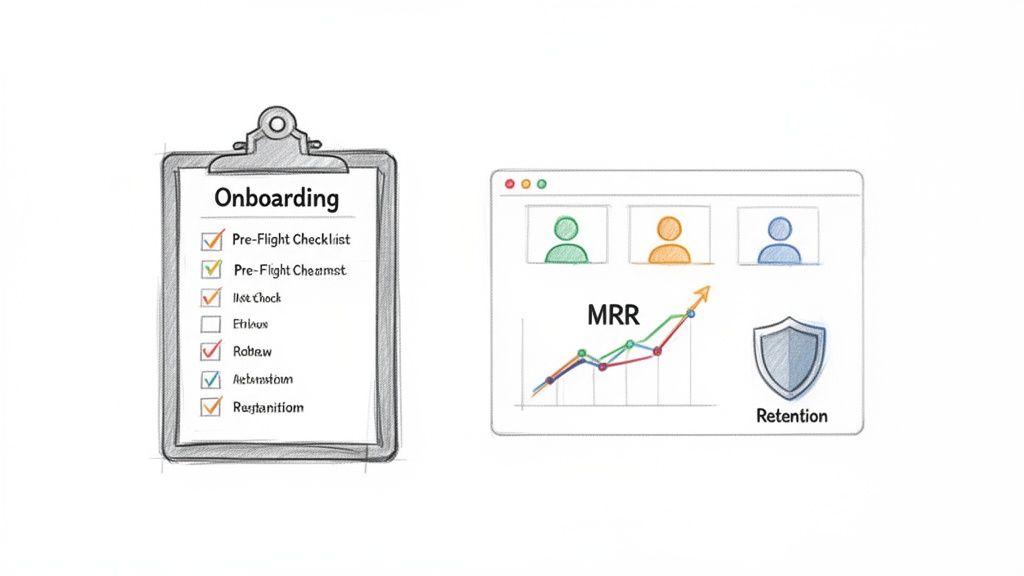
Those first few moments after a customer signs up are make-or-break. This initial experience shapes their entire perception of your brand, builds (or breaks) trust, and has a direct, measurable impact on whether they stick around.
Poor onboarding is a churn factory. It creates confusion and frustration, practically pushing new users out the door. A great process, on the other hand, makes customers feel smart, capable, and confident they made the right choice.
The numbers don't lie. A massive 63% of customers say that the quality of the onboarding experience is a major factor in their decision to subscribe. And for SaaS companies dealing with complex setups like payment systems, a difficult start is a death sentence—nearly three-quarters of users will jump ship to a competitor.
But when you get it right, the results are incredible. Apps with a fantastic onboarding flow enjoy 50% higher retention rates. It’s a crystal-clear connection: a strong start builds lasting customer loyalty.
The Foundation of Customer Loyalty and Growth
A solid onboarding process does so much more than just show people how to click buttons. It’s a core business function that drives real, sustainable growth.
- It shrinks the Time-to-Value (TTV): You want to get users to their first "aha!" moment as fast as humanly possible. This is when the product's value clicks, and they know they made a good investment.
- It slashes early churn: When you set customers up for success from day one, you head off the frustration that makes new users give up and cancel.
- It drives product adoption: A well-designed onboarding flow introduces key features in a natural, logical way, encouraging people to explore and use more of your product over time.
- It builds real relationships: A great process shows customers you’re invested in their success, not just their money. That’s how you build the trust that leads to loyalty and turns customers into fans.
In short, customer onboarding is your single best chance to prove your product's worth. It's how you turn a one-time sale into a long-term partnership.
The table below breaks down just how deeply onboarding quality affects the metrics that matter most to any SaaS business.
The Impact of Onboarding on Key SaaS Metrics
| Onboarding Quality | Impact on Customer Retention | Impact on Time-to-Value | Impact on Churn Rate |
|---|---|---|---|
| Excellent | Significantly higher long-term retention and loyalty. | Very fast. Customers achieve their first "aha!" moment quickly. | Dramatically lower, especially in the first 90 days. |
| Average | Moderate retention, but with a noticeable drop-off early on. | Slower. Users may struggle to find value without assistance. | Higher than ideal, driven by initial frustration. |
| Poor | Extremely low. Most new users churn within the first few months. | Painfully slow or never achieved. Value remains hidden. | Very high, creating a constant leak in revenue. |
As you can see, investing in a world-class onboarding experience isn't a "nice-to-have"—it's a direct investment in retention, revenue, and long-term growth.
From Welcome Email to Value Realization
The journey starts the instant a user signs up. A well-crafted welcome email, a frictionless first-login experience, and a few guided tutorials are non-negotiable. The goal is to build momentum, smoothly moving the user from setup to their first real win. Each small success builds their confidence and reinforces that they made the right call.
To get this right, you need a solid plan. Digging into a guide on essential user onboarding best practices can give you a clear roadmap for creating those powerful first impressions. When you nail this initial experience, you're not just helping users—you're actively protecting your monthly recurring revenue (MRR).
The Three Stages of a Modern Onboarding Flow
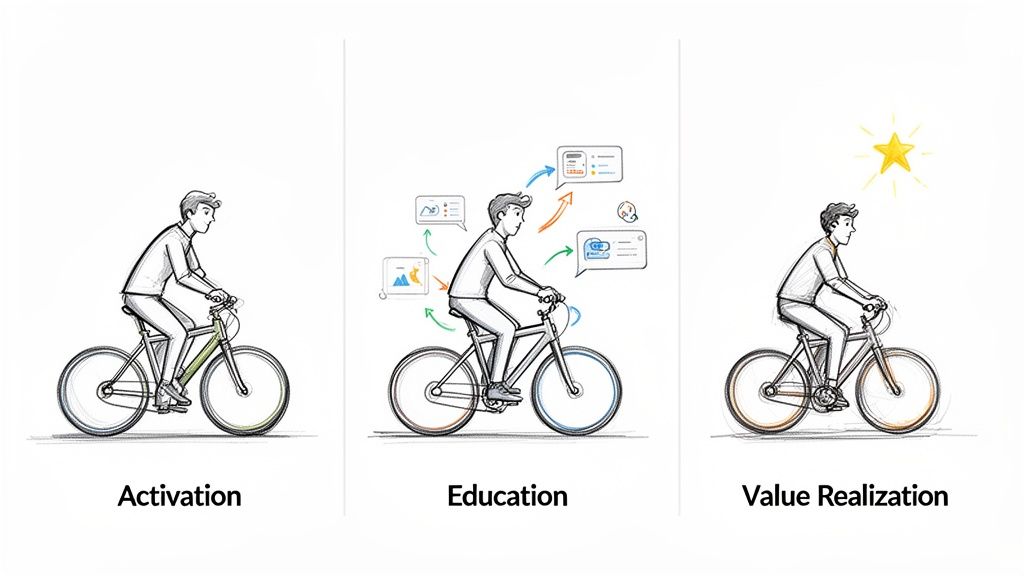
Great customer onboarding processes aren't a one-and-done event. They're a journey, carefully designed to turn a brand-new, slightly hesitant user into a confident product expert. When you think of this journey in distinct stages, a complex process becomes much simpler, broken down into manageable steps that build momentum and keep people hooked.
A good analogy is learning to ride a bike. You don't just hop on and expect to win a race. First, you get your balance. Then you figure out the pedals. Only then do you start steering with confidence. In the same way, we can break a modern onboarding flow into three key stages: Activation, Education, and Value Realization.
Stage 1: Activation
Activation is all about that first win. It's the moment a user performs one key action that makes your product's core promise feel real. The goal isn't to show them everything at once; it's to get them to do one thing that makes them think, "Okay, I see how this works."
For a project management tool, activation isn't sitting through a 10-minute video tour. It's creating your very first task. For a social media scheduler, it’s connecting an account and scheduling that first post. This initial taste of success is a huge deal—it builds instant confidence and reassures the user they made the right call signing up.
The activation stage is your chance to deliver that first "Aha!" moment. It's the spark that turns a curious visitor into an engaged user, validating their decision to give your product a try.
To figure out your activation milestone, just ask: What's the single most important action someone needs to take to start getting value? From there, aim all your initial in-app guides, checklists, and welcome emails at getting them to complete that one specific task.
Stage 2: Education
Once a user is activated, you can start the education stage. This is where you carefully reveal more features and capabilities, but—and this is important—always in the context of what they're trying to achieve. The biggest mistake you can make is dumping a huge, generic product tour on them that they'll forget in five minutes.
Instead, a well-designed education phase is contextual. It introduces features right when the user needs them. This usually works best with a mix of methods that cater to different learning styles:
- In-App Tooltips: These are small, targeted prompts that pop up as a user explores a new area, offering quick, just-in-time guidance.
- Drip Email Campaigns: A series of automated emails can introduce one new feature or best practice at a time, keeping things from feeling overwhelming.
- Video Tutorials: Short, snappy videos (think under two minutes) are perfect for walking through more complex workflows.
The key is to layer information gradually. Going back to our bike analogy, this is where the user learns to pedal, steer, and use the brakes—skills they only need after they've found their balance (activated). To really nail this phase, try building out a B2B customer journey map to visualize exactly what information users need and when.
Stage 3: Value Realization
Value Realization is the finish line—the ultimate goal of all customer onboarding processes. This is the point where the user achieves the exact outcome they signed up for in the first place. It’s where activation and education come together, turning theory into practice and solving a real problem for them.
For that project management tool user, this isn't just about creating a single task; it’s about marking a whole team project as "complete." For the social media scheduler user, it’s seeing their posts go live and actually drive engagement. It’s the payoff.
This moment is deeply personal and looks different depending on what each customer wants to accomplish. Figuring out what value realization means for your different user segments is essential. By tracking the right actions, you can see when users hit this milestone and help them transition from an "onboarding" mindset to one of long-term, daily use.
How to Measure Onboarding Success
You can't improve what you don't measure. When it comes to customer onboarding processes, just counting sign-ups is like judging a chef by how many ingredients they bought, not by the meal they cooked. True success is about figuring out if new users are actually finding value, adopting your product, and getting on the right track for the long haul.
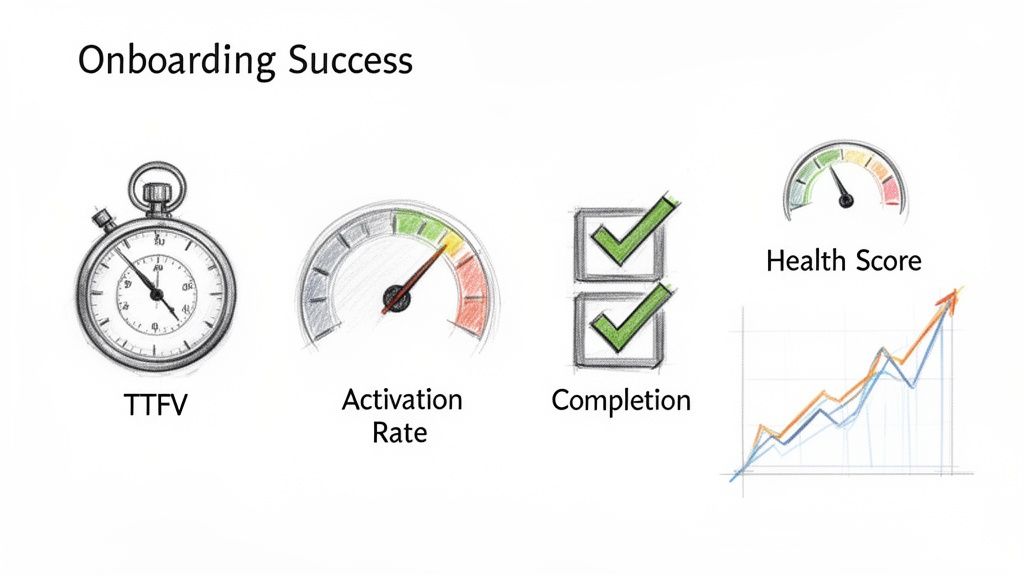
To get this right, you have to shift your focus from feel-good numbers to actionable key performance indicators (KPIs). These are the stats that tell the real story, exposing friction points in your process and shining a light on opportunities to make things better. Think of them as your GPS, guiding your strategy and proving your efforts are making a real difference.
Defining Your Core Onboarding Metrics
Measuring effectively starts with tracking the right things. Every SaaS product is a little different, but a handful of core metrics give you a powerful, universal look at how well your onboarding is actually working. These KPIs go beyond simple activity to measure real value delivery and user momentum.
Here are the essential metrics you should build your dashboard around:
- Time to First Value (TTFV): Honestly, this might be the single most important onboarding metric. It’s the stopwatch that measures how long it takes for a new customer to get their first "aha!" moment—that point where your product’s promise becomes real to them. A shorter TTFV is almost always better because it proves your product’s worth fast and builds a ton of user confidence right out of the gate.
- User Activation Rate: This KPI tracks the percentage of new users who hit a critical milestone that shows they’re truly engaged. For a project management tool, that might be creating their first project board. For an analytics platform, it could be installing a tracking snippet. Activation is the crucial bridge between just signing up and actually using the product.
- Feature Adoption Rate: This number tells you which key features new users are gravitating toward during their first few weeks. If a critical feature has a low adoption rate, it’s a red flag. It could point to a confusing UI, a gap in your tutorials, or a disconnect between what you think is important and what your customers really need.
- Onboarding Completion Rate: If you have a structured onboarding flow or a checklist, this one is simple but powerful. It tracks how many users actually finish all the essential steps. It gives you a clear, immediate signal of how engaging and effective your guided process is.
The Power of Customer Health Scores
While individual KPIs are vital, a customer health score pulls them all together into a single, dynamic rating. Think of it like a credit score for each customer’s engagement level. It combines various data points—like how often they log in, which features they use, and how many support tickets they've filed—into one easy-to-understand signal.
A customer health score is your early warning system. It moves you from a reactive to a proactive mindset, allowing you to identify at-risk users during the critical onboarding phase before they show obvious signs of churn.
For instance, a new user who logs in daily but hasn’t activated a key feature might get a "yellow" health score. This score can automatically trigger a targeted intervention, like an in-app message offering a quick tutorial on that specific feature or a personalized email from a customer success manager. This proactive approach is a total game-changer for retention. You can learn more about the components that make up these scores in our guide on how to measure customer engagement.
Leading vs. Lagging Indicators
It’s also really important to understand the difference between two types of metrics. Lagging indicators, like your churn rate or customer lifetime value, tell you what’s already happened. They're the final score of the game.
Leading indicators, on the other hand, are predictive. They're the in-game stats—the actions and behaviors during onboarding, like completing a checklist or adopting a "sticky" feature—that strongly correlate with long-term success. Focusing on these leading indicators is what allows you to influence the final score and stop churn before it even starts.
This proactive focus is becoming non-negotiable. Customer expectations are higher than ever. Research shows that over 90% of customers believe companies can drastically improve their onboarding. A significant 80% of B2B buyers now crave real-time interaction from day one. A clunky start can be fatal, with a shocking 55% of users admitting they’ve returned a product simply because they couldn't figure out how to use it. By tracking the right leading indicators, you can meet these high expectations and build a seamless, value-driven process from the very beginning.
Common Onboarding Failures and How to Fix Them
Even with the best intentions, a lot of customer onboarding processes just don't stick. They end up causing more frustration than excitement, leading straight to early churn and leaving money on the table. The first step to building an onboarding experience that actually keeps customers around is learning to spot these common mistakes. They might seem small, but they have a huge impact on a user's first impression.
Most of these pitfalls come from the same core misunderstanding: treating onboarding like a lecture instead of a conversation. When you build the process around your product's features instead of your customer's goals, you create friction at the exact moment you can't afford to. Let's dig into the most common offenders and, more importantly, how to fix them.
The One-Size-Fits-All Product Tour
We’ve all been there. You sign up for a new tool, and you're immediately forced into a long, generic product tour. It drags you through every single feature, whether you need it or not. This is probably the single most common onboarding mistake, and it's the digital equivalent of a real estate agent insisting on showing you the basement plumbing when all you asked to see was the kitchen.
Imagine a project manager who just needs to create a task and assign it to her team. Instead of getting straight to it, she’s stuck in a five-minute tutorial on generating annual financial reports—a feature she will likely never touch. That creates an instant gap between what she wants to do and what the product is making her do. The takeaway? This tool feels complicated and wasn't built for people like her.
The Fix: Start using role-based, segmented onboarding. It’s simpler than it sounds. Just ask new users a question or two during sign-up about their goals. Based on their answers, you can guide them directly to the features that will give them that first "aha!" moment. A developer probably wants to see the API docs, while a marketer is looking for campaign tracking. It’s all about personalization.
Front-Loading Too Much Information
Another classic mistake is drowning new users with a firehose of information on day one. We call this "cognitive overload." It happens when you try to teach them everything about your product in their very first session. They get hit with a flood of welcome emails, in-app pop-ups, video tutorials, and links to the knowledge base all at once.
The result is usually paralysis. When faced with too many choices and too much to learn, people often just give up. They close the tab, telling themselves they'll "figure it out later," but "later" rarely comes. This approach completely ignores that people learn gradually, with context and a bit of practice.
By trying to teach everything, you ensure the customer learns nothing. The goal of early onboarding isn't mastery; it's momentum. Focus on getting them one small, meaningful win.
The Fix: Drip your educational content out over time. A great way to do this is with a mix of in-app checklists and a series of timed emails that introduce new concepts when they’re actually relevant. A simple checklist showing "Your first 3 steps" is a world away from a massive library of help docs, and it’s infinitely more effective.
Impersonal and Robotic Communication
Finally, an onboarding process can fail simply because it feels cold and robotic. Automated emails with no personality, generic in-app messages, and no obvious way to reach a human for help can make a new customer feel like they’re just another number in your database. This is a massive missed opportunity to start building a real relationship.
Think about it: when a user gets stuck, they want to feel like a real person has their back. If their only option is to dig through a dense FAQ document, their frustration just builds, and their trust in your company starts to fade. This is especially true in the B2B SaaS world, where a staggering 70% of customers say that connected, human-driven processes are crucial.
To help you diagnose and solve these common issues in your own process, here's a quick cheat sheet.
Onboarding Pitfall vs Proactive Solution
This table breaks down the most common mistakes side-by-side with practical, effective solutions. Use it to spot weaknesses in your own onboarding flow and start turning at-risk users into happy, long-term customers.
| Common Onboarding Failure | Why It Causes Churn | Proactive Solution |
|---|---|---|
| Generic Product Tours | Ignores individual user goals, making the product feel irrelevant or overly complicated. | Use simple sign-up questions to segment users and trigger personalized onboarding paths. |
| Information Overload | Creates cognitive friction and decision paralysis, causing users to abandon the process. | Introduce features contextually with checklists and drip campaigns to create momentum. |
| Impersonal Communication | Fails to build trust and makes users feel unsupported when they encounter problems. | Combine automation with proactive human touchpoints, like a personal welcome from a CSM. |
By being mindful of these pitfalls, you can shift from a feature-dump to a value-driven onboarding experience—one that welcomes users, helps them achieve their goals, and sets the stage for a lasting customer relationship.
Using Churn Prediction to Improve Onboarding
Let’s be honest, most customer onboarding processes have a huge blind spot. We run new users through our checklists and tutorials, cross our fingers, and then scramble to react when someone sends a frustrated email or just stops logging in. By that point, the damage is already done. The account is likely a lost cause.
But what if you could stop being reactive and start being proactive? That’s exactly what modern SaaS companies are doing by using churn prediction. Think of it as an early-warning system that spots the subtle signs of trouble during those critical first few weeks. It’s where data science gives your customer success team superpowers.
How Churn Prediction Works During Onboarding
At its heart, churn prediction is all about pattern recognition. An AI model sifts through mountains of data to figure out what your successful, most engaged users do—and, just as importantly, what at-risk users don't do. We’re not just talking about tracking logins; this is about understanding the small, meaningful user behaviors right from the moment they sign up.
These systems connect product usage data (what users are clicking, creating, and ignoring) with their subscription information to paint a real-time picture of each new customer's health. For instance, the model might learn that users who don't invite a teammate within the first 48 hours are 75% more likely to churn. Or maybe it discovers that failing to set up a key integration by day seven is a massive red flag.
By constantly analyzing these behavioral clues, churn prediction tools can assign a dynamic "health score" to every new user. This score isn't a one-and-done thing; it updates in real time, giving your team an instant, data-backed view of who’s crushing it and who’s falling behind.
This completely changes the game for your customer success team. They can finally move from guesswork to precision, focusing their limited time and energy on the accounts that need help right now—when an intervention can actually make a difference. To see how this works under the hood, check out our guide on building a churn prediction model.
Turning Early Warnings into Actionable Interventions
Spotting a user who's struggling is one thing. Doing something about it is another. The real magic happens when these tools trigger smart, timely interventions that steer users back toward success. When a user's health score dips, it’s a signal to act immediately.
This simple flowchart shows how it works, moving from flagging a failure to deploying a proactive solution.
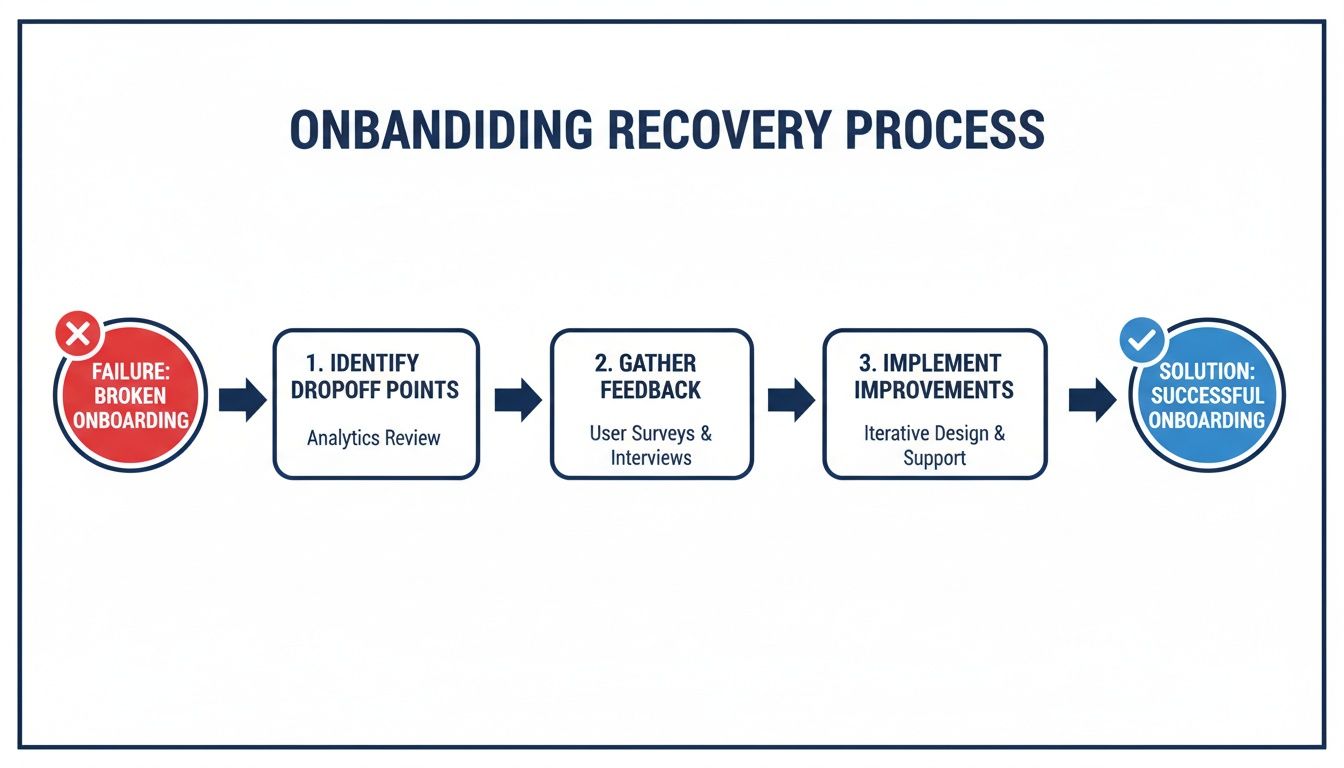
As you can see, a predictive system automatically flags when something goes wrong in onboarding and points your team to the right playbook to fix it. It turns a negative signal into a chance to create a positive outcome.
These interventions can be hands-off or hands-on, depending on the situation and the account's value:
- Automated Nudges: For smaller issues, the system can fire off a personalized in-app message or an email with a super-relevant resource. For example, if a user hasn’t created their first project, they might get an email with a link to a 90-second video showing them exactly how.
- High-Touch Outreach: For a high-value account showing major signs of disengagement, the platform can create a task straight in a CSM’s workflow. This is their cue to pick up the phone or send a personal video message offering one-on-one help.
Prioritizing Your Onboarding Efforts
When you're growing fast, it’s just not possible for your customer success managers to give every single new user white-glove service. A churn prediction dashboard solves this by creating a constantly updated, prioritized list of at-risk accounts. It ensures your team is always focused where they can have the biggest impact.
By putting churn prediction at the center of your customer onboarding processes, you transform it from a rigid, one-size-fits-all checklist into a dynamic, responsive system. It’s all about meeting customers where they are, offering the right help at the right time, and using data to give every new user the best possible shot at success. This isn't just about cutting churn—it's about building stronger, healthier customer relationships from day one.
Your Actionable Onboarding Process Checklist
Alright, let's turn all this theory into something you can actually use. Think of this as your practical, step-by-step checklist for taking your onboarding process from "just okay" to a powerful tool that keeps customers around.
You can use this to give your current flow a quick audit and spot the low-hanging fruit for improvement. The goal isn’t to cover every single possibility, but to give you a clear roadmap. Every point here is a lever you can pull to cut down on churn, get users to value faster, and start building a solid relationship from day one.
Define Your Milestones
First things first, you need a map. Before you can guide your users, you have to know where they need to go. Laying out the essential steps from sign-up to success is the foundation of any great onboarding experience.
- Pinpoint Your "Aha!" Moment: What’s the one action a new user takes that makes them truly get your product's value? That's your north star, the main goal of activation.
- Set Up Key Checkpoints: Break the journey down into 3-5 critical milestones. This could be anything from inviting a teammate or setting up a key integration to finishing their profile.
- Segment Your Users: An admin is going to have different goals than a day-to-day user, right? Create different paths for each role to make sure the guidance they get is actually relevant to them.
Personalize Your Communication
Now, it’s time to ditch the generic, one-size-fits-all welcome emails. Customers can spot those a mile away. When your communication is personal and timely, it shows you’re paying attention and are genuinely invested in their success.
An effective onboarding process feels less like a product tour and more like a guided conversation. It anticipates user needs and offers the right help at precisely the right moment, building trust from day one.
A great place to start is by setting up automated emails and in-app messages that trigger based on what a user does (or doesn't do), not just on a rigid timeline. If you're looking for more ideas on how to craft an exceptional customer journey, this guide on 10 Client Onboarding Best Practices is a fantastic resource.
Set Up Your Early Warning System
Finally, you can't fix problems you can't see. You need a system that flags new users who are struggling before they get frustrated and churn.
- Track the Right Signals: Keep a close eye on leading indicators like how often users log in, which features they’re adopting, and how many are completing your key onboarding milestones.
- Create Customer Health Scores: Combine these metrics into a simple health score (think: Red, Yellow, Green). This gives you a quick, at-a-glance way to see who needs help.
- Build Your Intervention Playbooks: Don't just identify risk; have a plan for it. A "yellow" account might get an automated email with a helpful guide, while a "red" account should probably trigger an alert for your customer success team to reach out personally.
Your Onboarding Questions, Answered
Even with the best playbook, you're bound to run into specific questions as you iron out your customer onboarding process. Let's tackle some of the most common ones I hear from SaaS teams. This isn't just theory—these are practical, straight-to-the-point answers to help you fine-tune your strategy right away.
Think of this as your quick-reference guide. It’s designed to clear up confusion and give you the confidence to make meaningful changes.
What Are the Three Stages of Customer Onboarding?
It helps to think of onboarding not as a single event, but as a journey with three key phases. Each one has a different job to do in getting a new user from sign-up to a loyal, happy customer.
- Stage 1: Activation. This is all about that initial "Aha!" moment. Your only goal here is to guide the user to experience your product's core value as fast as humanly possible. What's the one thing they need to do to get it? Focus on that.
- Stage 2: Education. Okay, they've seen the magic. Now it's time to show them what else your product can do. This stage is where you introduce secondary features and different use cases that make your tool stickier and more valuable in their daily workflow.
- Stage 3: Relationship Building. At this point, the user is moving from "learning mode" to "doing mode." Your focus shifts from teaching to strengthening the relationship. It's about gathering feedback, making sure they're still hitting their goals, and cementing your product as an indispensable part of their toolkit.
How Do You Measure Onboarding Success?
If you're only looking at sign-ups, you're missing the whole story. Success in onboarding is about whether people are actually finding value and sticking around. You need to measure what matters.
The best way to gauge success is to blend hard data with human feedback. Look at what users do and listen to what they say. Together, they paint the full picture.
Here are the metrics that truly count:
- Time to First Value (TTFV): How long does it take a brand-new customer to get that first win? Shorter is always better. A low TTFV is a huge sign that your onboarding is working.
- User Activation Rate: What percentage of new users complete that key first action? Whether it’s creating a project or sending an invoice, this metric tells you if people are getting over that initial hump.
- Feature Adoption Rate: Are new users exploring the key features you guide them toward? This shows you if your in-app tours and tutorials are actually landing.
- Customer Health Score: This is a fantastic way to get an at-a-glance view. It combines things like login frequency, feature usage, and support tickets into a single score that flags who's engaged and who might be slipping away.
Who Owns the Onboarding Process?
This is a classic question, and the answer is simple: onboarding is a team sport. While one person might quarterback the effort, it’s never a one-person show. A truly great experience is a group effort.
- Customer Success usually leads the charge, acting as the customer's main guide and advocate.
- Sales is responsible for a clean handoff. They have all the context on why the customer signed up in the first place.
- Product and Education teams are the ones building the in-app guides, help docs, and video tutorials that do the heavy lifting.
- Support is on the front lines, squashing bugs and answering those crucial early questions that can make or break the experience.
When everyone is on the same page, the customer feels like they're on a smooth, guided journey. That's how you build trust from day one.
Ready to stop guessing which customers are at risk during onboarding? LowChurn uses AI to analyze product usage and subscription data, predicting churn 7-30 days in advance. Get the early-warning system you need to intervene at the perfect moment and protect your MRR.