So, what exactly is a customer success strategy?
Think of it less as a department and more as a company-wide game plan. It’s a deliberate, proactive approach to making sure your customers get exactly what they came for when they signed up for your product. Instead of just waiting for problems to pop up, you're actively guiding them toward success, anticipating their needs, and proving your value every single day.
When your customers win, you win. That’s the core philosophy, and it’s what drives retention, expansion, and long-term growth.
Why a Customer Success Strategy is Non-Negotiable for SaaS
In the SaaS world, customers can walk away with a few clicks. Simply waiting around for a support ticket to land in your inbox is a surefire way to watch your churn rate climb. A proactive customer success strategy completely flips that dynamic on its head. It turns a simple transactional relationship into a real partnership.
This isn’t just a new name for customer support. Traditional support is reactive—it’s built to solve problems after they happen. Customer success is all about getting ahead of those problems, sometimes before the customer even knows they exist. It means you understand their business goals so well that you can steer them toward value at every single turn.
The Shift from Reactive Support to Proactive Partnership
Let's break down the fundamental difference between the old way and the new way.
| Aspect | Traditional Customer Support (Reactive) | Customer Success Strategy (Proactive) |
|---|---|---|
| Approach | Waits for customers to report an issue. | Actively monitors and engages to prevent issues. |
| Goal | Resolve tickets and close cases quickly. | Ensure customers achieve their desired business outcomes. |
| Focus | Technical problems and product features. | Business value, adoption, and customer goals. |
| Timeline | Short-term, transactional interactions. | Long-term relationship management. |
| Metrics | Ticket resolution time, response rate. | Churn rate, LTV, Net Revenue Retention (NRR), health score. |
| Impact | Cost center focused on efficiency. | Revenue driver focused on growth and retention. |
As you can see, we're talking about two completely different mindsets. One is about damage control; the other is about building value from day one.
When your company's success is directly tied to your customers' success, the business impact is massive. The old adage holds true: research shows that boosting customer retention by just 5% can increase profits anywhere from 25% to 95%. That's where a well-executed customer success plan truly earns its keep.
A structured strategy empowers you to:
- Slash Churn: You can spot the warning signs in at-risk accounts and step in with the right help before they even think about canceling.
- Drive More Revenue: Happy customers don't just stay—they grow. They're far more likely to upgrade, add seats, and expand their usage, directly boosting your Net Revenue Retention (NRR).
- Maximize Lifetime Value (LTV): By building real, long-term relationships, you transform customers from simple subscribers into partners with a much higher LTV.
- Create Raving Fans: Customers who consistently hit their goals with your product become your most powerful marketing channel, bringing in referrals and glowing reviews.
A customer success strategy isn’t just about keeping people happy—it’s a powerful growth engine. It’s built on the simple truth that the best source of new revenue is the customer base you already have.
The Business Case for Proactive Engagement
For any SaaS business, but especially one connected to a platform like Stripe, the numbers don't lie. Your entire model depends on stable monthly recurring revenue (MRR) and keeping churn low. Without a concrete plan to get customers onboarded, engaged, and seeing a return on their investment, you're just gambling with your revenue.
A formal customer success strategy gives you the playbook to manage the entire customer lifecycle, from that first "aha!" moment during onboarding to finding the perfect opportunity for an upsell. It’s the difference between crossing your fingers hoping customers stay, and giving them every possible reason to.
The Core Pillars of Your Customer Success Strategy
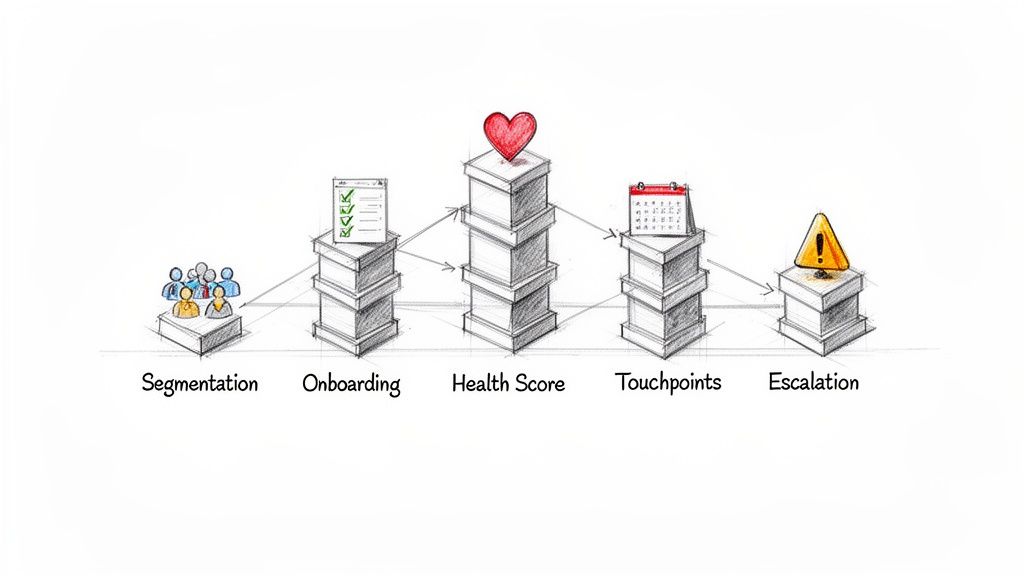
A truly effective customer success strategy isn’t just one brilliant move; it's a complete system where every part supports the others. Think of it like building a house. Each pillar provides critical support, and if one is weak, the whole structure feels shaky. These are the foundational components that give you a proactive grip on the entire customer lifecycle.
By deliberately building out each of these pillars, you create a repeatable, scalable engine that not only guides customers toward their goals but also flags risks before they become problems. Let's break down the essential building blocks you need to get right.
Foundational Customer Segmentation
Your customers aren't a monolith, so why treat them like one? Customer segmentation is the first step away from a one-size-fits-all approach. It’s the difference between shouting into a crowd and having a meaningful, one-on-one conversation that actually lands.
Start by grouping customers based on their shared DNA. For most SaaS companies, this means looking at:
- Subscription Tier or MRR: This is the most straightforward way to align your resources with your highest-value accounts.
- Company Size or Industry: A scrappy startup has wildly different needs and goals than a Fortune 500 enterprise.
- Product Usage Patterns: You can identify your power users, those who are barely scratching the surface, and everyone in between.
Once you have these groups, you can apply the right engagement model. Your top-tier enterprise clients might get a dedicated Customer Success Manager (CSM) and quarterly business reviews—a high-touch model. On the other end, smaller accounts might get everything they need from automated email sequences and community webinars—a tech-touch model.
Segmentation isn’t about ignoring anyone; it’s about giving the right level of attention to the right customer at the right time. It’s how you scale your impact without burning out your team.
Structured and Goal-Oriented Onboarding
If there’s one moment you absolutely have to nail, it’s onboarding. A fantastic onboarding experience can slash churn by up to 67% because it sets the tone for the entire relationship. This isn't just a product tour; it's a guided mission to get your customer to their first "aha!" moment as fast as humanly possible.
A rock-solid onboarding process should be:
- Goal-Oriented: Before you show a single feature, you need to know what they came here to do. Define their key success milestones from the get-go.
- Time-Bound: Create a clear 30- or 60-day plan with specific checkpoints. This keeps the momentum going and shows you’re a partner in their progress, not just a vendor.
- Role-Specific: The daily user needs different training than the admin who manages billing. Tailor the journey for each person involved.
The real prize here is achieving a short Time to First Value (TTFV)—that magical moment a customer gets a tangible, real-world benefit from your product. A fast TTFV builds immediate confidence and makes renewal a no-brainer.
Dynamic Customer Health Scoring
How do you spot the customers who are quietly struggling before they hit the cancel button? A customer health score is your early-warning system. It’s a smart metric that rolls up different data points into a single score, giving you a quick read on whether a customer is likely to renew, grow, or churn.
A good health score is more than just a login counter. It’s a blend of key indicators:
- Product Adoption: Are they using the "sticky" features that correlate with long-term value?
- Engagement Depth: How many users are active? Are they exploring different parts of the platform?
- Support Tickets: A sudden flood of tickets or a series of bad satisfaction ratings is a huge red flag.
- Relationship Signals: Are they showing up for webinars? Opening your newsletters? Responding to your CSM’s emails?
This score isn't a "set it and forget it" number. It should change in real-time with customer behavior. When a score dips, it can automatically trigger an alert or a playbook, empowering your team to step in before it's too late.
Proactive Touchpoints and Escalation Paths
Finally, you need a clear game plan for communication and intervention. Proactive touchpoints are scheduled interactions designed to provide value, not just to ask, "How's it going?" This could be sharing a new best practice, running a business review to prove their ROI, or giving them a heads-up about a feature they’ll love.
Just as crucial are your escalation pathways. When a health score tanks or a five-alarm fire breaks out in support, your team needs a predefined playbook. Who gets called in? What are the steps? A clear process ensures a fast, coordinated response that solves the problem and, more importantly, reinforces the customer’s trust in you as a partner.
Key Metrics That Measure Real Impact
A strong customer success strategy feels good, but it has to do more than that—it needs to deliver results you can actually measure. This is where we move from good intentions to hard numbers, proving the value of your efforts and building a team that runs on data.
Think of these key performance indicators (KPIs) as the vital signs of your customer relationships. They tell you exactly where your strategy is winning and where it needs a little help. Without them, you’re flying blind. You might have happy customers, but you have no idea if that happiness is turning into retention, growth, or long-term profit.
Let's break down the essential metrics that connect what your customer success team does every day directly to the company's bottom line.
Monthly Recurring Revenue Churn Rate
This is the big one. Your MRR Churn Rate is the most direct measure of how many customers are slipping through your fingers. It shows you the percentage of monthly revenue you lose when customers cancel or downgrade their subscriptions. For any SaaS business, this is arguably the most critical number to watch.
To calculate it, just divide the revenue you lost from churned customers in a given month by the total MRR you had at the start of that month. A high churn rate is like a leak in a bucket; no matter how much new business you pour in, you’ll always struggle to fill it up. A great customer success strategy directly attacks this number by spotting at-risk accounts and stepping in before they decide to leave.
For a venture-backed SaaS company, a "good" monthly churn rate is typically below 1%, which adds up to about 11.4% over a year. If you're selling to small businesses, the number might be a bit higher, but the goal is always the same: get it as low as you can.
Net Promoter Score
While churn tells you what your customers do, Net Promoter Score (NPS) tells you how they feel. It’s a beautifully simple metric that gets right to the heart of customer loyalty by asking one powerful question: "On a scale of 0-10, how likely are you to recommend our product to a friend or colleague?"
Based on their score, customers fall into one of three camps:
- Promoters (9-10): These are your champions. They love what you do and will spread the word for you.
- Passives (7-8): They're satisfied, but not wowed. They could easily be tempted by a competitor.
- Detractors (0-6): These are unhappy customers who might not only leave but also tell others about their bad experience.
You get your final NPS score by subtracting the percentage of Detractors from the percentage of Promoters. The number itself is a useful benchmark, but the real gold is in the comments they leave. Understanding why a detractor is unhappy gives your team a clear, actionable roadmap for making your product and service better. To get an even fuller picture, you can learn more about how to measure customer engagement in our comprehensive guide.
Customer Lifetime Value
How much is a customer really worth over the long haul? That's what Customer Lifetime Value (LTV) tells you. It’s a projection of the total revenue you can expect to bring in from a single customer throughout their entire time with you.
When your LTV is climbing, it's a fantastic sign that your customer success strategy is working. A simple way to calculate it is to divide your Average Revenue Per Account (ARPA) by your customer churn rate. You can see how this works: as your CS team drives churn down, LTV naturally goes up. This metric is absolutely essential for making smart decisions, like figuring out how much you can afford to spend to acquire a new customer.
Expansion MRR
Finally, we have Expansion MRR—the holy grail of SaaS growth. This is the new monthly revenue you generate from the customers you already have, whether through upsells to a higher-tier plan, cross-sells of new products, or feature add-ons.
It's the ultimate proof that your customers aren't just sticking around; they're getting so much value that they're happy to spend more with you.
Unlike other metrics that focus on plugging leaks, Expansion MRR is all about growth. A sharp customer success team is the engine for this. They build deep relationships, truly understand what a customer is trying to achieve, and know the perfect moment to suggest an upgrade or a new feature that will help them get there.
When your Expansion MRR is higher than the revenue you lose to churn, you hit a magical milestone called net negative churn. That’s when your business can grow even if you don't sign up a single new customer. It’s a powerful place to be.
How to Implement Your First Customer Success Strategy
Building your first customer success strategy can feel like a massive undertaking, but it doesn't have to be. The trick is to break it down into a clear, step-by-step roadmap that lets you move from theory to execution without getting bogged down. This isn't about boiling the ocean; it's about building a practical framework you can actually follow.
Think of it like assembling a high-performance engine. Each component has a specific job, and when they all work together, you create a powerful system that drives retention and growth. Let's walk through the key steps to get a foundational customer success program off the ground.
Step 1: Define What Success Means to Your Customers
Before you can make customers successful, you have to know what "success" actually looks like from their side of the table. This is about more than just logging in and using features—it’s about the real-world business outcomes they hope to achieve. Why did they sign up in the first place?
The best way to find out is to ask. Start by interviewing a handful of your best customers. Get on a call and ask them pointed questions to uncover their true goals:
- What specific problem were you trying to solve with our product?
- What key result would make your subscription an undeniable win for your team?
- How does our tool fit into your daily workflow and bigger business objectives?
This exercise gives you the "why" behind their subscription. These customer-defined outcomes become your North Star, guiding every single interaction from that first onboarding call all the way to renewal.
Step 2: Segment Your Customer Base
Let's be real: not all customers need the same level of attention. Customer segmentation is the crucial step where you organize your accounts into logical groups so you can focus your resources where they’ll make the biggest impact. For a SaaS business running on Stripe, the easiest place to start is right in your subscription data.
Group your customers into simple tiers, like:
- High-Touch: Your top-tier enterprise accounts with the highest MRR. These folks get dedicated one-on-one attention.
- Mid-Touch: Growing accounts that need periodic check-ins and strategic guidance to stay on track.
- Tech-Touch: Smaller accounts that can be managed effectively with automated emails, webinars, and other one-to-many communications.
This simple act of segmentation prevents you from over-serving small accounts while accidentally under-serving your most valuable ones. It's the bedrock of a scalable and efficient customer success strategy.
Step 3: Map the Entire Customer Journey
Next, you need to zoom out and create a high-level map of the customer’s entire lifecycle with your company. A customer journey map is a visual representation of every key stage, from the moment they sign up to the day they become a raving fan. This map is gold because it helps you spot the critical moments where your team can add value and smooth out any friction.
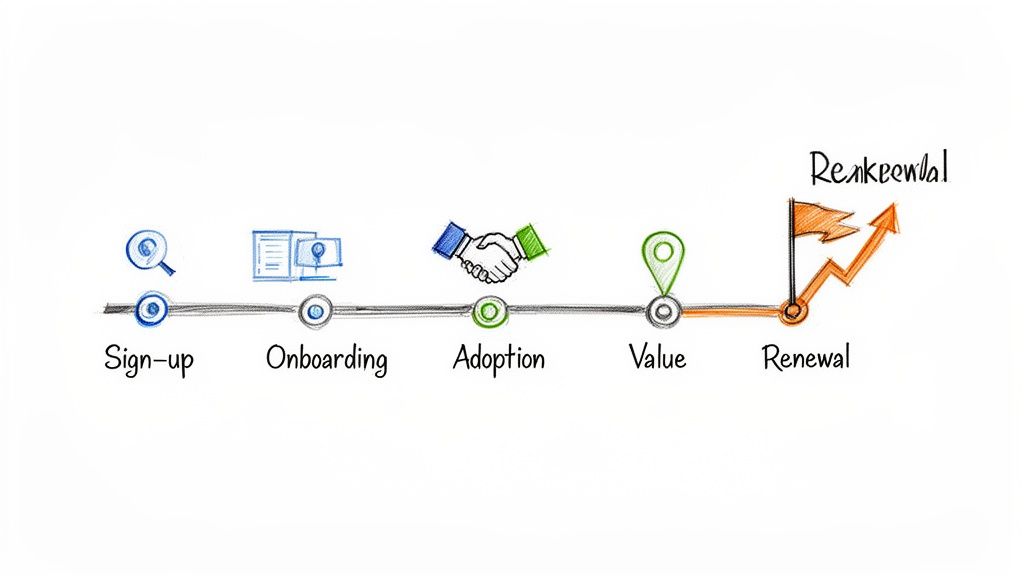
A typical SaaS journey breaks down into these stages:
- Onboarding: The initial setup, training, and "aha!" moment.
- Adoption: The point where they've fully integrated your product into their regular workflow.
- Value Realization: The moment they hit their first significant business outcome using your tool.
- Renewal: The decision point to continue their subscription for another term.
- Advocacy: When they become a vocal champion, referring new business and singing your praises.
For each stage, jot down the customer’s goals, potential roadblocks, and the proactive touchpoints your team should initiate. If you need help structuring these workflows, our customer success plan templates can be a really useful starting point.
Step 4: Choose Your Tech Stack and Build Your Health Score
With your strategy taking shape, it's time to pick the tools that will bring it to life. At a minimum, you’ll need a way to track customer interactions (like a CRM), monitor how they're using your product, and manage all your proactive communications.
A customer health score is your most important tool. Think of it as an early-warning system that pulls together different data points—like product engagement, recent support tickets, and subscription status—into a single, easy-to-understand metric.
Your first health score model doesn't need to be perfect. Start simple. Track a few key signals you can get from your Stripe and product data, such as login frequency, usage of "sticky" features, and any recent payment issues. This score will tell you, at a glance, which customers are thriving and which ones need your immediate attention.
This process flow shows how a well-implemented customer success strategy directly improves key SaaS metrics like MRR Churn, LTV, and Expansion MRR.
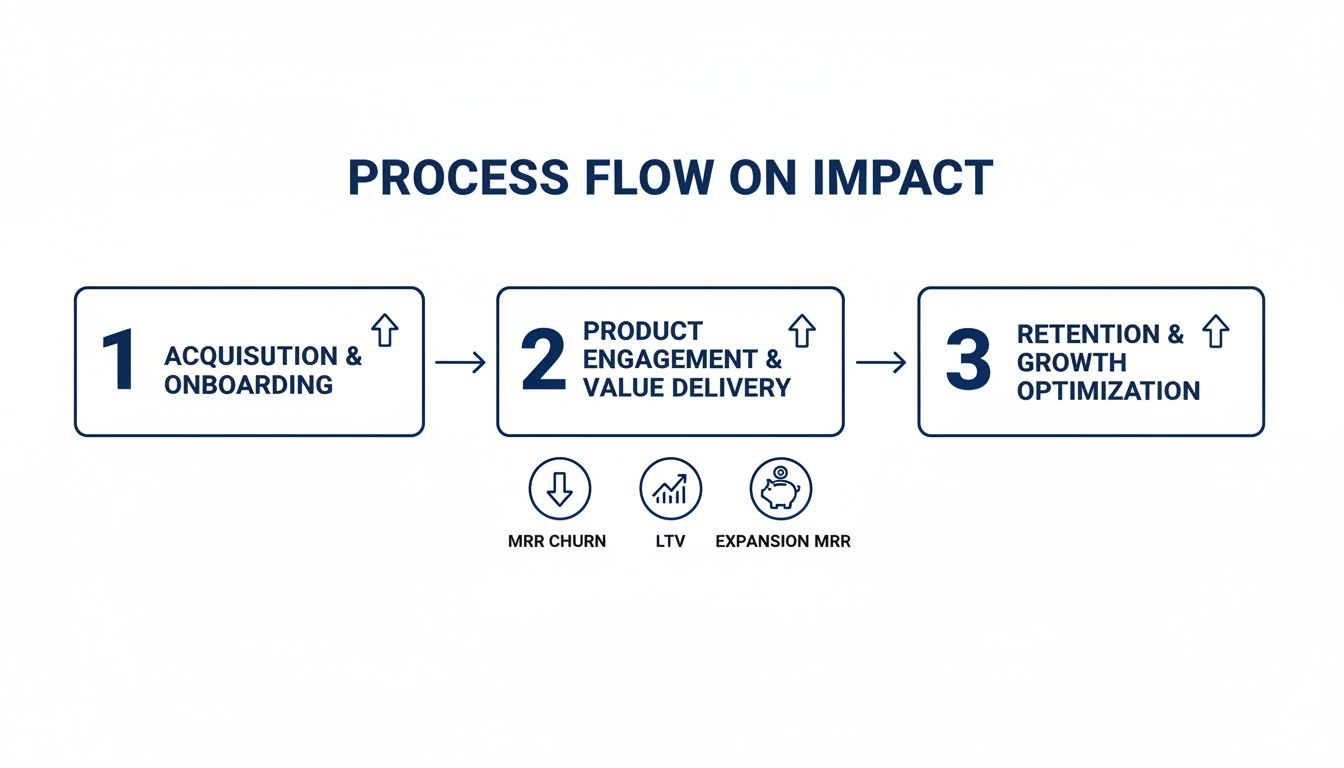
As you can see, as your strategy matures, you should see churn go down while customer lifetime value and expansion revenue start climbing.
As you build out the operational side of your customer success strategy, it's smart to consult a guide to the modern IT service desk to make sure your internal support systems are strong enough to handle escalations and technical questions effectively. Getting this foundational work right is what allows you to launch your first retention playbooks and start making a real impact.
Using AI for Predictive Churn and Smarter Workflows
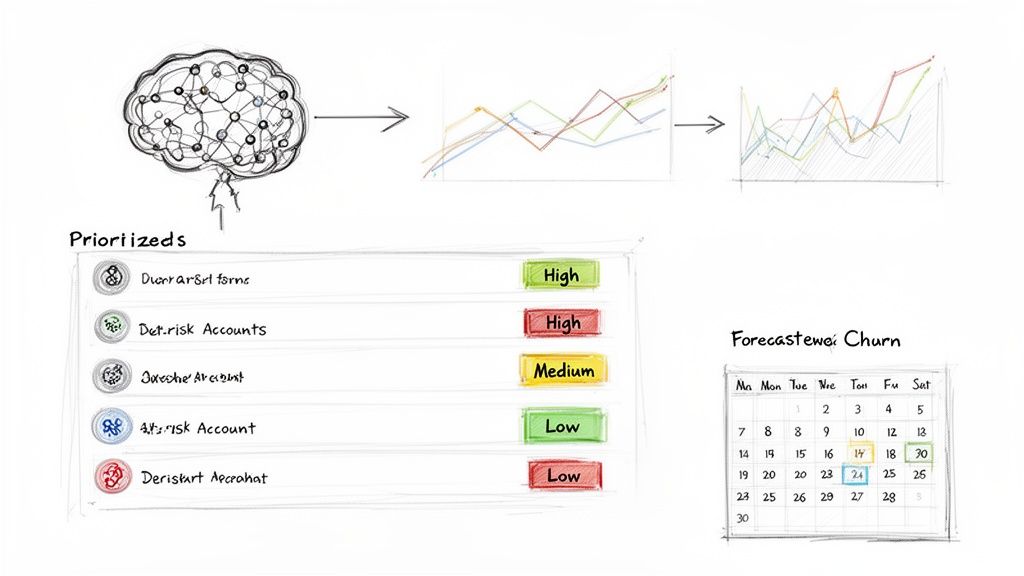
While customer health scores and manual playbooks are a great start, they're often based on lagging indicators—things your customers have already done. The real next step in building a modern customer success strategy is to stop looking in the rearview mirror and start looking ahead. This is where Artificial Intelligence (AI) completely changes the game, turning your team into a proactive, churn-fighting force.
Imagine knowing which customer is likely to cancel before they even think about sending a support ticket or ditching a key feature. That's exactly what AI-powered platforms do. They analyze thousands of subtle signals across product usage and subscription data to get ahead of the problem. So instead of just seeing a health score dip, you get a forecast telling you a specific customer has an 85% chance of churning in the next 30 days.
This isn't about replacing your team. It's about giving them superpowers. AI handles the heavy lifting of data crunching, freeing up your Customer Success Managers (CSMs) to do what they do best: build relationships and have strategic conversations, not spend their days buried in spreadsheets hunting for trends.
From Manual Analysis to Automated Insights
Traditionally, finding an at-risk account meant a CSM had to manually piece together clues from product usage, support history, and survey feedback. It's an intuitive process, but it's slow and simply doesn't scale.
AI flips that script. It connects directly to your data sources—like your Stripe account and product analytics—to build dynamic models of what your customers are actually doing. These models learn what "at-risk" behavior looks like for your product and your customers, making it far more accurate than a generic health score.
The practical benefits show up almost immediately:
- Prioritized Action Lists: Forget long, overwhelming lists of accounts with low health scores. Your team gets a daily, prioritized to-do list of the top customers at risk, ranked by churn probability and MRR impact.
- An Early Warning System: AI can flag potential churn weeks in advance, giving your team a critical window to step in with the right kind of outreach and support.
- Dynamic Health Scores: These aren't just simple red, yellow, or green lights. AI-driven scores adapt in real-time to subtle shifts in behavior, giving you a much more accurate, forward-looking view of account health.
AI transforms customer success from a practice of educated guessing into a data-driven science. It gives you the power to act on what a customer is going to do, not just what they've already done.
Protecting Privacy While Predicting Behavior
A common—and valid—concern with AI is data privacy, especially when you're dealing with sensitive subscription info. But leading platforms are built with privacy at their core. For instance, tools like LowChurn can deliver incredibly accurate predictions using just a read-only Stripe key, without ever touching sensitive financial data or Personally Identifiable Information (PII).
The system focuses purely on subscription metadata—things like plan changes, payment status, and usage signals. That’s all it needs to build an effective model. This approach keeps your customer data secure while giving you the predictive power you need. You can learn more about how this works by checking out our guide on predictive analytics for customer retention.
Making Your Workflows Smarter
Bringing AI into the mix also creates massive efficiency gains. It's not a coincidence that top-performing customer success teams using intelligent systems can handle way more accounts per CSM. In the fast-paced SaaS world, Gainsight has found that its customers can manage roughly 25% more accounts in commercial segments and an incredible 70% more in the high-volume SMB segment.
This proves that AI isn't about working harder; it’s about creating smarter, scalable workflows.
On top of that, integrating tools like Conversation Intelligence can uncover deeper insights from your customer calls and emails, helping to predict churn and make communication more efficient. By combining predictive churn alerts with automated playbooks, you create a seamless system that flags risk, suggests the right action, and empowers your team to save revenue with less manual effort.
Your Customer Success Strategy FAQ
Even the best roadmaps hit a few bumps. As you start putting a customer success strategy in place, you’ll naturally run into questions about resources, metrics, and how quickly you can actually expect to see a return. That's completely normal.
Let's tackle some of the most common questions I hear from founders and team leaders.
How Can a Small Team or Solo Founder Build a Customer Success Strategy?
This is the big one, especially for early-stage startups where everyone is already wearing ten hats. The answer isn't to hire a huge team; it's to be ruthlessly efficient and focus on scalable impact from day one.
You can punch way above your weight with a lean approach:
- Segment like a pro: You can't give everyone a white-glove experience, so don't even try. Use your Stripe data to find your top 10% of customers by MRR. They get your direct attention. Everyone else gets a fantastic, automated "tech-touch" experience.
- Automate your onboarding: Build a killer automated email sequence that walks new users straight to that first "aha!" moment. Pack it with links to help docs, short video tutorials, and pre-recorded webinars. This gives every single customer a consistent, helpful start without you lifting a finger.
- Keep your health score simple: Don't overcomplicate it. Start by tracking just one or two critical user actions. Are they logging in? Are they using that one sticky feature that correlates with long-term retention? This simple signal is more than enough to show you where to spend your limited time.
For a small team, the goal isn't to do everything. It's to do the right things with maximum efficiency. A solo founder with a smart, automated system can often get better results than a bigger, disorganized team trying to do too much by hand.
What Is the Real Difference Between a Customer Health Score and NPS?
This is a classic point of confusion. Both metrics seem to tell you if your customers are happy, but they’re measuring two completely different things. They answer very different questions.
A Customer Health Score is an objective, internal look at what your customers do. It’s all about their behavior inside your product—logins, feature adoption, support tickets. Think of it as a proactive early-warning system that helps you predict their likelihood to stick around or grow.
On the other hand, Net Promoter Score (NPS) is a subjective, external metric based on what your customers say. It’s a gut check on their loyalty and feelings about your brand, captured by asking how likely they are to recommend you. It's an incredible tool for understanding brand perception.
Here's a quick way to think about it:
| Aspect | Customer Health Score | Net Promoter Score (NPS) |
|---|---|---|
| What It Measures | Customer behavior and product usage. | Customer sentiment and brand loyalty. |
| Data Source | Internal product and subscription data. | Direct customer feedback from surveys. |
| Primary Use | Predict churn risk and spot growth opportunities. | Gauge overall satisfaction and find brand advocates. |
| Nature | Objective and predictive. | Subjective and reflective. |
Here's an analogy: a health score tells you if someone is actually eating their vegetables and going to the gym (the actions that lead to long-term health). NPS tells you if they feel healthy and would recommend their doctor to a friend. You really need both to see the full picture.
How Soon Can I Realistically Expect to See Results?
I know you want to see that churn rate plummet overnight, but building a solid customer success motion is more like planting a tree than flipping a switch. It’s a long-term investment. The good news is that you’ll start seeing positive signs much, much sooner.
Results tend to show up in waves:
- First 30-60 Days (The Quick Wins): Your fastest impact will be on onboarding. You should see a clear lift in new user activation rates and a shorter Time to First Value (TTFV). You might also get a nice bump in positive CSAT scores from having more structured, helpful first interactions.
- First 90-180 Days (The Behavior Shift): Now, your proactive work starts to pay dividends. You should see customer health scores begin to climb and notice higher adoption for your key features. This is the first concrete proof that you’re changing customer behavior for the better.
- 6-12 Months (The Bottom-Line Impact): This is when the big-picture metrics finally start to move. Things like MRR churn and Net Revenue Retention (NRR) are lagging indicators. After a couple of solid quarters, you should see a real, sustained drop in churn and a healthier expansion revenue number as all your good work begins to compound.
Patience is the name of the game. A customer success strategy builds momentum over time. So, celebrate those early wins with your team, but always keep your eyes on the long-term prize: building a retention engine that lasts.
Ready to stop guessing which customers are at risk? LowChurn uses AI to predict churn with over 85% accuracy, giving you a prioritized list of at-risk accounts and the playbooks to save them. Connect your Stripe account in one click and see your first predictions today. Protect your MRR with LowChurn.