
When we talk about customer onboarding in SaaS, what we're really talking about is guiding new users to that "aha!" moment—the point where they truly grasp your product's core value. This isn't about giving them a quick tour of features. It's a make-or-break journey that turns a curious trial user into a loyal, long-term customer and is your single best defense against churn.
Why Onboarding Is Your Most Critical Growth Lever
The first few interactions a new customer has with your product set the tone for the entire relationship. In SaaS, onboarding is so much more than a welcome email and a quick walkthrough. It's a thoughtfully designed experience aimed at delivering on your product's promise as quickly and clearly as possible.
Get it right, and you build a solid foundation for customer loyalty, turning fresh sign-ups into your biggest fans.
But if you get it wrong? A clunky or confusing onboarding experience is one of the fastest ways to lose a customer. It breeds frustration and overwhelm, which are the main reasons people churn out in those critical first few weeks. If a user can't get a meaningful win quickly, they're gone. And that’s not just a hunch—the numbers back it up.
In the fast-moving world of SaaS, a massive 90% of customers decide whether they'll stick around or churn within the first 30 days. A bad first impression is directly responsible for 23% of all customer churn, which just goes to show how much those initial moments matter. You can read more about how these initial experiences impact churn.
The Real-World Consequences of a Weak Onboarding Strategy
A weak onboarding strategy isn't just a minor issue; it creates real, tangible problems that can hamstring your growth. The fallout often includes:
- Sky-High Early Churn: Users who don't "get" the product or see its value in their first few sessions are almost guaranteed to cancel.
- Poor Product Adoption: Without clear guidance, customers often stick to one or two basic features, never unlocking the full power they’re paying for.
- A Swamped Support Team: Confused users flood your support channels with basic questions that a solid onboarding flow should have answered from the start.
- Negative Word-of-Mouth: Nothing travels faster than a bad review. Frustrated ex-customers can actively discourage potential new users from even giving you a try.
The Tangible Benefits of a Strong Onboarding Strategy
On the flip side, putting real effort into a thoughtful onboarding process pays off in spades. The benefits are clear, measurable, and directly impact your bottom line:
- Higher Customer Lifetime Value (LTV): When customers are set up for success from day one, they stick around longer, dramatically increasing their LTV.
- More Expansion Revenue: Users who understand and love your product are far more likely to upgrade, add new seats, or buy add-on features.
- Powerful Brand Advocacy: Happy, successful customers become your best marketers, driving referrals and leaving glowing reviews.
- Lower Customer Acquisition Costs: By keeping more of the customers you win, you ease the pressure on marketing and sales to constantly refill a leaky bucket.
The connection between onboarding and key business metrics is undeniable. A great first experience doesn't just feel good for the user; it directly fuels growth, while a poor one acts as a major drag on the entire business.
How Onboarding Quality Directly Impacts SaaS Metrics
| Metric | Impact of Poor Onboarding | Impact of Excellent Onboarding |
|---|---|---|
| Customer Churn | High churn in the first 30-90 days as users fail to activate. | Significantly lower early-stage churn and higher long-term retention. |
| Product Adoption | Users engage with only a small fraction of features, missing core value. | Deep and wide feature adoption, integrating the product into daily workflows. |
| Lifetime Value (LTV) | LTV is severely limited due to short customer lifespans. | LTV increases substantially as customers stay longer and are more engaged. |
| Support Costs | High volume of basic, repetitive support tickets strains resources. | Support ticket volume decreases as users are self-sufficient and educated. |
| Expansion Revenue | Minimal opportunities for upsells or cross-sells as value is not realized. | High potential for expansion revenue as users become power users. |
| Brand Advocacy | Negative reviews and poor word-of-mouth deter new customers. | Positive reviews and referrals create a powerful, low-cost acquisition channel. |
Ultimately, investing in a world-class onboarding experience is one of the highest-leverage activities a SaaS company can undertake. It’s the foundation upon which sustainable, long-term growth is built.
Designing Your Foundational Onboarding Framework
Great customer onboarding doesn’t happen by accident. It's a carefully designed experience, built on a strategic framework. Your one and only goal here is to guide a brand-new user from that initial sign-up to a moment of genuine, tangible value. Get this right, and you’ve proven your product's worth right out of the gate.
The cornerstone of any solid onboarding framework is what we call the "Aha!" moment. This isn't just when a user understands a feature; it's when they see exactly how that feature solves their specific problem. It's the lightbulb switching on. It’s when they think, "Ah, this is why I signed up."
How do you find it? Dive into your user data. Look at your best customers—the ones who stick around for the long haul. What did they do in their first few days or weeks? Which features did they adopt that correlated with high retention? Those actions are your activation milestones.
Mapping the Ideal Customer Journey
Once you’ve pinpointed those key milestones, you can start mapping out the ideal journey for a new user. This isn't about forcing them down a rigid, linear path. Instead, think of it as creating a series of small, achievable wins that build momentum and keep them engaged.
- The Welcome & First Win: Start with a warm welcome that immediately leads to a simple task. For a project management tool, this could be creating their first project. The goal is an instant feeling of accomplishment.
- Core Feature Adoption: Next, gently nudge them toward the one or two core features that deliver the most punch. This is where you connect your product directly to their primary pain point.
- Habit Formation: Finally, encourage actions that weave your product into their daily workflow. This might mean setting up an integration with Slack or inviting a teammate to collaborate. You're turning initial use into a lasting habit.
This journey is the first, and most critical, step toward turning a new user into a loyal advocate.
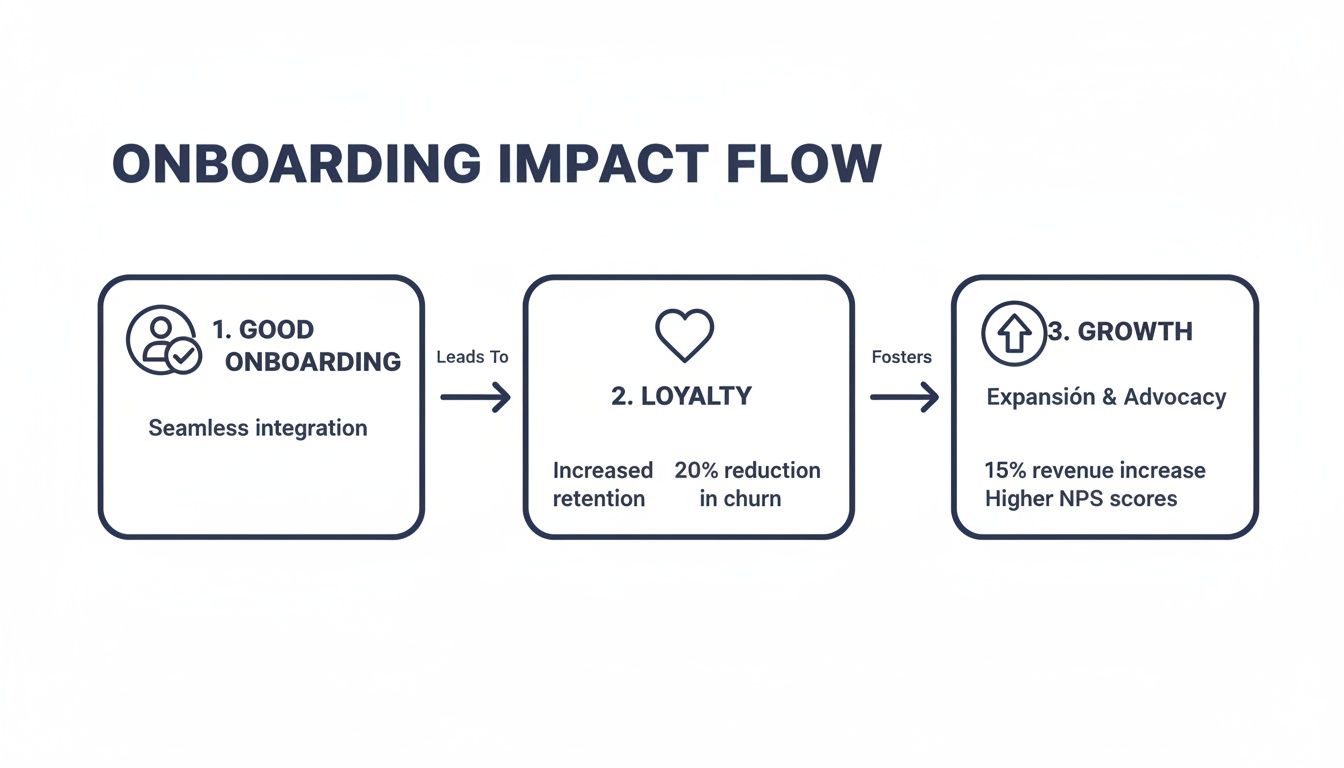
As you can see, a great onboarding experience directly fuels loyalty, which in turn drives retention and sustainable business growth.
Choosing the Right Onboarding Model
Your customers aren't all the same, so why would your onboarding be? A one-size-fits-all approach is a recipe for failure because it ignores different user needs, technical abilities, and business goals. You have to segment your approach.
High-Touch Model This is the white-glove treatment, perfect for complex enterprise products. It involves dedicated onboarding specialists, personalized training, and custom implementation plans. For these high-value clients, you’ll want to build a detailed roadmap; you can get a head start using some powerful customer success plan templates.
Low-Touch Model A great fit for many SMBs or less complex products, this model blends automation with a human safety net. Think automated email sequences, in-app product tours, and a robust knowledge base, with a real person ready to jump in when things get tricky.
Self-Serve Model Ideal for simple, intuitive products with a large user base, this model is fully automated. It relies on in-app checklists, tooltips, and contextual help docs to let users guide themselves. The key is making the experience so seamless that users can find value all on their own.
I’ve seen this mistake so many times: companies apply a self-serve model to a product that desperately needs a high-touch approach. If your tool requires complex data migration, forcing users to figure it out alone is a one-way ticket to churn. Always match the model to your product’s complexity and the customer's value.
Practical Steps for Implementation
With your framework and model in place, it's time to build the actual components.
Your welcome email series is your first touchpoint after sign-up. Use it to set expectations and give them one clear, next step. Don't drown them in information—keep each email focused on a single, actionable goal.
Next up is your in-app guidance. Ditch the generic product tours that show off every single button. Instead, design contextual walkthroughs that guide users through a specific task tied to their goal. If a user signed up to "improve team collaboration," your first prompt should guide them to invite a teammate. It’s that simple.
Finally, set up segmented nurture sequences. Use the data you collected during sign-up, like their role or company size, to make the onboarding experience feel personal. A marketing manager should get tips on campaign tracking, while a developer gets guidance on API integrations. This level of relevance is what separates onboarding that works from onboarding that gets ignored.
How to Automate Onboarding Without Sounding Like a Robot
Scaling a truly personal onboarding experience feels like a contradiction, doesn't it? How can you possibly give one-on-one attention to hundreds, or even thousands, of new users at once? The answer isn't to just hire a bigger team of onboarding specialists. It's about using smart, behavior-driven automation that feels personal.
The real key is to ditch the old-school, time-based email drips. You know the ones: "Day 1: Welcome!", "Day 3: Did you know about this feature?". Instead, build a system that reacts to what your users are actually doing inside your product. That’s how you make every message and every piece of guidance feel timely and genuinely helpful. It’s the difference between shouting at a crowd and having a real conversation.
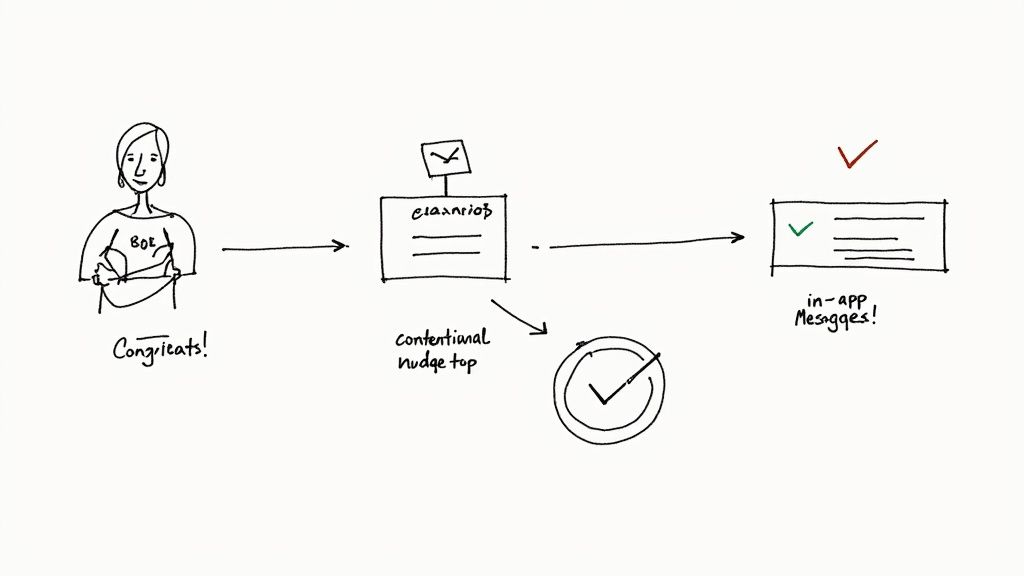
This approach is all about delivering the right help at the exact moment a user needs it, making the automated interaction feel surprisingly human.
From Generic to Trigger-Based Automation
Great automation is all about context. Instead of forcing a one-size-fits-all product tour on everyone who signs up, you can design workflows that respond to specific user actions—or their inaction. This creates a flexible experience that adapts to each person's unique pace and priorities.
Here are a few real-world examples of how this works:
- The "I'm Stuck" Nudge: A user is clicking around the integrations page but hasn't successfully connected anything after a few minutes. Instead of leaving them to struggle, trigger an in-app message. A simple, "Having trouble? Here's a 2-minute video that walks you through it," can be a lifesaver.
- The "Milestone Celebration": When someone hits a key activation milestone—like publishing their first landing page or inviting their first team member—send an automated high-five. A quick email or in-app message that says, "Congrats on creating your first report!" reinforces their progress and keeps the momentum going.
- The "Gentle Re-engagement": Someone signs up but doesn't log in again within three days. Instead of a generic "We miss you!" email, tie it back to the value they're missing out on. Something like, "Ready to get your first project organized? Here’s a quick guide to get started," is far more compelling.
I’ve found that the most effective automations are the small, contextual ones. A simple tooltip that appears only when a user hovers over an advanced setting for the first time is far more powerful than a 10-step tour they’re forced to click through on their first visit. It’s about being helpful, not loud.
The Rise of AI in Predictive Onboarding
The next level of onboarding automation is already here, and it’s powered by AI. By analyzing massive amounts of user behavior, AI can spot patterns that predict who will succeed and who will churn. This allows you to build truly predictive onboarding flows that adapt in real-time to individual needs and learning styles.
This isn't some far-off sci-fi concept. AI is quickly becoming standard for SaaS onboarding, with nearly 90% of organizations planning to use it by 2025 to create smarter user journeys. Automation is a huge part of this, with 34% of companies already automating their onboarding to cut process times by a whopping 78%. And for good reason: a staggering 80% of users have uninstalled an app just because they couldn't figure out how to use it—a problem a great onboarding flow solves. You can dive into more data on how technology is shaping customer expectations over on the Rocketlane blog.
An AI-driven system could, for example, learn that users who adopt Feature X almost always watch a specific tutorial video first. When a new user starts poking around Feature X without watching that video, the AI can proactively serve it up, gently guiding them down a path that’s already proven to lead to success.
Knowing When a Human Should Step In
As powerful as automation is, it’s not a silver bullet. You can't automate a genuine human connection, especially when you're dealing with high-value accounts. The goal is to let automation handle the repetitive, scalable tasks, freeing up your team to provide the high-touch support where it really counts.
Here’s a practical way to divide the labor:
| Automation's Role (Low-Touch Tasks) | Human's Role (High-Touch Tasks) |
|---|---|
| Sending welcome emails and tutorials. | Hosting personalized kickoff calls for enterprise clients. |
| Triggering in-app messages based on behavior. | Proactively reaching out when a user's health score drops. |
| Guiding users through setup checklists. | Offering strategic advice tailored to a customer's unique business goals. |
| Celebrating user milestones automatically. | Conducting quarterly business reviews to ensure long-term success. |
By letting your bots manage the predictable steps, your customer success team can focus their energy on building relationships, solving complex problems, and providing the strategic guidance that turns good customers into loyal advocates. This hybrid model gives you the best of both worlds: efficiency at scale and the personal touch that builds real loyalty.
You can’t fix what you can’t see. When it comes to customer onboarding, flying blind is a surefire way to lose customers you just fought so hard to win. Without the right data, you’re just throwing welcome emails and product tours at the wall, hoping something sticks.
To really nail your onboarding, you need to swap that guesswork for a data-driven approach. That means focusing on the key performance indicators (KPIs) that tell you what’s actually happening. These metrics are the story of your users—how they’re engaging, where they're finding that "Aha!" moment, and, just as importantly, where they’re getting stuck.
Get Past the Vanity Metrics
Let's be honest, some metrics just look good on a slide deck. A high number of users completing a product tour doesn't mean much if they all churn a week later. It's a classic vanity metric—it feels good but tells you nothing about long-term success.
We need to dig deeper into the data that really matters.
- Time to First Value (TTFV): This is the stopwatch on your "Aha!" moment. How long does it take for a brand-new user to actually experience the value you promised them? The shorter the TTFV, the stickier your product becomes, right from the start.
- Product Activation Rate: What’s the percentage of new users who complete those critical first steps? These aren’t just random clicks; they are the specific actions you know lead to long-term retention. For a project management tool, maybe it’s creating their first project and inviting a team member.
- Feature Adoption Rate: Are people actually using the core features you’ve built? If you see low adoption on a key feature during the first week, that’s a massive red flag. Either your onboarding isn't highlighting its value, or the feature itself is too confusing.
Tracking these gives you a much clearer picture of whether your onboarding is truly setting people up for success.
From First Impressions to Long-Term Habits
Great onboarding doesn't just stop after the first login. Its real impact is measured in sustained engagement and loyalty long after the welcome tour is over.
A user engagement score is a fantastic way to get a pulse on this. It rolls up different user actions—how often they log in, how many features they use, how long they stick around each session—into a single, easy-to-understand score. It quickly flags your power users and, more importantly, the ones who are quietly slipping away.
Another critical piece of the puzzle is your cohort retention rate.
Don’t get hypnotized by your overall churn number. You need to look at retention in batches. Analyzing 30, 60, and 90-day retention for each new wave of sign-ups tells you exactly how well your onboarding is working right now.
This approach immediately shows you if that new in-app checklist you launched last month actually moved the needle on retention. For an even more sophisticated view, you can feed this data into a system that teaches you how to build an effective customer health score, giving you a predictive edge on churn.
So, where should you start? Here are the absolute must-haves for your dashboard.
Essential Onboarding KPIs You Should Be Tracking
I’ve seen teams get lost in dozens of metrics, but you can get incredible insights by focusing on just a few core KPIs. These four will give you the clearest picture of your onboarding performance.
| Metric (KPI) | What It Measures | Why It's Important |
|---|---|---|
| Time to First Value (TTFV) | The time from sign-up to a user's first major value moment. | A shorter TTFV directly correlates with higher long-term retention. |
| Activation Rate | The percentage of users who complete key onboarding milestones. | Shows if users are successfully engaging with your product's core value proposition. |
| Feature Adoption | The usage rate of essential product features by new users. | Reveals if your onboarding effectively teaches users how to use the tool. |
| 30-Day Retention | The percentage of new users still active after 30 days. | The ultimate test of your onboarding's ability to prevent early-stage churn. |
By keeping a close eye on these numbers, you can turn your customer onboarding SaaS process from a static, one-and-done checklist into a living, breathing system that constantly improves—driving user activation and protecting your bottom line.
Common Onboarding Pitfalls and How to Sidestep Them
Let’s be honest: even the most brilliant SaaS product will stumble if the first few moments with a new user fall flat. A thoughtful onboarding experience is your first and best line of defense against early-stage churn, but I've seen a few common, well-intentioned mistakes trip up even the sharpest teams.
The biggest culprit I see is the one-size-fits-all onboarding flow. This is where every new user gets the exact same welcome, whether they're a solo freelancer just kicking the tires or a team lead rolling out your product to 50 people. It’s an approach that almost guarantees the experience will feel generic and impersonal to just about everyone.
Right behind that is the classic mistake of information overload. We all want to show off the cool stuff our product can do, but dumping every single feature on a new user at once is a recipe for disaster. This "firehose" method doesn't activate users; it just overwhelms them. They don't need to know everything on day one. They just need to know what to do right now to solve the problem that brought them here in the first place.
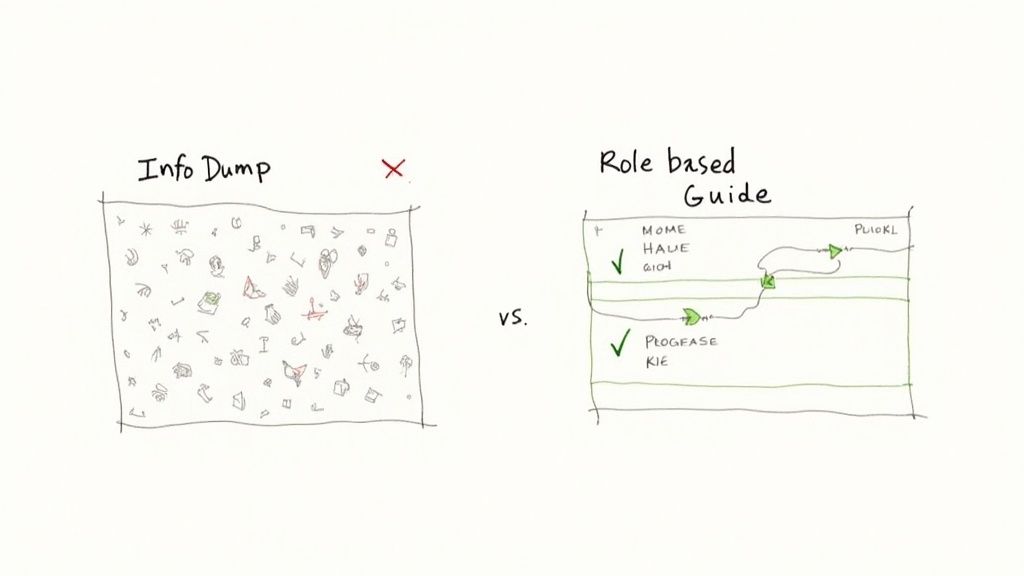
From Generic Tours to Guided Journeys
The good news is you don’t need to build a dozen unique onboarding paths from scratch. The real fix lies in smart segmentation and revealing information progressively.
First things first: ditch the generic product tour. You know the one—it just points out what every button and menu does. That kind of tour lacks context and is forgotten almost as soon as it's finished.
Instead, try these approaches:
- Create Role-Based Guides: A simple question during sign-up—"What's your role?" or "What do you want to accomplish today?"—is all you need. Use that answer to kick off a walkthrough that’s laser-focused on helping them get their specific job done.
- Focus on the "Job to Be Done": A marketer's first task is probably building a campaign. A developer just wants to get the API key. Your onboarding should guide them through that specific, critical task, not give them a grand tour of the entire user interface.
When you tailor the first run this way, the value becomes immediate and personal.
Avoiding the "Firehose" Effect
To prevent overwhelming your users, lean into the principle of progressive disclosure. This simply means you introduce features and complexity a little at a time, as the user gets more comfortable.
Don't show them every advanced setting and configuration option on their first login. Keep the initial experience clean and guide them to complete one core action that delivers that "Aha!" moment. Once they've gotten that first quick win, then you can gently introduce the next logical step or feature.
A new user doesn't need a map of the entire city on their first day; they just need clear directions to their first destination. Your job is to be the GPS that guides them step-by-step, not the overwhelming map.
This methodical approach builds momentum and makes users feel competent. The impact is massive. Consider that 63% of customers say a company's onboarding is a key factor in their decision to subscribe. On the flip side, poor onboarding is directly to blame for 23% of all customer churn.
With 89% of consumers ready to jump ship to a competitor after a bad experience, you simply can't afford to get this wrong. You can find more statistics on Custify.com that really drive home how crucial this is. By thoughtfully sidestepping these common pitfalls, you’re not just creating a better user experience—you’re building a stickier product and a much healthier bottom line.
Using Onboarding to Drive Proactive Retention
So many SaaS companies treat customer onboarding like a one-and-done event—a checklist to get through in the first week. But that’s a huge missed opportunity. The best companies I’ve seen treat it as a continuous strategy that follows the customer through their entire journey.
This is what it means to move from being reactive to proactive. Instead of just fighting fires when customers complain, you’re constantly showing them value.
Your existing customers are your biggest asset, but it's easy to forget about them once they’re activated. Think about your last big feature launch. Did you just fire off a generic email and hope for the best? Or did you build a mini-onboarding flow just for that feature to guide your loyal users? That's continuous onboarding, and it's the secret to keeping customers engaged for the long haul.
Playbooks for Churn Signals and Expansion
The real magic happens when you build targeted playbooks triggered by specific customer actions (or inactions). Instead of waiting for a cancellation email to land in your inbox, you can step in with the perfect message at the perfect time. This is a fundamental part of a smart customer lifecycle management strategy.
Here are a couple of practical playbooks you can build:
The "Disengaged User" Playbook: Imagine a user's activity drops for two weeks straight. Instead of doing nothing, an automation triggers a targeted in-app guide. This isn't your standard product tour; it's a specific walkthrough of a powerful feature they haven't touched yet. If they still don't re-engage, the playbook can automatically notify their customer success manager to send a personal email and offer a quick call.
The "New Feature" Playbook: Let's say you just launched a slick new reporting dashboard. For all your existing users, an in-app modal pops up on their next login. It gives them a quick preview and offers a short, interactive tour. This ensures your development work gets noticed and immediately shows customers the growing value of their subscription.
From Retention to Expansion
This mindset isn’t just about stopping churn—it’s about creating new revenue. A great onboarding process helps you pinpoint your power users and guide them toward more advanced features, creating a natural path to upgrades.
Your most engaged customers are your best candidates for expansion. They've already mastered the basics; now it's your job to show them what's next. Proactive guidance turns happy customers into your most profitable accounts.
For instance, you could create an "Expansion" playbook for accounts that consistently hit their usage limits. This could trigger an automated email inviting them to an exclusive webinar on advanced workflows or offering early access to a beta feature.
This makes your best customers feel like VIPs, solidifying their loyalty while organically introducing them to your premium tiers. When you weave these onboarding principles into every stage of the customer journey, you create a powerful, self-sustaining engine for both retention and growth.
Your Top SaaS Onboarding Questions, Answered
When you're deep in the weeds of building a SaaS business, the same onboarding questions tend to pop up again and again. Getting the answers right isn't just academic—it's the difference between a user who gets it and sticks around, and one who quietly churns out.
Let's tackle some of the most common questions I hear from fellow SaaS builders.
How Long Should Our Onboarding Be?
Everyone wants a magic number, but there isn't one. The best rule of thumb is: as short as possible, but as long as necessary.
Your real goal is to rocket users to that first "Aha!" moment. For a simple, single-purpose app, a slick 5-minute product tour might be all it takes. But if you're selling a complex enterprise platform, you could be looking at a multi-week, hands-on process. It just depends.
Instead of focusing on time, focus on Time to First Value (TTFV). Pinpoint the first key action a user needs to take to feel successful, measure how long it takes them to get there, and then obsess over shortening that path without cutting crucial corners.
What’s the Difference Between Onboarding and Implementation?
This one trips a lot of people up, but the distinction is pretty simple. Implementation is about getting the product working; onboarding is about making the product valuable.
Think of it like this:
- Implementation: This is all the technical heavy lifting. We're talking data migration, hooking up integrations, and configuring all the backend settings. It’s the foundational setup.
- Onboarding: This is the human side of the equation. It's about strategic guidance—training users, helping them adopt new workflows, and proving the value they signed up for.
Implementation is a finite project with a clear end date. True onboarding, on the other hand, is a continuous process that extends well beyond the initial technical setup.
"While the onboarding stage sets the tone for any future relationship between the customer and the company, the implementation stage proves the true ROI by ensuring that the customer can (and will) achieve their desired outcomes with the product."
Should We Be Charging for Onboarding?
It really depends on your business model. If you're running a self-serve or low-touch SaaS, a free and highly automated onboarding experience is the standard. Don't even think about charging for it.
However, if you're in the high-touch, enterprise world where onboarding requires significant hands-on work—think dedicated specialists, custom configurations, and on-site training—then charging a one-time fee is not only common but often expected.
The key is transparency. If you charge, you have to clearly articulate the value they're getting. Position it as a non-negotiable investment in their success, not just another line item on the invoice.
Ready to stop guessing which customers are about to churn? LowChurn uses AI to predict churn with over 85% accuracy, giving you the early warning you need to save valuable MRR. Connect your Stripe account in under a minute and see your customer health in a whole new light. Learn more and start your trial today at LowChurn.