The first 30 days of a customer's journey are the most critical. A weak start leads to confusion, low activation, and ultimately, churn. For SaaS teams running on Stripe, the pressure is even higher to demonstrate value quickly before the first renewal invoice hits. A generic welcome email and a basic feature tour are no longer enough to secure long-term loyalty. To build an engaged customer base that sticks around, you need a robust set of customer onboarding strategies that are personalized, measurable, and proactive.
This isn't another high-level list of vague ideas. We are breaking down 10 specific, actionable strategies designed for modern subscription businesses. Each item provides a clear blueprint covering what to do, when to do it, and which metrics to track for success. You will find practical messaging templates, experiment ideas to test with your user base, and notes on integrating predictive churn signals.
The goal is to move beyond reactive support and build a proactive onboarding machine. By leveraging data and automation, you can identify and rescue at-risk new customers before they even think about canceling. This guide provides the tactical details you need to overhaul your current process, reduce early-stage churn, and convert new signups into power users. Let’s dive into the strategies that will transform your customer lifecycle from day one.
1. Guided Product Walkthroughs and Interactive Tours
Guided product walkthroughs are structured, in-app tours that steer new customers through your platform's most critical features immediately after they sign up. This customer onboarding strategy uses elements like tooltips, modals, and interactive overlays to highlight the core workflows that deliver immediate value, preventing the confusion that often leads to early churn.
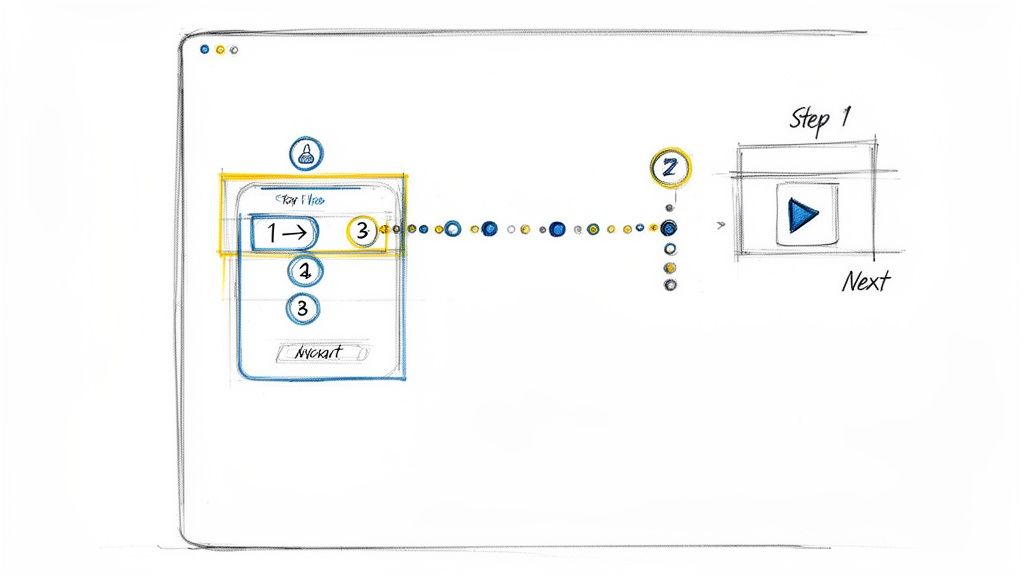
Think of Slack’s interactive tutorial that introduces channels and messaging, or Calendly’s initial setup guide for creating a scheduling link. These tours don't just show features; they actively help users accomplish their first key task, accelerating their journey to the "aha!" moment. This hands-on approach builds user confidence and solidifies their understanding of your product's value proposition from day one.
How to Implement This Strategy
To effectively deploy guided walkthroughs, start by identifying the one or two "activation events" that correlate highest with long-term retention. Is it creating a project, sending an invoice, or integrating a data source? Build your tour around helping users complete that specific action.
- Trigger Contextually: Don't launch a generic tour for everyone. Trigger specific walkthroughs based on user behavior or declared goals during signup. For example, a user who signs up for an "advanced" plan should see a different tour than a "basic" user.
- Keep it Brief: Aim for a completion time of 2-3 minutes. Long, multi-step tours have notoriously high drop-off rates. Always include a "skip" option to give users control.
- Measure and Optimize: Track tour completion rates, time-to-complete, and subsequent feature adoption. Use A/B testing on copy, design, and flow to continuously improve engagement. Tools like Appcues, Pendo, or Userguiding are essential for building and analyzing these experiences without requiring engineering resources.
This video demonstrates how to craft an effective interactive product tour:
2. Personalized Onboarding Sequences via Email Automation
Personalized onboarding sequences use triggered emails that adapt based on customer segment, company size, use case, or in-app behavior. Instead of a generic welcome series, this customer onboarding strategy delivers highly relevant content at the right time, guiding users through their initial setup and toward their first success milestones.
Think of ConvertKit’s email sequence for new creators, which offers platform tutorials, or Stripe’s automated emails that guide new accounts through the critical KYC verification process. These sequences keep new users engaged during the crucial first 30 days, reinforcing your product's value and directly reducing early churn by ensuring they don’t get stuck or lose momentum.
How to Implement This Strategy
To implement this strategy, map out the key milestones in your ideal customer journey and build automated email workflows around them. Segment your audience from the start using signup data to ensure every message resonates. For a step-by-step walkthrough, a detailed guide on how to automate customer onboarding can be invaluable.
- Act Quickly and Maintain Momentum: Send the first email within one hour of signup to capitalize on initial excitement. Keep the entire sequence concise, aiming for 5–7 emails over the first 30 days to avoid fatigue.
- Use Conditional Logic: Create branching paths in your automation. For example, if a user completes a key milestone, stop the onboarding sequence and move them into a different nurturing track. Conversely, if a user is inactive, trigger a re-engagement email with extra support.
- Measure and Refine: Monitor open rates, click-through rates, and unsubscribe rates (keep them below 0.5%). More importantly, track whether these emails correlate with higher activation rates and lower churn. Defining these pathways is a core part of building a successful B2B customer journey map.
This video demonstrates how to craft an effective interactive product tour:
3. Customer Success Manager (CSM) Rapid Handoff
A Customer Success Manager (CSM) Rapid Handoff is a high-touch customer onboarding strategy where new, high-value accounts are assigned a dedicated human contact within 24 hours of signing up. This CSM then conducts an initial discovery call and schedules weekly check-ins for the first 30 days, creating immediate accountability and a personal connection. This approach transforms onboarding from a self-serve process into a guided, consultative experience.
Think of how Salesforce assigns dedicated CSMs to new Enterprise accounts or HubSpot provides onboarding specialists for its mid-market customers. The goal is to ensure the customer has a human advocate who deeply understands their business objectives. This CSM proactively guides them toward value, troubleshoots roadblocks, and reinforces their decision to choose your solution, which is critical for complex or high-ACV products.
How to Implement This Strategy
This strategy is most effective for higher-ACV tiers where the cost of a dedicated CSM is justified by the potential lifetime value. It hinges on speed and creating a structured, goal-oriented partnership from day one. To learn more about building out this function, explore these customer success strategies.
- Assign CSMs Immediately: The handoff from sales to success must be seamless. Assign a CSM within 24 hours of the deal closing to capitalize on the customer's initial excitement and build trust. The first outreach should happen the same day.
- Use a Shared Success Plan: Don't just have calls; structure them. Use a shared document or success plan template that outlines the customer’s goals, key milestones, and responsibilities. Get their sign-off in the first week to align expectations.
- Measure Outcomes, Not Just Activity: Track CSM performance based on key activation metrics and 90-day retention rates, not just the number of calls made. The CSM's primary goal is to drive successful outcomes that lead to long-term adoption.
- Consider a Hybrid Model: You don't need to offer this to every customer. Reserve the rapid CSM handoff for your top-tier accounts. For smaller SMB customers, use automated, tech-touch onboarding sequences while reserving human interaction for escalation points. This optimizes your resources effectively.
4. Self-Serve Knowledge Base and Community Support
A self-serve knowledge base is a centralized, searchable repository of articles, FAQs, video tutorials, and troubleshooting guides that empowers customers to solve problems independently. This customer onboarding strategy is often complemented by a community forum where users can ask peers for help, share best practices, and discover new use cases. By providing on-demand answers, you reduce support ticket volume and let customers unblock themselves 24/7.
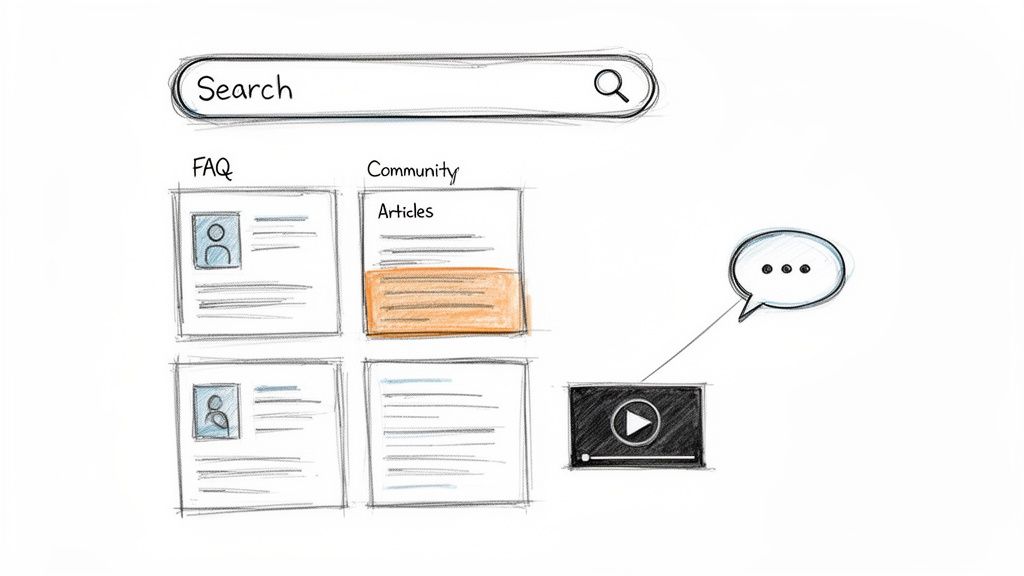
Think of Stripe's extensive API documentation or Notion's comprehensive help center. These resources don't just solve problems; they educate users and build their confidence, turning them into power users over time. This approach fosters a sense of independence and community, which is crucial for long-term loyalty and reducing reliance on your support team for common queries.
How to Implement This Strategy
A critical component of effective self-serve support is creating a self-serve knowledge base for users to access information independently. Start by identifying the 20 most common questions your support team receives and turn the answers into clear, concise articles or short videos.
- Prioritize Accessibility: Use clear section headers, a table of contents, and a prominent search bar for easy navigation. Integrate your knowledge base directly into your app with widgets that suggest relevant articles based on the user's current page.
- Identify Content Gaps: Regularly monitor search queries in your help center that return no results. These failed searches are a direct roadmap to the content your users need most.
- Foster Community Engagement: Encourage user participation in forums with recognition programs, badges, or by featuring top contributors. An active community becomes a powerful, self-sustaining support channel.
- Measure Success: Track metrics like ticket deflection rate (how many support tickets were avoided), reduction in first-response time, and time-to-resolution. A successful knowledge base directly improves support efficiency and customer satisfaction.
5. Outcome-Focused Onboarding with Measurable Milestones
Outcome-focused onboarding shifts the focus from feature adoption to achieving tangible business results for the customer. This customer onboarding strategy defines clear outcomes, such as "reduce support ticket resolution time by 20%," and maps all onboarding activities directly to these goals. Progress is tracked against pre-agreed KPIs, ensuring the customer sees real value, not just product activity.
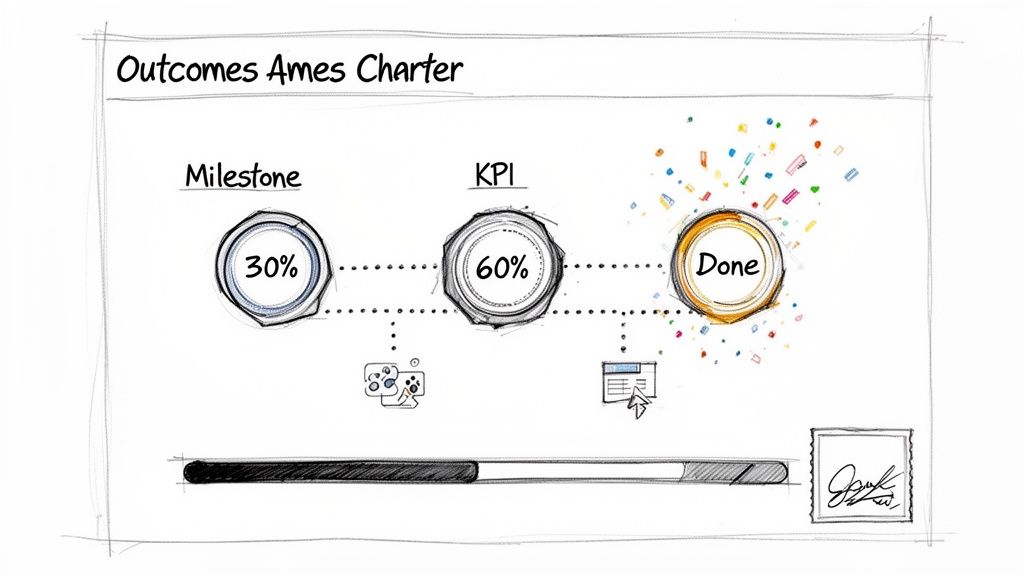
Think of how HubSpot's onboarding can track leads generated and deals closed, or how Zendesk's implementation is measured by reduced support costs. These approaches directly tie platform use to business impact, making the ROI undeniable and building a strong foundation for a long-term partnership. Success is defined by the customer's success, not just their ability to use your software.
How to Implement This Strategy
To execute an outcome-focused plan, you must first deeply understand your customer's business objectives. This requires a collaborative approach that starts during the sales handoff and continues through the first 90 days.
- Define and Document Outcomes: Conduct a thorough discovery call to identify 1-2 key business outcomes the customer wants to achieve. Document these in a shared "outcomes charter" or success plan that both parties agree on.
- Establish Measurable Milestones: Break down each outcome into smaller, achievable milestones with clear KPIs. For example, an outcome of "increase lead qualification speed by 40%" might have milestones like "integrate CRM" and "automate lead scoring rules."
- Track and Report Progress: Use a shared dashboard to visualize progress toward these milestones and KPIs. Hold regular check-ins (e.g., weekly or bi-weekly) and formal 30/60/90-day reviews to discuss progress and adjust the plan as needed. Measuring these outcomes is a key component of building a robust customer health score.
6. Freemium Tier with Smooth Upgrade Path
A freemium tier is a customer onboarding strategy that offers a free, perpetual-use version of your product to let users experience its core value without any financial commitment. This approach removes the initial friction of a purchase decision, allowing a wide audience to integrate your tool into their daily workflows. The key is to make the free experience valuable enough to create habituation but limited enough to create a natural motivation to upgrade.
Think of Slack’s free tier, which is fully functional but limits message history to 90 days, or Zapier, which offers five free "Zaps" per month. These models don't just provide a trial; they allow users to achieve their goals and reach an "aha!" moment. Once users become reliant on the product, the limitations on features, usage, or collaboration create a compelling reason to convert to a paid plan, making the upgrade feel like a natural next step rather than a forced sale.
How to Implement This Strategy
To succeed with a freemium model, you must strategically define the limitations that separate your free and paid tiers. The goal is to align these limits with the user's growing needs, so the upgrade path feels smooth and logical.
- Define Smart Limits: Base your free tier limits on value metrics, not just random features. For example, limit the number of projects (Notion), active integrations (Zapier), or data history (Slack). This ensures users can fully experience the core product value before hitting a paywall.
- Create Upgrade Triggers: Use in-app messaging to contextually highlight paid features when users approach their limits or attempt to use a gated feature. A simple prompt like, "Unlock unlimited projects by upgrading to Pro," is highly effective when a user tries to create their fourth project.
- Monitor and Nurture: Track free user engagement metrics closely. High engagement is a strong predictive signal for a future upgrade. Create automated email campaigns that nurture active free users by showcasing advanced use cases and offering a limited-time discount (e.g., "40% off your first year") to ease the upgrade friction.
- Analyze the Unconverted: Don’t ignore users who remain on the free plan or churn. Send automated surveys to understand why they didn't upgrade. This feedback is invaluable for refining your free tier’s value proposition and identifying gaps in your onboarding.
7. Cohort-Based Onboarding Batches with Live Instructors
Cohort-based onboarding moves away from self-serve, individual learning by grouping new customers into small batches that learn together. This customer onboarding strategy involves a series of live, instructor-led sessions over a set period, like two to four weeks. It transforms onboarding from a solitary checklist into a collaborative, community-driven experience, which is especially powerful for complex products.
Think of Reforge's intensive learning programs or Orbit's onboarding bootcamps for community managers. By bringing users together, these models foster peer accountability, create opportunities for live Q&A, and build a sense of community from day one. This high-touch, human-centric approach is highly effective at boosting engagement, accelerating user competence, and forging strong emotional connections to your brand.
How to Implement This Strategy
The key to successful cohort-based onboarding is creating a structured yet interactive environment. This model is ideal for high-ACV customers or products with a steep learning curve where personalized guidance significantly impacts long-term success.
- Structure Your Cohorts: Keep groups small, ideally 15–30 people, to ensure meaningful interaction. Schedule a series of 3–4 sessions over a few weeks to build momentum without overwhelming users. Open enrollment a week or two in advance to build a committed group.
- Create a Central Hub: Send a welcome email establishing a dedicated space for the cohort, such as a private Slack channel. Include the session schedule, Zoom links, and any pre-work required to set clear expectations.
- Encourage Peer Connections: Use breakout rooms during live sessions and rotate participants to help them build relationships with different peers. You can even assign a "cohort ambassador" to help rally the group and facilitate communication between sessions.
- Track Engagement and Outcomes: Monitor attendance, participation in discussions, and feature adoption post-onboarding. Analyze churn rates by cohort to identify which elements of the program are most effective at driving long-term retention. Tools like Maven and Kajabi provide platforms for managing this style of cohort-based experience.
This video from Maven co-founder Wes Kao explains the power of cohort-based learning:
8. Product-Led Growth (PLG) Onboarding with Usage Analytics
Product-Led Growth (PLG) onboarding is a model where the product itself serves as the primary driver for customer acquisition, activation, and retention. In this customer onboarding strategy, users sign up with minimal sales interaction, experience the product's value firsthand, and are guided toward paid tiers based on their usage patterns and feature needs. The entire onboarding experience is embedded directly within the product's UI through interactive elements like tooltips, walkthroughs, and in-app checklists.
Think of how Figma allows you to instantly create a design frame and invite collaborators, or how Notion’s templates eliminate the "blank canvas" problem by letting you build a functional workspace in seconds. These products don't just tell you their value; they let you experience it immediately. This self-service approach minimizes friction and empowers users to discover the product’s core benefits on their own terms, leading to higher activation rates and a more scalable growth engine.
How to Implement This Strategy
To build a successful PLG onboarding flow, you must obsessively focus on the user's time-to-value. Start by deeply understanding the key actions that correlate with long-term retention, known as "activation metrics," and design the initial user experience around getting users to that point as quickly as possible.
- Define and Track Activation: Clearly define your primary activation metric, such as "creating a project" or "inviting a teammate" within the first 7 days. Use product analytics tools like Amplitude or Mixpanel to track activation rates by user cohort (e.g., signup source, plan type) to identify underperforming segments.
- Design for Action: Use "empty states" (the screens users see before they've added any data) to guide them toward their first key action. Provide starter templates, sample data, or a setup wizard to reduce friction and show them what's possible.
- Measure and Iterate: Track the "time-to-first-key-action" and aim to reduce it from days to minutes. Use feature flags to A/B test different onboarding flows and UI elements in real time. Export activation and usage data into churn prediction models to proactively identify new users who are at risk of churning.
9. Onboarding Segmentation by Customer Profile and Use Case
Onboarding segmentation is a customer onboarding strategy that tailors the initial user experience based on specific customer profiles, roles, or intended use cases. Instead of a one-size-fits-all approach, you create distinct paths that highlight the most relevant features and workflows for each segment, dramatically reducing cognitive load and accelerating their path to value. This ensures every new user's first impression is hyper-relevant to their unique goals.
Think of HubSpot, which offers completely different onboarding flows for its Marketing Hub, Sales Hub, and Service Hub. Similarly, Stripe provides unique setup experiences for businesses processing payments directly versus platforms or marketplaces. This targeted approach makes complex products feel intuitive by showing users only what they need to succeed in their specific context, making activation feel effortless.
How to Implement This Strategy
The key to successful segmentation is to identify your most distinct and valuable customer personas or use cases. Start by analyzing your existing customer base to find patterns in feature adoption and long-term retention among different groups. Then, build tailored onboarding flows for the top two or three segments.
- Ask Early and Simply: The best time to segment users is during the signup process or with a simple modal right after their first login. Ask a single question like, "What is your primary role?" or "What do you hope to achieve with our product?"
- Create Unique Paths, Not Just Copy: A truly segmented experience goes beyond changing text. Design segment-specific feature tours, provide relevant sample data (e.g., sample Stripe transactions for a finance team), and offer templates that align with that segment's core job-to-be-done.
- Measure Segment Performance: Track activation rates, time-to-value, and churn risk separately for each segment. This data will reveal which onboarding paths are working and which need refinement. For instance, you might find that your "marketing manager" segment activates 30% faster than your "data analyst" segment, indicating a need to optimize the analyst's journey.
- Allow for Flexibility: Don't lock users into a path. Provide an easy way for them to switch their profile or use case later from their account settings, as roles and needs can evolve.
10. Incentivized Activation and Referral Programs
Incentivized activation is a customer onboarding strategy that offers tangible rewards for completing key milestones or referring new users. By providing discounts, account credits, extended trials, or access to premium features, you create powerful motivation for customers to engage deeply with your product right from the start, effectively gamifying their journey to value.
Think of Dropbox’s iconic program that offered free storage for inviting friends, a key driver of its explosive growth. Similarly, Airbnb provides travel credits for successful referrals, while Zapier unlocks premium features. These programs don't just encourage exploration; they transform your new customers into advocates, embedding a viral growth loop directly into the onboarding experience. This approach accelerates feature adoption and leverages your user base as a powerful acquisition channel.
How to Implement This Strategy
To build an effective incentive program, focus on rewards that directly enhance the user's product experience and are tied to actions that predict long-term value. The goal is to reward meaningful engagement, not just superficial activity.
- Tie Rewards to Activation Milestones: Don't just reward a signup. Offer a significant credit, like "$50 off your next bill," for completing a critical action, such as making their first three API calls or successfully integrating their primary data source. This reinforces the core value proposition.
- Make Referrals Frictionless: The process must be seamless. Use one-click sharing links, pre-populated email or social media messages, and a clear dashboard for users to track their referral status and earned rewards. The easier it is to share, the more likely they will.
- Monitor and Prevent Fraud: Actively track referral patterns to detect and prevent abuse, such as users creating fake accounts to claim rewards. Implement simple rules, like requiring a referred customer to remain active for a certain period before the reward is unlocked. This ensures the integrity and ROI of your program.
10-Strategy Customer Onboarding Comparison
| Item | Implementation Complexity 🔄 | Resource Requirements ⚡ | Expected Outcomes 📊 | Ideal Use Cases 💡 | Key Advantages ⭐ |
|---|---|---|---|---|---|
| Guided Product Walkthroughs and Interactive Tours | Medium — design + in‑app logic, ongoing updates 🔄 | Medium — tooling (Appcues/Pendo) + product dev ⚡ | 📊 Faster time‑to‑first‑value, higher activation; measurable drop‑offs (⭐⭐⭐) | PLG or feature‑rich apps needing fast activation | Immediate contextual guidance; highly trackable |
| Personalized Onboarding Sequences via Email Automation | Low–Medium — trigger logic and content variants 🔄 | Low — email/SMS platform, templating, data feeds ⚡ | 📊 Improved early engagement and activation; scalable (⭐⭐⭐) | High‑volume signups, SMBs, multi‑tier products | Cost‑effective, scalable, easy A/B testing |
| Customer Success Manager (CSM) Rapid Handoff | High — process + hiring + SLA management 🔄 | High — skilled CSMs, CRM integrations, training ⚡ | 📊 Strong retention and NPS uplift for high‑ACV accounts (⭐⭐⭐⭐) | Mid‑market and enterprise with complex onboarding | Human advocacy, proactive issue resolution, upsell enablement |
| Self‑Serve Knowledge Base and Community Support | Medium — content strategy, search, moderation 🔄 | Medium — content creators, community managers, platform ⚡ | 📊 Reduced ticket volume, 24/7 resolution, SEO benefits (⭐⭐⭐) | Products with repeatable problems, developer tools | Highly scalable support; builds loyalty and self‑sufficiency |
| Outcome‑Focused Onboarding with Measurable Milestones | High — discovery, outcome mapping, dashboards 🔄 | Medium–High — CSM time + analytics and reporting ⚡ | 📊 Increased perceived ROI and retention; strong case studies (⭐⭐⭐⭐) | Enterprise customers needing measurable impact | Aligns incentives; proves ROI; drives expansion |
| Freemium Tier with Smooth Upgrade Path | Medium — feature gating and upgrade UX 🔄 | Medium — infrastructure, support for free users ⚡ | 📊 Large top‑of‑funnel, lower CAC, slower conversion (⭐⭐) | Consumer/SMB/PLG businesses seeking viral growth | Low friction signup; self‑qualification for paid tiers |
| Cohort‑Based Onboarding Batches with Live Instructors | High — scheduling, curriculum, facilitation 🔄 | Medium–High — instructors, ops, community channels ⚡ | 📊 High engagement and peer accountability; cohort effects on retention (⭐⭐⭐) | Complex products that benefit from group learning | Live Q&A, peer learning, efficient expert leverage |
| Product‑Led Growth (PLG) Onboarding with Usage Analytics | High — product UX investment + analytics infrastructure 🔄 | High — dev, analytics, feature flags, instrumentation ⚡ | 📊 Scalable growth, rich activation signals; variable conversion (⭐⭐⭐) | Self‑serve products with viral potential | Low CAC, data‑driven churn signals, rapid habit formation |
| Onboarding Segmentation by Customer Profile and Use Case | Medium — segmentation logic + multiple flows 🔄 | Medium — content variants, templates, analytics ⚡ | 📊 Improved activation per persona; clearer success metrics (⭐⭐⭐) | Multi‑persona platforms and multi‑product suites | Increased relevance; better targeting and measurement |
| Incentivized Activation and Referral Programs | Medium — reward mechanics, fraud controls 🔄 | Medium — credits/discounts, fulfillment systems ⚡ | 📊 Higher activation and referral rates; potential margin impact (⭐⭐⭐) | Early‑stage growth, viral acquisition strategies | Drives referrals and engagement; gamifies onboarding |
From Onboarding to Advocacy: Turning New Users into Lifelong Fans
The journey from a new signup to a loyal, high-value advocate begins with a single, crucial phase: onboarding. As we’ve explored through these ten distinct customer onboarding strategies, this initial period is far more than a simple product tour. It’s your first and best opportunity to prove your product's value, build trust, and set the foundation for a long-term, profitable relationship. Simply put, world-class onboarding is no longer a luxury; it’s the engine of sustainable growth for modern SaaS businesses.
The strategies we've detailed, from automated guided walkthroughs to high-touch, cohort-based training, are not mutually exclusive. The most successful companies build a flexible, hybrid system. They blend scalable, automated sequences for the masses with personalized, high-touch interventions for high-value segments. The goal is to meet every customer where they are, guiding them efficiently to their "Aha!" moment-the point where they internalize the unique value your product delivers for them. This requires a deep understanding of your customer profiles, their desired outcomes, and the key activation milestones that correlate with long-term success.
Key Takeaways for Building a High-Impact Onboarding System
To distill these powerful concepts into actionable steps, focus on three core principles:
Be Proactive, Not Reactive: Don't wait for a customer to struggle or send a support ticket. Use data and automation to anticipate needs. An effective onboarding flow proactively addresses common friction points and guides users toward value, creating a seamless and confidence-inspiring experience from the very first login.
Personalize the Path to Value: A one-size-fits-all approach is a recipe for disengagement. Leverage segmentation based on user persona, job-to-be-done, or company size to tailor the onboarding journey. A small startup founder has different immediate needs than a department head at an enterprise company; your onboarding should reflect that reality.
Measure What Matters: Your efforts are only as good as their results. Move beyond vanity metrics and focus on tracking core activation rates, time-to-first-value, and feature adoption. These are the leading indicators of retention. Continuously analyze this data to identify drop-off points and run experiments to optimize your flow.
Your Next Steps: From Strategy to Execution
Mastering your customer onboarding strategies is an ongoing process of refinement, not a one-time project. Begin by auditing your current process against the frameworks we've discussed. Where are the biggest gaps? Where are new users getting stuck?
Choose one or two strategies from this list that align best with your current business stage and customer type. For instance, if you have a high volume of signups, start by optimizing your personalized email sequences and in-app interactive tours. If you’re focused on moving upmarket, implementing a structured CSM handoff and outcome-focused milestone tracking might be your top priority.
Ultimately, the most critical evolution in modern onboarding is the shift from reactive analysis to proactive intervention. The ability to predict which new users are showing early signs of risk-before they become inactive-is a game-changer. This is where integrating predictive signals becomes invaluable, allowing your customer success and growth teams to focus their energy where it will have the greatest impact. By building a robust, data-driven, and user-centric onboarding experience, you don't just reduce churn. You create a powerful flywheel of success that turns new customers into your most effective and passionate advocates.
Ready to transform your onboarding from reactive to proactive? LowChurn integrates with Stripe to provide predictive churn signals and automated campaigns, helping you identify at-risk new customers and deliver the right intervention at the right time. Start rescuing customers before they churn at LowChurn.