Customer retention automation is all about using technology to spot customers who are drifting away and then automatically reaching out to them with the right message at the right time. It's about turning a reactive, manual headache into a data-driven, scalable system that protects—and even grows—your monthly recurring revenue (MRR).
Why Retention Automation Is Your SaaS Growth Engine
We’ve all seen it happen. A SaaS company grows like a weed, pouring all its energy into acquisition, and then—bam—it hits a churn wall. Suddenly, cancellations are piling up, seemingly out of nowhere, and the team is stuck in a constant, stressful cycle of firefighting.
That reactive loop isn't just exhausting; it's a massive drag on growth.
Customer retention automation is what gets you ahead of the problem. It’s not just another tool; it’s a proactive engine for growth.
From Reactive Firefighting to Proactive Growth
Instead of just waiting for a credit card to fail or a user to finally click the "cancel" button, this approach is about finding the quiet, early-warning signs of churn. These signals are usually hidden in your product usage data and subscription events from payment platforms like Stripe.
Shifting to a proactive strategy gives you some serious advantages:
- Early Detection: You can spot red flags like a sudden drop in key feature usage or less frequent logins long before a payment ever gets missed.
- Scalable Engagement: You can set up automated, personalized emails or in-app messages that trigger based on specific actions, making sure no at-risk customer ever falls through the cracks.
- Data-Driven Decisions: Finally, you can measure exactly how your efforts impact key metrics like MRR at risk, recovery rate, and overall churn.
The big idea here is simple but incredibly effective: Turn your customer data into a predictive system. When you connect product usage signals with subscription data from Stripe, you create an early warning system that helps you save customers you didn't even know were about to leave.
At the heart of any solid SaaS growth strategy is a Revenue-First Playbook for Reducing Churn Rate, which offers data-backed methods that fit perfectly with these automation efforts.
The Tangible Impact on Your Bottom Line
Getting smart with automation isn't just about making customers happier; it delivers real, measurable financial results. We've seen companies that adopt this approach achieve significant revenue lifts, driven by better retention and a higher customer lifetime value.
Being able to deliver the right intervention to the right person at scale is a complete game-changer for any subscription business.
When you reframe retention as an automated, strategic function instead of a manual, reactive chore, you build a much more resilient and profitable SaaS company. Your team can finally stop chasing down cancellations and start focusing on high-value work that actually drives long-term growth.
Designing Your Automated Retention Blueprint
Before you write a single line of code or set up your first automation, you need a plan. Great customer retention automation isn't about just blasting users with emails; it's a carefully crafted strategy built on understanding your customer's journey and the subtle hints they leave along the way.
Think of this blueprint as your strategic guide. It's what will help you shift from putting out fires to proactively engaging customers based on real data. It all starts with pinpointing the specific behaviors that predict churn long before a payment ever fails.
Look Beyond The Obvious Churn Signals
Payment failures and cancellation requests are the last gasp of a dying subscription. By the time you see them, it's often too late. The real magic of automation lies in catching the early, quiet signals that a customer is losing momentum.
These signals are hiding in plain sight in your product and billing data. They're your early warning system.
- Product Usage Signals: This is all about how customers are—or aren't—interacting with your platform. Think about a sudden drop in logins, a decline in the use of key features, or an admin who hasn't invited new team members in months.
- Subscription Signals: This data, often pulled directly from your payment processor like Stripe, includes things like a user downgrading their plan, removing their credit card, or having multiple failed payments.
- Support & Communication Signals: Are they submitting more support tickets, especially frustrated ones? Or has a once-active account gone completely silent? These are powerful predictors.
This whole process is about turning observations into action. You spot a signal, which sets off a trigger, and that trigger fires a pre-planned automated response.
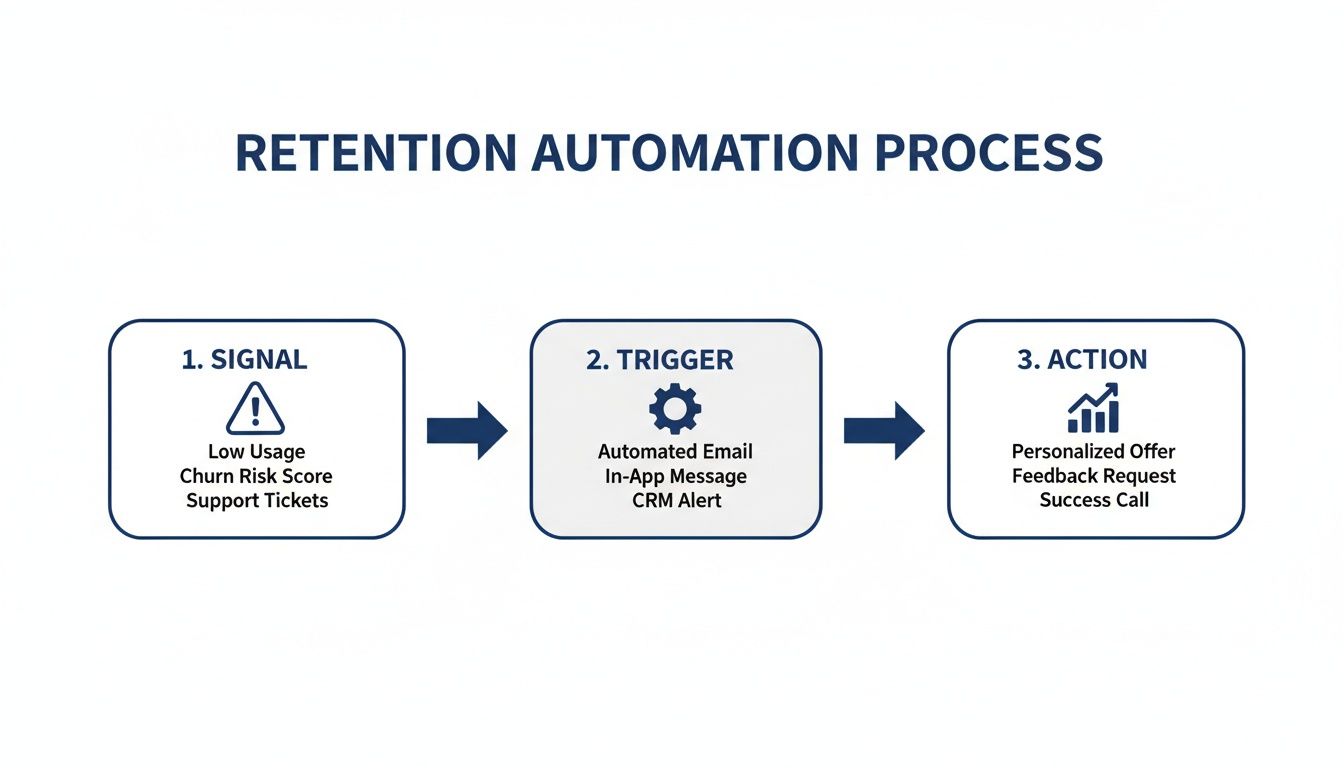
The key is that every meaningful retention action begins with a reliable signal. That signal then kicks off a specific, automated workflow you’ve already built.
Map Your Signals To Automated Actions
Once you've identified your most important signals, the next step is to connect them to specific, automated interventions. This mapping exercise is the heart of your retention blueprint. It makes sure every automated action has a clear purpose tied to a real customer behavior.
For example, a user who hasn't logged in for 14 days doesn't need a generic "we miss you" email. What they need is a targeted message that highlights a new feature related to their past activity or reminds them of the last win they had with your product.
You can get even more sophisticated here by creating a holistic view of account wellness. To dive deeper, check out our guide on https://www.lowchurn.com/blog/customer-health-scores.
To make this crystal clear, I've put together a table that connects common churn signals directly to automated responses you can build.
Connecting Churn Signals to Automated Responses
This table breaks down common churn predictors for SaaS businesses and shows you exactly what kind of automated actions you can implement in response.
| Churn Signal Category | Specific Signal (Example) | Automated Trigger | Automated Action or Campaign |
|---|---|---|---|
| Product Engagement | User hasn't logged in for 21 consecutive days. | A time-based trigger fires after 21 days of inactivity. | Send a personalized re-engagement email highlighting a new, relevant feature. |
| Feature Adoption | A team hasn't used a "sticky" core feature within their first 30 days. | A usage-based trigger checks for core feature adoption at the 30-day mark. | Fire an in-app tour or send a short educational video on how to use that feature. |
| Subscription Health | A customer's credit card is set to expire in the next 30 days. | A Stripe event triggers for the upcoming card expiration. | Kick off a pre-dunning email sequence asking the user to update their card. |
| Team Dynamics | The primary admin or power user on an account has been removed. | A user management event in your app triggers the workflow. | Send an internal Slack alert to the Customer Success team for a manual check-in. |
By mapping things out this way, you create a system where every signal has a purpose and every response is precise.
Build A Solid Foundation For Success
Your retention strategy doesn't exist in a vacuum. It’s deeply connected to the entire customer lifecycle, starting from their very first interaction. A clunky onboarding experience is a huge driver of early-stage churn, making it almost impossible for your later retention efforts to gain any traction.
A strong retention plan often starts with a great first impression. As you design your blueprint, think about integrating automation from day one. This How To Automate Customer Onboarding Step By Step Guide is a fantastic resource that can help you nail the initial experience and stop churn before it even starts.
By thoughtfully designing this blueprint, you move beyond guesswork. You create a system where each signal has a purpose and each automated action is a precise, helpful response. This strategic foundation is what separates effective, revenue-saving customer retention automation from just more marketing noise.
Building Your First Automated Recovery Campaigns
Okay, you've got your blueprint. Now for the fun part: turning those plans into real, revenue-saving campaigns that work for you 24/7. This is where the rubber meets the road.
The great news is that you don't need a massive engineering lift to get started. Modern, no-code tools are built for this exact purpose. You can typically get up and running in minutes by connecting your Stripe account with a simple JavaScript snippet and a read-only API key.
This approach is secure by design. Using a read-only key means the system can see subscription metadata—like plan status or renewal dates—but it can't touch sensitive payment details or personally identifiable information (PII). It’s a privacy-first model that gives you all the power without the risk.
Designing Your Initial Recovery Playbooks
Don't try to boil the ocean. Your first campaigns should be simple and laser-focused on the most common churn signals you identified earlier. Pick one or two high-impact scenarios and build automated playbooks to address them.
Here are a couple of battle-tested templates you can adapt right away:
The "Usage Slump" Nudge: This playbook targets users who are drifting away. For instance, if a user's login frequency drops by 50% over a 14-day period, you can trigger a friendly, automated email. This isn't a sales pitch; it's a helpful prompt. You could highlight a new feature they haven't tried or offer a quick tip based on their past activity.
The "Sticky Feature" Adoption Push: Every product has those one or two "sticky" features that correlate with long-term retention. If a new user hasn't touched these features within their first 15 days, that's a red flag. Trigger an in-app nudge or a short email that showcases the value and provides a direct link to try it out.
The goal here is proactive, helpful intervention. You're reaching out with relevant, contextual messages long before a user gets frustrated enough to even think about cancelling.
Integrating Seamlessly With Stripe
Connecting your product data to your billing system is the linchpin of this whole operation. Stripe is a goldmine of event data that can fuel incredibly effective retention campaigns.
When Stripe sends a webhook that a customer's payment failed, that’s not just a billing problem—it’s a retention opportunity. Instead of a single, cold "payment failed" email, you can trigger a smart dunning campaign. This multi-step sequence could involve a mix of emails, in-app messages, and even SMS reminders. To really nail this, you need a solid grasp of what the dunning process is and how to optimize it.
This workflow is a perfect example of how signals from your product and payment processor can come together to trigger automated recovery actions.
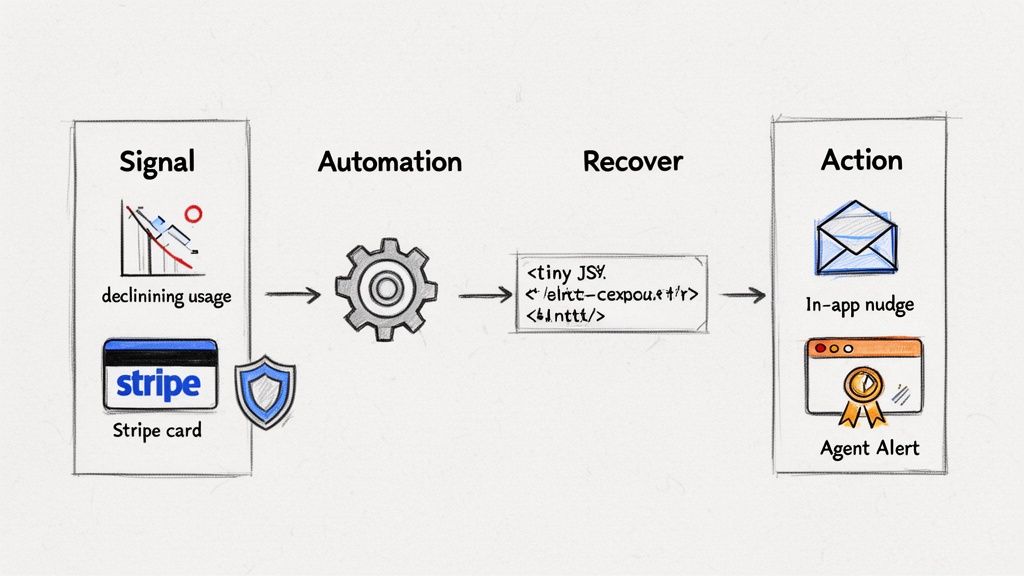
As you can see, different data sources feed into the system, which then triggers the right action to recover at-risk customers and protect your MRR.
The Power of Proactive Retention in B2B SaaS
In the hyper-competitive world of B2B SaaS, these automated systems are non-negotiable. Keeping the customers you have is the foundation of sustainable growth.
Luckily, B2B companies have a natural advantage. High switching costs, deep integrations, and complex buying decisions mean customers are less likely to churn on a whim. The data backs this up: B2B SaaS companies see an impressive 90% average annual retention rate, blowing away consumer subscriptions at just 72%. That 25% difference in loyalty is massive. (You can explore more industry-specific retention benchmarks on focus-digital.co for context.)
This is precisely why investing in automated retention isn't just a defensive tactic—it's a powerful growth strategy.
The best automated campaigns don't feel like automation at all. They feel like a helpful customer success manager reaching out at the perfect moment to offer guidance, not just to collect a payment.
By starting with these foundational campaigns, you'll see an immediate impact on your churn rate. From there, you can build on your successes by adding more sophisticated playbooks and segmenting users for even more personalized outreach. The key is to start, measure, and iterate.
Measuring and Optimizing Your Automation Efforts
Getting your first automated campaigns out the door is a great start, but it’s definitely not the finish line. The real magic of customer retention automation happens when you treat it like a living system—something you constantly measure, learn from, and tweak. Think of it less like a "set it and forget it" solution and more like an engine that needs regular fine-tuning to perform at its best.
To do that, you have to be tracking the right key performance indicators (KPIs). These numbers are your feedback loop, telling you exactly what's working, what’s falling flat, and where your biggest opportunities lie.
Key Metrics to Keep on Your Dashboard
Your automation platform should be giving you a crystal-clear, real-time snapshot of your retention health. Forget digging through spreadsheets; you need an actionable dashboard that puts the most critical data front and center.
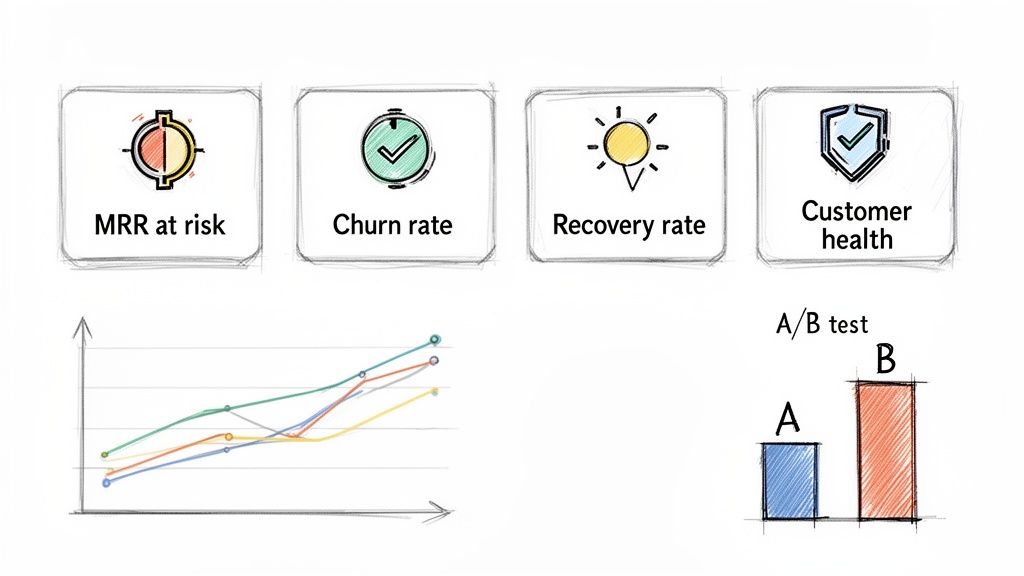
Here’s what I always recommend focusing on:
- MRR at Risk: This is the total monthly recurring revenue tied to customers who are in a dunning process or have been flagged as at-risk. It’s your most immediate financial pulse-check, showing you precisely how much revenue your automated campaigns are fighting to save at this very moment.
- Churn Rate: The classic SaaS metric. It tracks the percentage of customers who cancel their subscriptions in a given period. Your automation efforts should be directly pushing this number down. If your churn rate isn't improving, it’s a big red flag that your triggers or campaigns need a second look.
- Recovery Rate: This is the good stuff. It measures the percentage of at-risk customers or failed payments that your campaigns successfully bring back from the brink. A healthy recovery rate, often in the 60-80% range or even higher, is proof that your dunning sequences and payment reminders are hitting the mark.
- Customer Health Scores: This is a more predictive metric, usually calculated by your automation tool. It rolls up various signals—product usage, login frequency, support tickets—into a single score to help you spot churn risk before a payment ever fails. Keeping an eye on these trends allows you to step in proactively.
By tracking these numbers obsessively, you shift from guesswork to a data-driven strategy. You can see the direct ROI of your work and know exactly where to put your energy next.
Effective retention isn't just about saving one-off accounts; it's about building a system that consistently improves your core business metrics. When you can connect an automated email sequence to a measurable drop in your churn rate, you've unlocked a true growth lever.
The Power of Segmentation and Cohort Analysis
Let’s be honest: not all customers are created equal, and they certainly won't respond to your campaigns in the same way. A generic, one-size-fits-all approach is doomed to underperform. This is where segmentation becomes your secret weapon.
By grouping customers into specific cohorts, you can see how different types of users behave and start tailoring your automation to fit them. This leads to far more precise and effective results.
Try segmenting your customers by:
- Subscription Plan: Enterprise customers likely need a higher-touch, more personal sequence, whereas users on a starter plan might respond perfectly well to a fully automated email flow.
- Onboarding Date: Customers in their first 90 days are in a make-or-break adoption phase. The messages they need are completely different from those for a loyal customer who’s been with you for three years.
- Product Usage: Create groups based on activity levels. Your power users might love getting tips on advanced features, while inactive users just need a gentle nudge to re-engage with the basics.
Analyzing these cohorts will uncover some powerful truths. You might find that your dunning campaign is a home run for SMBs but completely misses the mark with enterprise clients. That’s your cue to build a new, tailored workflow for that high-value segment. For a deeper dive, learning how predictive analytics can identify at-risk segments can help you get ahead of churn before it even starts.
Prove Your Impact with A/B Testing
So, how do you actually know if your changes are working? You A/B test them. This is how you move from "I think this will work" to "I know this works."
It doesn't have to be some massive, complicated undertaking. Start small with a simple, high-impact test inside one of your core campaigns.
Practical A/B Testing Example: A Dunning Campaign
Let's say your current dunning email subject line is: "Action Required: Your Subscription Payment Failed." It's direct, but it also feels a little robotic and cold.
- Hypothesis: A softer, more helpful subject line will get more opens and lead to a better payment recovery rate.
- Control (Group A): "Action Required: Your Subscription Payment Failed."
- Variation (Group B): "Oops! We had trouble with your payment."
- Implementation: Set up your automation tool to send the control subject to 50% of users entering the dunning flow and the variation to the other 50%.
- Measurement: Let it run for a month, then compare the metrics: open rate, click-through rate, and—most importantly—the payment recovery rate for each group.
If Group B shows a 15% higher recovery rate, you've found a clear winner. Now you can confidently roll out the new subject line to 100% of your users and start looking for your next experiment. This continuous cycle of measuring, testing, and optimizing is what separates a good retention strategy from a truly great one.
Common Retention Automation Pitfalls to Avoid
It’s easy to get excited about the promise of customer retention automation. Who wouldn't want to automatically claw back revenue and stop churn before it even happens? But in the rush to get a system live, I've seen a lot of teams make the same costly mistakes.
Knowing what not to do is just as important as having the right playbook. Let’s walk through the most common traps I see companies fall into and, more importantly, how you can sidestep them to build something that actually works.
Relying on Too Few Data Points
The single biggest mistake is building your entire strategy around billing signals from a tool like Stripe. A failed payment is a critical event, for sure, but it’s often the last thing that happens before a customer churns. It's the end of the story, not the beginning.
To get ahead of churn, you need a much richer view. This means combining those payment events with in-app behavioral data. Think about it: a customer who stops logging in or abandons a key feature is a major churn risk long before their credit card ever expires. Relying only on billing data is like waiting to see smoke when a fire has been smoldering for weeks.
Losing the Human Touch Completely
Automation is supposed to make things more efficient, but you can’t sacrifice your customer relationships for it. The goal isn’t to replace your customer success team. It’s to give them superpowers—arming them with the intelligence to step in at just the right moment.
Over-automating can make your brand feel robotic and impersonal, especially to your highest-value customers. The best systems blend automated outreach for low-touch segments with manual intervention for enterprise accounts.
For example, a fully automated email sequence is probably fine for a user on a $29/month plan. But for a client paying $2,900/month? That same signal should trigger a Slack alert for their account manager to pick up the phone. Striking this balance is how you scale without alienating the customers who matter most.
Ignoring Qualitative Feedback
Metrics are fantastic, but they don't tell you the "why." Your data can show you that a specific cohort is churning after 90 days, but it can’t explain that the reason is a clunky UI in a workflow they depend on.
Don't let your automation make you deaf to the voice of your customer. You have to supplement all that quantitative data with real, human insights. Look for gold in places like:
- Support Tickets: What are the recurring points of friction and frustration?
- Cancellation Surveys: What are the real reasons customers give for leaving?
- Customer Interviews: Actually talk to people—both the happy ones and the ones who churned.
This feedback is invaluable. It helps you refine your churn signals and adjust your automated campaigns to solve the actual problems your customers are facing.
Launching Generic, Impersonal Campaigns
Finally, the most common pitfall is the one-size-fits-all message. An email that opens with "Hey there," and contains zero specific information about the user is just noise. It’s almost guaranteed to be ignored.
Great retention automation feels personal. Use dynamic tags to pull in the user's name, their company, or even specific data about how they've used your product. This simple step can make all the difference.
Example of an Impersonal vs. Personalized Message
| Category | Generic (Less Effective) | Personalized (More Effective) |
|---|---|---|
| Subject Line | Your Account | Quick question about your reporting dashboard |
| Opening Line | We noticed you haven't been active. | Hi Sarah, saw you haven't run a sales report in a couple of weeks. |
| Call to Action | Log in to your account. | Here's a 2-minute video on creating custom sales reports. |
This level of detail shows you're paying attention and genuinely trying to help. It transforms a robotic alert into a valuable, relationship-building touchpoint. By sidestepping these common mistakes, you’ll build a customer retention automation system that not only saves revenue but also makes your customers feel valued.
Answering Your Questions on Retention Automation
Jumping into a new strategy always sparks a few questions. When it comes to setting up customer retention automation, I’ve noticed that SaaS founders and revenue leaders tend to wrestle with the same practical concerns. Let’s tackle the most common ones head-on.
How Do You Balance Automation with a Personal Touch for High-Value Clients?
This is probably the most important question, and the answer is simpler than you'd think: great automation doesn't replace the human touch—it directs it. Your system should be an early-warning radar for your customer success team.
Instead of a one-size-fits-all approach, you build tiered responses.
- For smaller accounts: A fully automated email sequence, triggered when product usage drops off, is often all you need. It’s effective and scales beautifully.
- For enterprise clients: That exact same signal shouldn’t just send an email. Instead, it should automatically create a task in your CRM or ping the account manager on Slack with full context. This prompts a personal phone call or check-in, not a generic message.
Think of automation as the system that figures out the "who" and "why," freeing up your team to deliver a truly personal, high-touch response right when it matters most.
What Does the Initial Setup Time Realistically Look Like?
I get it. For a small team without dedicated engineers, the thought of a long, complicated implementation is a non-starter. But modern retention platforms are built for speed, not friction. If you’re using a payment processor like Stripe, the initial setup can be incredibly fast—often less than an hour.
It usually boils down to two simple steps:
- Connect Stripe: This is typically a one-click process using a secure, read-only API key. It just lets the platform see subscription metadata, not sensitive financial data.
- Add a JS Snippet: You pop a small piece of JavaScript code on your site. This is how you track behavioral signals like user logins and feature usage.
After that, you can launch your first campaigns using pre-built playbooks. The real work isn't the technical setup; it's the strategy you mapped out beforehand.
Your first automated campaign can be live and saving customers the same day you sign up. The barrier to entry has never been lower, making this a powerful tool even for the most resource-strapped teams.
Is This Suitable for an Early-Stage SaaS Company?
Absolutely. In fact, I'd argue it’s even more critical for an early-stage company. When you only have a few hundred customers, every single cancellation stings. Losing just a handful of users can have a massive impact on your MRR and completely derail your growth trajectory.
Putting retention automation in place early on does a few key things:
- It bakes a scalable, proactive retention culture into your company from day one.
- It helps you pinpoint your product's "aha!" moments and sticky features much faster.
- It stops you from falling into the classic "leaky bucket" trap, where you’re so focused on acquiring new users that you don't even notice the ones slipping out the back door.
For a founder wearing multiple hats, an automated system acts like a tireless team member, watching over your customer base 24/7. It lets you focus on building the product and finding your next ten customers. This isn't just a big-company play; it’s a foundational tool for building sustainable growth.
Ready to stop churn before it starts? LowChurn uses AI to predict at-risk customers and gives you the one-click campaigns to save them. Protect your MRR by getting started at https://www.lowchurn.com.