In the SaaS world, the cost of acquiring a new customer continues to climb, making retention the new frontier for sustainable growth. While chasing new logos is exciting, the real engine of a healthy subscription business lies in keeping the customers you've already won. But generic advice like 'listen to your customers' is no longer enough. The challenge is operationalizing retention, turning vague goals into a systematic, data-driven process. High-performing teams understand that reducing churn is not about heroic, last-minute saves; it's about building a proactive system that predicts and prevents it.
This article breaks down 10 modern customer retention best practices that top SaaS teams use to protect and grow their monthly recurring revenue (MRR). We'll move beyond the basics, providing actionable frameworks and clear examples for each strategy. You will learn how to implement everything from predictive churn analytics and automated re-engagement campaigns to sophisticated customer health scoring and proactive success management.
We'll also show how to put these theories into practice, demonstrating how tools like LowChurn can help you operationalize these strategies without a dedicated data science team. You will leave with a clear roadmap to:
- Identify at-risk customers before they show signs of leaving.
- Segment users to deliver personalized, high-impact interventions.
- Automate outreach to win back customers and prevent billing failures.
- Measure the right KPIs to track the health of your customer base.
By the end of this guide, you will have a comprehensive playbook for building a retention engine that drives profitability and long-term, sustainable growth.
1. Predictive Churn Analytics & Real-Time MRR Health Dashboards
The most effective customer retention best practices are proactive, not reactive. Instead of waiting for customers to cancel, modern SaaS businesses use AI-driven predictive analytics to identify at-risk accounts before they churn. This approach shifts retention from a lagging indicator (analyzing past churn) to a leading one (intervening based on future risk).
Platforms like LowChurn connect directly to data sources such as Stripe and product usage logs to build predictive models. These models analyze subtle changes in behavior, like decreased feature usage, payment hesitations, or reduced login frequency, to assign a dynamic "health score" to each customer. This allows teams to see a 7- to 30-day forecast of which accounts are likely to churn and why.
How to Operationalize Predictive Analytics
This isn't just about data; it's about action. The goal is to surface insights that your customer success and product teams can use immediately.
- Create Tiered Dashboards: An executive dashboard might show high-level MRR health, churn rate trends, and overall portfolio risk. An operational dashboard for a Customer Success Manager (CSM), however, should list specific at-risk accounts, their health scores, and the key factors driving that risk.
- Focus on Leading Indicators: While overall churn rate is important, dashboards should prominently feature forward-looking metrics. These include the number of accounts in the "at-risk" category, the total MRR at risk, and negative trends in health scores over the past week.
- Segment Your Churn Analysis: Don't just track your aggregate churn rate. Break it down by customer cohort, subscription plan, or user segment to pinpoint where the biggest problems are. For example, you might find that customers who don't adopt a specific feature within 30 days have a much higher churn probability.
Key Insight: The power of predictive analytics lies in translating complex data into a simple, actionable signal: "This customer needs attention now."
By combining predictive forecasts with real-time operational dashboards, teams can move from firefighting to strategic, targeted intervention, significantly improving net revenue retention. To dive deeper into this topic, you can learn more about how predictive analytics can boost customer retention.
2. Automated Win-Back & Re-engagement Campaigns
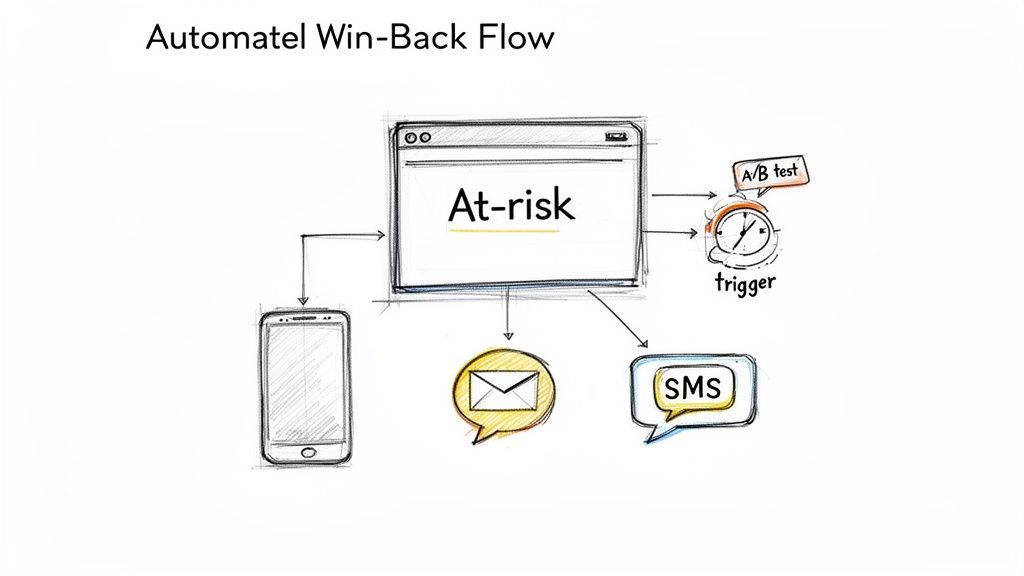
Identifying an at-risk customer is only half the battle; the other half is taking swift, targeted action. Automated win-back and re-engagement campaigns are a cornerstone of modern customer retention best practices, allowing you to proactively intervene the moment a customer's health score drops, without manual oversight for every single account.
These are not generic email blasts. They are multi-touch, multi-channel sequences triggered by specific behavioral data. Platforms like Intercom or HubSpot can use signals from a predictive tool like LowChurn to initiate a workflow. When a customer's churn probability passes a certain threshold, it can automatically trigger a sequence of emails, in-app messages, or even SMS notifications designed to demonstrate value and recapture engagement.
How to Operationalize Automated Re-engagement
The key is to make the outreach feel personal and relevant, even when it's automated. The goal is to deliver the right message to the right segment at the right time.
- Segment Campaigns by Churn Reason: Don't send a discount offer to a customer who is struggling with feature adoption. Create separate workflows based on the primary churn driver. For low usage, send product tips and success stories. For cost sensitivity, present a temporary discount or a plan downgrade option.
- Use Product-Specific Messaging: Leverage usage data to make your outreach highly specific. For example, a campaign could say, "We noticed you haven't used our new reporting feature. Here’s a 2-minute video showing how it can save you hours each week." This is far more effective than a generic "We miss you!" message.
- Test Non-Monetary Retention Offers: While discounts can be effective, they can also devalue your product. Test other incentives like a free trial extension, temporary access to a premium feature, a one-on-one session with a product expert, or early access to your product roadmap. This reinforces value over price.
Key Insight: Automation doesn't mean impersonal. When triggered by specific behavioral data, automated campaigns can deliver hyper-relevant, timely interventions that feel both personal and helpful.
By connecting predictive churn signals to an automated engagement engine, you create a powerful, scalable system that actively works to save customers before they are lost. For more inspiration, you can explore some of the most effective win-back email campaigns that brands are using today.
3. Customer Health Scoring & Segmentation
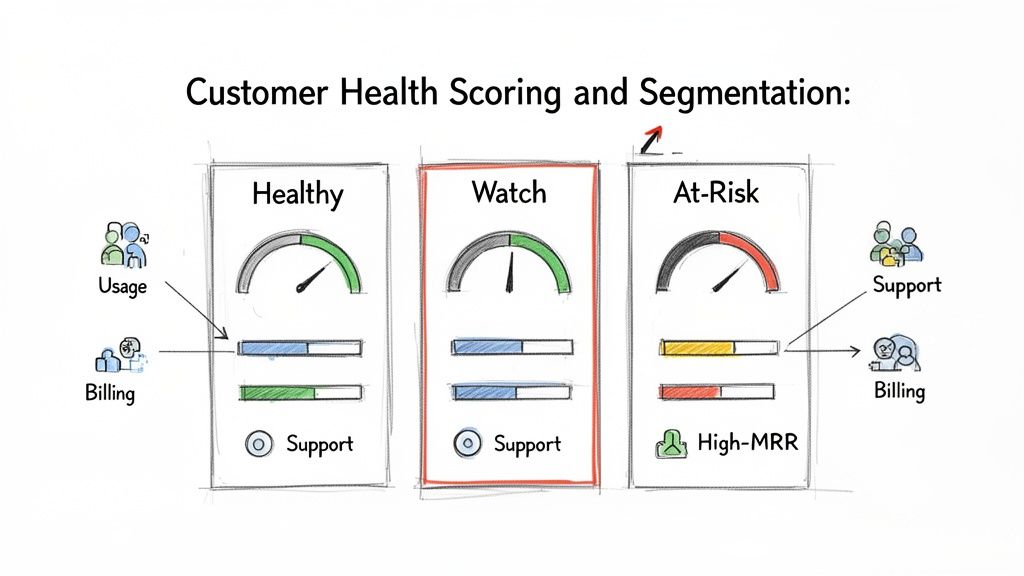
While predictive analytics forecasts future risk, customer health scoring provides a real-time, quantifiable measure of an account's current engagement and satisfaction. This practice involves creating a composite score from weighted indicators like product usage, feature adoption, support ticket sentiment, and payment history. It transforms abstract customer relationships into concrete data points, allowing teams to prioritize efforts effectively.
By assigning a score, you can segment customers into clear categories such as "Healthy," "At-Risk," or "Needs Attention." This segmentation is crucial for allocating resources intelligently. For example, a Customer Success Manager (CSM) can focus their high-touch efforts on high-value, at-risk accounts, while a low-touch digital campaign might target a broader segment showing early signs of disengagement.
How to Operationalize Customer Health Scoring
A health score is only useful if it drives action. The goal is to build a system that is both accurate and simple enough for your team to use daily.
- Start with Key Indicators: Begin with 3-5 high-impact metrics that strongly correlate with retention for your business. Common starting points include login frequency, adoption of a "sticky" feature, number of recent support tickets, and NPS responses.
- Establish Clear Benchmarks: Define what each score means. For example, a score of 80-100 might be "Healthy," 60-79 could be "Watch," and below 60 is "At-Risk." These thresholds should trigger specific automated or manual playbooks.
- Segment Your Scoring Model: Health indicators can vary significantly across customer segments. An enterprise customer's health profile looks different from an SMB's. Create distinct scoring models for different cohorts, such as plan type, industry, or company size.
- Combine Quantitative and Qualitative Data: While automated scores are powerful, they can miss crucial context. Empower CSMs to override a score based on their direct interactions and knowledge of the customer's business goals or internal changes.
Key Insight: A customer health score isn't just a number; it's a conversation starter that directs your team's attention to where it's needed most.
This approach is one of the most fundamental customer retention best practices because it creates a shared, data-driven language for understanding customer value and risk across the entire organization. To build your own system, you can explore the fundamentals of how to create an effective customer health score.
4. Proactive Customer Success Management & In-Context Support
Effective customer retention best practices require moving from a reactive support model to a proactive success framework. Instead of waiting for a customer to report a problem, proactive customer success management (CSM) uses data to anticipate needs, guide users toward value, and intervene before frustration sets in. This is about making customers successful with your product, not just answering their questions.
This approach combines high-touch human interaction with scalable, in-context digital guidance. Platforms like Gainsight and Intercom have popularized this model, where CSMs use product usage data to identify adoption gaps or opportunities. For example, Calendly sends users proactive tips on best practices based on their scheduling patterns, while Slack uses in-app guides to help new teams discover critical features organically.
How to Operationalize Proactive Success
The goal is to deliver the right help at the right moment, whether from a person or an automated tool. This ensures users achieve their desired outcomes efficiently, strengthening their reliance on your product.
- Segment CSM Outreach: Apply a tiered model. High-value accounts receive dedicated, one-on-one guidance from a CSM. For lower-tier customers, use automated email sequences and in-app messages triggered by specific behaviors or milestones, such as inviting their first teammate.
- Define and Track Success Milestones: Identify the key "aha!" moments in your customer journey, like creating the first project or integrating a key tool. Use in-app guidance from tools like Appcues to steer new users toward these milestones and celebrate their progress.
- Empower CSMs with Data: Give your CSMs access to real-time product usage data and health scores. An outreach call is far more effective when a CSM can say, "I noticed your team hasn't adopted our reporting feature yet; here’s how it can save you time," instead of a generic "Just checking in."
- Use In-Context Support for Friction Points: Analyze usage data to find where users get stuck. Implement targeted tooltips, walkthroughs, or contextual help articles directly on that screen to resolve friction at the point of need, preventing support tickets and abandonment.
Key Insight: Proactive success isn't about more communication; it's about more relevant, timely, and context-aware communication that helps customers achieve value faster.
By combining intelligent automation with data-informed human outreach, you create a scalable system that drives adoption and proves your product’s value continuously. To structure these efforts, you can build a more comprehensive strategy by exploring customer success plan templates.
5. Subscription Usage Monitoring & Feature Adoption Tracking
One of the most powerful customer retention best practices involves understanding not just if customers are paying, but how they are using your product. Monitoring subscription usage and feature adoption provides a direct window into the value customers are receiving. A sudden drop in logins or the neglect of a key feature is often the first silent signal that an account is at risk of churning.
Platforms like LowChurn integrate directly with subscription data from Stripe and product analytics tools like Amplitude or Mixpanel. This unified view connects billing metadata (plan tier, seat counts) with behavioral data (login frequency, feature usage) to create a comprehensive picture of account health. It helps answer critical questions: Are customers using the features that correlate with long-term retention? Is engagement dropping off after the first 30 days?
How to Operationalize Usage Tracking
Simply collecting data isn't enough; you must translate it into proactive retention strategies that your customer success and product teams can execute.
- Define "Active" For Your Product: An active user looks different for every SaaS. Define clear, quantifiable metrics for activity, such as logging in three times per week or using a specific "sticky" feature at least once a month.
- Set Segment-Specific Baselines: Engagement patterns vary significantly. An enterprise customer's usage will differ from an SMB's. Establish distinct engagement baselines for each customer segment to avoid false positives or negatives in your health scoring.
- Create Automated Usage Alerts: Configure automated alerts for significant drops in activity, such as a 50% decrease in logins week-over-week. This allows CSMs to intervene immediately with a targeted outreach campaign before the account disengages completely.
- Track Feature Adoption as a Leading Indicator: Low adoption of new or core features is a strong predictor of future churn. Use this data to identify gaps in your onboarding process or to inform product roadmap decisions.
Key Insight: How customers use your product is a more accurate predictor of retention than what they say. Usage data provides objective, real-time evidence of the value they are, or are not, receiving.
By systematically monitoring user behavior, you can identify disengagement early, address product-related friction, and ensure your customers are continuously realizing the value of their subscription.
6. Win-Loss & Cancellation Reason Analysis
Understanding why customers leave is just as critical as predicting who will leave. A systematic win-loss and cancellation reason analysis program moves your team beyond assumptions and provides concrete data to guide product, marketing, and retention strategies. Instead of guessing, you learn precisely whether churn is driven by price sensitivity, missing features, poor onboarding, or a competitor's new offer.
This process involves systematically collecting feedback at the point of cancellation through various channels. For example, Calendly uses concise exit surveys to differentiate between users churning due to feature gaps versus those who are price-sensitive. This feedback directly informs their product roadmap and pricing experiments. Similarly, high-growth companies use platforms like Qualtrics or simple tools like SurveyMonkey to categorize churn reasons by customer segment, revealing patterns that might otherwise go unnoticed.
How to Operationalize Cancellation Analysis
The goal is to create a consistent feedback loop that translates churn reasons into actionable business intelligence. This is a core component of effective customer retention best practices.
- Implement Layered Feedback Collection: Start with a mandatory, single-question multiple-choice survey in your cancellation flow to maximize response rates. For those who complete it, offer an optional open-text field for more detail. For high-value enterprise accounts, trigger an automated task for a CSM to schedule a brief win-loss interview.
- Segment Your Analysis: Don't aggregate all churn reasons into one bucket. Analyze feedback based on customer lifetime value, subscription plan, acquisition channel, or product usage levels. You may find that your enterprise clients are leaving for a competitor, while SMB clients are churning due to price.
- Create a Cross-Functional Feedback Loop: The insights are useless if they stay within the customer success team. Schedule a monthly or quarterly meeting to present churn reason trends to product, marketing, and leadership teams. This ensures the data directly influences roadmap prioritization and competitive positioning.
Key Insight: Proactively asking "Why are you leaving?" and rigorously analyzing the answers is the most direct way to fix the core issues causing churn in the first place.
By systematically capturing and dissecting the voice of the churning customer, you can make smarter, data-driven decisions that prevent future customers from leaving for the same reasons. This transforms every lost customer into a valuable lesson for improving long-term retention.
7. Value Communication & ROI Demonstration
Customers don't churn because they dislike your product; they churn because they no longer see its value. One of the most critical customer retention best practices is to proactively and continuously demonstrate the return on investment (ROI) your product delivers. Instead of assuming customers recognize the value, you must make it explicit, measurable, and impossible to ignore.
This approach goes beyond generic feature updates. It involves translating product usage into tangible business outcomes like hours saved, revenue gained, or costs reduced. Companies like Salesforce and Gainsight have built entire value realization programs around this concept, ensuring customers can always connect their subscription payment to concrete business results. This transforms your product from a "nice-to-have" expense into an indispensable asset.
How to Operationalize Value Communication
The goal is to embed ROI conversations into the entire customer lifecycle, not just during renewal negotiations. This requires a systematic approach to quantifying and communicating value.
- Define Core Value Metrics: Identify 2-3 key business outcomes your product directly influences. For an analytics tool, this might be "time-to-insight reduced." For a marketing automation platform, it could be "pipeline generated."
- Build In-App ROI Dashboards: Don't hide the value in a separate report. Create a section within your product that automatically calculates and displays ROI based on usage data. Datadog does this well by showing customers their estimated infrastructure cost savings directly on their dashboards.
- Conduct Quarterly Business Reviews (QBRs): For high-value accounts (e.g., those above $5K ARR), schedule regular QBRs. Use this time to present a formal report detailing their usage, achieved outcomes, and ROI, reinforcing the value of their investment.
- Create Industry-Specific Narratives: Tailor your value propositions. Show a retail customer how you've helped similar companies increase basket size, and show a B2B SaaS customer how you've reduced their customer acquisition costs.
Key Insight: Don't make your customers do the math. Proactively prove your product’s worth in the language of their business: money and time.
By consistently communicating tangible value, you anchor your product's importance in clear business terms. This makes renewal a logical conclusion rather than a difficult decision, significantly strengthening your customer retention best practices.
8. Expansion Revenue & Upsell/Cross-sell Programs
One of the most powerful customer retention best practices isn't just about preventing churn; it's about actively growing existing accounts. Focusing on expansion revenue through upsells and cross-sells turns happy customers into your best source of growth. This strategy not only increases MRR but also deeply embeds your product into a customer's workflow, making them stickier and less likely to churn.
This approach centers on identifying moments when a customer has outgrown their current plan or could benefit from additional features. For example, Slack masterfully encourages teams to upgrade from free plans once they hit message limits, while HubSpot guides users from its free CRM into specialized paid "Hubs" for Marketing, Sales, or Service. The goal is to align your product's growth path with the customer's success trajectory.
How to Operationalize Expansion Revenue
Building a successful expansion program requires identifying the right triggers and making the upgrade process seamless. It’s about offering more value at the precise moment it’s needed.
- Identify Expansion Triggers: Use product analytics to spot signals that a customer is ready for an upgrade. This could be hitting a usage limit (e.g., number of seats, contacts, or API calls), consistently using features adjacent to a premium tier, or achieving specific success milestones that indicate maturity.
- Create Clear Upgrade Paths: The path to expansion should be obvious and low-friction. Integrate clear calls-to-action within the product UI that highlight the benefits of upgrading. Offer trial periods for higher tiers or new modules to let customers experience the added value firsthand before committing.
- Segment and Target Your Efforts: Not all customers expand the same way. Analyze your data to see which cohorts or user segments are most likely to upgrade. You might find that customers in a certain industry or those who adopt a specific "sticky" feature are prime candidates for targeted upsell campaigns.
Key Insight: The best expansion revenue strategies feel like a natural next step for the customer, not a forced sales pitch.
By treating existing customers as a primary growth channel, you create a powerful flywheel. Increased adoption leads to greater value, which justifies a larger investment, ultimately strengthening the customer relationship and building a formidable defense against churn.
9. Community Building & User-Driven Engagement
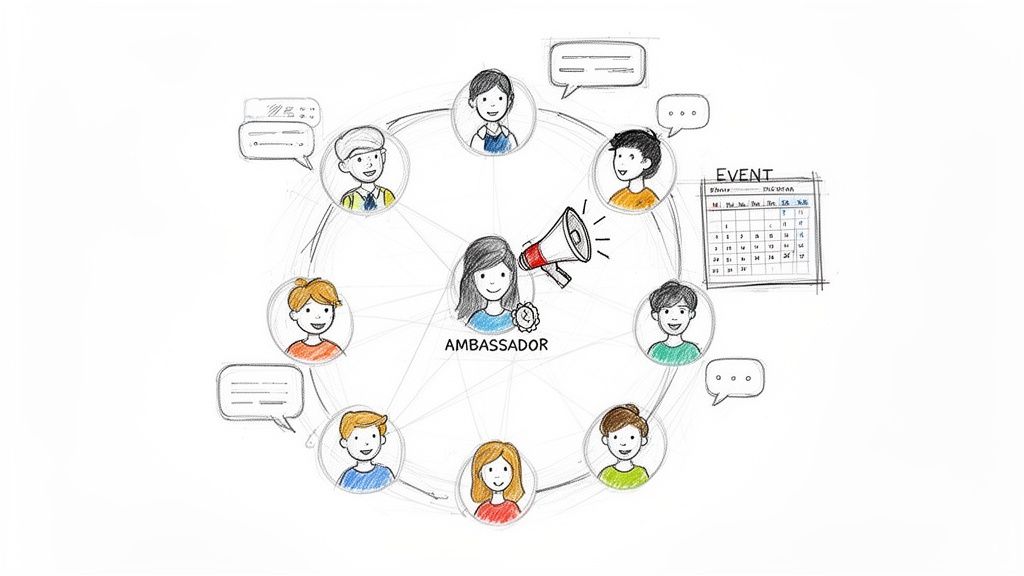
Effective customer retention best practices go beyond the product itself; they build a sense of belonging and emotional investment. Nurturing a user community transforms customers from passive users into active advocates who support each other, share best practices, and provide invaluable product feedback. This creates a powerful moat that is difficult for competitors to replicate.
Instead of your team being the only source of support and knowledge, a community allows customers to learn from one another. Companies like Salesforce with its Trailblazer community and Notion with its user-created templates have demonstrated that a vibrant community can become a core part of the product's value proposition, driving both stickiness and organic growth.
How to Operationalize Community Building
Building a community doesn't require a massive upfront investment. It's about creating a space for connection and consistently adding value. For those looking to implement community-driven engagement, exploring the 12 Best Online Community Platforms for Creators & Brands can provide valuable insights into suitable tools.
- Start Small and Focused: Begin with a single Slack channel or Discord server rather than a complex, custom platform. The goal is to prove the concept and generate early momentum before scaling your efforts.
- Recruit Your Power Users: Identify your 10 to 20 most engaged customers and invite them to be founding members or moderators. Empowering these advocates gives them a sense of ownership and helps seed initial conversations.
- Create Clear Incentives: Offer tangible value for participation. This could include early access to new features, exclusive content, direct access to the product team, or simple recognition through "super user" badges.
- Host Regular Events: Drive consistent engagement by hosting monthly webinars, "ask me anything" (AMA) sessions with your leadership team, or informal virtual office hours to foster direct interaction.
Key Insight: A strong community turns your product from a simple utility into a professional identity, making it much harder for customers to leave.
By fostering connections between users, you create a self-sustaining ecosystem of support and engagement. This not only improves retention but also serves as a critical source of feedback, helping you build a better product that truly meets customer needs.
10. Flexible Pricing, Pause & Downgrade Options
Rigid billing structures are a common source of involuntary and voluntary churn. When a customer's only options are to "pay in full" or "cancel," you force them into an all-or-nothing decision. One of the most effective customer retention best practices is to build flexibility directly into your pricing and billing model, acknowledging that customer needs and financial situations can change.
Instead of losing a customer entirely, offering options like pausing a subscription, easily downgrading to a lower tier, or choosing between monthly and annual plans can preserve the long-term relationship. For instance, a seasonal business using a tool like Shopify may not need full service in the off-season, and a "pause and build" plan retains them instead of forcing a cancellation. Similarly, Slack allows teams to pause their workspace billing, keeping the relationship intact for when they're ready to resume.
How to Operationalize Billing Flexibility
The key is to make these options a self-service, low-friction part of the customer experience, not a hidden feature that requires a support ticket.
- Implement a "Pause Subscription" Feature: Integrate a pause option directly into the billing portal. Set clear limits, such as allowing a pause for up to three months, to prevent abuse while still providing a valuable off-ramp for customers facing temporary budget constraints or disuse.
- Offer Seamless Downgrades: Make it just as easy to downgrade as it is to upgrade. A customer who downgrades is still a customer. This transparency builds trust and keeps them in your ecosystem, leaving the door open for future upselling when their needs change again.
- Use Annual Discounts Strategically: Offer a tangible incentive (typically 10-20% for SaaS) for committing to an annual plan. This locks in revenue and reduces monthly churn risk, but it should always be presented alongside a flexible month-to-month option for those who value less commitment.
- Track Pause and Downgrade Cohorts: Use your analytics to monitor customers who pause or downgrade. Analyze their reactivation rates and the reasons they provided. This data is a goldmine for identifying product gaps or pricing tier misalignments that can be addressed proactively.
Key Insight: Treating cancellation as the only alternative to full payment is a false choice. Flexible billing turns a potential churn event into a temporary change in status, dramatically improving long-term retention.
Top 10 Customer Retention Practices Comparison
| Strategy | 🔄 Implementation complexity | ⚡ Resource & technical requirements | 📊 Expected outcomes | 💡 Ideal use cases / tips | ⭐ Key advantages |
|---|---|---|---|---|---|
| Predictive Churn Analytics & Real-Time MRR Health Dashboards | High — ML, integrations, dashboards | High — billing + product data, data engineering | Early detection of at-risk MRR; prioritized interventions | Best for mid-to-large SaaS with historical data; surface leading indicators prominently | Proactive MRR-focused risk prioritization; executive visibility |
| Automated Win-Back & Re-engagement Campaigns | Medium — automation + channel orchestration | Moderate — marketing automation, templates, compliance | Scalable recovery of at-risk users; measurable ROI | Use when clear behavioral triggers exist; segment by churn reason | Scales outreach; rapid A/B testing and clear ROI |
| Customer Health Scoring & Segmentation | Medium — scoring design + CRM integration | Moderate — metric definitions, calibration, CRM links | Objective prioritization of CSM effort; trendable signals | Start with 3–5 indicators; reweight monthly by cohort | Operationalizes health; enables accountable CSM workflows |
| Proactive Customer Success Management & In-Context Support | Medium–High — process + product touches | High — CSM headcount, in-app tooling, cross-team alignment | Faster time-to-value, higher adoption, lower churn | Reserve hands-on CSM for high ARR; automate low-tier outreach | Drives feature adoption and customer NPS |
| Subscription Usage Monitoring & Feature Adoption Tracking | Medium — instrumentation + analytics | Moderate–High — event tracking, analytics stack | Early disengagement alerts; product insight for roadmap | Define "active" per segment; alert on usage drops | Objective engagement signals; links features to retention |
| Win-Loss & Cancellation Reason Analysis | Low–Medium — surveys + interviews + analysis | Low–Moderate — survey tooling, qualitative analysis | Root-cause insights to inform product and pricing | Keep exit surveys brief; interview high-value churners quickly | Reveals why customers leave; guides targeted fixes |
| Value Communication & ROI Demonstration | Medium — dashboards + QBR workflows | Moderate — data pipelines, CSM time for reviews | Higher renewals, upsell, reduced price sensitivity | Define 2–3 business metrics; automate dashboards | Shifts renewal conversations to measurable value |
| Expansion Revenue & Upsell/Cross-sell Programs | Medium — playbooks + CRM tracking | High — sales/CS effort, trigger detection data | Increased MRR and stickiness; lower churn for expanders | Identify clear upgrade triggers; offer trials for new tiers | High-margin growth with lower CAC than new acquisition |
| Community Building & User-Driven Engagement | Medium–High — ongoing moderation & events | High — community managers, events, content | Higher retention, advocacy, reduced support load over time | Start small; recruit power users as moderators | Drives organic engagement and network effects |
| Flexible Pricing, Pause & Downgrade Options | Medium — billing logic + policy | Moderate — billing system changes, CX flows | Reduced abrupt cancellations; preserved lifecycle value | Offer limited pause windows; track paused cohort reactivation | Keeps customers in-system; increases chance of reactivation |
From Reactive Firefighting to a Proactive Retention Engine
Navigating the landscape of customer retention can often feel like a constant battle against churn, a reactive scramble to save accounts on the brink. However, as we've explored, the most successful SaaS businesses reframe this challenge entirely. They don't just fight churn; they build a proactive, data-driven engine designed to prevent it from ever taking root. Mastering these customer retention best practices is the key to transforming your approach from a defensive position to an offensive strategy for sustainable growth.
The journey begins with a fundamental shift in mindset. Instead of asking, "Why did this customer leave?" the central question becomes, "How can we deliver overwhelming value before they even consider churning?" The answer lies in the interconnected strategies we've detailed, each serving as a critical gear in your retention machine.
Synthesizing Your Retention Strategy
The practices covered in this article are not standalone tactics but a cohesive framework. Let's recap how they synergize:
- Foundation of Insight: It all starts with data. Predictive Churn Analytics and Real-Time MRR Health Dashboards act as your early warning system. They identify at-risk accounts long before manual analysis could, giving you the crucial advantage of time.
- Targeted, Scalable Action: Once you know who is at risk, Customer Health Scoring & Segmentation allows you to understand why. This insight fuels Automated Win-Back & Re-engagement Campaigns for low-touch segments and informs the playbooks for your Proactive Customer Success Management team.
- Proving and Enhancing Value: Retention is ultimately a referendum on the value you deliver. By using Subscription Usage Monitoring to track feature adoption and Value Communication to demonstrate ROI, you continuously reinforce your product's indispensability. This creates natural opportunities for Expansion Revenue & Upsell/Cross-sell Programs, turning retention into a profit center.
- Building a Moat: Finally, you create a powerful competitive advantage by fostering a loyal base. Community Building turns passive users into active advocates, while offering Flexible Pricing & Pause Options shows empathy and builds long-term goodwill, reducing involuntary churn and strengthening the customer relationship.
Your First Steps Toward a Proactive Model
Implementing all ten practices at once can be daunting. The key is to start small, measure the impact, and build momentum. Choose one or two initiatives that address your most significant pain points today.
Is your CSM team overwhelmed? Start with Customer Health Scoring to help them prioritize their efforts. Are you losing customers without understanding why? Implement a robust Win-Loss & Cancellation Reason Analysis process. To transition effectively from reactive responses to a scalable retention engine, exploring robust tools like a dedicated Kytes' retention platform can provide the necessary infrastructure to manage these complex workflows and data points in one place.
Ultimately, adopting these customer retention best practices is about more than just reducing your churn rate. It's about building a resilient, customer-centric organization that sees every interaction as an opportunity to deepen relationships and prove its worth. By shifting from firefighting to proactive value delivery, you're not just saving revenue; you are actively building the foundation for predictable, long-term success and creating customers who don't just stay, but advocate for your brand. This strategic focus is what separates fleeting startups from enduring market leaders.
Ready to turn these best practices into reality? LowChurn provides the predictive analytics and real-time health scoring you need to stop firefighting and start building your proactive retention engine. See which customers are at risk and why, all with a simple, no-code setup that connects directly to your Stripe account. Get your free churn analysis with LowChurn today.