A customer retention program isn't just a set of "nice-to-have" activities. It's a deliberate, strategic system designed to keep the customers you've already won. For any SaaS business, this isn't merely a defensive move against churn; it’s the very foundation of predictable revenue, sustainable growth, and long-term success.
Why Retention Is Your True SaaS Growth Engine
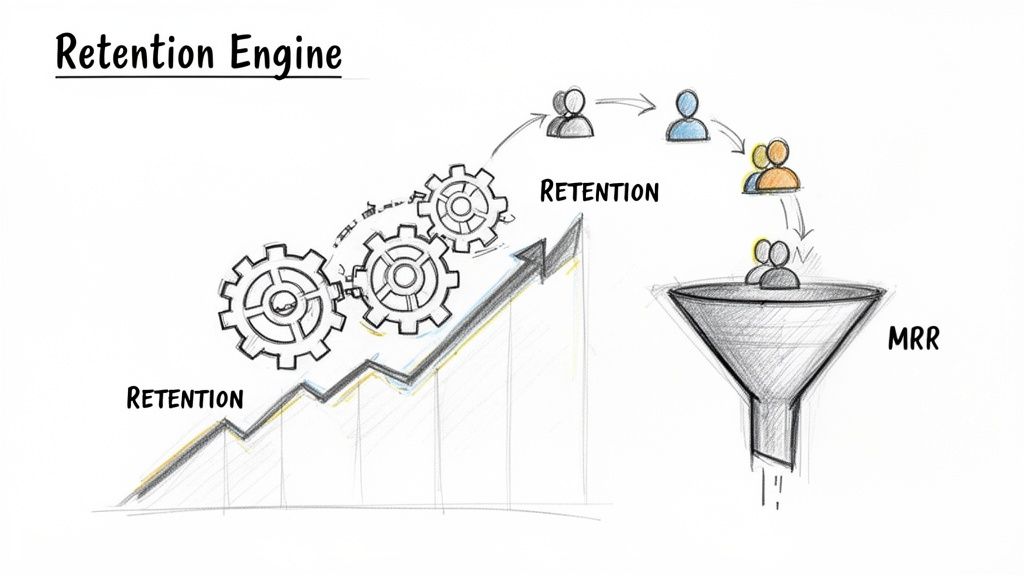
In the SaaS world, customer acquisition tends to soak up the spotlight. We get excited about new logos and celebrate every jump in top-line growth. But the quiet, compounding power of retention is where the real, enduring businesses are built.
Picture your Monthly Recurring Revenue (MRR) as a bucket. New customers are the water you pour in, but churn is a hole at the bottom. It doesn't matter how fast you pour; a leaky bucket will never stay full. A proactive retention program is how you patch that hole for good.
The Compounding Impact of Small Retention Gains
Let’s talk numbers, because this is where the magic happens. Imagine your SaaS business has an 80% annual customer retention rate, which means you're dealing with a 20% annual churn rate. Not terrible, but not great.
Now, what if you could implement a focused program that bumps that retention figure by just five points, up to 85%?
That tiny lift doesn't just add 5% to your bottom line. It actually slashes your churn rate from 20% down to 15%. That's a massive 25% reduction in customer churn. The financial impact is even more compelling.
The Compounding Impact of Small Retention Gains
This table illustrates how seemingly minor improvements in annual retention rates can lead to significant reductions in churn and protect your MRR.
| Annual Retention Rate | Annual Churn Rate | Impact on a $50k MRR Business (Annual MRR Protected) |
|---|---|---|
| 80% | 20% | Baseline |
| 85% | 15% | $30,000 in protected ARR |
| 90% | 10% | $60,000 in protected ARR |
| 95% | 5% | $90,000 in protected ARR |
For a business with $50k in MRR, that seemingly small 5% improvement protects an additional $30,000 in annual revenue that would have otherwise walked right out the door. That's the power of focusing on retention.
This is the leverage that retention provides. It’s not about incremental improvements; it's about making a fundamental shift in your growth trajectory by keeping the customers you worked so hard to acquire in the first place.
This isn't just a theory; the data backs it up. The best SaaS companies consistently hit 90-95% annual customer retention. Better yet, loyal customers become more valuable over time. Studies show that retained customers increase their spending by an average of 67% in their third year compared to their first six months.
Shifting from Reactive to Proactive
Ultimately, building a customer retention program is about changing your company's mindset. You stop waiting for cancellation emails and exit surveys to tell you what went wrong. Instead, you start predicting and preventing churn before it even has a chance to happen.
This turns retention into a core growth function, not just a task for the customer support team. For more ideas on how to build this proactive muscle, especially with modern tools, check out this piece on enhancing customer retention strategies with Mindreader. This forward-looking stance is what separates the businesses that scale from those stuck forever on the acquisition treadmill.
Setting Goals That Actually Drive Retention
Any good customer retention program starts with a clear plan, not just a vague hope to "reduce churn." That's like setting off on a road trip without a map—you're moving, but you have no idea if you're headed in the right direction. To get it right, you need specific, measurable goals that are tied directly to the health of your subscription business.
Generic targets just lead to generic, ineffective actions. The trick is to zero in on the KPIs that really matter for a recurring revenue model. These are the numbers that give you a real-time pulse on customer loyalty and value, and you can often find them right in your payment processor, like Stripe, or through connected tools.
Move Beyond Vague Ambitions
Your initial goals need to be sharp and have a deadline. They become the north star for every retention effort, making sure your whole team is on the same page about what success actually looks like. Forget fuzzy objectives and start thinking in terms of real, quantifiable outcomes.
Here are a few examples of what strong, actionable retention goals look like:
- Boost Net Revenue Retention (NRR) by 3% in Q3. This goal isn't just about stopping churn; it's about growing the revenue from the customers you already have.
- Cut first-90-day churn for new sign-ups by 15%. This laser-focuses your efforts on that critical, high-risk period right after a customer joins.
- Increase the average Customer Lifetime Value (CLV) by 10% over the next six months. A goal like this directly connects your retention work to long-term profitability.
Setting concrete goals transforms retention from a reactive support function into a proactive growth strategy. It allows you to measure the direct financial impact of your program, making it easier to justify resources and prove ROI.
The Core Metrics Your Program Can't Live Without
While every SaaS is a little different, there are a few core metrics that are non-negotiable for a retention program. These KPIs give you a complete picture of your customer health and business stability.
You should absolutely be tracking:
- Customer Lifetime Value (CLV): This is your forecast of the total revenue you can expect from a single customer. When CLV goes up, you know your retention strategy is working.
- Net Revenue Retention (NRR): NRR tracks the recurring revenue from your existing customer base, factoring in upgrades, downgrades, and churn. An NRR over 100% is the holy grail—it means your existing customers are growing your business for you, even before you add new ones.
- Customer Health Score: This is a predictive metric you build yourself by combining product usage data with subscription signals. Think of it as an early warning system that flags at-risk accounts long before they actually hit the cancel button.
By anchoring your program in these specific, trackable metrics, you build a framework for making decisions based on data, not guesswork. This ensures your efforts are always focused on activities that genuinely improve customer loyalty and protect your MRR.
Predicting Churn Before It Happens
Even a small churn rate can quietly erode your revenue. Waiting for customers to cancel feels like mopping up after a storm—by then, the damage is done. The smarter play? Spot trouble brewing weeks before someone clicks “cancel.”
By shifting from reactive repairs to forward-looking signals, you turn retention into a growth lever. Instead of scrambling when a ticket lands in your support queue, you’ll have a clear picture of who needs attention and why.
Combining Subscription and Product Signals
Building a reliable forecast means weaving together two data streams: the billing events in your subscription system and the way users interact with your product.
Subscription indicators usually come from platforms like Stripe. They’re often the first red flags of disengagement.
- Failed Payments: Occasional dings happen—expired cards or bank holds—but repeated failures hint at deeper issues.
- Subscription Downgrades: When customers slip into a lower-tier plan, it’s a telltale sign they’re renegotiating value.
- Card Expiration Warnings: Left unaddressed, these can trigger involuntary churn without a single click from the user.
On the flip side, product usage paints a richer picture of customer health. A lightweight JavaScript snippet can quietly track logins, feature adoption, and session length—all without harvesting personal data.
The following screenshot shows how an AI-powered dashboard can synthesize these data points into a clear, actionable view of customer health.
- Health Scores that update in real time
- At-Risk MRR spotlighted by account
- Engagement Trends broken down by feature
From Guesswork to AI-Powered Accuracy
What if you could fold all those signals into one living metric—a customer health score that flexes with every login and payment event? That score falls or rises dynamically, flagging accounts that need a quick check-in before they slip away.
“An AI-driven model can parse thousands of data points and predict churn 7 to 30 days in advance, giving your team time to step in with the right offer or outreach.”
This predictive edge is the backbone of a modern retention strategy. When you catch warning signs early, every conversation, email, or special promo lands at maximum impact. For an in-depth look at how a predictive churn model works—and how to build one—check out this detailed guide. By foreseeing churn, you empower your team to save customers long before they even think about leaving.
Segmenting At-Risk Customers for High Impact
Okay, so your early warning system is working, and you’re starting to see which accounts are at risk. Now what? The next question is the most important one: who do you help first?
If you try to save everyone with the same generic "we miss you!" email, you'll burn out your team and see disappointing results. A truly effective retention program doesn’t treat every customer the same; it intelligently prioritizes efforts based on potential impact.
This is where smart segmentation is a game-changer. An enterprise account paying you thousands a month that suddenly stops using a core feature needs a very different—and much faster—response than a small account that's been slowly fading for months. By grouping at-risk accounts, you can focus your best resources on protecting your most valuable revenue.
Creating High-Impact Segments
Let's start by bucketing these at-risk customers into a few key groups. You don't need a dozen complex categories to get started. Honestly, three or four well-defined segments will give you more than enough direction. The real goal here is to create actionable cohorts based on their value and their behavior.
Consider starting with segments like these:
- High-Value, High-Risk: These are your top-tier accounts—think highest MRR or LTV. The alarm bell for this group is a sudden, sharp drop in their health score or a dramatic change in their usage of key features.
- Medium-Value, Slow Decline: This segment includes your mid-tier accounts that are showing a gradual decrease in engagement over several weeks or even a month. They aren't on fire, but they're definitely drifting toward the exit.
- Low-Value, Inactive: These are typically your smaller accounts that have gone quiet. They've stopped logging in or their product usage has flatlined. While they represent a smaller slice of MRR, they can often be saved with low-touch, automated campaigns.
This simple decision tree gives you a great starting point for how to think about this. You're essentially deciding whether to analyze product usage data or monitor subscription signals from a tool like Stripe to start predicting who might churn.
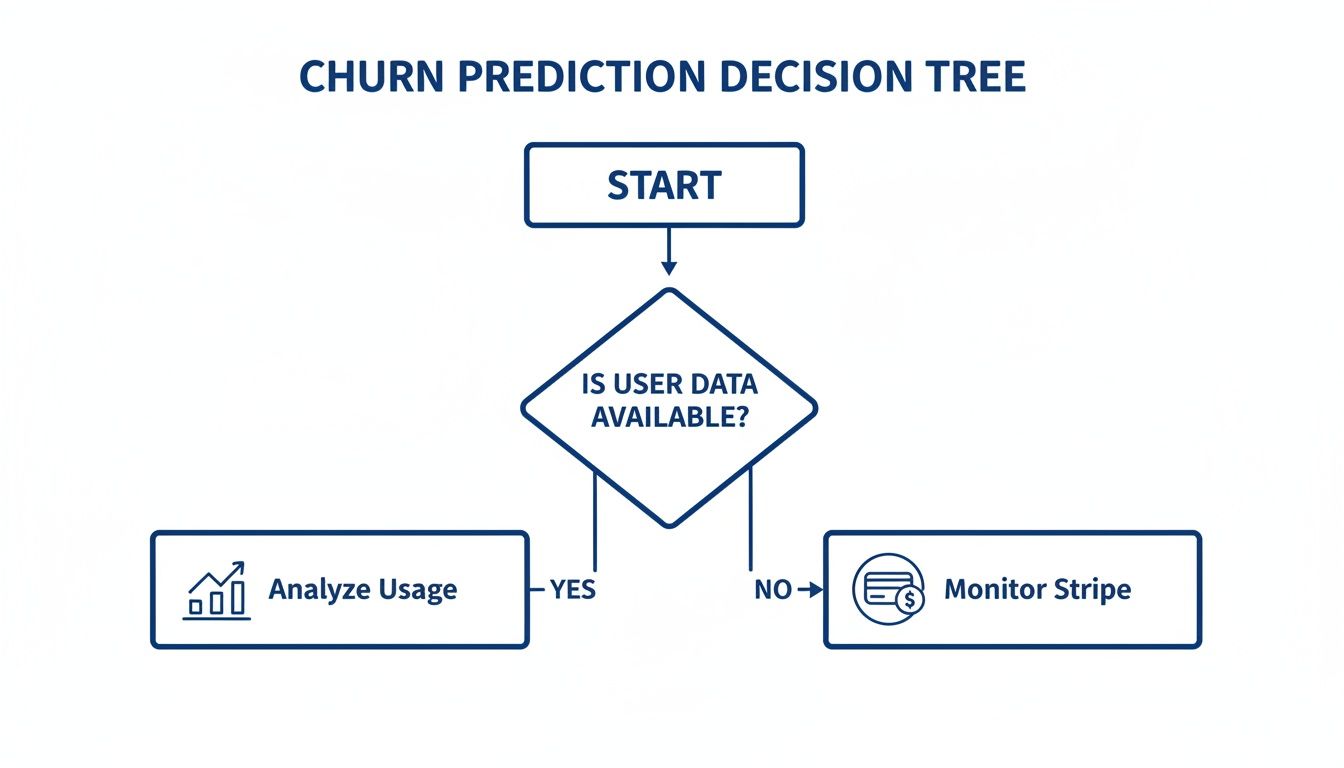
This kind of process helps you quickly pinpoint which data stream is most relevant for a first-pass risk assessment, which you can then build on with more detailed segmentation.
Matching the Action to the Segment
Once your segments are defined, you can create a specific playbook for each one. The key is making sure your response is proportional to the value of the account you're trying to keep.
A personalized, high-touch email from a founder or a dedicated call from a customer success manager should be reserved for your most valuable customers. For everyone else, automated and semi-automated campaigns can work wonders without draining your team's bandwidth.
Let’s get practical. A High-Value, High-Risk account should trigger an immediate, high-priority alert for a founder or account manager to send a personal email. Something like, "Hey, noticed you haven't used Feature X in a while. Is everything okay?"
Meanwhile, a customer in the Medium-Value, Slow Decline segment might get an automated email asking for feedback or offering a quick 15-minute training session on a feature they seem to be underusing.
By setting up this kind of tiered response, you give your most critical accounts the white-glove treatment they need while still efficiently tackling churn risk across your entire customer base. This strategic approach transforms your retention efforts from a chaotic scramble into a focused, high-impact operation.
If you want to go deeper, we've put together a full guide on how to build a customer segmentation model that can grow with your business.
Launching Campaigns That Win Customers Back
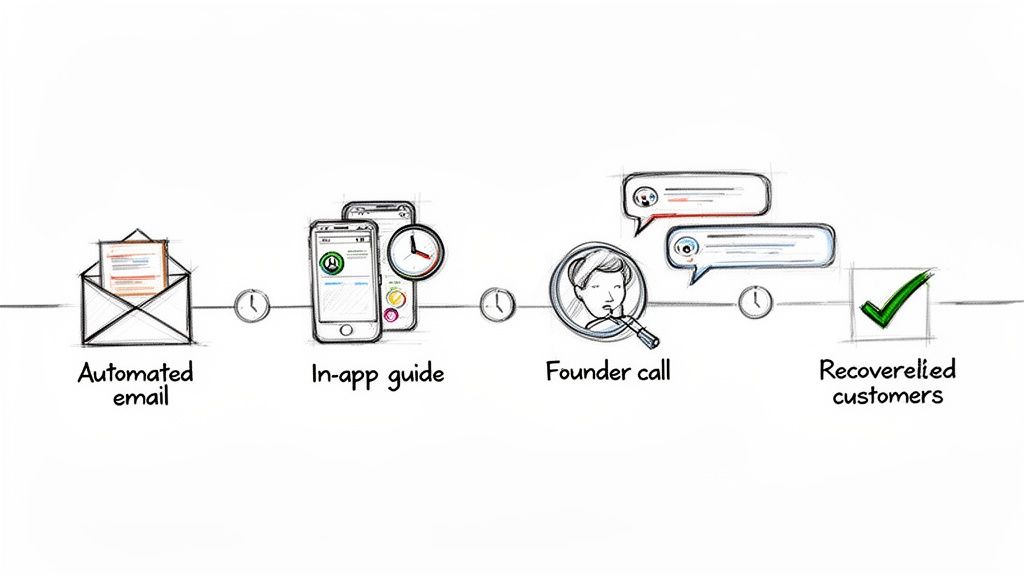
Alright, you’ve identified and segmented your at-risk accounts. Now for the fun part: moving from analysis to action. This is where you actually save customers. A well-timed, personal outreach can mean the difference between losing an account forever and creating a loyal advocate for years.
The beauty of a modern customer retention program isn't about having a huge team or a massive budget. It’s about using the right insights to trigger the right playbooks at the perfect moment.
Automated Nudges for Low-Touch Recovery
For customers in your lower-value segments or those just starting to drift away, automated campaigns are your secret weapon. These aren't your typical marketing blasts. They're smart, hyper-relevant messages triggered by specific behaviors or a drop in their health score.
Let's say a user's health score dips because they haven't touched a key feature in over two weeks. Instead of letting them fade away, this can trigger a simple, helpful email.
- Example Email Subject: Quick question about [Your SaaS Product]
- Example Body: "Hi [First Name], just checking in. I noticed you haven't had a chance to use our reporting feature recently. A lot of our users find it saves them hours on their weekly analysis. Would a quick 2-minute video guide be helpful?"
See how that feels? It's personal and genuinely helpful, not salesy. It pulls the user back in by offering immediate value and gently reminding them of the problems your product solves—often preventing churn without anyone on your team lifting a finger.
High-Touch Plays for High-Value Accounts
But what happens when one of your high-value customers starts showing signs of trouble? Automation just won't cut it. These situations demand a personal, human touch. This is exactly why you did all that segmentation work—to focus your most precious resource, your time, on protecting your most important revenue.
For these critical accounts, a direct outreach from a founder or a senior team member can work wonders. It signals to the customer that they aren't just another number on a dashboard; they're a valued partner.
A simple, direct email from a founder asking "How can we help?" at the exact moment a high-value customer is struggling can completely turn the relationship around. It rebuilds trust and reminds them why they chose you in the first place.
This is more critical than ever. While 57% of consumers spend more with brands they feel loyal to, a staggering 77% also retract that loyalty faster than they did just three years ago. This data highlights the urgent need for proactive campaigns that turn churn predictions into revenue you can count on.
Ultimately, your goal is to build a library of proven playbooks—a mix of automated nudges and high-touch interventions—that your team can deploy with confidence. For more specific ideas, check out our deep dive into proven customer win-back strategies you can start using today.
Measuring Success and Refining Your Strategy
Launching your first set of retention campaigns is a huge step, but it's really just the beginning. A customer retention program isn't a machine you can just "set and forget." Think of it as a living system that needs constant attention, data, and fine-tuning to really work. You have to close the loop by measuring what’s effective and ditching what isn't.
The most straightforward way to see your impact is by tracking Saved MRR. This is the monthly recurring revenue you’ve managed to hold onto from accounts that were flagged as at-risk. It’s a clean, simple metric that gives you a dollar-for-dollar justification for the program's existence.
But don’t stop there. You should also keep a close eye on how customer health scores are trending over time. Are those previously at-risk accounts showing steadily improving scores after you've intervened? That's a fantastic sign. It tells you your outreach isn't just a temporary patch but is genuinely re-engaging customers for the long haul.
Refining Your Outreach with A/B Testing
Even if you’re running a lean operation, you can still get smarter about your retention campaigns by doing some simple A/B testing. Instead of guessing which email subject line or offer will land best, test it. You'd be surprised how much you can learn from small, controlled experiments.
Here are a few ideas for what to test:
- Email Subject Lines: Pit a direct, problem-focused subject line against a more open-ended, helpful one. See which one gets more opens and replies.
- Outreach Channels: Does one segment of your customers respond better to a quick in-app message, while another prefers a personal email?
- Offers and Incentives: Is a discount more compelling than a free training session? Or maybe a simple, personal offer of help is all it takes to turn things around.
The real goal here is to figure out which specific actions give you the biggest bang for your buck. This data-driven mindset ensures you’re not just busy, but that your time and resources are laser-focused on campaigns that actually move the needle on your bottom line.
Turning Retention Insights into a Better Product
Your retention dashboard is so much more than a list of accounts to save. It's a goldmine of direct, unfiltered product feedback. When you get on a call with a user who’s about to churn and they tell you exactly which feature is causing them headaches, that’s pure gold.
This kind of feedback kicks off a powerful virtuous cycle. You’re actively listening to the people who are struggling the most, which helps you pinpoint the exact friction points in your product that need to be smoothed out.
Suddenly, your customer retention program is no longer just a defensive play. It becomes a proactive engine for product development. The insights you gain from saving customers today directly inform how you build a better, stickier product that prevents churn from happening in the first place tomorrow.
Frequently Asked Questions
How Long Until We See Results from a Retention Program?
You'll see the first signs of life a lot faster than you might think. With modern tools that plug directly into your Stripe data, you can get a list of at-risk accounts surfaced in just a few days. It's not a six-month project anymore.
We've seen teams save their first customer and recover that monthly recurring revenue (MRR) within the first 2-3 weeks of running targeted campaigns. The bigger-picture wins—like a healthier lifetime value (LTV) and net revenue retention (NRR)—start to compound over the next few quarters.
Do We Need a Dedicated Customer Success Team?
Not right out of the gate. If you're a solo founder or a small team just getting your customer retention program off the ground, a smart churn prevention platform can fill that gap for you.
Think of the right tool as your virtual customer success manager. It automates the heavy lifting—finding and prioritizing at-risk accounts—and gives you simple playbooks to act on what it finds. This lets founders manage retention effectively themselves until the business grows enough to justify a dedicated hire.
Is a Customer Retention Program Expensive to Start?
It doesn't have to be, and the return on investment is usually fantastic. The whole point is for the program to pay for itself many times over by saving MRR you were about to lose.
Let's say a tool costs you a few hundred dollars a month. If it helps you save just one or two of your average-sized accounts from churning, it's already paid for itself. Don't get stuck on the upfront cost; focus on the value of the revenue you're protecting.
Ready to turn churn predictions into protected MRR? LowChurn is the AI-powered early warning system for SaaS teams on Stripe. Connect your account in 60 seconds and see which customers are at risk before they cancel. Start your journey to better retention at https://www.lowchurn.com.