When you're trying to get a real handle on your SaaS company's health, you'll inevitably land on two key metrics: Gross Revenue Retention (GRR) and Net Revenue Retention (NRR). They sound similar, but they tell two completely different, equally important stories about your business.
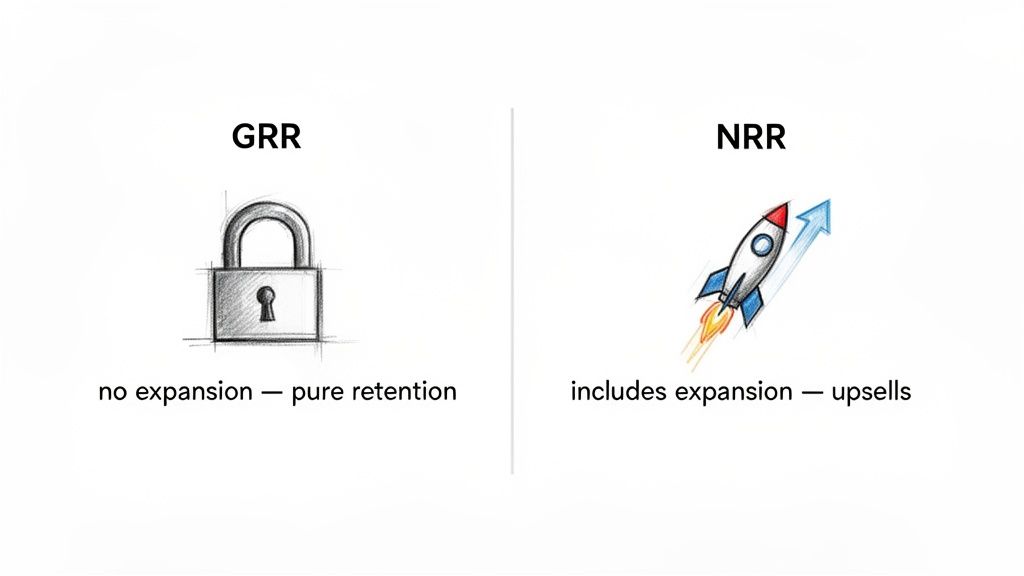
The core difference is simple. GRR tells you how good you are at holding onto the revenue you already have. NRR, on the other hand, shows you how good you are at growing that revenue. One is about defense, the other is about offense.
Defining Your Revenue Health: GRR and NRR Explained
For any founder running their business on Stripe, these metrics aren't just for board meetings; they are the fundamental language of sustainable growth. Let’s break down what each one really means.
Think of GRR as the ultimate measure of product stickiness. It calculates the percentage of revenue you kept from your existing customers over a set period, but only after you account for churn (lost customers) and contractions (downgrades). The most important thing to remember here is that GRR completely ignores any expansion revenue from upsells or cross-sells.
GRR is your unvarnished truth metric. It reveals how sticky your product is and how satisfied your core customers are, without any growth to mask underlying problems. A low GRR is a clear signal of a 'leaky bucket' that needs immediate attention.
Now, NRR is where your growth engine comes into play. It starts with the same revenue pool but adds in all the expansion revenue from those customers. Then, it subtracts the revenue you lost from churn and downgrades. The final number gives you the net effect of everything happening within your current customer base, making it a powerful gauge of your growth momentum.
What Each Metric Reveals
Looking at both GRR and NRR gives you a complete picture of your customer value and overall stability. One tells you if you can hold your ground, while the other shows if you can push forward.
Gross Revenue Retention (GRR): This is the acid test for your product’s core value. It answers one critical question: "Are we keeping the revenue we already have?" Since it can never go above 100%, it forces you to focus relentlessly on minimizing customer churn and plan downgrades.
Net Revenue Retention (NRR): This metric is all about your growth potential from within. It answers: "Are we successfully growing revenue from our existing customers?" An NRR over 100% is the holy grail for SaaS, indicating you’ve hit 'negative churn'—where the new revenue from your existing customers is greater than what you're losing.
GRR vs NRR At a Glance
This quick table cuts through the noise and lays out the fundamental differences between the two.
| Metric | What It Measures | Includes | Excludes | Maximum Value |
|---|---|---|---|---|
| GRR | Pure customer revenue retention and product stickiness | Renewals | Expansions (upsells, cross-sells) | 100% |
| NRR | Overall revenue growth and momentum from existing customers | Renewals, Expansions (upsells, cross-sells) | New customer revenue | Can exceed 100% |
In the end, you absolutely need both. A high GRR gives you a solid, stable foundation to build on. A high NRR proves that you can actually build something bigger and more valuable on top of that foundation.
Calculating GRR and NRR With Step-by-Step Formulas
It's one thing to know what GRR and NRR are, but the real magic happens when you plug in your own data. The formulas are what turn these concepts from abstract theory into hard numbers that can actually shape your strategy. Let's walk through exactly how to calculate both, using a straightforward example from a fictional SaaS company.
For any revenue leader in the SaaS world, especially those working within the Stripe ecosystem, getting these numbers right is non-negotiable. MRR churn can quietly erase 20-30% of your growth every year if you're not careful. GRR gives you the unvarnished truth about your core product stickiness, while NRR shows your potential for growth within your existing customer base.
The Gross Revenue Retention Formula
Think of Gross Revenue Retention (GRR) as the ultimate test of your product's value. It gives you a brutally honest look at your ability to hold onto the revenue you already have. It intentionally ignores any shiny new revenue from upsells or expansions, focusing only on what you kept after churn and downgrades.
Here's the formula:
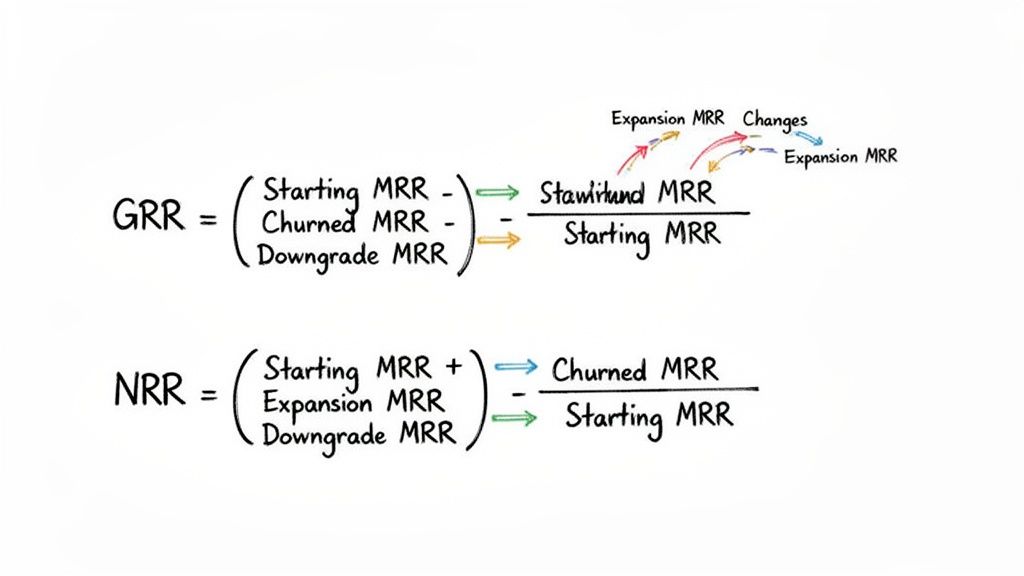
GRR = (Starting MRR - Churned MRR - Downgrade MRR) / Starting MRR
Let’s put this into practice. Imagine your company, "ConnectSphere," starts the month with this Stripe data:
- Starting MRR: $50,000
- Churned MRR: $3,000 (revenue lost from customers who canceled)
- Downgrade MRR: $1,500 (revenue lost from customers moving to a cheaper plan)
Plugging these numbers into the formula is simple:
- First, add up all the revenue you lost: $3,000 (Churn) + $1,500 (Downgrade) = $4,500.
- Next, subtract those losses from where you started: $50,000 - $4,500 = $45,500.
- Finally, divide that by your starting MRR: $45,500 / $50,000 = 0.91.
ConnectSphere’s GRR for the month is 91%. This tells a clear story: for every dollar the company had at the beginning of the month, it successfully held onto 91 cents from its existing commitments. If you want to dig deeper into the moving parts of churn, our guide on how to calculate your churn rate is a great resource.
The Net Revenue Retention Formula
Now, let's look at the other side of the coin: Net Revenue Retention (NRR). This metric tells a much broader story. It accounts for everything—churn, downgrades, and expansions—to show you the net result of all revenue changes from your existing customers. It’s a powerful indicator of your company's momentum.
The NRR formula adds one crucial element:
NRR = (Starting MRR + Expansion MRR - Churned MRR - Downgrade MRR) / Starting MRR
Using ConnectSphere again, we just need one more number:
- Expansion MRR: $8,000 (new revenue from upsells and add-ons)
Here’s how the NRR calculation plays out:
- First, figure out the net change in your MRR: $8,000 (Expansion) - $3,000 (Churn) - $1,500 (Downgrade) = +$3,500.
- Now, add that net change to your starting MRR: $50,000 + $3,500 = $53,500.
- Finally, divide that by the starting MRR: $53,500 / $50,000 = 1.07.
ConnectSphere’s NRR for the month is 107%. Anything over 100% is fantastic news, as it signals "negative churn"—your existing customers are growing faster than they are leaving. In this case, expansion revenue didn't just cover all the losses; it added an extra 7% of growth. This is the crucial difference in the GRR vs NRR debate: GRR showed solid stability, but NRR revealed powerful, underlying growth.
Why GRR Is Your Foundation for Sustainable Growth
While Net Revenue Retention (NRR) often steals the spotlight with its flashy growth story, Gross Revenue Retention (GRR) is the unglamorous, non-negotiable bedrock of a healthy SaaS business. Think of GRR as your "truth metric." It gives you a brutally honest, unfiltered view of your ability to keep the revenue you've already earned, without any smoke and mirrors from new sales or expansions.
This laser focus on pure retention is exactly what makes GRR so critical. It’s a direct reflection of your product's core value and how well your customer success team is performing. When customers stick around month after month without downgrading, it’s a powerful signal that your product is essential to their daily operations.
A high NRR can easily hide some very real problems. Your sales team might be crushing expansion goals, making your NRR look amazing, even while you’re quietly losing a big chunk of your smaller customers. This creates a classic "leaky bucket" scenario. You're pouring new revenue in at the top just to offset the constant drain at the bottom—an expensive and ultimately unsustainable way to run a business.
GRR cuts through the noise. It forces you to confront the reality of customer satisfaction and product stickiness. Before you can scale, you have to stabilize. GRR tells you if the foundation you're building on is solid rock or shifting sand.
Decoding GRR Benchmarks
It’s one thing to track GRR, but it's another to understand what the numbers actually mean for your business. These benchmarks aren't just vanity metrics; they're direct indicators of your company's long-term viability. A low GRR is a flashing red light warning you that a fundamental retention problem is actively undermining your growth engine.
In the high-stakes world of SaaS, every percentage point of retained revenue counts. GRR zeroes in on your ability to hold onto revenue from existing customers, subtracting only churn and downgrades from your starting MRR. The benchmarks tell a clear story: anything below 70-85% is a serious red flag. A GRR of 85-95% is solid for most, but the best-in-class companies push past 95%. You can learn more about these critical SaaS retention benchmarks from Stripe.
Let’s break down what these tiers really mean:
- GRR Below 85%: This is a clear warning sign. A rate this low signals a major "leaky bucket" problem, suggesting issues with product-market fit, a clunky onboarding experience, or poor customer support. Your customer acquisition efforts are fighting a losing battle against churn.
- GRR of 85% - 95%: This range is considered healthy for many SaaS companies, especially those serving SMBs where churn is naturally a bit higher. It shows you have a solid product and a competent customer success function, but there's definitely room to tighten things up.
- GRR Above 95%: This is the gold standard, particularly for businesses selling to enterprise clients. A GRR this high means your product is mission-critical. It creates a highly predictable revenue stream, lowers your acquisition costs, and gives you a powerful competitive moat.
The Strategic Importance of a High GRR
A strong GRR isn't just about playing defense; it’s the launchpad for efficient, profitable growth. When you retain your customers, you create a stable and predictable revenue base. That stability lets you forecast with more confidence, invest in new initiatives, and reduce your dependency on constantly finding new customers—which is almost always more expensive than keeping the ones you have.
Better yet, a high GRR creates the perfect conditions for a stellar NRR. Happy, long-term customers are your best candidates for upsells and cross-sells. By first ensuring they are successful with your core product (which a high GRR proves), you earn the right to expand that relationship. This is why focusing on GRR first isn't about ignoring growth. It’s about building the sustainable foundation required to achieve it.
How NRR Drives SaaS Valuation and Growth Momentum
If Gross Revenue Retention (GRR) is the foundation of your house, Net Revenue Retention (NRR) is the engine that drives its value skyward. GRR shows you're stable, but NRR tells the story of your company's future. It's the metric that transforms a healthy business into a high-growth investment opportunity.
Why do investors and acquirers fixate on NRR? Because it measures your ability to grow revenue from the customers you already have—the most capital-efficient growth path there is.
An NRR consistently above 100% is the benchmark for elite SaaS companies. Reaching this milestone signals you've achieved "negative churn," a beautiful state where revenue from expansions and upsells completely cancels out any losses from churn or downgrades. For a founder, this is undeniable proof of a strong product-market fit and a solution that has become essential to your customers' operations.
For an investor, a high NRR is more than just a healthy metric; it’s a leading indicator of future performance. It proves your business has an organic growth engine that isn't entirely dependent on burning cash to acquire new customers. That's a direct multiplier on your company's valuation.
NRR as a Predictor of Capital Efficiency
Picture two companies, both acquiring new customers at the same rate. One has a low NRR, meaning it's constantly bailing water out of a leaky boat. The other has a high NRR, and its boat seems to get bigger and faster the more it paddles. Which one would you bet on?
The second company is far more attractive. It shows that your customer base isn't just a static source of income; it's an appreciating asset. This is why companies with NRR figures north of 120% often command such premium valuations—their growth is compounding, predictable, and incredibly efficient.
The Primary Drivers of a High NRR
World-class NRR doesn't just happen. It's the outcome of a smart product and commercial strategy designed to grow with your customers. The idea is to make it a no-brainer for them to spend more over time because they're getting more and more value.
Here are the core plays that drive up your NRR:
- Tiered Pricing Models: This is foundational. As a customer grows, their needs get more complex. Well-designed pricing tiers give them an obvious path to upgrade for more features, higher usage caps, or better support, which flows directly into your Expansion MRR.
- Usage-Based Pricing: This approach perfectly aligns cost with value. Think API calls, data storage, or active seats. As your customers use your product more successfully, their bill naturally scales with them, creating a frictionless expansion loop.
- Valuable Add-On Features: Instead of bundling everything, you can offer optional, high-value modules. This gives you multiple shots at upselling and cross-selling as a customer’s needs evolve.
- Cross-Selling New Products: If you have a product suite, introducing existing happy customers to complementary solutions is a fantastic way to deepen the relationship and give NRR a serious boost.
These strategies are effective because they tie your financial success directly to your customers' success. When your product helps them win, they invest more in it. This symbiotic relationship is what creates a powerful growth engine, catches the eye of investors, and ultimately drives a much higher valuation. When you look at GRR vs NRR, NRR is what truly tells the story of your momentum.
Using AI-Powered Analytics to Improve GRR and NRR
Knowing the difference between GRR and NRR is one thing, but actually improving these metrics means moving beyond manual spreadsheet analysis. For modern SaaS teams, especially those built on Stripe, this is where AI-driven analytics tools really give you an edge.
These platforms plug right into your subscription and product usage data, sifting through thousands of customer signals in real-time. Instead of finding out a customer is unhappy when they hit the "cancel" button, an AI model can spot the subtle behavioral shifts that mean they're heading for the door.
This kind of proactive insight is a complete game-changer for protecting your Gross Revenue Retention. By flagging at-risk accounts 7 to 30 days in advance, you give your customer success team a real chance to step in, solve the problem, and stop that churn or downgrade from ever hitting your books.
Strengthening GRR as the Foundation
The most direct impact of AI-powered churn prevention is on your GRR. Since GRR purely measures how well you hold onto the revenue you already have, every single customer you save from churning makes this fundamental metric stronger.
Think of a tool like LowChurn as your early-warning system. It automatically flags accounts showing signs of trouble—maybe they've stopped using a key feature or their login frequency has dropped off a cliff. This lets your team get ahead of the problem, shifting from reactive firefighting to a focused, proactive retention strategy.
A stable GRR is the bedrock of a healthy SaaS business. By using predictive analytics to minimize churn and downgrades, you build a more predictable revenue base, which is the essential prerequisite for sustainable growth and a healthy NRR.
This turns retention from a guessing game into a data-driven science. Using technology to get this right is critical. If you want to dig deeper into how AI can upgrade your data analysis, check out the key benefits of AI in cross-channel reporting.
How a Stable GRR Fuels NRR Growth
Once you get your GRR stabilized, the benefits naturally ripple out to your Net Revenue Retention. When you have a solid base of happy, retained customers, you suddenly have a much larger pool of accounts ready for expansion.
Here’s exactly how preventing churn helps drive up your NRR:
- It creates more upsell candidates. A customer you just saved from churning is a perfect candidate for a future upsell. After you've resolved their issue and reminded them of the value you provide, they'll be far more open to hearing about premium features later on.
- It increases customer lifetime value. By cutting down churn, you're extending the average customer lifespan. This simply gives you more time and more opportunities to introduce add-ons or cross-sell other products.
- It builds trust for expansion. Reaching out proactively shows customers you're invested in their success, not just their credit card number. That trust makes future conversations about expansion feel like a partnership, not a sales pitch.
Ultimately, the customers you save today become part of the "Starting MRR" in next month's NRR calculation. Without a strong GRR, your NRR is always fighting an uphill battle, with expansion revenue just trying to fill a leaky bucket. We cover more tactics on this in our guide to predictive analytics for customer retention. By using AI to secure your revenue base, you free up your team to focus on what really grows the business: delivering more value to a happy, loyal customer base.
Actionable Playbooks to Improve Your Retention Metrics
Knowing the difference between GRR and NRR is one thing, but actually moving those numbers is what separates fast-growing SaaS companies from the rest. It all comes down to having clear, tactical playbooks for both shoring up your foundation (GRR) and fueling your growth engine (NRR).
When you're staring at your Stripe dashboard, the GRR vs. NRR conversation is really about two different things: retention purity and growth momentum. You absolutely need both to scale. GRR gives you the unvarnished truth, showing how much revenue you've held onto before any expansions. Industry benchmarks tell a clear story here: a GRR of 95% or more is a sign of a very healthy, sticky product. If you dip below 85%, alarm bells should be ringing—you’ve got a serious churn problem that needs immediate attention.
Playbooks to Strengthen Your GRR
Boosting your GRR is fundamentally about plugging leaks. Every dollar lost to churn or downgrades hurts, so the goal is to make your product an indispensable part of your customers' workflow.
- Nail the First 90 Days: A clunky onboarding is a leading cause of early churn. Your top priority should be getting new users to their "aha!" moment as fast as possible. A smooth, guided experience that delivers immediate value makes customers far less likely to have second thoughts.
- Get Proactive with Customer Health Scoring: Don't wait for a customer to tell you they're unhappy; by then, it's often too late. Use product usage data, login frequency, and support ticket trends to create a health score for each account. This lets your team spot the warning signs and step in before a customer starts looking for the exit.
- Run Targeted Re-Engagement Campaigns: Have a segment of users gone quiet? Launch automated email or in-app messaging campaigns to pull them back in. Showcasing a new feature or offering a quick, personalized demo can be just the nudge they need to remember why they signed up in the first place.
Mastering these tactics creates a stable revenue floor. For a deeper dive, check out our complete guide on customer retention best practices.
This is where AI-driven analytics can make a massive difference, turning raw data into a clear path from analysis to action.
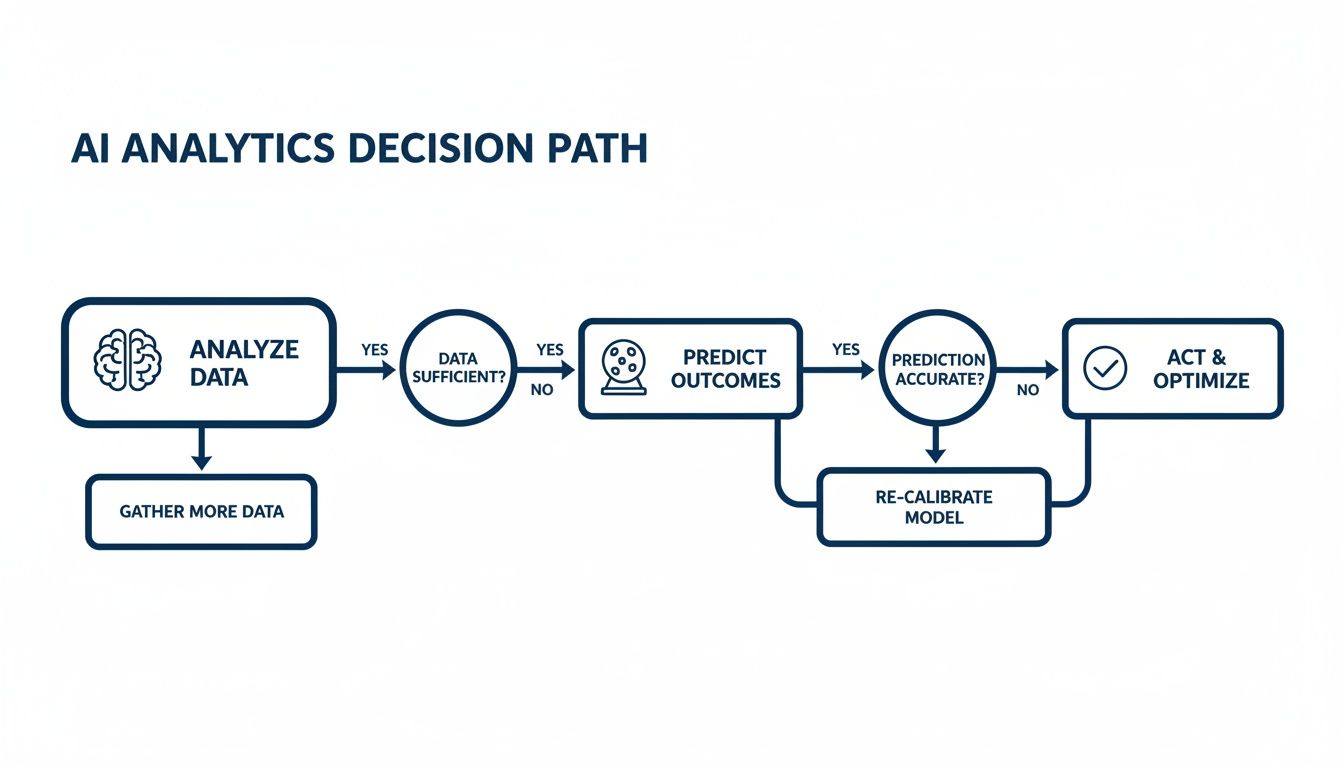
This workflow shows how a tool like LowChurn can translate complex customer signals into the exact, proactive interventions needed to protect your GRR.
Playbooks to Elevate Your NRR
With a solid GRR in place, you can confidently shift your focus to the more exciting part: elevating NRR by growing revenue from the customers who already love your product.
A high NRR doesn't happen by accident. It's the direct result of a strategy that aligns your product's growth with your customers' success, making an upgrade the most natural next step for them.
Here are some proven ways to drive that crucial expansion revenue:
- Design Obvious Upgrade Paths: Your pricing tiers need to tell a story of growth. As a customer's business scales, it should feel completely logical for them to move to a higher plan to get more features, add more users, or increase their usage limits. Make it an easy "yes."
- Systemize Quarterly Business Reviews (QBRs): For your most valuable accounts, regular strategic check-ins are non-negotiable. Use QBRs to dig into their goals for the next quarter and proactively show them how your premium features or add-ons can help them get there faster.
- Launch High-Value Add-Ons: Your most engaged customers are often hungry for more. Develop and release new features or modules that solve a deeper, more specific problem for them. This not only adds value but also creates brand-new avenues for account expansion.
Answering Your Top Questions About GRR & NRR
Even after you nail down the formulas, the real-world application of GRR vs. NRR can bring up some tricky questions. Let's tackle a few of the most common ones we hear from founders.
Can My NRR Be High Even If My GRR Is Low?
Absolutely, and this situation is a classic "leaky bucket" problem that you need to jump on immediately. It’s easy to get excited by a high NRR, but it’s often propped up by a handful of large customers expanding their accounts.
A low GRR, however, tells a different story—it shows you’re losing or seeing contractions from a larger chunk of your customer base. While the big upgrades are masking the issue for now, you’re stuck in a reactive cycle of replacing lost revenue instead of compounding your growth.
A high NRR paired with a low GRR is a serious red flag. It means your growth hinges on a few champions, signaling potential retention problems with your broader customer base.
What Is a Good GRR for an Early-Stage SaaS Company?
For a startup, a "good" GRR really comes down to who you're selling to. The benchmarks are quite different.
- SMB Focus: If you're selling to small and medium-sized businesses, you'll naturally see more churn. An 85% GRR is a solid, healthy number to aim for.
- Enterprise Focus: For enterprise clients, the bar is much higher. You should be targeting a GRR of 95% or more. These customers have stickier contracts and much lower churn rates.
Frankly, if your GRR drops below 80%, it's time to pause your scaling efforts. That number points to a core issue with your product-market fit or onboarding process that needs fixing first.
How Often Should I Track GRR and NRR?
You should be looking at both metrics monthly and quarterly. They each tell a different part of the story.
Monthly tracking is your ground game. It’s for making tactical adjustments and gives your customer success team the data they need to spot a negative trend and step in before it snowballs.
Quarterly tracking gives you that 10,000-foot strategic view. This is the cadence you'll use for board reporting, investor updates, and figuring out if your big-picture initiatives are actually moving the needle on revenue health.
LowChurn is an AI-powered platform designed to help SaaS teams on Stripe get ahead of churn. By flagging at-risk accounts 7-30 days before they cancel, we give you the runway to save customers, protect your GRR, and build the stable foundation you need for explosive NRR growth. See how it works at https://www.lowchurn.com.