When we talk about improving customer lifetime value, what we're really talking about is a fundamental shift in mindset. It's about moving away from the short-term thrill of a new sale and focusing on building profitable, long-term relationships with the customers you already have.
For any SaaS business, this isn't just another metric to track; it's the ultimate indicator of sustainable growth. It tells you if you've truly found product-market fit.
What Is Customer Lifetime Value in SaaS
Customer Lifetime Value (often called CLV or LTV) is the total revenue you can reasonably expect to earn from a single customer for as long as they stick with you.
Think of it like this: acquiring new customers is like planting seeds in a garden. It's essential, of course. But the real, lasting success comes from nurturing those seeds into healthy plants that yield fruit season after season. That's the core idea behind CLV.
This perspective forces you to stop obsessing over new sign-ups and start asking much deeper, more meaningful questions about your business:
- Are our customers actually using the product and getting value from it?
- Does our pricing reflect the value we provide?
- Are we making the right product improvements to keep people subscribed for longer?
The answers to these questions reveal the true health of your company. CLV acts as a lens, bringing weaknesses in your product, onboarding, or customer support into sharp focus—long before they show up as a terrifying spike in your churn rate.
Why CLV Is More Than Just a Metric
Understanding CLV is so important because it's directly tied to your profitability. It's one side of the most critical equation for any subscription business: the LTV-to-CAC (Customer Acquisition Cost) ratio. The common wisdom is that a healthy SaaS business should have an LTV that is at least three times its CAC.
A high ratio implies attractive economics because your essential profit formula is a success, while a low ratio implies you may need to adjust your business model—perhaps your customer value proposition, your go-to-market methods, or your pricing.
Suddenly, CLV isn't just a number on a dashboard; it becomes your North Star. It guides strategic decisions, helping you pinpoint your most valuable customer segments and telling you exactly where to invest your marketing and product development resources for the biggest impact.
To calculate a basic historical CLV, you'd typically multiply the average revenue per customer by their average lifespan as a subscriber. This chart visualizes that concept perfectly.
What you're seeing is a cumulative profit line. As long as that customer sticks around, their value to your business keeps climbing. It's a powerful reminder that for long-term profitability, keeping the customers you have is far more important than just acquiring new ones.
Before we dive into the specific strategies, let's look at the main levers you can pull to increase your CLV. Think of these as the core pillars of a strong customer value strategy.
Key Levers for Improving Customer Lifetime Value
| Strategy Lever | Primary Goal | Impact on CLV |
|---|---|---|
| Onboarding | Guide new users to their "Aha!" moment quickly | Reduces early-stage churn and sets the stage for long-term engagement |
| Engagement | Drive consistent product usage and value realization | Increases user stickiness and makes the product indispensable |
| Pricing | Align price points with the value delivered to customers | Maximizes revenue per customer and supports expansion opportunities |
| Retention | Proactively identify and resolve issues causing churn | Extends the average customer lifespan, directly increasing LTV |
| Upsells & Cross-sells | Increase the average revenue per account (ARPA) | Boosts the "value" part of the LTV equation by generating more revenue |
| Product Improvement | Continuously add value and solve more user problems | Creates a moat against competitors and justifies higher price points |
Each of these levers represents a massive opportunity to build healthier, more profitable customer relationships. In the sections that follow, we'll break down actionable playbooks for every single one.
How to Calculate and Segment Your CLV
Alright, let's get our hands dirty. Moving beyond the theory is where you start to see real improvements in customer lifetime value. While CLV might sound like a metric reserved for data scientists, the basic calculation is surprisingly simple and gives you a powerful lens for looking at your subscription business.
At its core, calculating CLV answers one critical question: "What is a customer actually worth to us over their entire time with our company?" Answering this is the key to making smarter calls on how much you can really afford to spend on marketing, sales, and customer success.
The Basic CLV Formula for Subscription Models
For a SaaS business, the simplest and often most effective way to figure out CLV is to look at two things: how much revenue you get from a customer on average, and how long they stick around.
You can get started with a straightforward formula:
CLV = Average Revenue Per Account (ARPA) x Customer Lifetime
Let's break that down with a quick example. Imagine your SaaS product has an ARPA of $100 per month. After digging into your data, you find that the average customer stays subscribed for about 36 months.
The math is simple: $100 (ARPA) x 36 months = $3,600 CLV
This tells you that, on average, every new customer you bring in is worth $3,600 in revenue. Just having that single number gives you a powerful benchmark. If you want to explore more advanced models, our guide on how to calculate customer lifetime value dives much deeper.
This isn't just an accounting exercise. It turns abstract goals like "reduce churn" into real financial targets, directly tying your retention efforts to bottom-line growth.
The Real Power Is in Segmentation
Calculating one single CLV for your entire company is a great first step, but it’s a bit like looking at your customer base through a foggy window. The true magic happens when you start segmenting that data.
Segmentation is just a fancy word for slicing your CLV calculation across different customer groups. Doing this reveals who your most valuable customers are, where they came from, and what they all have in common. Think of it as creating a high-resolution map of your business, showing you the peaks of high value and the valleys of churn risk.
This is where you can see how things like product-market fit, revenue, and satisfaction all feed into one another to create a high CLV.
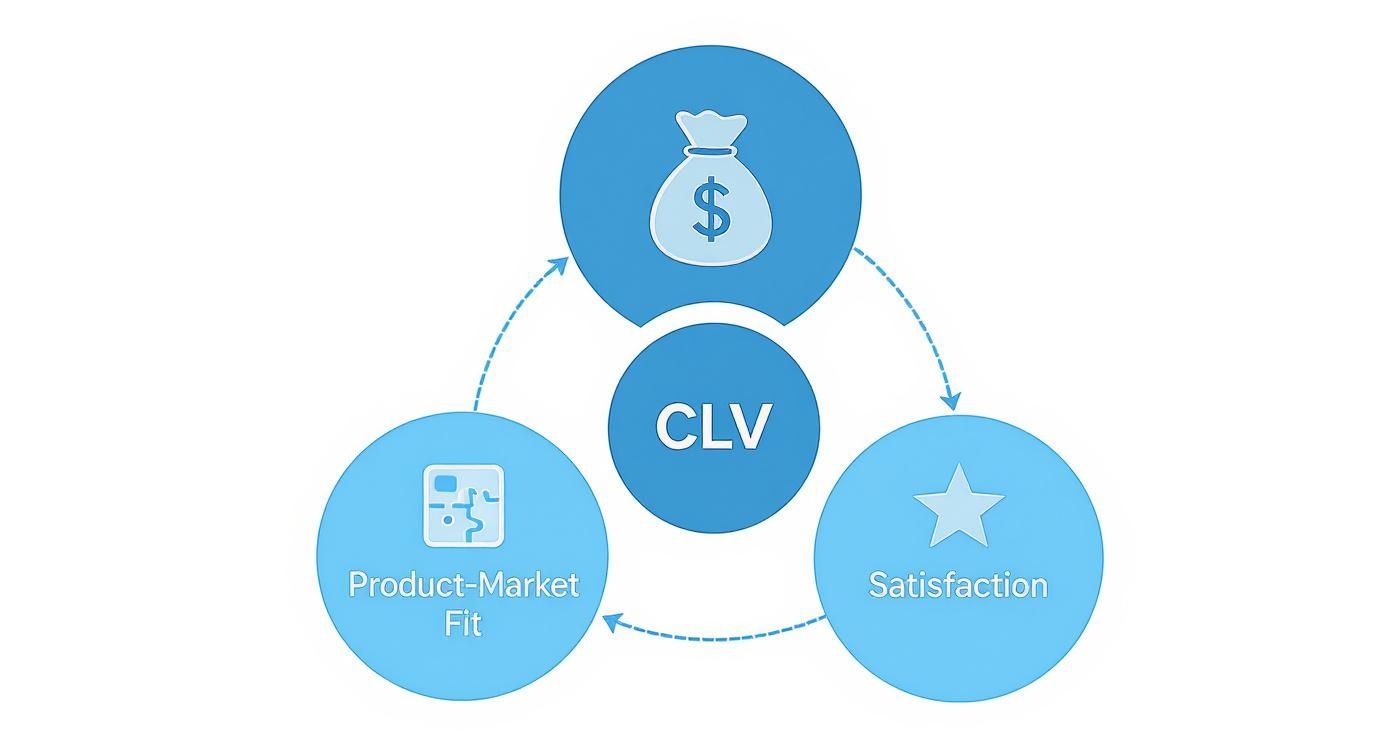
As you can see, these aren't isolated metrics. They're part of a virtuous cycle: a strong product and smart pricing create happy customers, who then stick around longer and generate much more value.
Common Ways to Segment CLV
By breaking down your CLV, you can uncover insights that will directly shape your strategy. Here are a few of the most impactful ways to segment your customers:
- By Acquisition Channel: Are customers from paid Google ads more valuable over time than those from organic search or a referral program? This tells you exactly where to double down on your marketing spend.
- By Subscription Plan: Do customers on your "Pro" plan have a significantly higher CLV than those on your "Basic" plan? This can inform your pricing strategy and shine a light on upsell opportunities.
- By User Behavior: Compare the CLV of users who adopted a specific "sticky" feature in their first 30 days versus those who didn't. This can prove that feature's role in long-term retention.
- By Company Size or Industry: Do enterprise clients have a 5x higher CLV than SMBs? This helps your sales team focus their energy on the most profitable market segments.
Segmenting your CLV is what shifts you from being reactive to proactive. Instead of just looking in the rearview mirror, you can identify the DNA of your best customers and build a plan to attract and keep more of them.
Designing an Onboarding Experience for High CLV
A customer's first few moments with your product are incredibly telling. This initial period, known as onboarding, isn't just about technical setup or a quick product tour. It's the very first—and most critical—phase of your entire retention strategy. If you nail it, you're laying the groundwork for a long, profitable relationship. If you don't, you risk losing that customer before they ever really get started.
Think of it like the first chapter of a great novel. If it doesn’t hook you immediately, you probably won't stick around for the rest of the story. It's the same with your product. If your onboarding process doesn't quickly and clearly prove your product's value, new users will churn out of frustration or unmet expectations. That kills any chance you had at a high CLV.

The whole point of onboarding is to get each user to their "Aha!" moment as fast as possible. This is that magic instant when they personally experience the core value you promised them. It’s when your solution finally "clicks," and their mindset shifts from a curious trial user to an invested customer who can't imagine their workflow without you.
Shifting from Passive Tours to Active Value
So many traditional onboarding flows fail because they’re completely passive. They force every user through the exact same generic product tour, pointing out features without explaining why they should care. Honestly, it’s a recipe for early-stage churn.
A high-CLV onboarding experience is the complete opposite. It's an active, confidence-building journey. It should feel personalized, be interactive, and stay laser-focused on helping the user achieve a specific, meaningful outcome.
An effective onboarding process doesn't just show users how to use your product; it shows them how to be successful with your product. This subtle shift transforms onboarding from a cost center into a powerful engine for long-term retention and growth.
This active approach is all about guiding users toward a win, not just pointing at buttons. That’s how you build a solid customer relationship right from day one.
Building a Value-Driven Onboarding Playbook
To build an onboarding flow that actually drives up CLV, you need to focus on delivering tangible wins. Forget the long, front-loaded setup process. Instead, break the experience down into small, manageable steps that build momentum and keep the user engaged.
Here’s a practical playbook for designing an onboarding experience that fights churn:
Personalize the Welcome Flow: Stop treating every new user the same. During sign-up, ask a few simple questions about their role, their goals, or their company size. Then, use that information to tailor the initial experience, showing them the features and use cases that are most relevant to them.
Create an Interactive Checklist: Guide new users through the 3-5 key actions they absolutely must take to experience value. For a project management tool, this might be "Create Your First Project," "Invite a Teammate," and "Assign Your First Task." This simple checklist turns a potentially overwhelming interface into a clear, step-by-step path to success.
Use Contextual In-App Tutorials: Ditch the boring, overwhelming tour you show everyone at the beginning. Instead, use tooltips and modals that pop up when a user interacts with a feature for the very first time. This "just-in-time" guidance is way more effective because it provides help exactly when and where it's needed.
When you put these strategies into practice, you transform onboarding from a procedural hurdle into your best tool for improving customer lifetime value. You're not just activating an account; you're activating a loyal, long-term customer who gets your product's value because they’ve already experienced it firsthand.
Boosting Engagement and Customer Retention
Alright, you've nailed the onboarding. Your new user is in the door and set up. But this is where the real work to grow CLV begins. That initial excitement for a new tool can wear off fast, turning this post-onboarding period into a critical moment for keeping them around for the long haul. It's no longer about first impressions; it's about proving your product is an indispensable part of their daily grind.
This means you have to shift your mindset from a reactive "break-fix" support model to a proactive engagement strategy. The mission? To weave your product so deeply into your customer's workflow that the thought of leaving becomes absurd. This doesn't happen by accident. It’s the result of a deliberate, data-driven plan to deliver value, day in and day out.
Build a Proactive Communication Engine
Real engagement is built on communication that feels timely, relevant, and personal. The old one-size-fits-all newsletter just won't cut it anymore. What you need is a multi-channel communication engine that anticipates what your customers need and guides them toward success, no matter where they are in their journey.
This is about more than just a monthly email. It’s about using the right channel for the right message to create a seamless experience that feels genuinely helpful, not intrusive. When you get this right, the results are massive. Companies with strong omnichannel engagement strategies retain an average of 89% of their customers, a world away from the 33% retention rate for companies with weak ones. Better yet, these highly engaged customers also generate about 30% higher lifetime value.
Retention isn't a single action. It's the sum total of every single interaction a customer has with your brand. Each touchpoint is an opportunity to either build loyalty or plant a seed of doubt.
Use Your Data to Spot At-Risk Users
Your most powerful retention tool is hiding in plain sight: your product usage data. It gives you an unfiltered look at how people are actually using your platform, showing you who’s thriving and, more importantly, who’s quietly drifting away. By keeping an eye on key behavioral signals, you can spot at-risk users long before they even think about hitting the cancel button.
This is where proactive check-ins, guided by data, become your secret weapon for improving customer lifetime value. For instance, your customer success team can reach out to a user who hasn't logged in for two weeks or has stopped using a feature that used to be part of their daily routine. A simple, targeted message can uncover problems you’d never know about otherwise—like a key team member leaving or a shift in company priorities.
Here are the key signals to watch for:
- Decreased Login Frequency: A sudden drop in activity is the reddest of red flags for disengagement.
- Low Feature Adoption: If a customer is only scratching the surface of what your product can do, they aren't getting the full value and are at a much higher risk of churning.
- Reduced Support Tickets: This might sound strange, but a sudden silence from a previously active customer can mean they've simply given up trying to solve their problems.
- Team Member Churn: When your main contact or a power user leaves the company, your account is immediately vulnerable.
By setting up automated alerts for these triggers, you give your team the power to step in with precision and care, turning a potential churn event into a chance to strengthen the relationship.
Create Powerful Feedback Loops
Finally, one of the most effective retention strategies is simply making your customers feel heard. When you build strong, accessible feedback loops, you show users that you see them as partners in building a better product, not just as numbers on a spreadsheet.
This goes way beyond sending an annual survey. It means actively asking for feedback through different channels and—this is the crucial part—closing the loop by showing them what you’ve done with their input.
Try implementing a few of these feedback mechanisms:
- In-App Microsurveys: Use short, contextual pop-ups to ask for feedback on a specific feature right after someone uses it.
- Customer Advisory Boards: Invite a select group of your most engaged customers to give you regular, high-level feedback on your product roadmap.
- Public Idea Portals: Let users submit and vote on feature requests. This gives you a clear, democratic view of what your customer base really wants.
By weaving these strategies together, you build a powerful system for engagement and retention. This ongoing effort is absolutely fundamental to extending the customer lifecycle, which directly translates into a higher CLV. To learn more, check out our guide on how to improve customer retention.
Driving Revenue with Smart Pricing and Upsells
While a solid onboarding experience and consistent engagement build the foundation, your pricing and commercial strategy are where you can really move the needle on customer lifetime value. This is about being smart. Smart pricing, perfectly timed upsells, and meaningful loyalty programs actively boost the "value" part of CLV, transforming your happy customers into your most profitable ones.
This isn't about nickel-and-diming people. It’s about making sure your revenue model is a direct reflection of the results your product delivers. When customers feel your pricing is fair and see a clear path to getting even more value, they’re not just willing to spend more—they’re happy to do it.
Aligning Price with Customer Value
The best SaaS pricing models all share one core principle: as your customers find more success with your product, your revenue grows right alongside them. This is the heart of value-based pricing.
Instead of a simple flat fee, you anchor your pricing tiers to the metrics that your users actually care about. This creates a smooth, almost effortless ramp to expansion revenue.
Common value metrics you see in SaaS include:
- Per-User Pricing: Perfect for collaboration tools like Slack or Asana where every new person added brings more value to the team.
- Usage-Based Pricing: A natural fit for infrastructure or API products (think Twilio or AWS). Customers simply pay for what they use, like data storage or API calls.
- Feature-Based Tiers: Customers graduate to higher plans to unlock more powerful features as their own needs get more complex.
When you structure pricing this way, upselling stops feeling like a pushy sales tactic and becomes a natural part of the customer's journey. They aren't just buying the "Pro" plan; they're solving a bigger, more important problem that your product is ready to handle.
Identifying the Perfect Moment for an Upsell
The line between a helpful suggestion and an annoying sales pitch is all about timing. A badly timed offer feels desperate. A well-timed one feels like you're reading their mind. The trick is to show them the offer at the exact moment they need it most.
You can spot these moments by keeping an eye on customer success milestones inside your product.
The best upsell opportunities pop up right after a customer has scored a big win or is starting to bump up against the limits of their current plan. In that moment, the value of upgrading is blindingly obvious because it solves an immediate problem.
For example, a user on your marketing automation tool is getting close to their contact limit for the third month in a row. That's the perfect time for an in-app prompt to pop up, showing them the benefits of the next tier. Or maybe a team just used one of your core features for the 50th time. This could be the ideal moment to introduce a related premium feature that would make their workflow even slicker.
Building Loyalty Beyond Discounts
Finally, a killer strategy for boosting CLV is to build a loyalty program that actually rewards long-term commitment. In SaaS, this means going way beyond a simple 10% discount. It's no wonder that over 90% of companies now have some kind of loyalty initiative. The numbers don't lie: repeat customers spend 67% more in their third year than they did in their first six months. The financial impact is huge, as you can read in these insights about the power of loyalty programs at SellersCommerce.
Great SaaS loyalty programs provide real value that makes customers feel more invested in your product and community. Think about offering perks like:
- Exclusive Features: Give your oldest customers a sneak peek at new beta features before anyone else.
- Priority Support: Offer a dedicated support line or faster response times for your most loyal users.
- Community Access: Create a private Slack channel or forum just for your VIP customers to network and share ideas.
These kinds of initiatives show your best customers you see them and appreciate their business. It strengthens their bond with your brand and makes them far less likely to even think about churning. Combine this with fair pricing and timely upsells, and you've built a powerful engine for growing revenue from the customers you already have.
Using AI to Predict and Prevent Customer Churn
So far, we’ve covered foundational strategies like improving onboarding and driving engagement. Now, let’s look at how you can get ahead of the curve, moving from reacting to churn to proactively stopping it before it ever happens. This is where Artificial Intelligence takes retention from an educated guess to a data-driven science.
Think of traditional churn analysis like an autopsy. You can figure out what went wrong after a customer has already left, but it’s too late to save them. AI-powered churn prediction, on the other hand, is like a preventative health screening. It spots the early warning signs of trouble while there’s still time to intervene and keep the relationship healthy.
These models are a powerful early-warning system, constantly scanning user behavior for subtle patterns a human could never hope to catch. This is the real secret to improving customer lifetime value at scale.
How AI Demystifies Churn Prediction
At its heart, a churn prediction model is a machine-learning algorithm that crunches huge amounts of customer data to generate a "churn risk score" for every single user. This score is simply the probability that a customer will cancel their subscription within a certain window, like the next 30 days.
The AI essentially learns what a happy, loyal customer looks like versus one who's drifting away. It sifts through countless behavioral data points, allowing it to flag at-risk accounts with remarkable accuracy.
Common data points fed into these models include:
- Product Usage Patterns: A sudden drop in how often a user logs in or the abandonment of a once-popular feature.
- Engagement Signals: A noticeable decline in opening marketing emails or interacting with in-app messages.
- Support Ticket History: An unusual spike in support tickets (especially unresolved ones) or, just as telling, sudden silence from a previously vocal user.
By connecting these seemingly unrelated dots, the AI can spot a customer who is quietly disengaging long before they hit the cancel button. For a deeper look at the mechanics, our guide on customer churn prediction breaks down these models in much more detail.
With AI, you stop asking, "Why did our customers churn last month?" and start asking, "Which of our customers might churn next month, and what can we do about it right now?" This shift from reactive to proactive is a complete game-changer for retention.
Turning Predictive Insights into Action
Of course, just identifying an at-risk customer is only half the battle. The real magic happens when you use that insight to trigger automated, personalized retention workflows that can save the account. When AI is integrated properly, it doesn't just hand you a report; it kicks off a specific, helpful action.
For example, an AI model might flag a user whose feature adoption has stalled. That insight could automatically trigger a workflow sending them a targeted email with a tutorial video for the exact feature they’re struggling with. Or, if a high-value account shows a dip in team-wide usage, the system could alert their dedicated customer success manager to schedule a proactive check-in call.
This kind of intelligent automation is incredibly powerful. A Forrester study found that businesses using AI-based Customer Data Platforms reported up to a 25% increase in customer lifetime value and an 80% improvement in customer satisfaction. This is because the technology processes data in real-time, making CLV a dynamic, actionable metric instead of a static report you look at once a quarter. You can find out more by reading these findings on AI's role in CLV at SuperAGI.
By adopting AI, you build a forward-looking system that not only protects your existing revenue but actively guides your efforts toward building more valuable, long-term customer relationships.
Have Questions About CLV? We’ve Got Answers.
As you start digging into customer lifetime value, a few common questions always seem to pop up. Let's tackle some of the ones we hear most from SaaS leaders.
Is CLV the Same Thing as Customer Profitability?
Not quite, but they're definitely related. Think of it this way: CLV is all about the total revenue a customer brings in. Customer profitability goes a step further by subtracting all the costs to acquire and serve them—things like marketing spend, sales commissions, and support time—to get to the net profit.
So, CLV gives you the top-line picture of a customer's value, while profitability tells you about the bottom-line health of that relationship. You really need both to make smart decisions.
How Often Should We Be Calculating CLV?
This isn't a "set it and forget it" metric. For most SaaS companies, a quarterly check-in is the sweet spot. It's frequent enough to catch important trends but not so often that you're drowning in data noise from day-to-day changes.
Now, if your company is in a major growth spurt or you're actively testing new retention strategies, you might want to bump that up to a monthly review. This gives you much faster feedback on whether your experiments are actually working.
The key is to see CLV as a living, breathing indicator of your customer health, not just a static number for an annual report. It should be an active part of your strategic conversations.
What’s a Good CLV to CAC Ratio?
In the SaaS world, the gold standard is a CLV to Customer Acquisition Cost (CAC) ratio of at least 3:1. This is a solid benchmark for a healthy, sustainable business. It means that for every dollar you put into acquiring a new customer, you get at least three dollars back over their lifetime with you.
Here's how to think about the different ratios:
- Below 1:1: This is a red flag. You're actually losing money on every customer you sign up.
- 1:1 to 3:1: You're in the right ballpark, but there's room for improvement. You're either breaking even or just barely profitable, which suggests you might need to tweak your pricing or double down on retention.
- Above 3:1: This is where you want to be. It points to a powerful business model with healthy margins and a ton of potential to scale.
At the end of the day, everything you do to increase customer lifetime value is really about making this crucial ratio stronger.
Ready to stop reacting to churn and start preventing it? LowChurn uses AI to predict which customers are at risk of canceling, giving you the time and tools to win them back. Protect your MRR in minutes at LowChurn.