
Monthly recurring revenue (MRR) is the predictable, normalized income a subscription business expects to receive every month. It’s the single most critical metric for gauging financial health and growth potential in the SaaS world.
Why MRR Is the Heartbeat of Your Subscription Business
Let's think of your business's financials as a river. One-time sales are like unpredictable flash floods—they bring a rush of cash, but you can't build a sustainable business on them. MRR, on the other hand, is the steady, reliable current of that river. It's the predictable flow that lets you plan, build, and grow with real confidence.
This predictability is exactly why founders, investors, and growth teams obsess over MRR. It’s not just another revenue figure; it's a direct indicator of your business's stability and momentum.
MRR strips away the noise of one-off payments and seasonal spikes, giving you a clear, consistent signal of your company's health. It answers the fundamental question: "Are we growing sustainably?"
This metric is the lifeblood for SaaS businesses, powering a market projected to skyrocket from $565.6 billion in 2025 to a staggering $2,095.7 billion by 2034. That growth is driven by a robust 15.7% Compound Annual Growth Rate (CAGR), a trend that highlights just how vital mastering recurring revenue has become. You can explore more about the subscription economy's future on Baytech Consulting's blog.
The Foundation for Strategic Decisions
A solid grip on your MRR empowers every single part of your organization. It shifts your financial tracking from reactive accounting to proactive strategy, giving you the clarity needed to make sharp, informed decisions. When you know your baseline revenue, you can forecast cash flow, set realistic budgets, and invest in growth without just guessing.
MRR acts as a common language that aligns every department toward a shared goal. Each team looks at MRR through a slightly different lens, but it's central to all of their missions.
| Role | Primary Focus with MRR |
|---|---|
| Founders & CEOs | The ultimate measure of company valuation and long-term viability. It's the headline number for the board and investors. |
| Sales & Marketing | Validates acquisition strategies. Rising MRR proves campaigns aren't just getting leads, but valuable, long-term customers. |
| Product Teams | Signals product-market fit. When customers stick around and upgrade, it confirms the product is delivering real value. |
| Customer Success | A direct reflection of retention efforts. Protecting and expanding existing customer revenue is measured by MRR stability. |
Simply put, everyone from the C-suite to the front lines relies on this metric to understand if what they're doing is actually working.
Setting the Stage for Deeper Analysis
Your total MRR gives you a high-level snapshot, but the real magic happens when you understand the forces that shape it. The predictable flow of your revenue river is influenced by several key currents. New customers add to the flow, while cancellations create leaks. Customer upgrades increase the volume, and downgrades reduce it.
In the sections ahead, we’ll break down these components—new, expansion, contraction, and churned MRR. By dissecting these movements, you can go beyond simply tracking a number and start actively managing the drivers of your business's growth.
How to Calculate Your Core Monthly Recurring Revenue
Getting a real number on your monthly recurring revenue is less complicated than you might think. The core idea is simple: multiply the number of paying customers you have by the average amount each one pays you every month.
It all starts with this basic formula:
MRR = Total Number of Customers × Average Revenue Per User (ARPU)
This gives you that first, crucial snapshot of your predictable monthly income.
A Practical Calculation Example
Let's put this into practice. Imagine your SaaS business uses Stripe to handle subscriptions and you offer a couple of different plans.
- Pro Plan: You have 100 customers paying $50/month.
- Business Plan: You have 50 customers paying $100/month.
To get your total MRR, you just need to calculate the revenue from each plan and add them up.
- Pro Plan Revenue: 100 customers × $50/month = $5,000 MRR
- Business Plan Revenue: 50 customers × $100/month = $5,000 MRR
- Total MRR: $5,000 + $5,000 = $10,000
Boom. Your total Monthly Recurring Revenue is $10,000. This number is your baseline—the steady income you can expect to start with next month, before you add any new sales or lose any customers. Looking at how different plans are priced, like in Illumichat's pricing structure, can give you a feel for how these inputs shape a company's total revenue potential.
The Critical Role of Normalization
The simple example above is perfect for monthly plans, but what happens when customers pay for a full year upfront? Or quarterly? This is a classic tripwire. You can't just count a $1,200 annual payment as $1,200 of MRR for the month you received it. That one mistake would completely skew your numbers and make the metric useless for tracking predictable growth.
The solution is normalization—the practice of converting all subscription revenue into its monthly equivalent.
Normalization is about making sure you're comparing apples to apples, regardless of the billing cycle. It smooths out the big revenue spikes from long-term deals and gives you a true, consistent picture of how your business is actually performing.
Getting this right isn't just a good idea; it's essential for accurate MRR tracking. Here’s how it works:
- For Annual Plans: Divide the total contract value by 12. A $1,200 annual plan contributes $100 to your MRR each month.
- For Quarterly Plans: Divide the total contract value by 3. A $300 quarterly plan also contributes $100 to your MRR.
- For Semi-Annual Plans: Divide the total contract value by 6. A $600 semi-annual plan? You guessed it, $100 in MRR.
By normalizing every single subscription this way, you create a reliable, standardized view of your revenue. It keeps you from making bad decisions based on misleading data and ensures your financial forecasts are built on solid ground. This is how you calculate MRR with confidence, knowing the number truly reflects the health of your business.
Understanding The Five Engines Of MRR Growth
Your total MRR is a critical health metric, but on its own, it’s just the final score of the game. It doesn't tell you how you won or lost. To get that story, you need to look at the play-by-play—the five core components that drive your MRR up or down each month.
Think of your MRR as the water level in a bucket. Some activities fill it up, while others create leaks. By measuring each of these flows individually, you can pinpoint exactly what’s working, what’s broken, and where to focus your energy. This turns a simple number into an actionable diagnostic tool.
Before you can track these movements, you need a solid MRR baseline. This starts with normalizing all your different subscription plans (annual, quarterly, etc.) into a consistent monthly value.
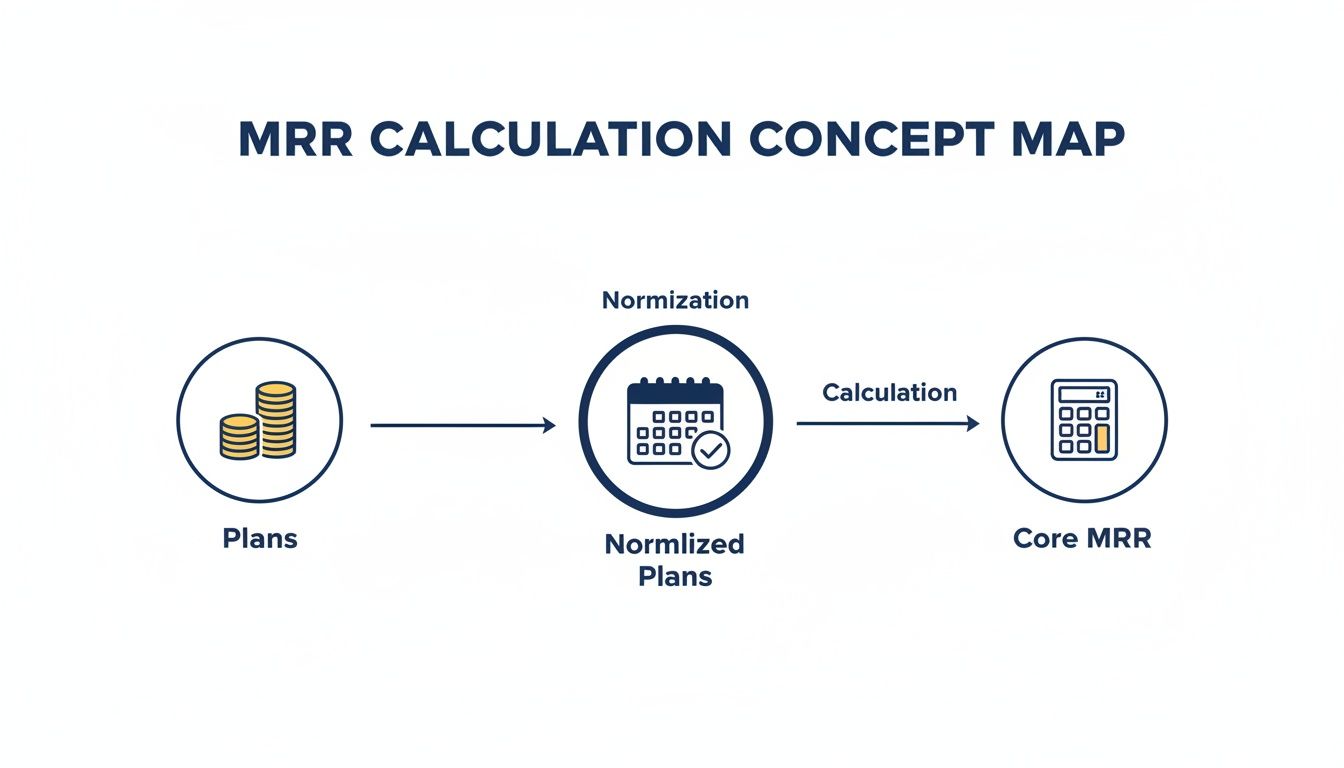
With that baseline established, you can start tracking the five key MRR movements that define your growth trajectory.
Decoding Your MRR Movements
Each of the five MRR components tells a unique part of your growth story. Understanding them is the first step to influencing them. This table breaks down what each one means for your business.
| MRR Component | What It Measures | Example |
|---|---|---|
| New MRR | Revenue from brand-new customers joining this month. | 10 new customers sign up for your $100/month plan, adding $1,000 in New MRR. |
| Expansion MRR | Additional revenue from existing customers upgrading or adding services. | An existing customer upgrades from a $200 plan to a $300 plan, adding $100 in Expansion MRR. |
| Contraction MRR | Revenue lost from existing customers downgrading or removing services. | A customer on a $500/month plan downgrades to a $300/month plan, creating $200 in Contraction MRR. |
| Churned MRR | Total revenue lost from customers who cancel their subscriptions completely. | Two customers on your $250/month plan cancel, resulting in $500 of Churned MRR. |
| Reactivation MRR | Revenue from former, churned customers who return and resubscribe. | A customer who canceled their $150/month plan six months ago signs up again, adding $150 in Reactivation MRR. |
Now, let's dig into what drives these numbers and why they matter so much.
The Positive Forces: New and Expansion MRR
Two of these engines are responsible for adding revenue. These are the growth drivers every SaaS business is laser-focused on maximizing.
New MRR: This one is straightforward—it’s the lifeblood of any growing company. New MRR is the total recurring revenue you gain from acquiring brand-new customers. This is your acquisition engine at work, turning prospects into paying users. For SaaS businesses, mastering B2B lead nurturing best practices for SaaS growth is a non-negotiable part of keeping this engine running strong.
Expansion MRR: Often called "upgrade MRR," this is the extra revenue you earn from your existing customer base. It happens when customers upgrade to a pricier plan, add more seats, or buy an add-on. This is a huge sign of a healthy product; it proves your customers are finding so much value that they’re willing to pay you more for it.
The Negative Forces: Contraction and Churn MRR
Just as important as filling the bucket is plugging the leaks. Two negative forces are constantly working to drain your MRR, and getting them under control is the key to sustainable growth.
Contraction MRR: This is the slow leak. It’s the revenue you lose when existing customers downgrade to a cheaper plan, reduce their user count, or drop an add-on. They haven't left you completely, but their value has decreased. A customer moving from a $200/month plan to a $100/month one creates $100 in Contraction MRR.
Churned MRR: This is the gushing hole in the bucket. Churned MRR represents the total revenue lost when customers cancel their subscriptions entirely. If five customers on your $100/month plan leave, you’ve lost $500 in Churned MRR. It’s the most painful loss because you've lost both the revenue and the customer relationship. This dynamic is central to another crucial metric we cover in our guide to Net Retention Rate.
The Comeback Story: Reactivation MRR
Finally, there’s one last engine—the comeback.
Reactivation MRR is the recurring revenue you gain from former customers who previously churned but decided to return. Maybe they left for a competitor and realized the grass wasn't greener, or perhaps you released a feature they were waiting for.
While it’s often a smaller number than New or Expansion MRR, reactivation is a powerful vote of confidence in your product and a sign that your win-back campaigns are working.
Avoiding Common MRR Calculation Mistakes
Getting your MRR calculation right is non-negotiable. An inaccurate number is honestly worse than having no number at all—it can send you chasing flawed projections, making bad strategic calls, and even shake investor confidence.
The good news? Most MRR errors boil down to a handful of classic, avoidable mistakes. Once you get a feel for what to include and—just as importantly—what to leave out, you’ll be able to generate a trustworthy MRR report every single month.
Let's walk through them.
Mistake 1: Including One-Time Revenue
This is, without a doubt, the most common and damaging mistake. It’s so tempting to see cash hit the bank and want to lump it all into MRR, but that completely misses the point of the "recurring" part of the metric. One-off payments create artificial spikes that hide the true, predictable pulse of your business.
- The Common Mistake: Adding one-time setup fees, implementation costs, or consulting charges into MRR for the month they're paid.
- The Correct Approach: Always exclude one-time payments. Your MRR should only reflect the predictable revenue you can count on, month in and month out. Those other payments are great, but they belong in a separate bucket tracked as non-recurring revenue.
Think of it this way: your MRR is your salary, while a one-time fee is like getting a surprise bonus. You plan your monthly budget around your salary, not the bonus you might never get again. Your business planning needs that same discipline.
By keeping your MRR pure, you ensure it remains a reliable indicator of your company's sustainable health. Mixing in non-recurring revenue is like adding a shot of espresso to a decaf coffee—it temporarily changes the result but doesn't reflect the underlying reality.
Mistake 2: Mishandling Discounts and Coupons
Discounts and promo codes are fantastic for getting new customers in the door, but you have to account for them correctly. If you calculate MRR based on the full sticker price, you're just fooling yourself with vanity metrics.
- The Common Mistake: Calculating MRR based on the full, pre-discount price of a subscription plan.
- The Correct Approach: Subtract all discounts and coupons from the recurring charge before adding it to MRR. If a customer uses a 20% off coupon on a $100/month plan, they contribute $80 to your MRR, not $100. It's all about reflecting the actual cash you expect to receive.
This rule applies to everything, whether it’s a first-month promo or a permanent discount. Your MRR has to represent the net revenue you actually bank from subscriptions.
Mistake 3: Forgetting to Normalize Multi-Month Contracts
We touched on this earlier, but it’s so critical it’s worth repeating. Taking a full annual payment and counting it all in one month is a massive, foundational error. An annual payment is a booking, not a month's worth of revenue. For a deeper look, you can learn more about the critical differences between revenue vs bookings in our guide.
- The Common Mistake: Counting a $1,200 annual payment as $1,200 in MRR for the month it was received, and $0 for the next eleven months.
- The Correct Approach: Divide the total contract value by the number of months in the term. That same $1,200 annual contract should be normalized to contribute exactly $100 to your MRR for each of the next 12 months. This is the only way to get a smooth, accurate, and comparable view of your revenue stream.
Mistake 4: Ignoring Prorated Charges and Credits
People rarely upgrade or downgrade their plans on the first of the month. When a customer changes their subscription mid-cycle, tools like Stripe often create prorated charges or credits to true things up. These little adjustments are easy to overlook but are crucial for pinpoint accuracy.
- The Common Mistake: Ignoring prorations entirely, or just waiting until the next full billing cycle to account for the change.
- The Correct Approach: Factor in the prorated monthly value. If a customer upgrades halfway through the month, their MRR contribution for that specific month should be a blend of the old and new plan values, reflecting the time spent on each. It’s a bit more work, but it ensures your MRR is a real-time snapshot of your business.
How to Protect and Grow Your Revenue Base
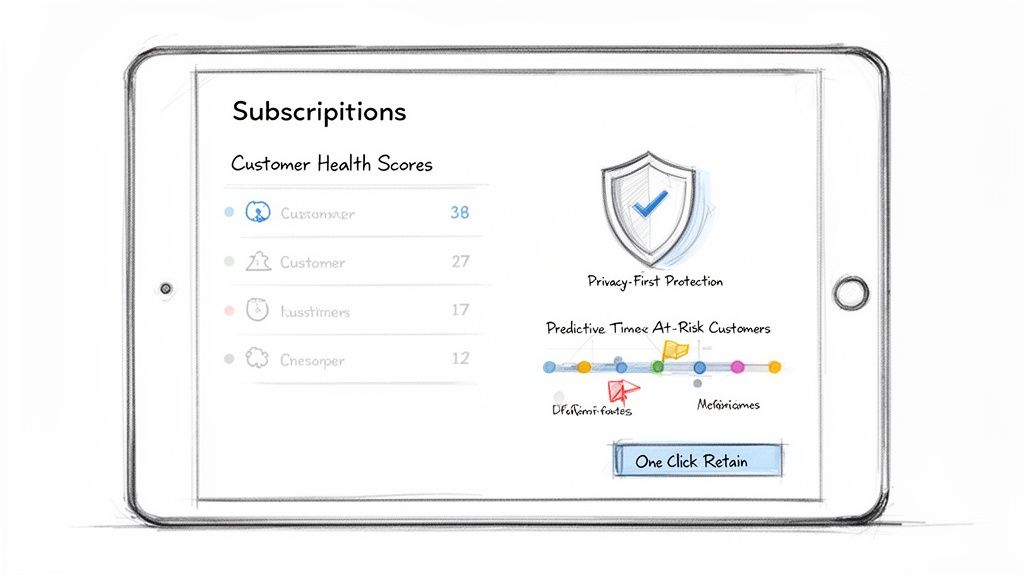
Alright, you've got a handle on what MRR is and how all its moving parts work. That’s step one. The real game-changer is what you do next: actively defending and expanding that revenue.
Winning in the subscription world requires a major mental shift. You have to move away from being reactive—just watching cancellation notices roll in—and get proactive about preventing churn before it even starts.
That's where you find your leverage. Bringing in new customers is always important, but protecting the revenue you’ve already earned is by far the most efficient way to grow. Thankfully, modern tools have evolved from simply analyzing past churn to accurately predicting future churn.
Moving from Reactive to Predictive Retention
Imagine knowing which customers are quietly drifting away, days or even weeks before they finally click "cancel." That’s the magic of predictive churn platforms. Instead of waiting for a grim Churned MRR report at the end of the month, you get a powerful early-warning system.
Platforms like LowChurn plug directly into your Stripe account, analyzing user behavior right alongside subscription data. By spotting tiny changes in how customers use your product, these systems can forecast who is likely to churn with incredible accuracy. This gives you the chance to step in at just the right moment, turning a potential loss into a success story.
The impact here is massive. For a mid-sized company, cutting churn by just 5% can save $300K in Annual Recurring Revenue (ARR). With platforms like LowChurn predicting at-risk customers with over 85% accuracy, your team can finally launch retention campaigns that directly protect your MRR.
How to Instrument Your Stripe Data
The best part? Setting up this kind of early-warning system is surprisingly straightforward and built with customer privacy in mind. It usually takes just two quick, no-code steps:
- Connect Your Stripe Account: Using a secure, read-only link, the platform pulls subscription metadata—things like plan changes, payment history, and lifecycle events. It never touches sensitive financial details or personally identifiable information (PII).
- Add a Lightweight Snippet: You add a tiny piece of JavaScript to your app. This snippet tracks anonymized product usage, like login frequency or feature engagement, to build a full picture of each customer's health.
Once connected, these data points merge to create a dynamic health score for every single customer. This gives you a clear, prioritized list of at-risk accounts, showing you their MRR value and health score at a glance. Your team can stop guessing and start focusing their energy where it matters most.
Launching Proactive Retention Campaigns
With a prioritized list of at-risk accounts, you can stop flying blind. It’s time to run targeted retention campaigns that actually work. We’re not talking about generic "we miss you" emails; this is about using data to send the right message at the perfect time.
Proactive retention transforms customer success from a cost center into a powerful revenue engine. By saving just a few at-risk accounts each month, these systems often pay for themselves almost immediately.
Here are a few proven, one-click campaigns you can get started with:
- Targeted Outreach: See a high-value account that's disengaged? A quick, personal check-in from a customer success manager can uncover problems before they escalate into churn.
- Feature Re-Engagement: If a customer isn’t using a key feature that delivers your product's core value, you can trigger an automated email or in-app guide to show them what they're missing.
- Offer a Plan Adjustment: For a customer whose usage has dipped, proactively suggesting a more fitting, lower-cost plan can prevent a complete cancellation. This turns Churned MRR into manageable Contraction MRR.
- Automated Dunning Management: Involuntary churn from failed payments is a silent killer. A smart dunning process is non-negotiable. You can learn exactly how to set up an effective dunning process to recover failed payments in our detailed guide.
By embracing a predictive, data-driven strategy, you build a fortress around your MRR. Churn prevention stops being a defensive chore and becomes one of your most powerful engines for growth.
It’s Time to Build Your Playbook
If there’s one thing to take away from this entire guide, it’s this: getting a real handle on your monthly recurring revenue is the single most important thing you can do to build a SaaS business that lasts. MRR isn't just another number on your dashboard. It’s the pulse of your company—a clear signal of your health, the strength of your product-market fit, and where you're headed.
By really understanding what makes up that number, you can finally stop just watching your revenue and start actively shaping it.
The whole point of this guide is to give you a concrete playbook. It all starts with getting the calculation right—normalizing different contract lengths and stripping out one-time payments to get a clean, honest metric. From there, you have to dissect that number into its five core components: new, expansion, contraction, churn, and reactivation. This is how you see exactly where growth is coming from and, just as importantly, where you're leaking cash.
A Shift to Proactive Growth
Dodging the common calculation pitfalls is table stakes; it’s about having data you can actually trust. The real magic happens when you shift from a reactive "Oh no, a customer churned" mindset to a proactive one. Churn stops being an unavoidable cost of doing business and becomes a problem you can see coming.
The final, empowering takeaway is this: by mastering your monthly recurring revenue and using predictive tools like LowChurn to get ahead of churn, you gain control over your company’s destiny.
This is how you build a SaaS business that's resilient, predictable, and ready to scale. You're no longer scrambling to react to yesterday's cancellations. Instead, you're designing tomorrow's growth.
It’s a powerful shift that puts you in the driver's seat, ready to protect your revenue, deepen customer relationships, and lock in long-term success. With this playbook, you’re equipped to build a business that doesn't just survive—it thrives.
Answering Your Top Questions About Monthly Recurring Revenue
Even after you get the hang of MRR, some tricky questions always seem to pop up. Let's tackle the most common ones we hear from SaaS founders and operators to make sure you're managing your business with total clarity.
What's the Real Difference Between MRR and ARR?
Think of MRR (Monthly Recurring Revenue) and ARR (Annual Recurring Revenue) as two different ways to look at the same predictable income stream. They just operate on different timelines.
MRR is your speedometer. It gives you a real-time, month-to-month reading of your growth momentum. It’s perfect for operational planning, tweaking your marketing spend, and making quick adjustments.
ARR, on the other hand, is your roadmap. You calculate it as MRR × 12, and it gives you a big-picture, annualized view of your business. This smooths out any monthly bumps and is the go-to metric for long-term financial planning, conversations with investors, and company valuation, especially if you have a lot of annual contracts.
Should Usage-Based Fees Be Part of My MRR?
This is a really important one to get right for accurate reporting. The short answer is no.
Strictly speaking, your monthly recurring revenue should only ever include the fixed, predictable part of a customer's subscription. By their very nature, usage-based fees are variable and unpredictable, so lumping them in with your core MRR can give you a false sense of stability.
The best practice is to track these two revenue streams separately. This way, you have an honest, clear view of your financial foundation, which is crucial for both your internal team and any outside stakeholders, like investors.
A great way to report this is by breaking it down into Committed MRR (your fixed, recurring base) and Usage Revenue (the variable component). This separation keeps your core MRR a reliable and trustworthy metric.
What's a Good MRR Growth Rate for an Early-Stage SaaS?
While there’s no single magic number, and it can depend heavily on your funding and market, a common target for venture-backed SaaS startups is 10-20% month-over-month growth. For bootstrapped companies or those that are a bit more established, a healthy and sustainable rate is often closer to 5-10%.
But here’s the thing: the quality of that growth matters way more than the number itself. Sustainable growth is powered by two key engines:
- New MRR: Revenue from signing up brand-new customers.
- Expansion MRR: Getting more revenue from existing customers when they upgrade or add services.
If your growth rate is just high enough to mask a major churn problem, you don't have a healthy business—you have a leaky bucket.
How Can I Track MRR Accurately if My Business Runs on Stripe?
If you’re using Stripe, you’re already in a great spot. The native Stripe Billing analytics dashboard is your first stop. It automatically crunches the numbers and gives you your top-line MRR along with its core components.
For a deeper level of insight, tools like LowChurn can plug directly and securely into your Stripe account. They go way beyond just calculating the numbers. By enriching your Stripe data, these tools can provide predictive churn insights and dynamic health scores for every customer. This adds an intelligent, proactive layer on top of your raw data, so you can stop just tracking MRR and start actively protecting and growing it.
Ready to stop reacting to churn and start preventing it? LowChurn gives you an AI-powered early-warning system that identifies at-risk customers in Stripe 7-30 days in advance. Protect your monthly recurring revenue and build a more resilient business. Get your free churn audit today.