Let's get one thing straight: acquiring new customers is exciting, but it's not the whole story. The real secret to sustainable, long-term growth? It lies with the customers you already have.
Think of your business like a leaky bucket. You pour new revenue in the top (new customers), but some of it leaks out the bottom (churn). Net Retention Rate (NRR) tells you how good you are at not just plugging those leaks, but also getting the water already inside the bucket to expand. It’s the ultimate health score for a subscription business.
Why Net Retention Rate Is Your True Health Score
While most companies obsess over customer retention—simply asking, "Did they stay?"—NRR asks a much smarter question: "How did their value to our business change over time?"
This single metric paints a complete picture by balancing two powerful, opposing forces:
- Revenue Churn: The money that walks out the door when customers cancel or downgrade.
- Expansion Revenue: The new money that comes in when existing customers upgrade, add more seats, or buy other products from you.
A high NRR is a massive vote of confidence from your customers. It proves they’re not just sticking around, but they’re so happy with the value you provide that they’re willing to spend more with you over time.
Before we jump into the math, let's quickly break down the moving parts that make up your NRR.
Key Components of Net Retention Rate
| Component | Description | Impact on NRR |
|---|---|---|
| Starting MRR | The total monthly recurring revenue from your customer base at the beginning of the period. | This is your baseline. |
| Expansion MRR | Additional revenue from existing customers (upgrades, cross-sells, add-ons). | Increases NRR. |
| Downgrade MRR | Revenue lost when existing customers move to a lower-priced plan. | Decreases NRR. |
| Churned MRR | Revenue lost from customers who cancel their subscriptions completely. | Decreases NRR. |
This table gives you a quick reference for the inputs we'll be using. Each one tells a small part of the story about your customer base's health.
The Power of a 100%+ NRR
Here’s where it gets really interesting. When your NRR tips over 100%, something magical happens. It means your expansion revenue from current customers is more than covering all the revenue you’re losing from churn and downgrades.
This is the holy grail for SaaS. It means your business can grow even if you don't sign up a single new customer. This phenomenon, often called "negative churn," is a powerful signal to investors and your internal team that you have a sticky product with incredible product-market fit.
On the flip side, an NRR below 100% is a warning sign that your existing customer revenue is shrinking. It’s a clear signal that you need to shift from just fighting churn to proactively creating more value for the customers you have. Getting a handle on NRR is the first step toward building a truly resilient business.
How to Calculate Your Net Retention Rate
Figuring out your net retention rate can feel like a complex task, but the actual math is more intuitive than you might think. At its core, it's about answering one question: are you making more money from the customers you had last month than you were before?
Think of it like a bucket of water. Your starting revenue is the water in the bucket. Churn and downgrades are leaks, while expansion revenue (from upsells and cross-sells) is you pouring more water in. NRR tells you if the water level is rising or falling over time.
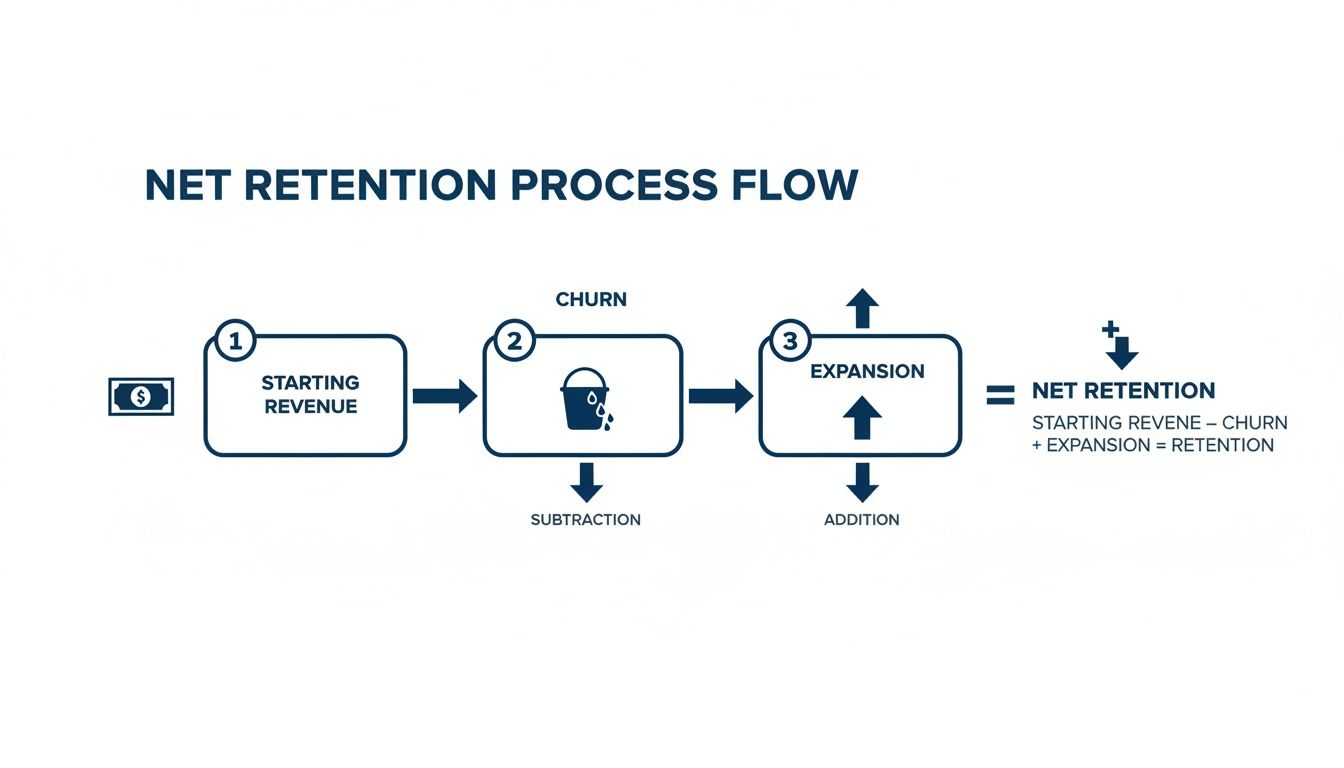
This simple flow highlights the tug-of-war happening in your customer base. To grow sustainably, the new revenue you generate from existing customers has to be greater than the revenue you lose.
The Standard NRR Formula
The most common way to calculate net retention gives you a clean snapshot of your revenue health from your current customers over a set period.
Net Retention Rate = [(Starting MRR + Expansion MRR) - (Churn MRR + Downgrade MRR)] / Starting MRR
Just multiply the final number by 100 to get your percentage. Let's quickly define each piece so you can plug in your own numbers.
- Starting MRR: This is your Monthly Recurring Revenue from a specific group of customers at the start of the period (like on the first day of the month).
- Expansion MRR: All the new revenue you gained from that exact same group of customers. This comes from things like plan upgrades, buying more seats, or adding new features.
- Churn MRR: The revenue you lost when customers from that starting group canceled their subscriptions for good.
- Downgrade MRR: The revenue lost when customers from that group moved to a cheaper plan.
If you want to dig deeper into the "leaks" in your bucket, a SaaS churn calculator can be a great way to isolate those specific metrics.
A Real-World NRR Calculation Example
Theory is one thing, but let's walk through a real-world scenario. Imagine you run a SaaS company that provides project management software.
At the beginning of March, your Monthly Recurring Revenue (MRR) from existing customers was $50,000.
Over the course of the month, a few things happened:
- Several clients loved the product and upgraded to a higher tier for more advanced reporting. This added $7,500 in Expansion MRR.
- Two smaller clients downgraded to a basic plan after a big project wrapped up, resulting in $1,500 of Downgrade MRR.
- Sadly, one client went out of business and had to cancel, which meant $3,000 in Churned MRR.
Let’s plug those numbers right into the formula:
NRR = [($50,000 + $7,500) - ($3,000 + $1,500)] / $50,000
- Add the Gains: First, add your expansion revenue to your starting MRR. ($50,000 + $7,500 = $57,500)
- Add the Losses: Next, add up all the revenue you lost from churn and downgrades. ($3,000 + $1,500 = $4,500)
- Find Your End-of-Month Total: Subtract the total losses from your gains. ($57,500 - $4,500 = $53,000)
- Calculate the Rate: Finally, divide this new total by where you started. ($53,000 / $50,000 = 1.06)
Multiply by 100, and you get a Net Retention Rate of 106% for March. A number over 100% is fantastic news! It means the growth from your happy, expanding customers more than made up for the revenue you lost. You're not just retaining customers; you're growing with them.
So, What's a "Good" Net Retention Rate, Anyway?
Once you’ve finally calculated your net retention rate, the next question is always the same: "Is this number any good?" The honest answer? It depends. A "good" NRR for a startup serving small businesses is a world away from what an enterprise software giant should be aiming for.
The universal floor for a healthy SaaS business is a net retention rate of 100%. Hitting this magic number means your expansion revenue from existing customers is perfectly canceling out any revenue lost to churn and downgrades. You’ve built a self-sustaining engine.
But the best companies don't just settle for 100%. An NRR above 100% is where the real magic happens. It's a clear signal of efficient, compounding growth, proving that your existing customers are finding so much value they’re willing to spend more. Your customer base has officially become your best growth channel.
How Your ACV Changes the Game
Your Average Contract Value (ACV) is probably the single biggest factor in defining what a "good" NRR looks like for you. It makes sense, right? Companies with bigger contracts usually have more invested customers, longer sales cycles, and more hands-on support, all of which lead to higher retention.
Industry benchmarks from SaaS Capital show a clear split. For companies with an ACV between $25,000 and $50,000, the median NRR hovers around 102%. For those selling high-ACV products over $50,000, that median jumps to 111% or even higher. These stickier, more complex products naturally build deeper partnerships.
The chart below, also from SaaS Capital, breaks down how NRR benchmarks shift as a company’s Annual Recurring Revenue (ARR) grows.
There’s a clear pattern here: as companies get bigger, their median net retention tends to climb. This reflects more stable customer relationships and, crucially, more opportunities to expand those accounts.
Why Investors Obsess Over NRR
Investors love NRR, and for good reason. It’s one of the cleanest indicators of product-market fit and long-term business health. A high NRR doesn't just show that people like your product; it proves it’s an essential tool they’re willing to grow with.
A strong NRR is one of the most compelling signals of a healthy business. It tells investors that a company has a durable revenue model, a loyal customer base, and a clear path to profitable, scalable growth without relying solely on expensive new customer acquisition.
This is exactly why companies with an NRR of 110% or more often command much higher valuations. It’s a direct reflection of their ability to build lasting value. Of course, NRR is just one piece of the puzzle. It's vital to see how it stacks up against other metrics, so be sure to check out our guide on SaaS churn rate benchmarks to get the full picture of your customer health.
Actionable Strategies to Improve Your Net Retention Rate
Improving your Net Retention Rate isn't about finding one magic trick. It's about a focused, coordinated effort across three fundamental growth levers: growing expansion revenue, fighting voluntary customer churn, and stamping out involuntary churn from failed payments. When you master these areas, your existing customer base transforms into a powerful, self-sustaining growth engine.
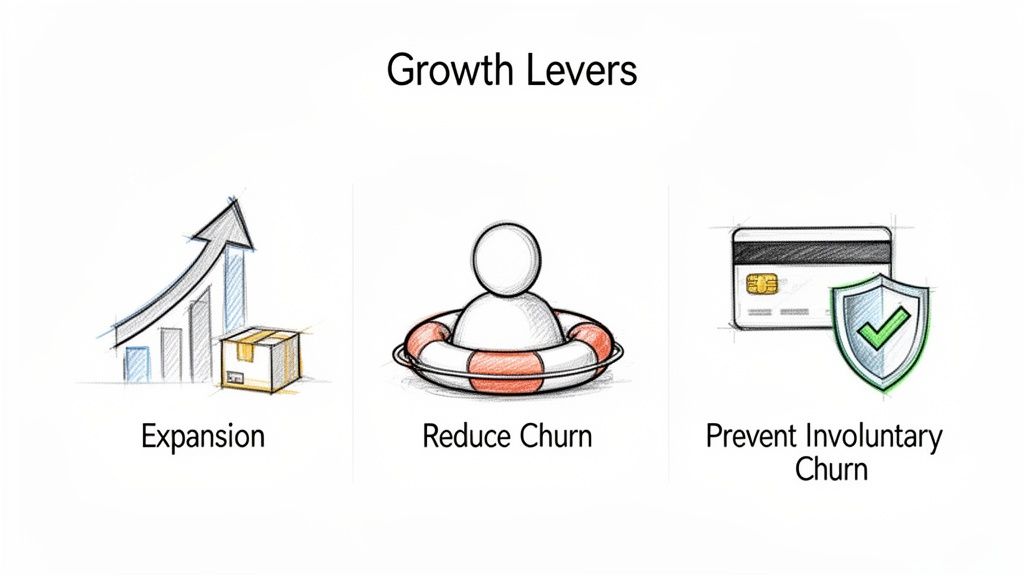
Each of these levers needs a different playbook, but they all work in concert to drive your NRR above 100%. Let's dig into the practical steps you can start taking today for each one.
Drive Expansion Revenue with Strategic Upsells
The most direct path to a higher NRR is by increasing your Expansion MRR. Your happiest, most engaged customers are your best audience for this. They already get the value you provide, which makes them prime candidates for additional features or premium tiers.
Here’s how to make it happen:
- Introduce Value-Based Pricing: Structure your pricing so that it scales with the value your customers receive. As their business grows and they accomplish more with your product, they should naturally move into higher tiers that unlock even more capabilities.
- Identify Your Power Users: Find the customers who live inside your platform and use its core features to the fullest. These are the folks who are ready for an upgrade. Reach out and show them exactly how your premium features can solve their next big challenge.
- Time Your Offers Perfectly: Use product usage data to trigger upgrade prompts at the most relevant moments. For instance, when a user is about to hit a limit on their current plan, you can present them with a seamless, one-click upgrade path right inside the app.
Focusing on expansion is so much more than just a sales tactic—it's about deepening the partnership with your customer. An upgrade is a clear signal of long-term commitment and shows that your product is becoming deeply embedded in their daily operations.
Proactively Reduce Voluntary Churn
Voluntary churn is what happens when a customer makes the conscious decision to cancel their subscription. Your best defense here is a rock-solid customer success program that turns potential leavers into loyal advocates. By implementing effective customer success strategies, you can build the kind of loyalty that makes customers stick around for the long haul.
It all starts with onboarding. A great onboarding experience is your first and best line of defense. You need to make sure new users achieve a meaningful "quick win" and fully grasp your product's core value within their first few sessions. That initial positive experience makes them far more likely to stay.
Beyond that, you have to keep a pulse on customer health. By tracking metrics based on product usage, you can create a customer health score that acts as an early-warning system. A sudden dip in engagement is your cue to step in with proactive support or training before the customer even starts thinking about leaving.
Minimize Involuntary Churn from Failed Payments
Involuntary churn is the silent killer of NRR. It's the revenue you lose not because a customer is unhappy, but because a payment failed—an expired credit card, a bank decline, or insufficient funds. This is often the lowest-hanging fruit when it comes to boosting retention.
The State of Retention report from Churnkey really shines a light on this. It found that while voluntary churn rates are starting to level off, involuntary churn is all over the map. For example, generic payment declines shot up to a staggering 62.2% in India, which points to major gaps in payment processing. The report also found that top-performing companies are using AI-powered dunning tools to cut involuntary churn by 20-30%. You can discover more insights in the full retention report from Churnkey.
Here’s your game plan to fight back:
- Automated Dunning Campaigns: Set up smart email sequences that automatically notify customers before their card expires and follow up methodically after a payment fails.
- In-App Notifications: Don't just rely on email. Alert users about payment problems directly inside your app, where they are most engaged and can update their billing information in seconds.
- Flexible Payment Options: Offer multiple ways to pay (credit cards, ACH, digital wallets) to reduce the risk of a single point of failure.
NRR Improvement Strategy Comparison
Choosing where to focus your efforts depends on your specific situation. The table below breaks down these three core strategies to help you decide which levers to pull first.
| Strategy | Primary Goal | Effort Level | Potential Impact |
|---|---|---|---|
| Expansion Revenue | Increase customer lifetime value from happy users. | Medium to High | High |
| Reduce Voluntary Churn | Improve product stickiness and customer loyalty. | High | High |
| Minimize Involuntary Churn | Recover revenue lost to technical payment failures. | Low to Medium | Medium |
Ultimately, a balanced approach that addresses all three areas will yield the best results. Start by tackling the low-hanging fruit like involuntary churn while you build out more comprehensive customer success and expansion programs for long-term, sustainable NRR growth.
How to Monitor and Report Your NRR Effectively
Calculating your net retention rate is one thing, but actually weaving it into your company’s day-to-day rhythm is a whole different ballgame. NRR shouldn't be a metric you dust off once a quarter for a board meeting. To get real value from it, you need a solid system for monitoring and reporting that turns raw data into clear, strategic actions.
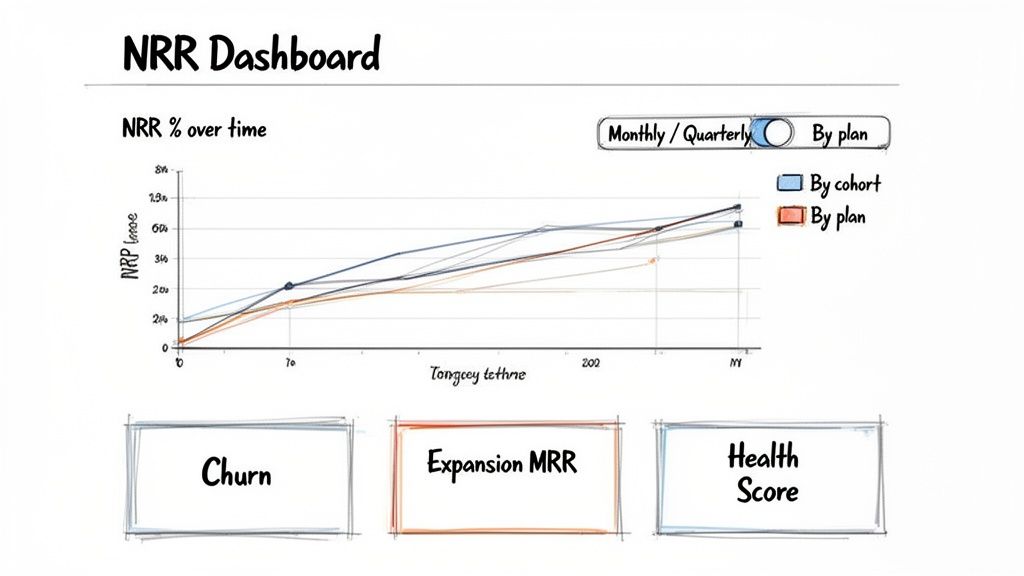
Think of it like a pilot's cockpit. A single altitude reading is helpful, sure, but it’s the combination of speed, direction, and fuel levels—all updated in real-time—that allows for a safe and successful flight. Your NRR dashboard does the same job for your business, giving you a complete, at-a-glance view of your revenue health.
Setting Your Tracking Cadence
So, how often should you be looking at this? For most SaaS companies, tracking NRR on a monthly basis hits the sweet spot. It’s frequent enough to spot emerging trends and measure the impact of recent changes—like that new onboarding flow you just launched—without getting bogged down by tiny, meaningless daily fluctuations.
Then, you can zoom out for a quarterly review. This gives you a more stable, big-picture perspective that’s perfect for high-level strategic planning and investor updates. The key, no matter what, is consistency. Pick your cadence and stick to it so you're always comparing apples to apples.
Of course, none of this matters if your data is a mess. It's crucial to implement data quality best practices for reliable analytics to make sure the numbers you're basing decisions on are accurate from the get-go.
Building Your NRR Dashboard
A simple, visual dashboard is the best way to make your NRR visible and understandable for the whole team. It’s not enough to just display the final percentage; a truly useful dashboard breaks down the moving parts that feed into it.
Here’s what every good NRR dashboard needs:
- NRR Trend Line: A simple line graph showing your NRR over the past 12 months. Is it trending up, down, or flat?
- Expansion MRR: The total revenue you're adding from existing customers through upsells and cross-sells. This is your growth engine.
- Churn & Downgrade MRR: The total revenue you're losing from cancellations and plan downgrades. This is the leak in your bucket.
- Customer Health Score: A leading indicator that helps predict which accounts might be at risk of churning.
Keeping users engaged is a huge piece of this puzzle. User retention benchmarks show that software companies often keep just 39% of users after the first month, a scary number that directly drags down NRR. For many SMBs, simply predicting cancellations 7-30 days out by tracking usage patterns can lead to a 10-15% retention bump through automated recovery campaigns.
A great NRR dashboard doesn't just report the past; it helps you predict the future. By monitoring leading indicators like customer health scores, you can spot trouble and intervene before a customer even thinks about churning.
The real magic happens when you start segmenting this data. Break it down by customer cohort, plan type, or even geography. You might discover that your enterprise plan boasts a 125% NRR while your starter plan is struggling at 85%. That's not just a number; it's a bright, flashing sign telling you exactly where to focus your customer success efforts. To dive deeper, check out our guide on the customer health score.
Common Questions About Net Retention Rate
Once you get the hang of the basics, you start running into the tricky "what if" scenarios. Let's walk through some of the most common questions that pop up when you start applying NRR to your own SaaS business.
What's the Difference Between NRR and Gross Retention Rate?
This is a big one. The key difference is what they account for.
Gross Retention Rate (GRR) strictly measures how much of your existing revenue you kept, period. It ignores all expansion revenue from upsells or cross-sells. Because of this, GRR can never top 100%. It’s a pure measure of your ability to prevent revenue loss.
Net Retention Rate (NRR), on the other hand, gives you the full picture. It starts with your existing revenue, subtracts churn and downgrades, and then adds back any expansion revenue from those same customers. This is huge, because it means your NRR can go above 100%.
I like to think of it this way: GRR tells you if your bucket has holes. NRR tells you if the water you're adding is more than what's leaking out. You need to know both to understand your true growth potential.
How Often Should I Calculate My NRR?
The right answer is: consistently. Pick a schedule and stick to it so you can track trends reliably.
- Monthly: This is great for a tactical, on-the-ground view. You can see the immediate impact of a new feature launch, a pricing update, or a new customer success campaign.
- Quarterly: This gives you a more strategic perspective. It smooths out any weird monthly fluctuations and is much better for board reporting and long-term planning.
Most teams I know calculate it monthly for internal tracking and report on it quarterly to stakeholders. The most important thing is to make it a regular part of your business rhythm.
Can a High NRR Hide a Serious Churn Problem?
Yes, and this is one of the most dangerous traps you can fall into. You could be celebrating a stellar 115% NRR, but that number might be coming from just a handful of huge enterprise accounts expanding like crazy.
Meanwhile, you could be bleeding smaller customers—what we call "logo churn." While the revenue looks good today, you're losing the seed corn for future growth. A shrinking customer base means fewer accounts to expand into down the road. Always look at NRR alongside logo churn for an honest view of customer health.
What Are the Classic Mistakes When Calculating NRR?
Getting this calculation wrong can send you chasing the wrong goals. Precision really matters here.
Here are the top three mistakes I see teams make all the time:
- Mixing in New Customer Revenue: This is the cardinal sin. NRR is only about the journey of the customers you had at the start of the period. Don't let a single dollar from a new logo sneak into your calculation.
- Using Fuzzy Definitions: You need firm, written-down rules. What counts as an expansion? Is a new department at an existing company a new sale or an upsell? Decide on your definitions, document them, and apply them consistently every single time.
- Botching the Starting Cohort: The entire calculation hinges on getting the baseline right. Make absolutely sure you've correctly identified the specific group of customers and their total MRR on day one of the period you're measuring. Everything else flows from that number.
Stop guessing which customers are about to cancel. LowChurn uses AI to analyze product usage and subscription data, predicting churn 7-30 days in advance with over 85% accuracy. Act on real-time health scores and launch proven retention campaigns with one click. See how LowChurn can protect your MRR.