
Customer onboarding isn't just a welcome email and a product tour; it's the single most critical phase in the customer lifecycle that determines long-term retention. A flawed first impression sends new users searching for alternatives, while a seamless, value-driven experience creates loyal advocates. Yet, many SaaS companies treat onboarding as a simple checklist rather than a strategic retention engine. This crucial initial period is where you prove your product's value and set the tone for the entire customer relationship.
The difference between a customer who churns in 30 days and one who stays for years often comes down to the quality of their first seven days. Getting this right means proactively guiding users to their "aha!" moment as quickly as possible, demonstrating clear value, and building momentum that carries them through the learning curve. To lay a solid foundation for customer success, leveraging an actionable client onboarding process template can be invaluable for standardizing these initial steps.
In this guide, we'll break down 10 actionable onboarding customers best practices that move beyond the basics. We will explore how to design structured flows, measure success with leading indicators, and leverage automation to proactively identify and engage at-risk accounts. These strategies are designed to be implemented immediately, providing a blueprint for turning new signups into power users. Whether you're a startup founder or a seasoned customer success leader, you will learn how to build an onboarding machine that systematically reduces churn and boosts customer lifetime value from day one.
1. Implement Automated Health Scoring Systems
Instead of waiting for lagging indicators like support tickets or payment failures, proactive customer onboarding best practices require a predictive approach. Automated health scoring systems provide this by continuously analyzing customer data to generate a real-time, predictive score that quantifies churn risk. This allows your team to intervene before a customer decides to leave.
These systems aggregate multiple data signals, including product usage frequency, feature adoption depth, and subscription metadata. For instance, LowChurn’s dashboard uses Stripe data to surface MRR health and prioritizes at-risk accounts, effectively turning raw data into a clear action plan. Similarly, tools like Amplitude can track behavioral signals to predict a decline in user engagement long before it impacts revenue.
How to Implement Health Scoring
The goal is to move from reactive problem-solving to proactive engagement. By identifying at-risk customers 7 to 30 days before they might cancel, you create a crucial window for intervention.
- Combine Data Sources: Your model should incorporate both product engagement metrics (e.g., daily logins, key feature usage) and subscription signals (e.g., plan tier changes, failed payments, contract end dates). This provides a holistic view of account health.
- Set Clear Thresholds: Define what constitutes a "healthy," "at-risk," or "critical" score. This prevents your customer success team from being overwhelmed and helps them focus their efforts on the accounts that need it most.
- Integrate with Action: A score is useless without a corresponding action. Connect your health scoring system to automated retention campaigns. For example, a customer whose score drops into the "at-risk" category could automatically receive a targeted in-app message or an email from their account manager.
- Validate and Refine: Regularly review the accuracy of your model by comparing its predictions against actual churn outcomes. Use this feedback loop to refine the data signals and weighting in your scoring algorithm.
Key Insight: An automated health score is the foundation of a scalable retention strategy. It replaces manual guesswork with a data-driven system that directs your team's attention where it can have the greatest impact on preserving revenue. To build a robust system, explore how to develop a comprehensive customer health score that accurately predicts customer behavior.
2. Create a Structured First-Week Onboarding Experience
The first seven days after a customer signs up are the most critical period for long-term retention. A structured first-week onboarding experience moves customers from initial purchase to their first moment of value realization as quickly as possible. This approach establishes momentum and demonstrates your product’s worth before initial excitement fades.
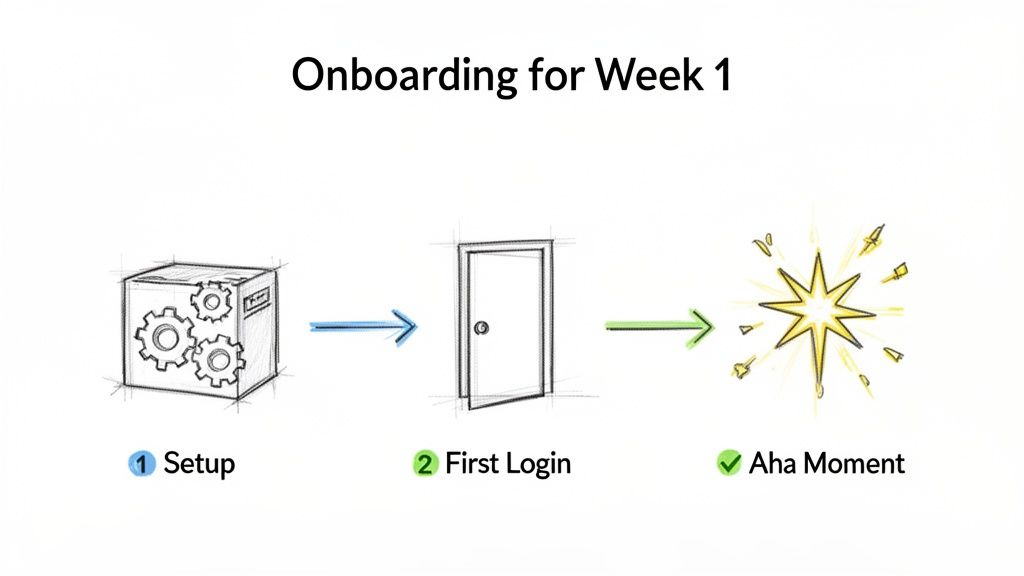
This process involves guiding new users through a predefined sequence of critical setup actions and feature discoveries. For example, Slack’s renowned onboarding flow relentlessly focuses on getting a user to send their first message, while Notion uses an interactive template library to help users create their first functional workspace. These guided experiences prevent users from feeling overwhelmed and ensure they complete the actions most correlated with future success.
How to Implement a First-Week Onboarding Plan
The objective is to guide users to their "aha moment"- the point where they personally experience your product's core value. Customers who achieve this milestone in their first week are far less likely to churn.
- Define Key Milestones: Identify the 3-5 non-negotiable actions a user must take to become successful. This could include setting up an integration, inviting a team member, or completing their first core task. Use these as the foundation of your onboarding checklist.
- Use In-App Checklists: Provide a visible, interactive checklist that tracks progress. This creates psychological momentum and clearly communicates the next steps, reducing user confusion and friction.
- Segment Your Approach: Your onboarding shouldn't be one-size-fits-all. Offer high-touch, personalized calls for enterprise customers while using automated in-app guides and email sequences for self-serve users.
- Monitor and Intervene: Track completion rates for each milestone. Users who fail to complete the first-week plan are prime candidates for proactive intervention. Feed this data into your health scoring system to flag them as at-risk before they become disengaged.
Key Insight: A successful first week is the single best predictor of a successful customer relationship. By front-loading value and creating a clear path to the "aha moment," you build the foundation for long-term engagement and turn new signups into power users. This is a core tenet of effective onboarding customers best practices.
3. Establish Clear Success Metrics and Expected Outcomes
Effective onboarding goes beyond teaching features; it focuses on delivering tangible business value. A critical best practice is to explicitly define what success looks like for each customer by establishing clear, measurable outcomes from day one. This process aligns your product’s capabilities with their specific goals, turning abstract potential into a concrete action plan.
This shared definition of success creates mutual accountability and prevents misalignment down the road. For example, Calendly might define success as "scheduling 20 new sales demos per month," while Gong could measure it by "increasing sales win rates by 15% through call analysis." For Intercom, a key metric might be "reducing average customer response time from 4 hours to under 60 minutes." These metrics tie product usage directly to the customer's desired business impact.
How to Implement Success Metrics
The objective is to create a clear, documented path to value that motivates customer engagement and proves your product's ROI. This framework becomes the basis for your entire customer relationship, from onboarding check-ins to renewal conversations.
- Define Primary Metrics: Work with the customer during kickoff to identify 1 to 3 primary success metrics. Trying to track ten different goals is a recipe for failure; focus on what delivers the most significant value.
- Use SMART Criteria: Ensure each metric is Specific, Measurable, Achievable, Relevant, and Time-bound. A vague goal like "improve efficiency" is useless, whereas "reduce manual data entry time by 5 hours per week within 90 days" is actionable.
- Schedule Regular Reviews: Discuss progress toward these metrics in regular check-ins. For SMB customers, a monthly touchpoint is effective, while quarterly business reviews (QBRs) are more suitable for enterprise accounts.
- Celebrate and Investigate: When a customer achieves a milestone, send a "success achieved" message to reinforce value. If metrics are missed, it triggers a proactive investigation: Is there a product gap, an adoption issue, or have their business needs changed? To effectively measure success and continuously improve, explore these proven tactics to improve your customer onboarding process.
Key Insight: Customers who can clearly articulate the value they receive from your product are far less likely to churn. By co-creating success metrics, you transform the onboarding process from a product tour into a strategic partnership focused on delivering measurable outcomes.
4. Deploy Personalized Onboarding Paths by Customer Segment
A one-size-fits-all onboarding flow fails to address the unique goals and technical abilities of different users, leading to disengagement and a longer time-to-value. One of the most effective onboarding customers best practices is to segment users and deliver tailored experiences. This ensures that every customer receives the most relevant guidance for their specific needs, dramatically improving adoption.
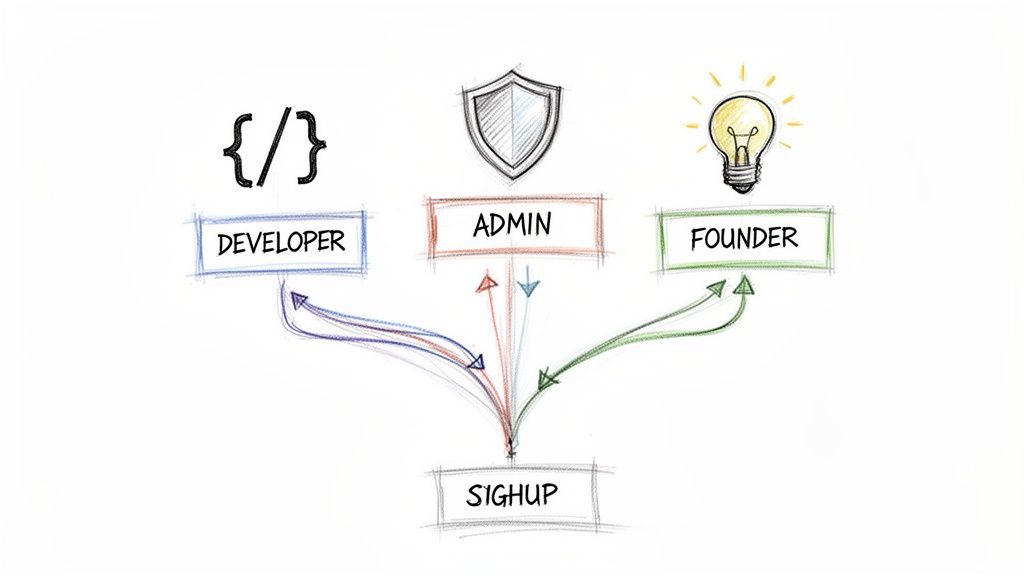
An enterprise administrator requires a different set of instructions than a startup founder, just as a developer needs different guidance than a non-technical marketer. For example, Stripe offers separate onboarding for developers that prioritizes API keys, while its flow for non-technical merchants focuses on the dashboard. Similarly, Zendesk provides distinct paths for support, sales, and IT teams, each highlighting the features most relevant to their roles.
How to Implement Segmented Onboarding
The objective is to guide each user to their "aha!" moment as quickly as possible by removing irrelevant steps and focusing on their primary job-to-be-done.
- Identify Key Segments: Start by defining 3-4 primary customer personas based on role, use case, company size, or plan tier. Avoid over-segmenting initially; you can expand later as you gather more data and have the resources to maintain additional paths.
- Automate Segment Assignment: Use data collected during signup, such as role or company size, to automatically place users into the correct onboarding flow. Ensure customer success teams have the ability to manually override assignments if a customer is miscategorized.
- Tailor the Content: Create unique in-app checklists, email sequences, and tooltips for each segment. A technical user might receive API documentation links, while a business user would get tutorials on report generation.
- Measure and Optimize: Track key metrics like completion rates, feature adoption, and time-to-value for each segment. Use this data to identify which paths are performing well and which need refinement. Regularly review your segments to ensure they remain relevant to your customer base.
Key Insight: Personalization is not just a feature; it's a core strategy for accelerating customer success. By tailoring the onboarding experience to a customer's specific context and goals, you demonstrate an immediate understanding of their needs, building a strong foundation for a long-term relationship.
5. Use Progressive Feature Disclosure and In-App Guidance
Instead of overwhelming new users with your product's entire feature set at once, progressive disclosure gradually introduces functionality as they become more proficient. This onboarding best practice reduces cognitive load and prevents paralysis by analysis. It is supported by contextual in-app guidance, such as tooltips and interactive walkthroughs, that teaches features at the precise moment of need, directly within the product experience.
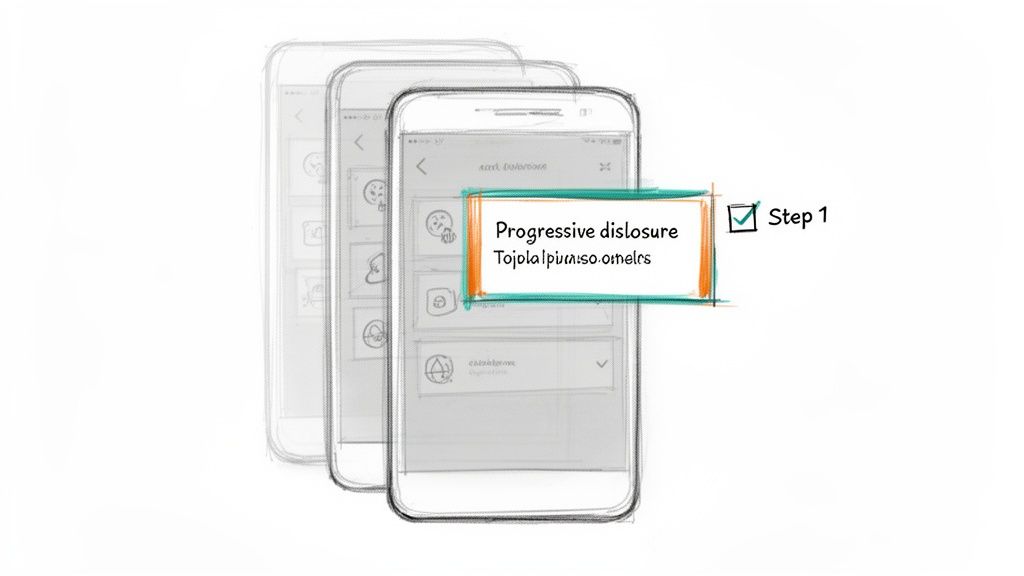
This approach focuses on guiding users from one small win to the next, building momentum and competence. For example, Asana first guides users to create a basic task before revealing advanced features like custom fields or workflow automation. Similarly, Slack ensures users master basic messaging before introducing more complex capabilities like bots and integrations. This method transforms the learning curve into a series of manageable, rewarding steps.
How to Implement Progressive Disclosure
The objective is to make your product feel intuitive and powerful by revealing complexity only when the user is ready for it. This layered approach is a key part of effective onboarding for customers, as it aligns feature discovery with user mastery.
- Map Features to the Journey: Identify your "foundational" features necessary for the initial "aha!" moment and separate them from "advanced" features. Introduce foundational features first, then gate advanced ones until key milestones are met.
- Leverage Product Analytics: Use data to pinpoint where users get stuck or abandon a workflow. These are prime locations for targeted in-app guidance, such as a tooltip or a short interactive tutorial that clarifies the next step.
- Respect User Autonomy: Always make it easy and obvious for users to skip or dismiss guidance. Forcing a user through a lengthy tour they don't need creates friction and frustration, undermining the goal of a smooth onboarding process.
- Test and Measure Your Guidance: Written instructions often differ from how users actually behave. Test your walkthroughs with new users to ensure they are clear and helpful. Track engagement metrics like completion and dismissal rates; a high dismissal rate might indicate poorly timed or irrelevant guidance.
Key Insight: Progressive disclosure isn't about hiding features; it's about revealing them at the right time to maximize understanding and adoption. By creating a guided path from simple to complex, you reduce initial friction and empower users to become experts at their own pace, which is fundamental to long-term retention.
6. Establish Regular Check-ins and Success Reviews
A successful initial setup is only half the battle; sustained value delivery is what drives long-term retention. One of the most effective onboarding customers best practices is to implement proactive, scheduled check-ins. These reviews, often at 30, 60, and 90-day intervals, keep customers accountable, surface issues early, and demonstrate a tangible investment in their success. They are the human touchpoint that complements automated systems.
These meetings are designed to assess progress against the success metrics defined at the start of the relationship. For instance, HubSpot’s 30/60/90-day review cadence ensures all new accounts receive consistent guidance, while Salesforce uses more in-depth Quarterly Business Reviews (QBRs) for its enterprise clients. This consistent communication identifies adoption barriers and allows teams to course-correct before minor frustrations escalate into churn risks.
How to Implement Regular Check-ins
The goal is to build a predictable, value-driven cadence that reinforces your product's role in the customer's success. These touchpoints turn your relationship from transactional to consultative, cementing your position as a strategic partner.
- Prepare with Data: Before each call, arm your team with relevant data, such as product usage metrics, progress against initial baselines, and health scores. This allows you to demonstrate tangible ROI and lead the conversation with insights, not just questions.
- Ask Open-Ended Questions: Instead of jumping straight to solutions, start by asking questions like, "What has been your biggest challenge since our last talk?" or "Where are you seeing the most unexpected value?" This uncovers hidden pain points and opportunities.
- Document and Follow Up: Record all key discussion points, action items, and next steps in a centralized CRM or customer success platform. Send a summary email after the meeting to ensure alignment and accountability for both parties.
- Adjust Cadence Based on Risk: While a standard 30/60/90-day cadence works for most, high-risk or high-value accounts may require more frequent check-ins. For at-risk customers, consider temporarily increasing the frequency to weekly or bi-weekly to provide hands-on support.
Key Insight: Consistent check-ins transform onboarding from a one-time event into a continuous process of value realization. This structured communication builds trust and provides invaluable feedback, creating a powerful defense against churn. Explore how these touchpoints fit into your broader retention efforts by learning more about holistic customer success strategies that protect your revenue.
7. Offer Tiered Support and High-Touch Onboarding for Enterprise
Not all customers are created equal, and your onboarding process shouldn't treat them as such. While self-serve models are perfect for SMBs, enterprise clients expect and require a fundamentally different experience. A tiered, high-touch onboarding model acknowledges that high-value accounts demand dedicated resources, customized implementation, and strategic guidance to achieve their complex business goals.
This approach segments your customer base to deliver a "white-glove" experience where it matters most. For example, Salesforce and HubSpot offer dedicated Customer Success Managers (CSMs) and implementation specialists to their top-tier clients, guiding them through setup, integration, and adoption. Similarly, Stripe provides dedicated integration teams for its highest-volume customers. This isn't just better service; it's a strategic investment in securing and expanding your most critical revenue streams.
How to Implement Tiered Onboarding
The goal is to align your onboarding investment with customer value, ensuring your most important accounts receive the support necessary for long-term success. Effective onboarding customers best practices for enterprise involve a structured, consultative partnership.
- Define Explicit Tiers: Create clear criteria based on MRR, contract value, or expansion potential. For instance, accounts over $5,000 MRR get a dedicated CSM, while mid-market accounts receive quarterly business reviews and SMBs use a self-serve knowledge base.
- Create Enterprise Playbooks: High-touch onboarding requires a detailed project plan. Document key milestones, stakeholder responsibilities, custom integration requirements, and clear timelines. This formalizes the process and sets clear expectations.
- Train for Consultation: Equip your enterprise CSMs with more than just account management skills. They need to act as strategic advisors who understand the customer’s business and can identify expansion opportunities, transforming onboarding into a value-add consultation.
- Measure Tiered Performance: Track metrics like Net Promoter Score (NPS), feature adoption, and expansion revenue separately for each tier. This allows you to validate the ROI of your high-touch program and refine your resource allocation.
Key Insight: Tiered support isn't about neglecting smaller customers; it’s about strategically allocating your most valuable resource, your team's time, to the accounts with the highest potential impact on revenue. By creating a differentiated onboarding experience, you protect enterprise-level MRR and build the foundation for significant account expansion.
8. Measure Onboarding Effectiveness Through Leading Indicators
Instead of waiting for lagging indicators like churn to tell you something went wrong months ago, the best onboarding practices measure effectiveness in real-time. Leading indicators are early user behaviors and milestones that are highly predictive of long-term retention. Tracking these allows you to gauge the health of new cohorts within their first few weeks, not quarters.
This approach shifts the focus from reacting to churn to proactively influencing retention. For example, Slack famously identified that teams sending their first message were far more likely to become long-term customers. Similarly, for a payment processor using Stripe, the "first transaction processed" is a powerful leading indicator of future success. These metrics provide an early warning system, revealing the quality of your onboarding program and identifying at-risk customers before their dissatisfaction solidifies.
How to Implement Leading Indicators
The goal is to create a direct feedback loop between your onboarding efforts and the metrics that predict customer loyalty. By monitoring these signals, you can quickly iterate and improve the new user experience.
- Identify Your Key Indicators: Pinpoint the 1 to 3 "aha moment" actions most correlated with long-term value. This could be creating a first project, inviting a team member, or integrating a key tool. These become your north-star metrics for onboarding.
- Benchmark by Cohort: Track these metrics for different user groups, such as by sign-up month, acquisition channel, or subscription plan. This helps you spot performance variations and understand what drives success for different segments.
- Establish a Review Cadence: Monitor your leading indicators weekly for at least the first 30 days of a customer's lifecycle. A sudden drop in feature adoption velocity for a new cohort signals an immediate need to investigate and address the root cause.
- Create Shared Visibility: Build dashboards that display these key onboarding metrics and make them visible to your entire organization. When product, customer success, and marketing teams are aligned on the same early indicators, they can work together to improve them.
Key Insight: Leading indicators transform onboarding from a checklist of tasks into a strategic, data-driven function. They provide the earliest possible signal that your onboarding process is succeeding or failing, giving you the critical time needed to intervene and guide customers toward long-term success.
9. Create Onboarding Content Libraries and Self-Service Resources
Effective customer onboarding best practices don't end with a structured tour; they empower users with autonomy. Comprehensive content libraries with video tutorials, knowledge base articles, and best-practice playbooks allow customers to self-serve at their own pace. This approach supports formal onboarding and provides a critical long-term reference, reducing reliance on your support team.
These resources are especially vital for self-serve and mid-market segments where high-touch guidance isn't scalable. For example, Stripe’s extensive developer documentation allows engineers to integrate complex payment systems independently, while Notion’s template gallery helps users find immediate value by applying pre-built solutions to their specific needs. Similarly, HubSpot Academy offers certifications that turn users into expert advocates.
How to Implement Self-Service Resources
The objective is to equip customers with the tools they need to solve problems and discover value on their own terms, fostering long-term product adoption and reducing support costs.
- Prioritize Based on Support Volume: Start by creating content that addresses your top 15-20 most frequent support ticket questions. This 80/20 approach provides maximum initial impact by solving the most common friction points.
- Organize by Use Case, Not Features: Structure your knowledge base around customer goals. Instead of a dry article titled "Feature Y Overview," create a guide titled "How to Achieve X with Feature Y." This user-centric framing makes content far more discoverable and useful.
- Leverage Video for Complex Workflows: For multi-step processes or conceptually difficult features, create short video tutorials. Visual demonstrations are often more effective than text, with studies showing a strong preference for video learning when available.
- Analyze Search and Engagement: Implement analytics in your help center to track what users are searching for. High-volume searches with few or no results highlight critical content gaps that need to be filled.
Key Insight: A well-organized, searchable content library transforms your customer onboarding from a one-time event into an ongoing resource. It builds customer confidence and scales your support capacity by empowering users to find answers instantly. To maximize its impact, focus on building a robust customer self-service portal that is intuitive and easy to navigate.
10. Implement Feedback Loops and Continuous Iteration on Onboarding
A static onboarding process quickly becomes obsolete. The best onboarding programs are treated like products themselves: they are continuously measured, tested, and improved based on real customer feedback and data. This iterative approach ensures your onboarding evolves alongside your product and customer expectations, preventing it from becoming a source of friction.
This methodology transforms onboarding from a one-time project into a dynamic system of improvement. For example, Slack famously refined its onboarding flow over several years, successfully reducing the time it took for a new user to send their first message by over 60%. Similarly, Calendly A/B tested onboarding messaging variations to significantly boost completion rates, demonstrating that small, data-informed changes can produce major impacts on user activation.
How to Implement Onboarding Iteration
The objective is to create a closed-loop system where customer insights directly fuel onboarding enhancements. This prevents your process from stagnating and ensures it remains effective at guiding users to value.
- Define Success Metrics First: Before collecting feedback, clearly define what a "successful" onboarding looks like. Is it completing a key workflow, inviting a team member, or reaching a specific usage threshold? This prevents confirmation bias and focuses your analysis.
- Systematically Collect Feedback: Gather insights from multiple channels, including in-app surveys (e.g., NPS or CES), user interviews, support ticket analysis, and product analytics. Look for patterns that indicate where users are struggling or dropping off.
- Prioritize with a Framework: Not all feedback is equal. Use a prioritization framework like RICE (Reach, Impact, Confidence, Effort) to systematically evaluate which potential improvements will deliver the most value. This ensures your team focuses on high-impact changes.
- Run Controlled Experiments: Instead of making wholesale changes, A/B test variations of your onboarding flow. Run experiments for a defined period (e.g., 2-4 weeks) to gather statistically significant data. Document all experiments, outcomes, and learnings in a shared repository to build institutional knowledge.
Key Insight: Treating onboarding as a product that requires continuous iteration is a critical component of modern onboarding customers best practices. This mindset shifts your team from "set it and forget it" to a cycle of learning and optimization. By tying onboarding improvements directly to 30, 60, and 90-day retention metrics for each cohort, you can directly measure the revenue impact of a better first experience.
10-Point Customer Onboarding Best-Practices Comparison
| Item | 🔄 Implementation Complexity | ⚡ Resource Requirements | 📊 Expected Outcomes | Ideal Use Cases | ⭐ Key Advantages (💡 Tip) |
|---|---|---|---|---|---|
| Implement Automated Health Scoring Systems | High — data pipelines, ML models, continuous tuning | High — data engineers, ML/ops, billing integration (Stripe) | Predictive churn detection (7–30d); prioritized at‑risk accounts; measurable ROI | Mid‑market & enterprise SaaS with subscription signals | High accuracy and scalable prioritization. 💡 Start with highest‑value segments |
| Create a Structured First‑Week Onboarding Experience | Medium — design milestones and multi‑channel flows | Medium — content, automation, occasional CS touch | Improved Week‑1 retention; faster time‑to‑value; fewer early dropouts | Products with clear "aha" moments; self‑serve and SMB | Boosts early retention and reduces support. 💡 Make 'aha' the Week‑1 goal |
| Establish Clear Success Metrics and Expected Outcomes | Medium — customer discovery and baseline measurement | Low–Medium — CS time, reporting tools | Shared accountability; objective value proof; fewer pricing objections | Enterprise/strategic accounts and ROI‑focused customers | Clarifies value and tracks outcomes. 💡 Define 1–3 SMART metrics |
| Deploy Personalized Onboarding Paths by Customer Segment | High — branching logic and content variants | Medium–High — segment content, automation rules | Higher engagement and faster TTV per segment | Diverse customer base with distinct personas/tier | Improves relevance and adoption. 💡 Start with 3–4 primary segments |
| Use Progressive Feature Disclosure and In‑App Guidance | Medium — UX design and contextual triggers | Medium — product dev, walkthrough content | Reduced cognitive load; better feature adoption at point‑of‑need | Feature‑rich products with novice and power users | Teaches features in context; less overwhelm. 💡 Make skip obvious |
| Establish Regular Check‑ins and Success Reviews | Medium — scheduling, agendas, documentation | High — CS time for calls; automation to scale | Early issue detection; stronger vendor/customer relationship; improved retention | Enterprise and mid‑market accounts needing strategic guidance | Proactive interventions reduce churn. 💡 Prepare usage data in advance |
| Offer Tiered Support and High‑Touch Onboarding for Enterprise | High — custom plans, SLAs, exec involvement | Very High — dedicated CSMs, implementation teams | Higher enterprise retention, upsell, increased LTV | High‑value enterprise customers | White‑glove service justifies premium pricing. 💡 Define explicit tier criteria |
| Measure Onboarding Effectiveness Through Leading Indicators | Medium — analytics instrumentation and cohort analysis | Medium — analytics, dashboards, tracking | Early warning signals; rapid iteration; strong correlation with long‑term retention | Teams with product analytics and growth focus | Actionable early metrics guide improvements. 💡 Pick top 1–3 leading indicators |
| Create Onboarding Content Libraries and Self‑Service Resources | Low–Medium — content creation and taxonomy | Medium — content creators, CMS/search tools | Reduced support volume; scalable customer education; self‑serve autonomy | Self‑serve and mid‑market segments; scaling products | Scales learning beyond CS headcount. 💡 Start with top 20 support questions |
| Implement Feedback Loops and Continuous Iteration on Onboarding | Medium — experiment framework and feedback collection | Medium — product, CS, analytics to run tests | Incremental improvements; validated onboarding changes; higher retention | Products evolving quickly; teams practicing experimentation | Ensures onboarding stays effective. 💡 Use RICE to prioritize experiments |
From Onboarding to Advocacy: Operationalize Your Retention Strategy
The journey from a newly signed-up user to a loyal, long-term advocate is paved with intentional, strategic onboarding. As we've explored, world-class customer onboarding isn't a single event; it's a meticulously crafted system designed to deliver value, build trust, and proactively guide customers toward success. The best practices we've detailed, from automated health scoring to personalized onboarding paths and continuous feedback loops, form the essential pillars of a retention-focused growth engine. Simply knowing these strategies isn't enough; the real competitive advantage comes from putting them into practice consistently and at scale.
Mastering these onboarding customers best practices transforms your relationship with your users. Instead of a transactional start, you create a partnership from day one. By defining clear success metrics, you align your product's capabilities with their most critical business goals. By segmenting users and deploying personalized in-app guidance, you ensure every customer feels the product was built specifically for them, accelerating their time-to-value and solidifying their decision to choose you. This proactive approach is the fundamental difference between a business that simply acquires customers and one that retains and grows them.
Key Takeaways: From Theory to Action
To truly embed these principles into your operations, focus on transforming insights into repeatable workflows. Your key takeaways should revolve around operationalization:
- Data is Your Compass: Move beyond gut feelings. Implement automated health scoring and track leading indicators like feature adoption and session frequency. This data provides an objective, early-warning system that identifies at-risk customers long before they consider canceling.
- Structure Creates Success: A structured first-week plan, complete with clear milestones and progressive feature disclosure, eliminates overwhelm. It provides a clear, guided path that builds momentum and confidence, making your product feel intuitive and indispensable from the start.
- Personalization is Non-Negotiable: One-size-fits-all onboarding is a recipe for churn. By creating distinct paths for different user segments (e.g., SMB vs. Enterprise, technical vs. non-technical users), you meet customers where they are and deliver relevant value immediately.
- Iteration is Everything: Your onboarding flow is never truly "finished." Establishing tight feedback loops, both qualitative (surveys, check-ins) and quantitative (metrics analysis), allows you to continuously refine and improve the experience, adapting to your customers' evolving needs.
The True Impact of Elite Onboarding
Ultimately, investing in a robust onboarding process is an investment in the long-term health of your business. It directly impacts your most critical SaaS metrics: it reduces early-stage churn, increases customer lifetime value (LTV), and shortens the time it takes to recoup customer acquisition costs (CAC). A customer who quickly and easily achieves their desired outcome is far more likely to upgrade, expand their usage, and become a vocal champion for your brand. They stop seeing your product as a simple tool and start seeing it as an essential partner in their success.
This shift from a vendor to a partner is the ultimate goal. When you operationalize these onboarding customers best practices, you are not just preventing churn; you are systematically building a foundation for sustainable, capital-efficient growth. You are creating a flywheel where successful customers drive referrals, positive reviews, and a powerful brand reputation, turning your initial onboarding efforts into a compounding asset for your company.
Ready to turn these best practices into an automated, churn-fighting machine? LowChurn connects to your Stripe account in under a minute to provide AI-powered health scores, at-risk customer alerts, and one-click intervention campaigns. Stop guessing who's about to churn and start proactively saving customers with LowChurn.