
When we talk about reducing customer churn, we're really talking about a fundamental shift in how you approach growth. It's not just about damage control when a customer hits the "cancel" button. It's about turning a reactive headache into a proactive, predictable engine for retaining revenue. This means getting smart about spotting at-risk users—based on how they use (or don't use) your product and their subscription history—and then stepping in with the right message at the right time.
Understanding the Real Cost of SaaS Customer Churn
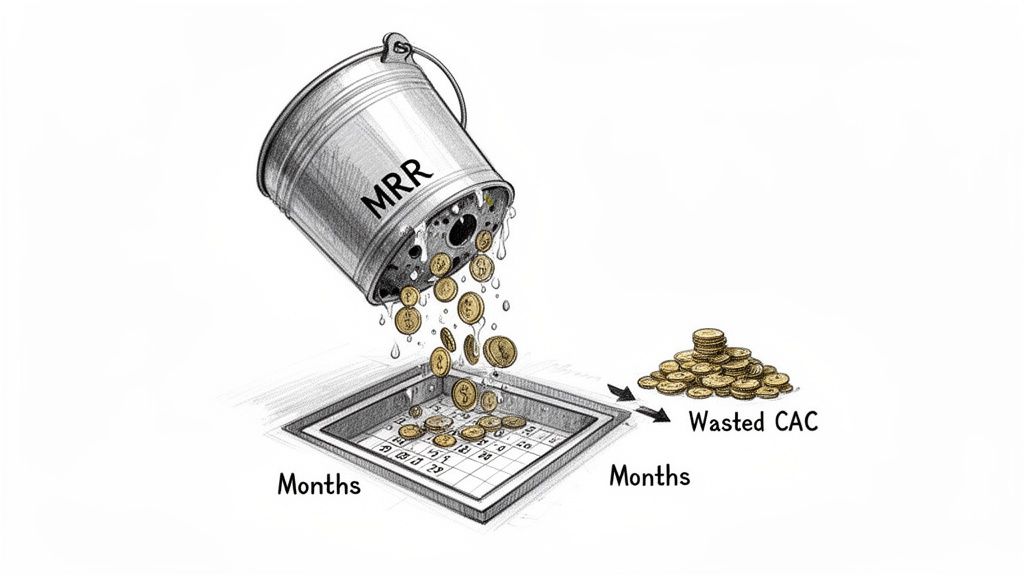
Before you can fix a leaky bucket, you have to know just how much water you’re losing. Too many SaaS founders I've talked to see churn as just an abstract percentage on a dashboard. The reality is far more painful. Churn is a silent killer that slowly erodes your Monthly Recurring Revenue (MRR), torches your Customer Acquisition Costs (CAC), and puts a compounding drag on your growth. Every customer that walks out the door takes all their future revenue potential with them.
To get a real grip on the financial hit, you first need to learn how to calculate Customer Lifetime Value (CLV). This metric isn't just a vanity number; it shows you the total revenue you can reasonably expect from a single customer, making the cost of losing them painfully clear.
The Compounding Damage of Churn
Let's put some numbers to it. Say you have a SaaS company with $50,000 MRR and a 5% monthly churn rate. That 5% isn't just a one-time $2,500 MRR loss this month. It's a $30,000 annual revenue leak that only gets worse over time. And if your average CAC is $500, that $2,500 in lost monthly revenue also represents thousands in marketing spend that just went up in smoke.
Churn is the anti-viral loop. While new customers add to your growth engine, churned customers actively subtract from it, forcing you to run faster just to stay in the same place.
This isn't a niche problem. The average annual churn rate hovers around 21% in the US across key sectors. That translates to US businesses losing a mind-boggling $136.8 billion every year to avoidable churn. A staggering 67% of consumers say they've left a business due to a poor experience, which really drives home the need for proactive engagement.
Shifting from Reactive to Proactive
This is where you need to change your mindset. Forget waiting for cancellation emails to pile up. The goal is to build an early-warning system. This is precisely what tools like LowChurn are designed for, especially when integrated directly with Stripe. By analyzing product usage patterns right alongside subscription signals, you can spot the warning signs weeks before a customer even thinks about leaving.
This playbook is all about making that proactive vision a reality. We'll walk through how to:
- Measure and benchmark your churn so you know exactly where you stand.
- Detect at-risk customers by spotting the leading indicators.
- Run prioritized, targeted retention campaigns to save that valuable MRR.
Building Your Churn Early Warning System
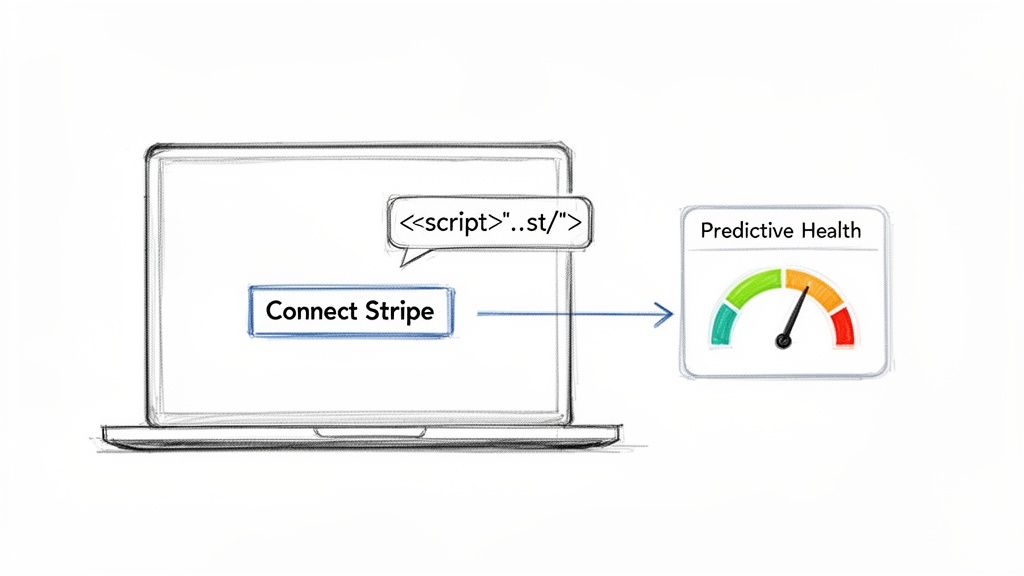
Talking about churn is easy. Actually stopping it before it happens? That takes a system. The great news is, you don't need a team of data scientists to build one. Modern tools are built for founders and lean teams, making complex data analysis surprisingly simple to set up. The goal here is to create an early warning system that tells you who's thinking about leaving long before they ever click "cancel."
For most SaaS companies using Stripe, the fastest way to get this up and running is with a platform like LowChurn. It usually takes just a couple of no-code steps to start pulling in the right signals to reduce customer churn.
First, you just connect your Stripe account. This is typically a one-click process that gives the platform secure, read-only access. It’s designed to be privacy-first, so it never touches sensitive financial data. Instead, it looks at subscription metadata—things like plan changes, trial end dates, and payment events—which are huge clues about a customer's health.
Next, you add a small JavaScript snippet to your app's header. This little piece of code is what unlocks all the behavioral insights, and it does so without compromising user privacy.
Turning Raw Data into Predictive Power
Once you’re connected, this setup immediately starts analyzing two streams of data in real time. It's the combination of these two that makes for an incredibly accurate predictive model.
On one hand, the system is pulling subscription signals right from Stripe. Has a customer's payment failed more than once? Did they just switch from an annual plan to a monthly one? These are often lagging indicators, but they give you critical context about an account's financial stability and overall commitment.
At the same time, the JavaScript snippet is tracking product usage patterns. This is where you get to be truly proactive. It watches for leading indicators of churn, such as:
- Session Frequency: Are they logging in less often this month than last?
- Feature Adoption: Are they actually using the core, sticky features that make customers stay?
- Time in App: Has their overall engagement just fallen off a cliff?
What this does is create a dynamic, real-time health score for every single customer. You go from flying blind to having a dashboard that surfaces your highest-risk accounts and tells you exactly why they’re in trouble. If you want to go deeper on the specific signals, our guide on how to predict customer churn is a great resource.
The magic isn’t just in collecting data; it’s in putting it all together. A good early warning system spots the subtle drop in engagement long before a cancellation request ever hits your inbox.
Most founders are surprised at how quickly they can go from zero visibility to a predictive dashboard. Within just a few days, you can have a prioritized list of at-risk MRR. You stop guessing who might churn and start acting on a data-driven plan that points you straight to the customers who need your attention right now.
Decoding the Signals from At-Risk Customers
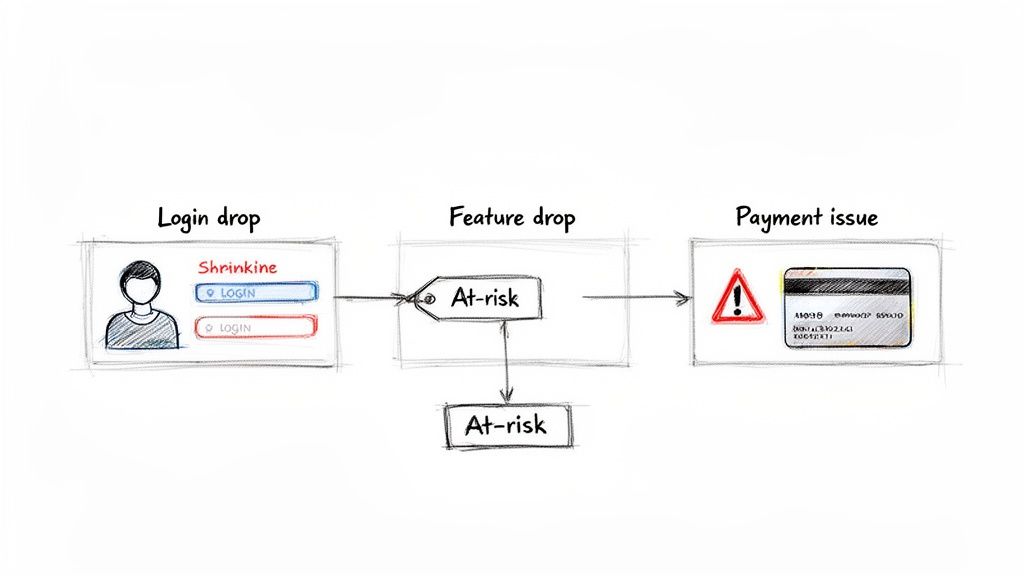
Once you've got your signal-gathering systems fired up, the real work begins: learning to read the tea leaves. This isn't about glancing at a vague "customer health score" and crossing your fingers. It’s about becoming a detective, piecing together the subtle clues from user behavior and subscription events that tell a story of disengagement long before a customer clicks "cancel."
Getting this right is how you can meaningfully reduce customer churn. The financial upside is staggering; a mere 5% improvement in customer retention can lift profits by an incredible 25-95%. Yet, for many SaaS businesses, only 39% of users stick around after the first month, contributing to the $136.8 billion that US companies lose every year from churn that could have been prevented.
The secret is learning to differentiate between two kinds of signals: the quiet whispers of behavioral changes and the loud, last-minute alarms of subscription problems.
Behavioral Indicators: The Early Warnings
Behavioral signals are the breadcrumbs customers leave behind as they use—or stop using—your product. Think of them as leading indicators. They're subtle shifts in activity that hint at frustration or a drop in perceived value, giving you the maximum amount of time to intervene and get them back on track.
I’ve seen this happen over and over. A marketing agency that was a power user of our reporting feature suddenly stops pulling reports. A small business owner who logged in every single morning now only pops in once a week. These aren't just random dips; they're waving red flags.
Keep an eye out for patterns like these:
- Decreased Login Frequency: A drop from daily to weekly logins is a classic sign someone is slowly drifting away.
- Key Feature Abandonment: When a customer stops using the one feature that solved their biggest pain point, the value of your product is in freefall for them.
- Lower Session Duration: Shorter, less focused visits suggest they're no longer deeply engaged with the workflows in your app.
- Reduced Team Activity: For accounts with multiple seats, if you see fewer active users from a single company, the entire account is at risk.
These behavioral shifts are your golden opportunity. A customer who has stopped using a key feature is silently telling you they've either hit a wall or no longer see the value. This is the perfect moment for a targeted, helpful intervention.
Leading vs Lagging Churn Indicators
Understanding the difference between early behavioral warnings and late-stage subscription signals is key to proactive retention. One gives you time to act; the other forces you to react.
| Indicator Type | Signal Example | What It Means | Best Time to Act |
|---|---|---|---|
| Leading (Behavioral) | A user stops accessing a core feature. | They're no longer getting key value from the product. | Immediately, with a helpful nudge or guide. |
| Lagging (Subscription) | A recurring payment fails. | The customer might be gone already (involuntary churn). | Within 24 hours, with dunning emails. |
| Leading (Behavioral) | Login frequency drops by 50%. | The product is becoming less essential to their workflow. | Within a week, with a check-in or new feature highlight. |
| Lagging (Subscription) | A customer downgrades their plan. | They're reducing their commitment and may cancel next. | Immediately, with an offer to understand their needs. |
Recognizing these distinctions helps you build a smarter, more effective retention strategy that prioritizes the right actions at the right time.
Subscription Signals: The Lagging Alarms
While behavioral signals let you be proactive, subscription signals from your payment processor like Stripe are almost always reactive. These are lagging indicators because they surface very late in the churn cycle, often right before a customer is officially gone. Saving them at this stage is tougher, but it's not impossible.
Look out for these common subscription-based alarms:
- Recurring Payment Failures: This is often the first sign of involuntary churn, but multiple failed payments can also be a passive way for a customer to let their subscription die.
- Credit Card Expiration: A customer who doesn't bother updating an expiring card might be intentionally creating their own off-ramp.
- Plan Downgrades: Moving from an annual to a monthly plan, or dropping to a lower tier, signals a major dip in commitment and is often a direct precursor to canceling.
Mastering both types of signals is foundational. By digging into the nuances of predictive analytics for customer retention, you can start turning this raw data into a powerful, automated system for saving your most valuable accounts before they even think about leaving.
Okay, you know which customers are at risk. Now what?
You're staring at a list of accounts with red flags, and the natural impulse is to try and save them all. But with a small team and only so many hours in the day, that's a recipe for burnout and failure. If you try to save everyone, you often end up saving no one.
The real trick to protecting your revenue is to get strategic. You have to decide who to save first.
The most effective way I've found to do this is to stop looking at a flat list of at-risk accounts. Instead, map them out. We're going to segment them based on two incredibly important factors: their likelihood to churn and how much they're paying you (their MRR). This simple exercise turns a chaotic list into a clear, prioritized action plan.
Creating Your Prioritization Matrix
Picture a simple four-quadrant grid. The vertical axis is their churn risk score, from low to high. The horizontal axis is their MRR, also from low to high. Every single customer who's showing signs of trouble will land in one of these four boxes, and each box demands a completely different response.
This framework is a game-changer because it tells you exactly where to focus your energy for the biggest impact. No more guessing games or just reacting to the loudest alarm. You can now deploy your team's valuable time where it really counts.
Here’s the breakdown I use with my own clients:
High-Risk, High-Value: This is a code-red situation. A customer paying you a significant MRR who is about to walk out the door requires immediate, personal intervention. We're talking an "all-hands-on-deck" response. It’s time for a direct call from a senior customer success manager or, depending on the account size, even one of the founders. The goal isn't just to save them—it's to personally understand what went wrong and fix it.
High-Risk, Low-Value: This is where smart automation becomes your best friend. You absolutely want to keep these customers, but their smaller MRR doesn't justify a 30-minute one-on-one call. This segment is perfect for well-timed, automated email sequences. Think about triggering a campaign that offers a small discount, points out a powerful feature they haven't used, or shares a case study that directly relates to their business. It’s about delivering value at scale.
A common mistake is treating all at-risk customers equally. By segmenting, you can apply high-cost human effort where it has the highest ROI and use low-cost automation to address the rest at scale.
Low-Risk, High-Value: Don't make the mistake of ignoring these accounts just because their churn risk is low. These are your best customers—your potential champions and biggest advocates. The play here is all about proactive engagement. Check in with them. Show them a new feature you know they’ll love. Talk to them about their long-term goals. Your job is to deepen the relationship and find upsell opportunities before risk even enters the picture.
Low-Risk, Low-Value: With this group, the best strategy is often just to keep an eye on them. You should absolutely monitor their health scores and usage patterns, but you don't need to invest active outreach time here unless something changes. Your resources are far better spent on the other three quadrants where the stakes are higher.
To effectively reduce churn, it's essential to understand and implement a robust set of retention efforts. For a deeper dive into practical approaches, explore these 10 proven SaaS customer retention strategies.
Executing Targeted Campaigns That Actually Work
Talking about retention is one thing, but actually saving customers is a whole different ballgame. Once you’ve identified and prioritized your at-risk accounts, it's go time. This is where you shift from analyzing data to taking decisive action, launching focused campaigns designed to address the specific reason a customer is slipping away.
The whole trick is matching the campaign to the churn signal. A generic "we miss you" email just isn't going to cut it. Your outreach needs to be contextual and genuinely helpful, proving you understand their unique situation. This is how you start to reduce customer churn in a way you can actually measure.
Campaigns for Behavioral Red Flags
When a customer's usage starts to dip, your mission is to reignite the value they once found in your product. These campaigns need to be proactive and feel like a helpful nudge, not a desperate sales pitch.
- Declining Engagement Campaign: Let's say a user's login frequency drops by 50%. This is your trigger to send an automated email highlighting a new feature or a popular use case they haven’t explored yet. Keep the message simple: "Hey [Name], thought you might find this useful for [their business goal]."
- Feature Abandonment Campaign: It’s a huge red flag when a customer stops using a core feature they once relied on. Reach out with a personalized offer for a quick, 15-minute demo to walk them through some advanced functionality they might have missed. This shifts the conversation back to value, not their disengagement.
Don't ask, "Why are you leaving?" Instead, ask, "How can I help you get more value?" This subtle change in framing turns a potentially negative interaction into a supportive one, making customers far more receptive to re-engaging.
This decision tree gives you a great visual for figuring out which accounts need a high-touch, personal approach versus those you can engage with automated campaigns.
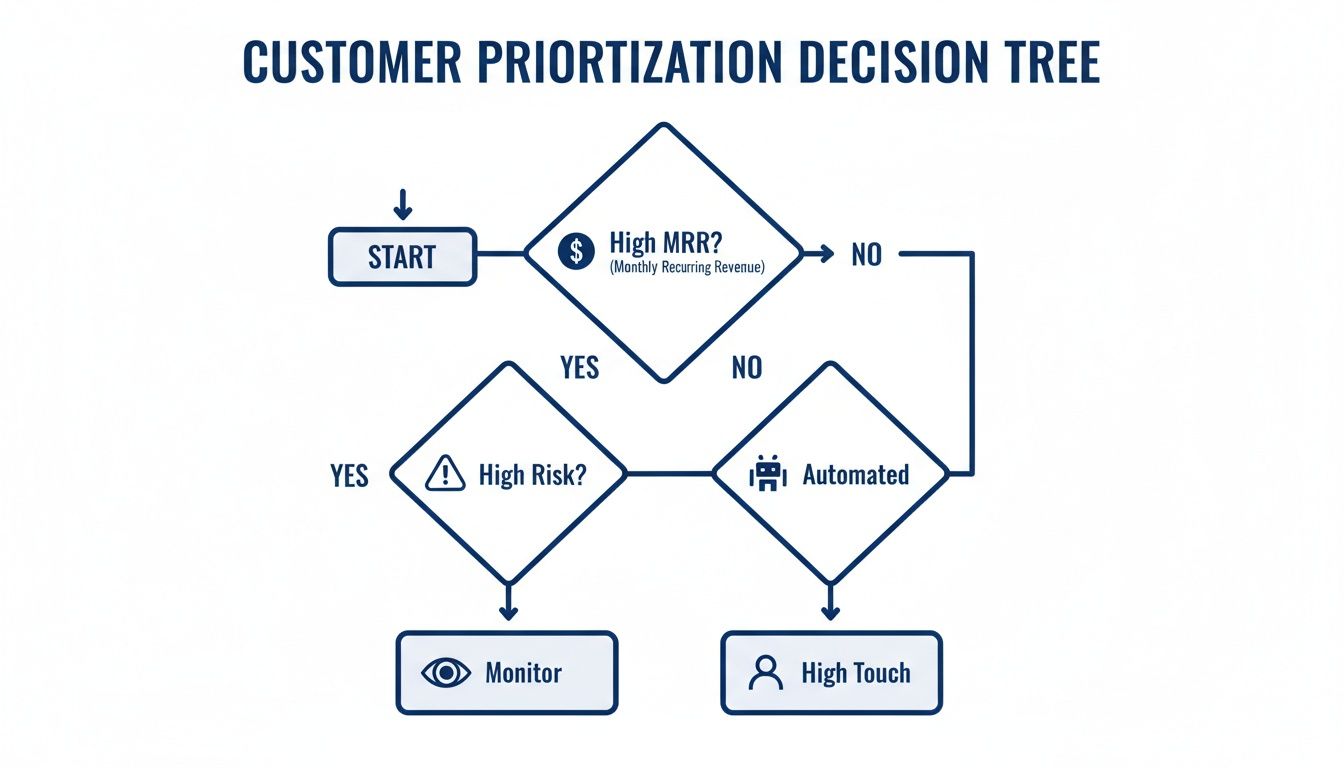
As you can see, there’s a clear path: your high-value, high-risk accounts always get personal, human attention. Meanwhile, automation efficiently handles the lower-value segments at scale.
Campaigns for Subscription-Based Issues
Subscription signals like failed payments are far more urgent. These campaigns are all about resolving a specific, time-sensitive problem as quickly and smoothly as possible to head off involuntary churn.
A friendly, automated dunning sequence is absolutely essential here. When a payment fails, don't just fire off a cold, transactional receipt. Instead, trigger a multi-step email campaign that feels human and helpful.
- Day 1 (Immediate): Send a friendly heads-up. "Hi [Name], we had a little trouble processing your payment. No worries, you can update your details here to keep things running smoothly."
- Day 3: Follow up with a gentle reminder. "Just a quick follow-up to make sure you saw our last note. Let us know if we can help!"
- Day 7 (Final Notice): The tone gets a bit more urgent. "To avoid any service interruption, please update your billing info today."
Every single message should include a direct, one-click link to update their payment method. You have to remove as much friction as possible. These simple campaigns are incredibly powerful; you can literally start recovering at-risk MRR the same day you turn them on. For a deeper dive into more campaign ideas, our guide on SaaS customer retention strategies has you covered.
By tailoring your outreach to the specific risk signal, you stop guessing and start following a systematic playbook for protecting your revenue.
Measuring the ROI of Your Churn Reduction Efforts
So, you’ve launched your retention campaigns. That's a huge step, but the job isn't done until you can prove they actually moved the needle.
Justifying the time and resources you've spent means connecting your actions directly to revenue. This is how you show everyone that your efforts to reduce customer churn are a profit center, not just a cost center.
To do this right, you have to look past the vanity metrics. Sure, a lower overall churn rate is what we're all after, but that number alone doesn't tell the full story. To really understand your impact, you need to dig into analytics that show clear cause and effect.
Go Beyond a Simple Churn Rate
A single churn rate is a lagging indicator. It tells you what already happened, but it doesn't tell you why it happened or which specific customers you managed to save.
For a much clearer picture, you need to turn to cohort analysis.
A cohort is just a group of customers who signed up around the same time—think of them as your "January 2024 Signups." By tracking the retention of these specific groups over time, you can see the direct impact of your new strategies.
For example, did the cohorts you engaged with your new campaigns have a better retention rate after three months than cohorts from before you started? This kind of side-by-side comparison gives you undeniable proof of what’s working and what isn't.
Your goal isn't just to lower the overall churn number. It's to prove that the specific actions you took are creating stickier customers who stay longer than they would have otherwise.
The Ultimate Metric: Recovered MRR
While cohort analysis is powerful, the most convincing metric you can possibly track is Recovered MRR.
This is the exact dollar amount you saved by successfully keeping customers who were already heading for the door. It’s the direct, tangible return on your investment, and it’s a number that gets people's attention.
Here’s how it works in a real-world scenario:
- Your system flags $15,000 in MRR from at-risk accounts this month.
- You run your targeted retention playbook for these specific customers.
- At the end of the month, $9,000 of that at-risk MRR is still active and healthy.
That $9,000 is your Recovered MRR. It’s money that was about to walk out but didn't because you intervened.
This single metric completely changes the conversation. You’re no longer saying, "We're trying to reduce churn." Instead, you're reporting, "Our retention efforts saved the company $9,000 last month." That’s a concrete result that gets everyone—from the C-suite to the product team—to buy into what you're doing.
A Few Lingering Questions
Founders I talk to often have a couple of last-minute questions, especially when they're just getting started with a more structured approach to fighting churn.
"Can I really do this with a small team?"
This is probably the most common one. You're a solo founder or a tiny team, already juggling a million things. The idea of running complex retention campaigns sounds exhausting, right?
Absolutely. But the key here isn't to work harder; it's to work smarter. Modern retention tools are built for this exact scenario. Instead of you having to manually sift through data to find at-risk accounts, the system does it for you. It bubbles up the highest-priority customers who need your attention right now, letting a single person make a massive impact without getting bogged down in spreadsheets.
"What about data privacy and security?"
Another valid concern. You're connecting a tool to your Stripe account, which holds incredibly sensitive information.
Any reputable platform in this space is built with a privacy-first mindset. They should only ever require read-only access to your Stripe data. This means they can see subscription metadata (like plan types and renewal dates) and anonymized usage patterns, but they can't touch sensitive financial data or personally identifiable information (PII). It's designed to give you the insights you need to reduce churn while keeping both your and your customers' data completely protected.
Stop guessing which customers are about to leave. It's time to start acting on a data-driven plan.
With LowChurn, you can get a real-time health score for every single customer and launch targeted retention campaigns with just one click. See exactly how it works on our website.