Before you can even think about fixing churn, you have to get brutally honest about why you're losing customers in the first place. It’s easy to jump straight to solutions, but without a proper diagnosis, you're just guessing.
The starting point is understanding the critical difference between customers choosing to leave versus those who disappear because of a simple, fixable payment issue. This distinction is the bedrock of any smart retention strategy.
Why Your SaaS Churn Rate Is Higher Than You Think
Most SaaS founders I talk to are tracking a single, blended churn rate. The problem? That one number is a classic vanity metric. It tells you that you're losing customers, but it gives you zero clues as to why.
To actually make a dent in your churn, you need to split that number into two completely different problems, each with its own playbook.
The first is voluntary churn. This is what most people think of when they hear "churn." It’s when a customer makes a conscious decision to hit the cancel button. Maybe their onboarding was a nightmare, they didn’t see the value, or a competitor swooped in with a better offer. This is the kind of churn you fight with a better product, better support, and a stronger customer experience.
Then there's the silent killer: involuntary churn. This happens when a customer's subscription ends by accident, almost always because of a failed payment. An expired credit card, a fraud alert from the bank, or a simple lack of funds are the usual suspects. These customers didn't want to leave—a technical glitch pushed them out the door.
Logo Churn vs. Revenue Churn
To get the full story, you also need to view churn from two different angles:
- Logo Churn: This is the percentage of customers (or "logos") you lose each month. It's a headcount of lost accounts.
- Revenue Churn: This measures the percentage of monthly recurring revenue (MRR) you lose from those same cancellations. This is often the more painful number, because losing one huge enterprise client can hurt way more than losing a dozen small startups.
Looking at both helps you focus your energy. If you have high logo churn but low revenue churn, you might have a problem with your entry-level plans. But if it's the other way around, you have a five-alarm fire brewing with your most valuable customers.
How Do Your Numbers Stack Up?
So, what's a "normal" churn rate? It depends entirely on who you're selling to. Context is everything here.
Here's a quick look at some industry benchmarks to give you a sense of where you might stand.
SaaS Monthly Churn Rate Benchmarks
A breakdown of average monthly churn rates across different SaaS segments to help you benchmark your performance.
| SaaS Segment | Average Monthly Churn Rate |
|---|---|
| Overall Average | 4.1% |
| Serving SMBs | 3-7% |
| Serving Enterprise | 1-2% |
| Low-Priced (under $25/mo) | Up to 6.1% |
These numbers tell a clear story: churn is not a one-size-fits-all problem. A 4% monthly churn rate might be fantastic for an SMB-focused tool but a disaster for an enterprise platform.
When you start breaking your churn down—voluntary vs. involuntary, logo vs. revenue—you stop staring at a scary, abstract number and start looking at an actionable diagnostic report. You can dive deeper into these SaaS churn rate benchmarks to see how you compare.
Gaining this kind of clarity is the first real step toward building a system that actually plugs the leaks in your revenue.
Building Your Early Warning System for Churn
Trying to win back a customer after they've already hit "cancel" is a tough, uphill battle. The real secret to getting your churn rate down is to stop reacting and start predicting. You have to catch at-risk customers before they even start thinking about leaving.
That’s where an early warning system comes in. And no, this doesn't require some complex, enterprise-level software. It's about being smart and combining two crucial data sources you likely already have: subscription signals from your payment processor and product usage patterns from inside your app.
Reading Subscription Signals
If you're using Stripe, you have a goldmine of information that goes way beyond simple failed payments. Your payment processor is packed with subtle clues that a customer might be on their way out. You just have to know what to look for.
Keep an eye out for patterns like credit card declines that eventually get resolved, frequent plan downgrades, or subscriptions that get paused but never reactivated. These are the quiet whispers that come before the storm of a cancellation notice. Think about it: a customer whose card fails a few times before they update it might be signaling cash flow issues or, more likely, that they're starting to question the value of your service. These aren't just billing hiccups; they're valuable behavioral clues.
A good early warning system can give you a 7 to 30-day heads-up on potential churn. It completely changes the game, turning retention from a desperate scramble into a proactive, data-driven process.
For a deeper dive into this, checking out a proactive guide to churn marketing can give you some great frameworks for diagnosing these signals and building out your retention strategies.
Tracking In-App Behavior
The most powerful churn predictions, by far, come from how people actually use your product. Disengagement is the single biggest predictor of voluntary churn. When a customer stops logging in or using the features that deliver value, they've already churned in their mind. The cancellation is just a formality at that point.
Your goal is to pinpoint your "golden features"—those specific actions or product milestones that are tightly correlated with long-term retention. Do customers who set up three integrations stick around longer? Is creating five projects in the first week a sign of a future power user? Answering these questions is absolutely fundamental to reducing your churn rate.
This process involves measuring what matters, segmenting users based on that data, and then benchmarking against what your best, healthiest customers are doing.
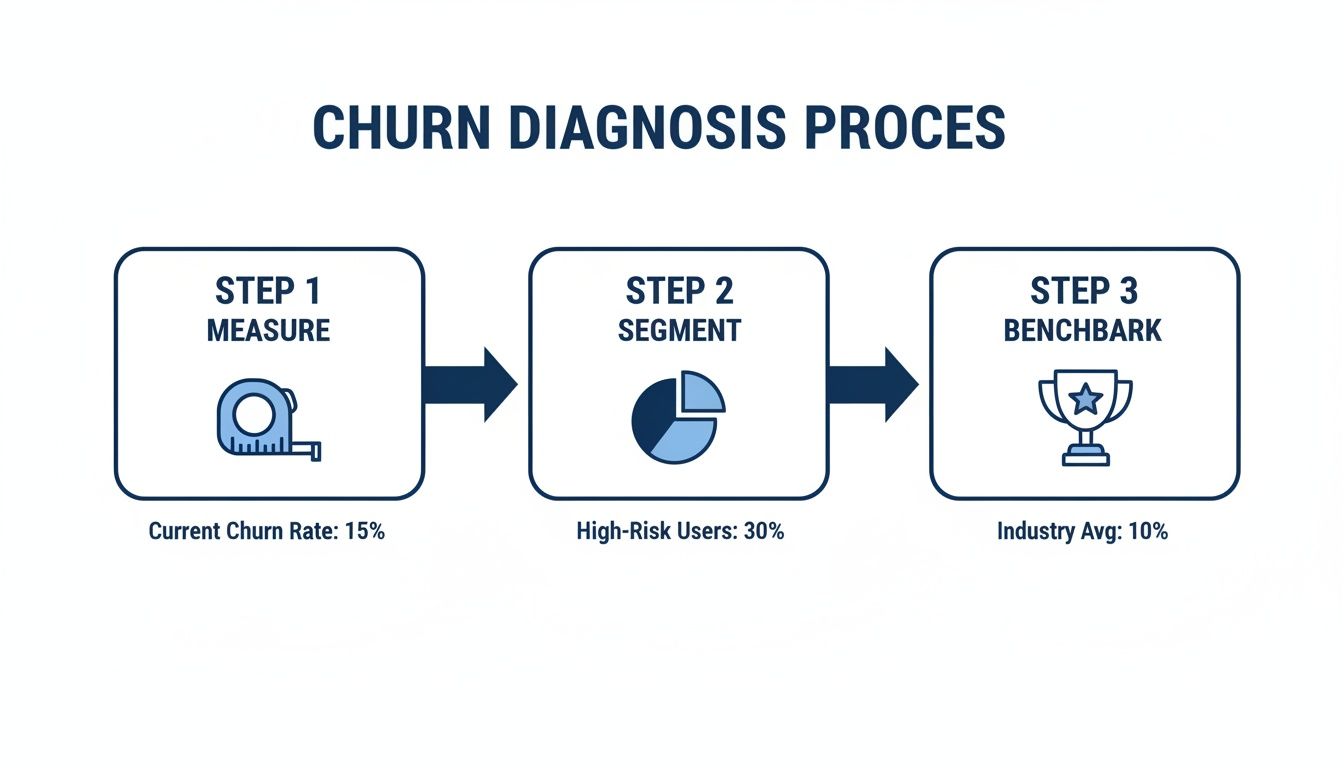
This simple flow helps you turn raw data into real insights, letting you see exactly which behaviors signal an account is in trouble.
You don't need invasive, creepy tracking to get this data, either. Lightweight, privacy-friendly event tracking can give you incredibly powerful signals.
- Login Frequency: A sudden drop is the most obvious red flag. If a daily user hasn't logged in for a week, they are at very high risk.
- Key Feature Adoption: Are they using the sticky features that deliver the core "aha!" moment? Low adoption means they haven't truly experienced your product's main benefit.
- Support Ticket Volume: A sudden spike in support tickets can signal frustration. On the flip side, a complete lack of tickets might mean they aren't engaged enough to even bother asking for help.
When you start combining these in-app behaviors with the subscription data we talked about earlier, you can build a really robust profile of account health. To learn more about how to blend these signals effectively, check out our guide on creating actionable https://www.lowchurn.com/blog/customer-health-scores. This predictive layer is what gives you the power to step in with the right message at the perfect time, turning a potential churn event into a moment of re-engagement.
Launching Retention Campaigns That Actually Work
So, you've identified a customer who's on the verge of churning. That's a huge first step, but the real work starts now. Moving from that insight to a real intervention is where I see a lot of SaaS teams stumble. It’s time to ditch the generic, one-size-fits-all "we miss you!" emails. An effective retention strategy is all about launching targeted, context-aware campaigns.
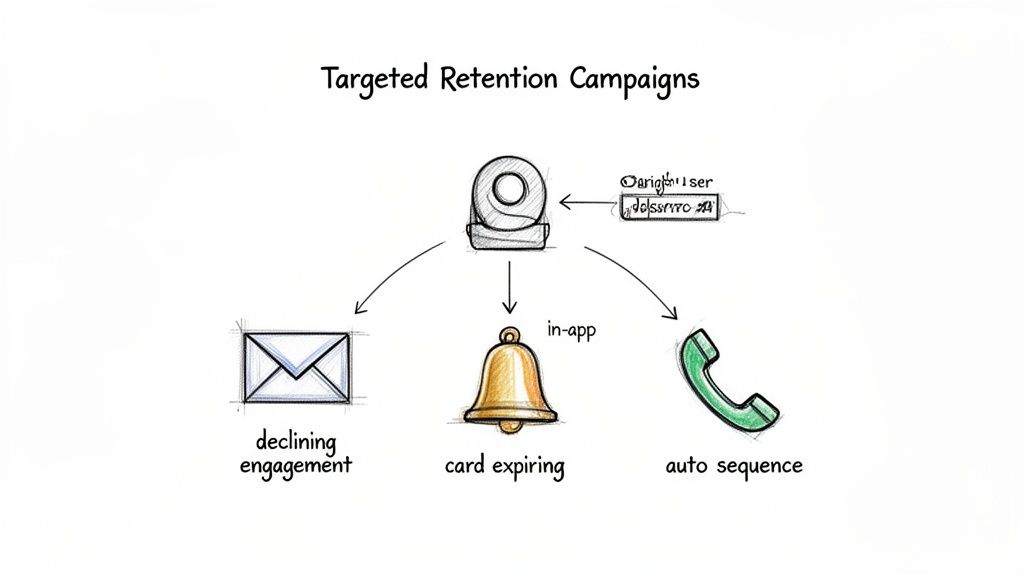
Think about it: the right response for a user whose credit card is about to expire is completely different from what you'd send to a power user who hasn't logged in for two weeks. The secret is matching your outreach to the specific churn signal you’ve picked up on. This is all about delivering the right message at the exact moment of friction.
Playbooks for Common Churn Signals
Instead of trying to reinvent the wheel, it's best to start with proven playbooks. Here are a couple of adaptable campaign ideas that we've seen work time and again in real-world situations.
Scenario 1: The Disengaged User
You've got a user who used to log in daily, but now they've been MIA for 14 days. Their product usage has fallen off a cliff. This is a classic signal of voluntary churn, and you need to act.
- Your Tactic: The goal here is a value-driven, non-needy email. Whatever you do, don't beg them to come back. Instead, try highlighting a new feature they'd actually find useful or share a short case study that’s relevant to their industry.
- Example Email Subject: A quick tip for [User’s Company Name]
- Email Body Snippet: *Hi [First Name], I noticed you haven't been in the app recently and wanted to share a new template we just launched for [Their Use Case]. A few teams like yours have used it to cut their [Relevant Task] time by 30%. Thought you might find it useful!*
Scenario 2: The Failed Payment
This is a totally different beast—an involuntary churn problem. The customer almost certainly wants to keep using your service, but a pesky technical issue is standing in the way. Your job is to make it incredibly easy for them to fix it without making them feel embarrassed or frustrated.
Pro Tip: The Perfect Stripe Dunning Email Hi [First Name],
We had some trouble processing the payment for your [Product Name] subscription. This can happen for a number of reasons—sometimes it's as simple as an expired card.
No action is needed just yet! Stripe will automatically retry in a few days. If you'd like to update your billing details now to ensure uninterrupted service, you can do so here: [Secure Billing Link]
Thanks for being a customer!
This copy is brilliant because it’s low-pressure, normalizes the problem ("this happens!"), and gives them a clear, one-click path to a solution.
Beyond the Inbox: In-App and Personal Outreach
Not every campaign should live in email. Sometimes, the most effective touchpoints happen right inside your product or over the phone.
A great example is the soon-to-expire credit card. An in-app banner that pops up the moment the user logs in is way more effective than an email they might just ignore. It’s contextual, timely, and lets them fix the issue on the spot.
And for a high-MRR account that's showing signs of disengagement, you should automate a task for their Customer Success Manager to pick up the phone. That human touch can uncover deep-seated issues that a dozen emails would never reveal.
Ultimately, there’s no single magic bullet for retention. It's about building a system of targeted, automated, and personal responses that make your customers feel seen and understood at every potential breaking point. As you build out your strategy, it’s worth exploring different customer win-back strategies to find what truly resonates with your audience.
How to Prioritize Your Retention Efforts
So, your early warning system is working and starting to flag at-risk accounts. That's a huge win. But it quickly leads to a new, more overwhelming problem: a sea of red flags. As a founder or team lead, your time is your most precious resource, and there’s simply no way to personally reach out to every single customer showing signs of trouble.
If you try to save every single account yourself, you're on a fast track to burnout. The real secret to cutting your churn rate isn't just taking action—it's about taking the right action with the right customer. Smart prioritization is what separates a frantic, low-impact scramble from a retention strategy that actually delivers a high ROI.
Segmenting for Maximum Impact
Let's be honest: not all at-risk customers are created equal. Losing a customer on your $19/month plan stings, but losing a high-value account with massive expansion potential can completely derail your quarterly goals. The very first thing you need to do is segment those at-risk accounts into tiers based on their real value to your business.
And this isn't just about their monthly recurring revenue (MRR). You need to think bigger.
- High-Value Accounts: These are your VIPs. They're defined by high MRR, sure, but also by their huge lifetime value (LTV) or serious expansion potential. Think enterprise plans or fast-growing startups that could become your next huge case study.
- Mid-Tier Accounts: This group is the bedrock of your customer base. They bring in solid, reliable MRR and are generally stable, but they might not have the same strategic weight as your top-tier accounts.
- Low-Value Accounts: These are the customers on your lowest-priced plans. They're important when you look at them all together, but the revenue impact of losing any single one is pretty small.
A classic mistake is treating every churn risk as a five-alarm fire. When you segment, you create a playbook. It tells you exactly how much manual effort is justified to save an account, preventing you from wasting a founder-level intervention on a low-value user.
Matching the Action to the Account
Once you have your at-risk customers neatly segmented, you can build a tiered response system. This simple framework takes the guesswork out of the day-to-day and focuses your team's limited energy where it will save the most revenue. A systematic approach is the only way to reduce your churn rate without completely overwhelming your team.
Here's a simple but incredibly powerful framework you can put into action today.
This table provides a clear framework for prioritizing your outreach, moving from high-touch, personal interventions for your most valuable customers to more scalable, automated campaigns for everyone else.
Retention Strategy by Customer Segment
A framework for prioritizing retention efforts based on customer value and churn risk.
| Customer Segment | Churn Risk Level | Recommended Action |
|---|---|---|
| High-Value | Any Sign of Risk | Immediate personal outreach. This is an all-hands-on-deck situation. A personal call from a founder or head of success is non-negotiable. |
| Mid-Tier | Medium to High | Automated personal check-in. Trigger a personalized email sequence from a named account manager using a tool like LowChurn. The goal is to start a conversation, not just send a generic alert. |
| Low-Value | Any Sign of Risk | Scalable, automated campaigns. Use in-app notifications, value-driven emails about new features, or links to helpful resources. The focus is on re-engagement at scale. |
Adopting this tiered approach gives you a clear, repeatable process for handling churn risk. It guarantees your most critical accounts get the white-glove treatment they deserve while you still address risk across your entire customer base in an efficient way. It's all about being surgical with your time to protect your most important revenue streams.
So, Did It Work? Measuring Success and Refining Your Strategy
Let’s be clear: reducing your churn rate isn't a one-and-done project. It's a fundamental business process that needs constant attention and fine-tuning. Kicking off a few retention campaigns is a great first move, but if you’re not building a feedback loop, you're essentially just guessing what actually works. The real difference between companies that just stay afloat and those that truly scale is a relentless, data-driven focus on retention.
Your first instinct might be to just watch the main churn rate metric, but that number doesn't tell you the whole story about the financial impact of your work. A huge part of refining your strategy is keeping a close eye on everything you try. For instance, if you're using video in your retention campaigns, you need a reliable way of measuring AI video performance with analytics. The same logic applies to every email, offer, and in-app message you send.
Key Metrics for Measuring Retention ROI
To really prove your success, you have to track metrics that tie your actions directly to the bottom line. This is how you change the conversation from a vague "we lowered churn" to a powerful "we saved X amount in MRR."
Here are the numbers that matter:
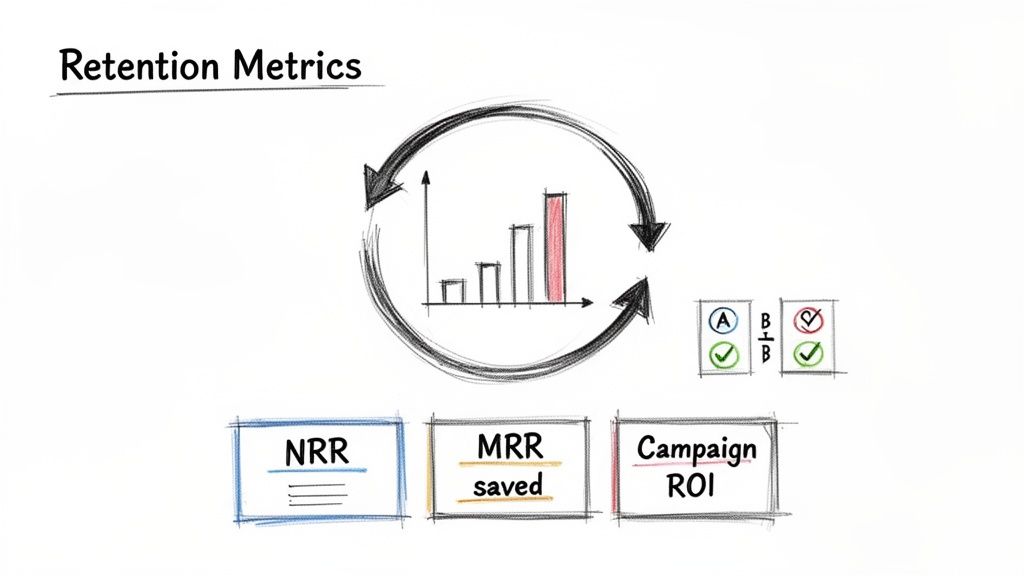
Monthly Recurring Revenue (MRR) Saved: This is the clearest, most direct measure of your campaign's success. If you stopped $5,000 in cancellations from going through this month, that’s a concrete win you can take to the bank.
Net Revenue Retention (NRR): Often called the holy grail of SaaS metrics, NRR shows you the revenue from your existing customer base, accounting for both churn and expansion revenue. If your NRR is over 100%, it means the revenue from upgrades and add-ons is more than making up for the revenue you lose to churn. That’s the sign of a seriously healthy subscription business.
Campaign Success Rate: This is all about A/B testing. Pit different messages, offers, and channels against each other to see what your customers actually respond to. Did that personal check-in email work better than the generic in-app popup for users who went quiet? Knowing this lets you put your resources where they’ll have the biggest impact.
Reducing churn isn’t just about plugging a leaky bucket; it's about compounding your growth. Every customer you save today is a customer who might upgrade, expand their usage, or refer a new lead tomorrow.
The long-term impact of small improvements can be massive. For perspective, a 5% monthly churn rate means you lose 46% of your customers over a year. But if you can knock that down to just 3%, you’ll hang on to 40% more of your customer base in that same timeframe. This is where tools like LowChurn really shine—their real-time health scores and one-click campaigns can often pay for themselves within weeks by saving that critical MRR.
Building a Continuous Improvement Loop
The final, crucial piece is to build a repeatable process for getting better. Think of it as a simple, powerful cycle that should become second nature for your team.
You have to constantly measure your key retention metrics, analyze what’s working (and what isn’t), iterate on your campaigns by tweaking copy and offers, and then repeat the whole process. This isn't a quarterly review; it should be a constant rhythm in your business, ensuring your strategy to reduce your churn rate gets sharper every single month.
Of course. Here is the rewritten section, focusing on a natural, expert-driven tone:
Common Questions About Reducing Churn
Even with a solid game plan, you're bound to run into questions as you start digging into churn reduction. Let's tackle a few of the most common ones I hear from SaaS founders.
What's A "Good" Churn Rate For A New SaaS Startup?
For a brand new SaaS, especially if you're selling to SMBs, a monthly churn rate between 3-5% is a pretty normal starting point. It's not great, but it's not a five-alarm fire either. What really matters is the trend.
Are you seeing that number tick down month-over-month as you polish the product and fix your onboarding? If so, you're on the right track. Don't get discouraged by comparing your startup to some massive enterprise platform that brags about 1% churn—they're playing a completely different game. Early on, the "why" behind your churn is a goldmine; the qualitative feedback from customers who cancel is infinitely more valuable than any industry benchmark.
How Long Until I Actually See Results?
This really depends on what you’re trying to fix. The good news is some strategies can make a dent almost immediately.
- Involuntary Churn: Fixing stuff like failed payments is the low-hanging fruit. When you set up smart dunning emails for failed Stripe charges, you can see a measurable impact in a single billing cycle. We're talking less than 30 days. You're essentially catching revenue that was about to slip through your fingers.
- Voluntary Churn: Getting ahead of customers who choose to cancel is a longer game. After you roll out predictive models and start reaching out to at-risk accounts, you’ll likely start seeing a real impact on saved MRR within 4-8 weeks. That’s when your interventions really start to pay off.
Can I Really Do This Without A Dedicated Retention Manager?
Absolutely. In most early-stage or bootstrapped companies, the founder is the first head of retention, whether they have the title or not. This isn't about headcount; it's about having smart systems.
The trick is to lean on automation and tools that do the heavy lifting for you. You can't possibly watch every single user's behavior or hand-write every follow-up email. That’s just not scalable.
By plugging your Stripe data into a platform that can predict churn and run proven retention campaigns for you, you can get the results of a dedicated team without the overhead. This frees you up to focus your personal attention where it truly matters—on those high-value opportunities that need a human touch.
Ready to stop guessing and start saving customers? LowChurn gives you the early warning system and one-click retention campaigns you need to reduce churn rate and protect your MRR. Connect Stripe and see your at-risk customers in minutes.