Picture this: your SaaS business is a bucket, and you're working hard to fill it with new customers. SaaS churn is the hole in the bottom of that bucket. It's the constant, slow leak of customers and revenue that can drain your growth if you don't pay attention to it. Getting a handle on this number is the first, most critical step to plugging that hole and building a business that lasts.
The Leaky Bucket: A SaaS Founder's Guide to Churn
Think of your churn rate as more than just a number on a dashboard. It’s a direct measure of how happy your customers are and how well your product fits their needs. It simply tells you what percentage of your customers or revenue walked out the door over a given period—say, a month or a year.
No one gets churn down to zero. That’s just not realistic. But getting it under control is everything.
A high churn rate is like trying to drive with the emergency brake on. You have to work twice as hard just to stay in the same place, constantly scrambling to sign up new customers just to replace the ones you lost. This "leaky bucket" problem kills momentum and can make your whole business model unsustainable.
Customer Churn vs. Revenue Churn: What's the Difference?
It’s really important to know that not all churn is the same. There are two main ways to look at it, and each one tells a very different story about the health of your business.
Customer Churn: This is the most straightforward way to measure it. It’s simply the percentage of customers who cancel. If you had 100 customers at the start of the month and 5 of them left, your customer churn rate is 5%. Simple.
Revenue Churn (MRR Churn): This is where things get more interesting. This metric tracks the percentage of monthly recurring revenue (MRR) you lost from those cancellations. Losing one big enterprise client paying $10,000 a month hurts a lot more than losing ten small businesses paying $50 each, even though the customer churn number looks way better in the first scenario.
For most SaaS founders, MRR Churn is the number that really matters. It measures the financial damage and gives you a much clearer picture of how churn is affecting your bottom line and ability to grow.
Why Churn Is a Critical Health Indicator
At the end of the day, your churn rate is one of the most honest forms of feedback you can get. It points a big, flashing arrow at the friction points in your customer’s experience. Maybe your onboarding is confusing, a key feature is missing, or you're just not doing a good enough job showing them the value they're paying for.
Low churn, on the other hand, is a sign that you’re delivering on your promises and keeping customers happy.
Today, smart tools can even give you an early warning. They analyze how people are using your product to predict who is at risk of leaving before they hit the cancel button. This flips the script on churn, turning it from a reactive cleanup job into a proactive growth strategy. When you can spot at-risk accounts early, you can step in with the right help or a targeted retention campaign, effectively patching the leaks in your bucket before they turn into a flood.
Key Churn Concepts at a Glance
Before we dive deeper, let's quickly summarize the essential terms we'll be exploring. Think of this as your cheat sheet for understanding the language of customer retention.
| Concept | What It Measures | Why It's Critical for SaaS Founders |
|---|---|---|
| Customer Churn Rate | The percentage of total customers who cancel their subscriptions in a given period. | A basic health check. High customer churn can signal widespread product or support issues. |
| Revenue Churn Rate (MRR Churn) | The percentage of monthly recurring revenue lost from cancellations and downgrades. | The financial bottom line. It reveals the true monetary impact of losing customers, especially high-value ones. |
| Net Revenue Churn | The net percentage of MRR lost after accounting for expansion revenue (upgrades, cross-sells) from existing customers. | The ultimate growth indicator. Negative Net Churn means you're growing even without new customers. |
| Cohort Analysis | Grouping customers by a shared characteristic (e.g., sign-up month) to track their behavior over time. | Helps you pinpoint when and why customers are leaving, linking churn to specific events or product changes. |
Understanding these distinctions is the foundation for building a truly data-driven retention strategy. Each metric offers a different lens through which to view your business, helping you make smarter decisions.
How to Accurately Calculate and Segment Your Churn Rate
Knowing what churn is and actually calculating it are two different things. This is where the rubber meets the road—turning raw numbers into a clear story about your business's health and where it’s leaking customers. Think of this calculation as your first diagnostic test.
The most straightforward place to start is with Customer Churn Rate. It’s a simple metric that tells you what percentage of your total customers bailed during a specific time frame.
The formula is pretty basic: (Customers Lost in Period / Customers at Start of Period) x 100 = Customer Churn Rate %
Let’s say you started May with 200 customers. If 10 of them canceled that month, your math would look like this: (10 / 200) x 100. That gives you a 5% monthly customer churn rate. It’s a quick, high-level pulse check on customer retention.
Why MRR Churn Is the Metric That Matters Most
Here’s the thing about customer churn: it can be a bit of a vanity metric because it treats every customer equally. But in SaaS, that's rarely the case.
Losing one enterprise client on a $5,000/month plan hurts a whole lot more than losing ten startups on a $50/month plan—even though your customer churn number would look far better in the first scenario.
This is exactly why smart SaaS founders obsess over Monthly Recurring Revenue (MRR) Churn Rate. This metric cuts through the noise and measures the actual revenue you lost from cancellations and downgrades. It reveals the true financial bleeding.
MRR Churn Rate highlights the monetary damage from customer attrition. It answers the crucial question: "How much predictable revenue did we lose this month?" This is the number that directly impacts your ability to grow, hire, and invest back into your product.
Getting this distinction right is key. A high customer churn rate among your lowest-paying users might just be the cost of doing business. But even a tiny MRR churn from your high-value accounts could be a five-alarm fire. For a deeper dive, our guide on how to calculate churn rate breaks it down with more detailed examples.
This simple flow shows you how a customer leaving translates directly into a hit on your recurring revenue.
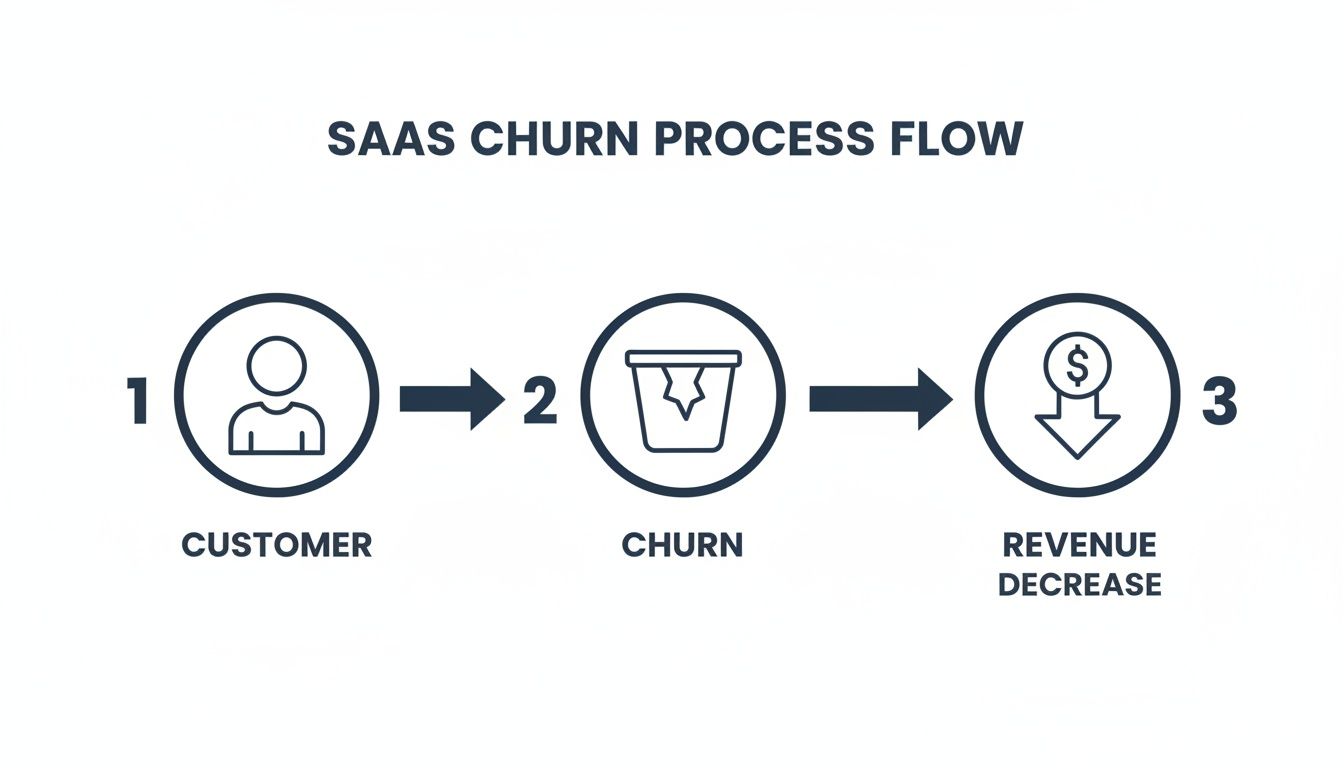
The takeaway here is that every churned customer isn't just a lost logo; it’s a crack in your financial foundation.
Uncovering Hidden Stories with Churn Segmentation
Your overall churn rate tells you what happened, but it doesn't tell you why. To get those answers, you have to slice and dice your data. This is called segmentation, and it's all about breaking down your churn rate by different customer groups to find the hidden patterns.
Think of yourself as a detective. You wouldn't just stop at knowing a crime occurred; you'd dig into who was involved, where it happened, and what the motive was. That’s precisely what segmentation does for churn.
Here are a few powerful ways to segment your churn analysis:
- By Pricing Tier: Are your "Basic" plan customers churning out at a wild rate compared to your "Pro" users? That might point to a value gap at the low end or tell you that your premium features are incredibly sticky.
- By Sign-up Date (Cohort Analysis): Group your customers by the month they joined. Are the folks who signed up in March leaving faster than your January cohort? Maybe a product update or a wonky marketing campaign in March attracted the wrong kind of user.
- By User Behavior: This is where the real gold is. Segmenting by how people actually use your product is incredibly insightful. You might discover that customers who never use a specific "sticky" feature are 90% more likely to churn in their first 60 days.
This kind of analysis gives you the clues you need to build a retention strategy that actually works. If you're ready to move beyond basic spreadsheets, exploring AI-powered churn rate analysis in Excel can provide a more advanced framework. By pinpointing exactly which customers are leaving and why, you can finally stop guessing and start fixing the real problems.
So you've run the numbers and have your churn rate. The next question is always the same: is that a good number or a bad one?
Everyone wishes there was a single, simple answer, but the reality is that a "good" SaaS churn rate is a moving target. It really depends on who your customers are, the age of your business, and how you price your product.
You’ll often hear that a healthy annual churn rate is between 5% and 7%. This has become a sort of industry standard, a goalpost many SaaS companies aim for. But that number almost always refers to established businesses selling to mid-market or enterprise customers.
If you’re a startup selling to small businesses (SMBs), a 5% annual churn rate is pretty much a fantasy. SMBs are just a different breed of customer. They have tighter budgets, are more sensitive to price hikes, and sometimes, they just go out of business. It's the nature of the beast.
Context Is Everything When Benchmarking Churn
To get a real sense of how you're doing, you have to compare your business to others like it. Setting realistic goals for your churn rates means understanding the context of your company's stage and who you sell to.
- Early-Stage Startups (targeting SMBs): Don't be shocked to see a monthly churn rate of 3-5%. That annualizes to a scary-looking number, but it's normal. At this stage, your job is to obsessively learn from every single cancellation to sharpen your product and nail down who your ideal customer really is.
- Growth-Stage Companies (targeting Mid-Market): Once you’ve hit product-market fit and your customer base is more stable, you should be aiming to get that monthly churn down into the 1-2% range.
- Established Companies (targeting Enterprise): This is where you see the gold standard. Companies serving big, enterprise clients can often get their monthly churn below 1%. Why? These customers sign long-term contracts, and the cost and pain of switching to a new tool are incredibly high, which makes them very sticky.
You can dive deeper into these figures by exploring detailed SaaS churn rate benchmarks to see how you stack up against companies in your weight class. This is a far more useful way to measure success.
The Holy Grail: Net Negative Churn
Here's a secret: the best SaaS companies eventually stop obsessing over just lowering churn. Their focus shifts to a much more powerful goal: net negative churn.
Net negative churn is the ultimate growth engine for a SaaS business. It happens when the revenue you gain from existing customers—through upgrades, cross-sells, and expansion—is greater than the revenue you lose from cancellations.
Think of your customer base less like a leaky bucket and more like a garden. A few plants might wither and die, but the healthy ones grow so much that the entire garden becomes bigger and more valuable over time. That’s the magic of net negative churn. Your business can actually grow without acquiring a single new customer. It’s the clearest sign you have a fantastic product and a base of incredibly happy customers.
The Real Reasons Customers Churn
Calculating your churn rate gives you the "what." The real magic happens when you uncover the "why." Churn is almost never a single, dramatic event. It’s more like a slow burn—the result of a thousand tiny frustrations and unmet expectations that finally push a customer to hit "cancel."
When you start digging into the root causes, you can stop treating churn as a lagging indicator and start using it as a powerful diagnostic tool for your entire business. Most of these churn drivers fall into a few key categories, each telling you something important about a weak point in your customer's journey.
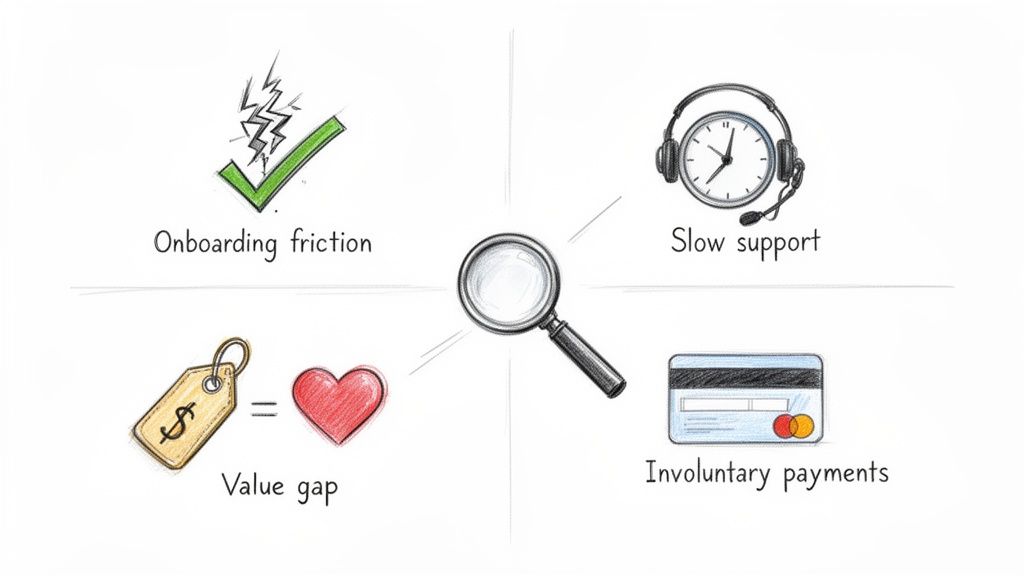
Product and Feature Friction
This is a big one. It’s all about the moments when your own product creates roadblocks, stopping customers from getting the job done.
- A Confusing Onboarding: If users can't figure out how to get started or find that "aha!" moment quickly, they're gone. A messy first-run experience is one of the biggest predictors of early churn.
- Missing a Crucial Feature: Your product might be fantastic, but if it lacks one key feature a competitor has, you're at risk. For some customers, that one gap is an absolute dealbreaker.
- Bugs and Glitches: Nothing erodes trust faster than a slow, buggy product. When users feel like they're fighting your tool instead of being empowered by it, their patience wears thin.
These issues directly attack the value proposition. When the friction of using the product outweighs the benefits, canceling just makes sense.
A Breakdown in Customer Experience
Sometimes the product is flawless, but the human side of the business drops the ball. A bad customer experience can make even your most loyal users feel taken for granted and start looking elsewhere.
Imagine a customer hits a critical snag and needs help—fast. If your support team is slow to respond or just sends back a generic, canned answer, that one negative touchpoint can poison the entire relationship. It's no surprise that studies show one-third of customers will consider jumping ship after just a single bad service experience.
Churn isn't just about a broken product; it's often about a broken promise. Customers expect timely, empathetic support when things go wrong. Failing to deliver is a direct path to higher churn.
The Widening Value Gap
Over time, how a customer sees your product's value can shift. This "value gap" opens up when the price they're paying no longer feels justified by the benefits they're getting.
This usually happens in a few ways:
- Price Hikes Without More Value: Raising your prices is a normal part of growing a business. But if you don't back it up with new features or obvious improvements, customers will start questioning what they're paying for.
- Competitors Offer More for Less: The SaaS world is crowded. The moment a competitor launches a similar product with a better feature set at a lower price, you can be sure your customers will notice.
- They're Barely Using It: Maybe the customer is only using 10% of your product's features but is paying for 100%. Eventually, someone on their team will realize they're overpaying for a bunch of tools they don't even need.
Once the perceived value drops below the price, your subscription becomes an easy line item to cut from the budget. Using an AI-powered churn analysis tool can give you incredible clarity here, helping you pinpoint exactly why customers are losing faith.
Involuntary and Passive Churn
Finally, not all churn is an active, conscious decision. A huge chunk of it—often between 20% and 40%—is completely involuntary. This is the churn that happens when a customer's payment simply fails without them realizing it.
The usual culprits are expired credit cards, outdated billing info, or a temporary decline from their bank.
Honestly, this is the lowest-hanging fruit you can possibly pick. These are customers who want to stay with you but are slipping through the cracks because of a simple, fixable billing problem. Ignoring involuntary churn is just leaving money on the table.
Using AI to Proactively Reduce Churn
For way too long, SaaS companies have played a reactive game with churn. A customer cancels, a frantic "we're sorry to see you go" email gets sent, and then the team starts digging through data to figure out what went wrong. It’s like waiting for the smoke alarm to go off before you start looking for the fire—by that point, the damage is already done.
The modern playbook flips this entirely. It's about getting ahead of cancellations by using AI and automation to see which customers are losing steam before they even think about leaving.
This shift from defense to offense is more critical than ever. While the market has stabilized since the churn spikes of 2023, keeping customers is still a major challenge. Recent data shows the average B2B SaaS monthly churn rate is hovering around 3.5% in early 2024. That’s a huge improvement from its 7.5% peak, but it’s still a number that demands a smarter, more proactive strategy.
How Predictive AI Identifies At-Risk Customers
So, how exactly does an AI predict the future of a customer relationship? Think of it like a detective that never sleeps, constantly sifting through thousands of subtle clues hidden in your customer data.
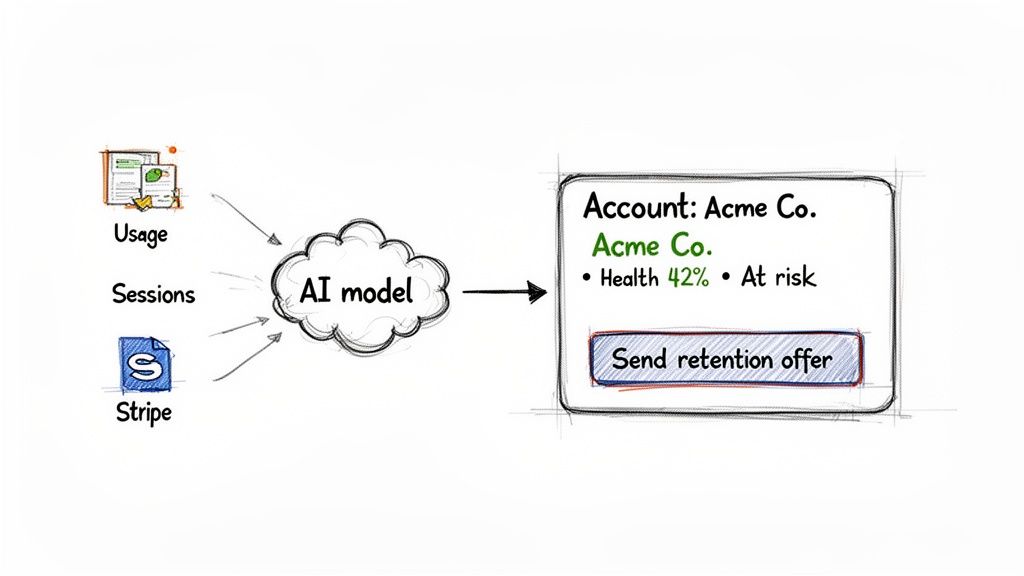
These predictive platforms plug directly into your core systems, like your product analytics and your Stripe subscription data. From there, the AI models analyze a massive range of signals to build a complete picture of each customer's health.
It’s looking for answers to questions like:
- Product Usage Signals: Is the customer logging in less often? Have they stopped using a key feature that our stickiest customers can't live without?
- Feature Adoption Rates: Did they breeze through onboarding, or are they still only using the most basic functions of our tool?
- Subscription Data: Have they had a few failed payments lately? Are they on a monthly plan when our most successful customers are all on annual contracts?
By analyzing these patterns across your entire user base, the AI learns what a healthy, engaged customer looks like. More importantly, it learns to spot the subtle warning signs of a disengaged, at-risk one.
This process generates a dynamic customer health score for every single account. This score isn't a static number; it's a living, breathing metric that changes in real-time as a customer's behavior shifts, giving you a powerful early-warning system for potential churn.
From Prediction to Actionable Retention Plays
Just knowing a customer is at risk is only half the battle. The real magic happens when you can turn that prediction into a quick, targeted action that saves the account. A truly powerful churn prediction model doesn't just raise a red flag; it gives you a clear playbook for what to do next.
This is where platforms like LowChurn completely change the game. The entire workflow is built to close the gap between insight and action, making it fast, precise, and incredibly effective.
Here’s a look at how it works in practice:
- The System Flags a High-Risk Account: The AI detects that a customer's health score has dipped into the "at-risk" zone. This automatically flags them on your dashboard, often weeks before they would have actually canceled.
- The Dashboard Reveals the "Why": You don't just see who is at risk; you see why. The system surfaces the specific negative signals—like a drop in logins or ignored features—that triggered the alert in the first place.
- Launch a One-Click Retention Campaign: Armed with this context, you can launch a tailored retention campaign right from the platform. Maybe it's a personalized email from a customer success manager, an in-app offer for a training session, or a special discount to remind them of the value they're getting.
This approach transforms churn management from a slow, manual guessing game into a precise, data-driven strategy. It gives your team the crucial window of opportunity needed to step in, solve the customer's problem, and guide them back toward success and long-term loyalty.
The Hidden Costs of High Churn
A high churn rate isn't just a number on a dashboard; it's a crack in your company's foundation. While the most obvious impact is the direct hit to your Monthly Recurring Revenue (MRR), the real damage runs much deeper, slowly undermining your ability to grow.
Think of it this way: every time a customer leaves, your Customer Lifetime Value (LTV)—the total revenue you can expect from that account—takes a nosedive. Meanwhile, your Customer Acquisition Cost (CAC)—what you spend to get a new customer in the door—remains the same or even increases.
For a SaaS business to be healthy, you need a solid LTV-to-CAC ratio, ideally 3:1 or higher. When churn is high, that ratio gets flipped upside down. You end up spending a fortune to acquire customers who leave before you can even recoup the cost, grinding your growth engine to a halt.
The Ripple Effect on Your Team and Brand
The damage isn't just financial. High churn is a huge morale killer. Imagine being on the customer success or sales team, pouring your energy into winning and helping customers, only to see them constantly heading for the exit. It creates a feeling of spinning your wheels, which can quickly lead to burnout for your best people.
This fallout also spills outside your company. Customers who churn don't just disappear quietly; they often share their bad experiences with others. That negative word-of-mouth can tarnish your brand's reputation, making it significantly harder and more expensive to attract new prospects.
In a tough economy where new customers are harder and more expensive to win, retention isn't just a growth lever—it's your lifeline. Your existing revenue base is the key to building a resilient business.
We saw this play out dramatically during the SaaS churn crisis in mid-2023. As economic pressures mounted, churn rates shot up. The ProfitWell B2B SaaS Churn Index reported a staggering 20.5% increase over the previous year's average.
This period was a wake-up call, proving that external forces can magnify any internal weaknesses. You can dig into the historic SaaS churn index findings to see the data for yourself. It’s a powerful reminder that getting a handle on churn isn't just a good idea; it's non-negotiable.
Common Questions About SaaS Churn
Even after you've got the basics down, a few tricky questions always seem to pop up when you're in the trenches fighting churn. Let's tackle some of the most common points of confusion for SaaS founders and solidify the key ideas you need for a rock-solid retention strategy.
What Is the Difference Between Voluntary and Involuntary Churn?
This is a critical distinction to make. Voluntary churn is what most people think of: a customer consciously decides to hit the "cancel" button. Maybe they're unhappy with the product, found a competitor they like better, or their own business needs have changed. This is the churn you combat with a great product and stellar customer service.
Then there's involuntary churn, which is purely accidental. It happens when a customer's payment fails—think expired credit cards, insufficient funds, or a random bank decline. These are customers who probably wanted to stick around but dropped off because of a simple, fixable billing hiccup. Shockingly, these preventable payment failures can account for 20-40% of total churn.
When Should an Early-Stage Startup Focus on Churn?
The short answer? Immediately. From day one. It's so tempting for new startups to pour every ounce of energy into acquiring new users, but ignoring early churn is a classic mistake that snowballs into a massive problem later on.
Your very first cancellations aren't failures; they are your most valuable source of unfiltered feedback. They tell you exactly where your product, onboarding, or ideal customer profile might be off the mark.
Figuring out why your first handful of users leave is essential for building a company that lasts. That initial feedback is pure gold, helping you patch the leaks in your bucket before you spend a fortune trying to fill it.
Is It Possible to Achieve Zero Churn?
For pretty much any SaaS business, getting to zero churn is a fantasy. Customer needs change, businesses go under, and markets shift. Chasing a perfect zero is often a frustrating and inefficient use of your time and energy.
The real holy grail isn't zero churn; it's net negative churn.
This is the magic moment when the new revenue you're generating from your existing customers—through upgrades, expansion seats, or add-ons—is greater than the revenue you're losing from those who cancel. When you hit this milestone, your customer base stops being a leaky bucket and starts being a growth engine, pushing your business forward all on its own.
Ready to stop reacting to churn and start preventing it? LowChurn uses AI to predict which customers are at risk of canceling and gives you the one-click campaigns to save them. See how it works at LowChurn.com.