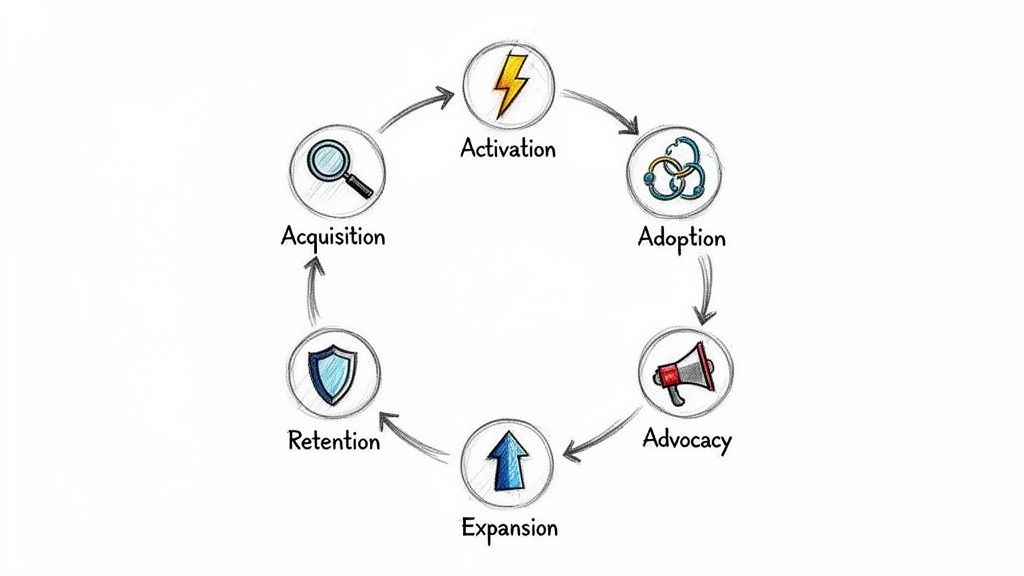
For a SaaS business, the customer lifecycle isn't just another marketing funnel. It's the entire story of your relationship with a customer, a continuous loop that can either fuel explosive growth or slowly bleed you dry. This guide breaks down the six core stages of the customer lifecycle every subscription business needs to master: Acquisition, Activation, Adoption, Retention, Expansion, and Advocacy. Getting this right is the secret to building a company that lasts.
Understanding the SaaS Customer Lifecycle
Think of the customer journey less like a straight line and more like a relationship. It starts the moment someone first hears about your product and, if you play your cards right, it never really ends. Instead of a one-way street from sign-up to churn, the goal is to create a cycle where delighted customers become your best source of new growth. This mindset is especially crucial for businesses built on recurring revenue platforms like Stripe, where every single renewal is a vote of confidence in the value you deliver.
Why does this matter so much? Because a "leaky bucket" — focusing only on pouring new users in the top while ignoring the ones slipping out the bottom — is an expensive and exhausting way to run a business. A smart lifecycle strategy is all about mastering customer acquisition retention for SaaS growth by turning that initial spark of interest into genuine, long-term loyalty. If you neglect any part of this journey, you’re just inviting churn and stalling your own progress.
The Six Stages Defined
To make your product something customers can't live without, you need a clear map of their journey. This roadmap helps you see where things are going wrong and what to do about it. Each stage has its own set of challenges and massive opportunities.
- Acquisition: This is all about attracting the right people—not just anyone, but users who truly need what you’ve built.
- Activation: The magic happens here. This is where you guide a new user to that first "aha!" moment, where they truly get the value your product offers.
- Adoption: This is about moving from a first impression to a daily habit. Your product becomes a core part of their workflow.
- Retention: The game here is to consistently prove your worth, making the decision to renew a no-brainer.
- Expansion: You've earned their trust, now what? This is where you grow revenue by helping them get even more value through upgrades or new features.
- Advocacy: The final evolution. You turn your happiest customers into your most passionate salespeople.
The infographic below shows how this journey flows, turning a brand-new user into a vocal champion for your brand.
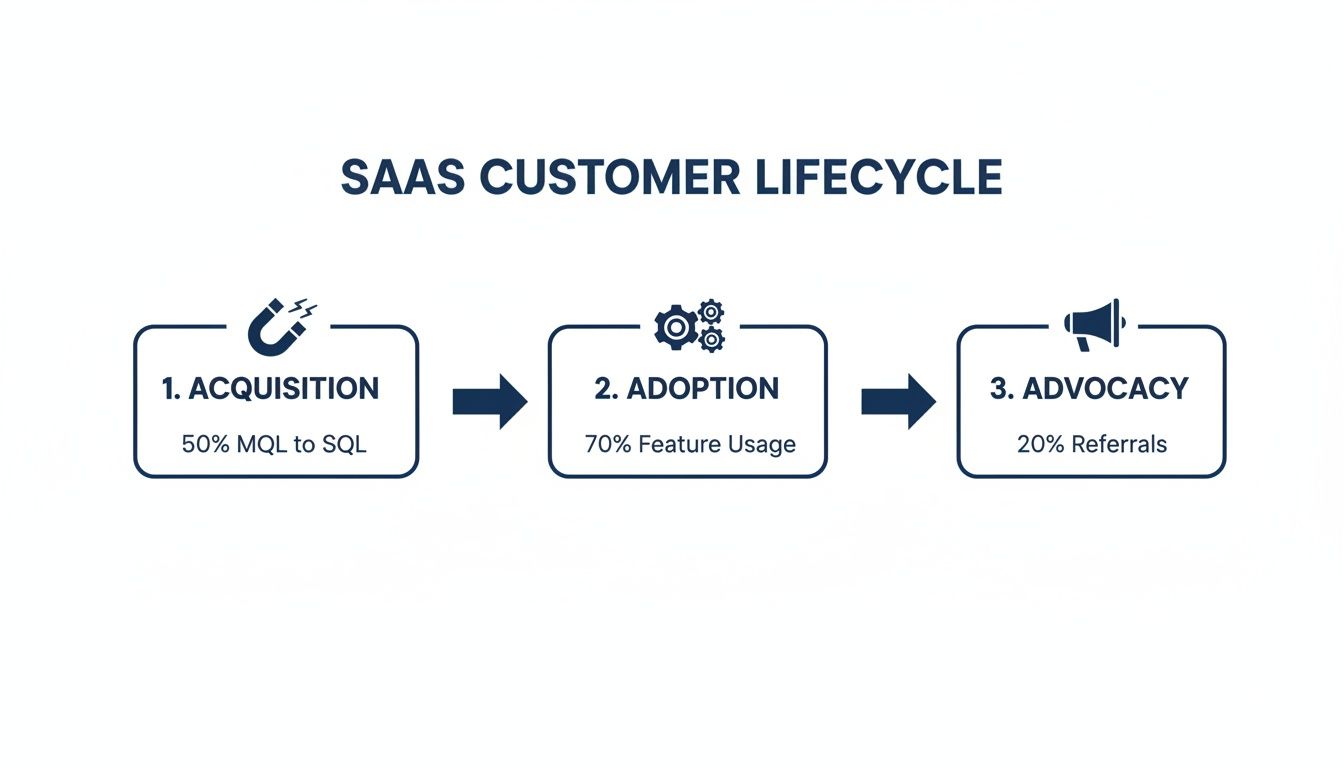
This process isn't just about closing a deal; it's about creating a powerful, self-sustaining engine for growth.
To kick things off, the table below provides a quick snapshot of each stage and its core objective.
The Six Stages of the SaaS Customer Lifecycle
| Stage | Primary Goal |
|---|---|
| Acquisition | Attract and convert ideal customer profiles (ICPs) into new users or trial sign-ups. |
| Activation | Guide new users to experience the product's core value proposition ("aha moment") quickly. |
| Adoption | Integrate the product into the user's regular workflow, making it a sticky, habitual tool. |
| Retention | Ensure ongoing customer satisfaction and value delivery to prevent churn and secure renewals. |
| Expansion | Increase customer lifetime value (CLV) by upselling or cross-selling additional features or plans. |
| Advocacy | Turn loyal customers into brand promoters who drive referrals and positive word-of-mouth. |
Now that we have the big picture, we can dive deep into what makes each of these stages tick.
Winning the First Battle with Acquisition and Activation
The first two stages of the customer lifecycle—Acquisition and Activation—are where you either build a foundation for a long-term relationship or lose a customer before you even have one. This isn't just about getting sign-ups; it's about attracting the right users and proving your product’s value right out of the gate.
Think of Acquisition as matchmaking. Your goal isn’t just to rack up leads but to find users whose problems are a perfect fit for the solution you offer. A mismatch here is a huge source of future churn. If your marketing promises a tool for enterprise teams but your product is really built for freelancers, you're just setting everyone up for disappointment.
Getting this right has gotten tougher and more expensive. Across the board in SaaS and B2B, Customer Acquisition Cost (CAC) has shot up by over 50% in the past decade. At the same time, free-trial conversion rates for self-serve products often hover between a modest 15–25%. This is why the smartest companies obsess over metrics like win rates and average deal size—they know every new user has to count.
Defining the "Aha Moment" in Activation
The second a user signs up, the clock starts ticking. Activation is the race to guide that new person to their "aha moment"—that instant they genuinely experience your product's core value. It’s the difference between them thinking, "Okay, another dashboard," and, "Wow, this just saved me an hour."
A slow or confusing path to that moment is a major drop-off point. People have very little patience for complicated setups or unclear instructions. The metric that matters most here is Time-to-First-Value (TTFV). The faster you deliver a meaningful outcome, the better your chances are that the user will stick around.
Common roadblocks that absolutely kill activation include:
- Confusing Onboarding: A generic product tour that doesn't help the user with their specific goal.
- The Empty State Problem: An intimidatingly blank dashboard with no obvious first step.
- Promise vs. Reality Gap: The user signs up expecting one thing from your marketing but finds the product does something else entirely.
The goal of activation isn't just to get users to click around. It's to make them feel successful and competent with your tool as quickly as possible. This first win builds the momentum needed to carry them into the next lifecycle stage.
Identifying At-Risk Users Before the First Payment
That trial period is a goldmine of behavioral data. A user who signs up and never returns is an obvious churn risk. But what about the one who logs in but fails to complete a key setup action? That’s a massive red flag, too. This is where proactive intervention is everything. You can find some great advice for structuring this phase in our guide to effective customer onboarding strategies.
Modern platforms like LowChurn are built to spot these early warning signs automatically. By analyzing product usage signals, they can pinpoint trial users who are showing low engagement or haven't hit those critical activation milestones.
For instance, having a dashboard that surfaces these at-risk accounts allows your team to jump in before the trial even ends.
This kind of visibility lets you deploy targeted playbooks—like an automated email with a helpful tutorial or a pop-up offering a quick demo—to nudge struggling users back on track. By solving their problems before they even think about canceling, you turn a potential churn event into a powerful activation success story.
Building Habits Through Adoption and Retention
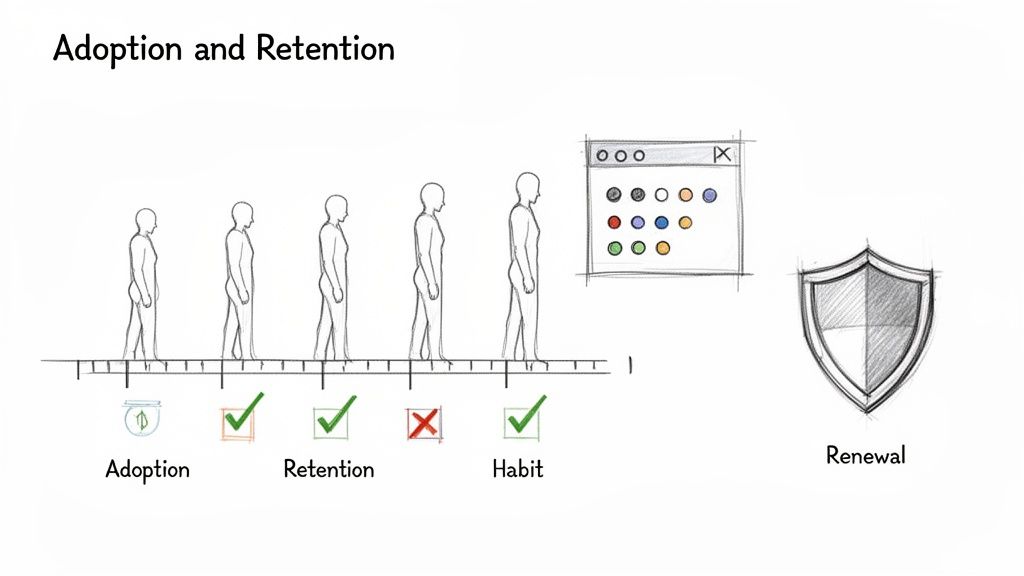
Once a customer gets that first taste of success—that "aha moment"—the real work begins. The focus shifts from making a great first impression to building a genuine, lasting relationship. This is where the Adoption and Retention stages come into play, and they're all about turning initial interest into deep-seated loyalty.
Think of it this way: your product needs to go from being a novelty to a necessity.
Adoption is about habit. It’s the point where a user stops deciding to use your product and just… uses it. It’s woven into their workflow. Imagine a new project management tool. Activation is creating that first task. Adoption is when the team can’t imagine starting their day without opening it up to see what’s on their plate.
When adoption is done right, retention is the natural result. Customers stick around not because they're locked into a contract, but because leaving would feel like a genuine step backward. The thought of going back to "the old way" is painful.
From Casual User to Power User
The mission here is to move customers from a "nice-to-have" mindset to a "can't-live-without-it" one. This means guiding them beyond the basic features and helping them integrate your tool deeply into their core processes. Success isn't measured in logins; it's measured by how embedded your product becomes.
A few key metrics tell the real story here:
- Product Stickiness (DAU/MAU Ratio): This is the classic "habit" metric. The ratio of Daily Active Users to Monthly Active Users shows how many people are truly hooked. A high ratio means you're essential.
- Feature Adoption Rate: Are people just using the surface-level stuff, or are they digging into the high-value features that solve their biggest problems? Tracking this shows you how deep their engagement really is.
- Net Revenue Retention (NRR): This is the ultimate health indicator. An NRR over 100% means your existing customer base is actually growing in value, even after you account for any churn.
The goal of the adoption stage is to make your product's value so consistent and obvious that renewal becomes a non-event. Retention isn't something you fight for at the eleventh hour; it's what you earn every day through solid adoption.
The Slow Fade: Catching Churn Before It Happens
Even your best customers can be at risk, but the warning signs at this stage are often subtle. Customers don't just disappear overnight. It’s usually a slow fade before the final breakup.
This table breaks down the key performance indicators to watch and the common tripwires that can signal a customer is losing their way.
Key Metrics and Churn Signals by Lifecycle Stage
| Lifecycle Stage | Key Metrics | Common Churn Triggers |
|---|---|---|
| Adoption | Product Stickiness (DAU/MAU), Feature Adoption Rate, Time-to-Value | Usage of core features stagnates or declines. The user never integrates the product deeply into their workflow. |
| Retention | Net Revenue Retention (NRR), Churn Rate, Customer Lifetime Value (CLV) | A sudden drop in activity from a power user. Failed payments (dunning). They stop engaging with new feature announcements. |
Catching these signals early is what separates proactive retention from reactive panic.
Spotting Trouble Before It's Too Late
Common churn triggers at this stage are often behavioral:
- A sudden drop in usage: When a daily power user goes quiet for a week, that’s a five-alarm fire.
- Ignored feature announcements: Disengagement from your product updates often signals they’re mentally checking out.
- Failed payments (Dunning): While it can be a simple credit card issue, a failed payment from Stripe is often the first concrete sign that a customer is on their way out.
- Going quiet: If a previously engaged customer stops reaching out for support or providing feedback, their loyalty might be wavering.
To really nail this, you need a holistic view. You can get a much fuller picture by diving into the most important customer retention metrics. For a complete playbook, our guide on customer retention best practices is packed with actionable strategies.
The real magic happens when you connect these behavioral signals with hard subscription data from a payment processor like Stripe. This is where a tool like LowChurn comes in, automatically creating a dynamic health score that flags at-risk accounts in real time.
This kind of dashboard gives you a clear, visual breakdown of an account's health, pointing out the exact risks.
By combining product usage with Stripe data, you move from guesswork to a predictive view of your customer base. This early warning system is your ticket to proactive retention, helping you secure revenue and build the kind of loyalty that powers the next stages of growth.
Fuelling Exponential Growth with Expansion and Advocacy
Once you have a solid base of happy, engaged users, you reach the most exciting part of the customer journey: Expansion and Advocacy. This is the inflection point where a good SaaS business becomes a great one. You're no longer just keeping customers; you're turning them into a powerful growth engine that practically runs itself.
Think of expansion as growing revenue from the customers who already know and trust you. It's about finding that perfect moment to offer an upgrade, an add-on, or a related product that solves their next big problem. You're deepening the relationship by delivering even more value.
Advocacy is the ultimate prize. This is when your successful customers become your best, most authentic marketing team. They leave glowing reviews, refer new business, and happily participate in case studies. This creates a powerful flywheel, feeding high-quality leads right back into the very first stage of the lifecycle: Acquisition.
Driving Revenue with Strategic Expansion
Expansion revenue is the secret weapon for scaling a SaaS company efficiently. The key metric here is Expansion Monthly Recurring Revenue (Expansion MRR), which tracks all the new revenue you generate from your existing customer base.
When your Expansion MRR starts to outpace the revenue you lose from churn, you achieve "negative churn"—the holy grail of SaaS growth. It means your business is growing even without signing up a single new customer.
The secret to making expansion work is all about timing and relevance. A generic "upgrade now!" email blast is just noise. Real success comes from using product usage data as a trigger. For example, you can automate an upgrade prompt when a user consistently hits a plan limit or starts exploring features that signal they're ready for more power.
These moments aren't just sales opportunities; they're a direct reflection of your customer's success. It shifts the conversation from cost to value. To really dig into this, it helps to understand the core principles of what Customer Lifetime Value is and how to calculate it.
Expansion isn't about squeezing more money out of customers. It's about recognizing when they’ve outgrown their current plan and proactively offering them the next logical step to help them achieve even greater success with your product.
These final stages have an incredible impact on your growth. In many mature subscription businesses, a massive 20–40% of new customers come directly from word-of-mouth and referrals. This drastically lowers your overall customer acquisition costs.
What’s more, research consistently shows that increasing customer retention rates by just 5% can boost profits by a staggering 25–95%.
Turning Happy Customers into Your Best Marketers
Advocacy is what happens naturally when a customer feels genuinely successful because of your product. These brand champions are priceless, and spotting them is easier than you might think. A fantastic way to measure this sentiment is with a Net Promoter Score (NPS) survey, which simply asks customers how likely they are to recommend you.
But a high score is just the starting point. You need a system to act on that feedback.
- Promoters (Score 9-10): These are your future advocates. You should immediately follow up with an automated request for a review on a site like G2 or Capterra, or maybe invite them to an exclusive beta program.
- Passives (Score 7-8): They're happy enough, but not blown away. This is a golden opportunity to ask what it would take to truly "wow" them.
- Detractors (Score 0-6): This is a five-alarm fire. A score this low is a critical churn signal. You need to trigger an immediate alert for your customer success team to reach out and solve their problem, fast.
Tools like LowChurn provide pre-built playbooks to automatically turn these NPS responses into action.
By systemizing how you identify and engage your happiest customers, you create a reliable, scalable source of high-quality leads. This closes the loop on the customer lifecycle, fueling your growth for years to come.
Putting Your Lifecycle Strategy on Autopilot
Understanding the customer lifecycle is one thing. Actually doing something about it to protect your revenue? That’s a whole different ballgame. Execution is everything, and this is where we shift from theory to a hands-on system that works for you around the clock.
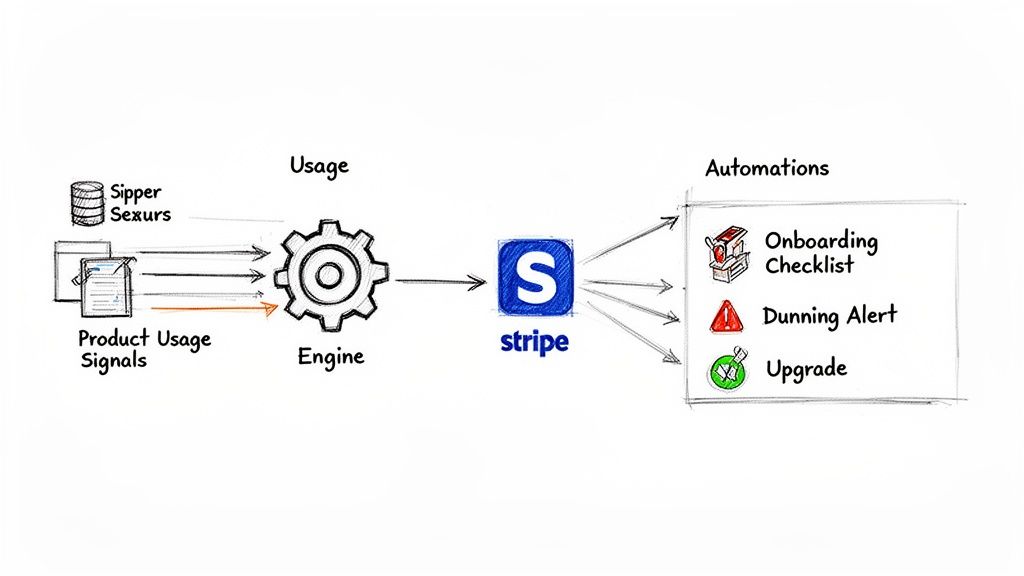
For a modern SaaS business, especially one built on Stripe, setting up a powerful retention engine doesn't have to be a multi-month engineering marathon. It can start with a one-click integration with your payment processor and a lightweight code snippet. That simple setup is your key to getting ahead of churn before it happens.
This is how you move beyond just reacting to problems—like scrambling to save a customer who's already hit the cancel button—and into a predictive, automated workflow that even the smallest teams can manage.
From Raw Data to Predictive Insights
The real power here comes from blending two critical streams of information: product usage patterns and subscription signals. On their own, each only tells you half the story. A customer might log in every day, but if their credit card is about to expire, they're still a massive churn risk.
On the flip side, a customer with a perfectly healthy Stripe subscription might be quietly drifting away from your product. That’s a silent threat that payment data alone will never catch. The magic happens when you bring these two worlds together.
An automated platform can instantly analyze these combined signals to create a real-time health score for every single customer. This isn't a static number; it’s a living metric that shifts with their behavior. It intelligently weighs different factors to give you a clear, prioritized list of who needs your attention right now.
This dashboard from LowChurn gives you a sharp, at-a-glance view of your overall MRR health and immediately flags the accounts that are in trouble.
Seeing your at-risk MRR laid out like this completely changes the game. Churn stops being a lagging indicator and becomes a proactive mission, showing you exactly where to focus.
Deploying Automated Campaigns at Every Stage
Once you know who’s at risk, the next step is to act. A modern retention platform comes with pre-built playbooks you can launch instantly, each tailored to a specific stage of the customer journey. You don’t need a data science degree or a team of engineers to get them running.
Here’s what that looks like in the real world:
- Activation Stage Playbook: A new user signs up but hasn't completed key setup steps within 48 hours. You can automatically trigger a simple, interactive onboarding checklist to guide them toward that crucial "aha!" moment, all without you lifting a finger.
- Retention Stage Playbook: The system detects a once-active user whose login frequency has plummeted by 50% in the last two weeks. An automated, personalized "rescue" email can go out, offering a quick 15-minute check-in call or pointing them to a new feature they might love.
- Expansion Stage Playbook: A customer on your mid-tier plan starts consistently hitting 90% of their feature limits. The system can trigger a subtle in-app message highlighting the benefits of the next plan up, making the upgrade feel like a helpful suggestion, not a pushy sales tactic.
The core idea is simple: use data to understand the customer's context, then automate the right message at the perfect time. This approach allows you to scale personalized, high-touch interactions without scaling your headcount.
Making Sophisticated Strategy Accessible
Not long ago, building this kind of predictive retention engine was a luxury. It was something only big companies with huge data teams could afford, requiring months of development and constant maintenance.
Today, platforms like LowChurn are built to democratize this power. They give you a full-fledged, data-driven strategy in a package that a small, fast-moving team can set up in minutes. By connecting directly to Stripe and your product, the system does all the heavy lifting—the data analysis, the modeling, the predictions—for you.
This empowers founders and small teams to stop guessing why customers are leaving and start taking precise, data-backed actions to convince them to stay. It levels the playing field, helping you build a healthier, more resilient subscription business from day one.
Turning Customer Insights Into Sustainable Revenue
When you look closely at the six stages of the customer lifecycle, from that first moment of Acquisition all the way to Advocacy, a simple but powerful idea comes into focus for subscription businesses. Lasting growth isn’t about winning one big moment. It’s built by consistently nurturing the entire customer relationship with the right actions at the right time.
For years, the playbook was just to pour more users into the top of the funnel and hope for the best. That approach simply doesn't work anymore.
The real opportunity is found in understanding what your customers are actually doing—or not doing—and responding to those signals at every stage. This is how you stop hemorrhaging customers and start building real momentum.
From Guesswork to Growth
For founders, product managers, and customer success leaders, the game has fundamentally changed. The tools you need to understand and guide customer behavior are no longer out of reach. You don't have to guess why a customer is slipping away or which accounts are ready for an upgrade.
This change turns retention from a reactive fire drill into a predictive, strategic part of how you grow your business.
The big takeaway here is one of empowerment. Making a real dent in churn and boosting your revenue doesn't have to be some decade-long odyssey. It’s something you can achieve in weeks just by turning customer insights into automated actions.
It's time to stop wondering about churn and start building a healthier, more resilient subscription business. Tools like LowChurn give you the predictive insights and automated playbooks you need to protect your MRR from the very beginning. By linking what's happening inside your product with your Stripe data, you can finally get ahead of churn and turn would-be losses into real opportunities for retention and expansion.
Frequently Asked Questions
When you're building a SaaS business, figuring out the customer lifecycle can bring up a lot of questions. Here are some of the most common ones we hear from founders who are serious about cutting churn and growing sustainably.
What Is the Difference Between the Customer Lifecycle and the Customer Journey?
It's easy to get these two mixed up, but they look at the customer relationship from two different perspectives. Let's use a road trip analogy.
The customer lifecycle is the big-picture itinerary. It’s the list of major cities you plan to hit: Acquisition, Activation, Retention, and so on. These are the key, high-level stages that define your relationship with the customer.
The customer journey, however, is the detailed, turn-by-turn navigation. It’s every single interaction, from the moment they see your ad on social media to when they read a support article or get their first invoice.
The lifecycle is your strategic map. The journey fills in all the tactical details of their experience. You really need to understand both to build a solid growth strategy.
At What Stage Should We Start Focusing on Churn Prevention?
Honestly? Day one. Churn prevention has to start the moment you acquire a new user, right in the Acquisition and Activation stages.
Churn isn't an event that happens when someone finally clicks "cancel." It’s a process. It starts when you sign up a customer who isn't a great fit for your product, or when you fail to show a good-fit customer how to get value out of it, fast.
The early warning signs are always the most powerful. Think about a trial user who signs up, pokes around for five minutes, and never logs in again. That’s a huge red flag—what we call "pre-churn." This is your golden opportunity to step in and guide them toward that "aha!" moment while you still have their attention.
How Can a Small Team Implement a Full Lifecycle Strategy?
You don't need a huge team or a massive budget to manage the entire lifecycle. The trick is to be smart about it—lean on automation and put your energy where it will have the biggest impact.
Here’s a simple game plan:
- Start with a No-Code Platform: Find a tool that handles the heavy lifting of churn prevention for you. This gets you moving without tying up your engineers.
- Connect Your Data: The first real step is hooking up your payment processor, like Stripe, to a platform that can start crunching subscription and product usage data right away.
- Use Predictive Health Scores: Let the system do the work of finding your most at-risk accounts. This automatically points you toward the customers who need your help the most, right now.
- Deploy Pre-Built Playbooks: Don't reinvent the wheel. Use proven templates to engage customers at just the right moments. This lets you act on data instantly instead of spending weeks building campaigns from scratch.
This approach gives a small team the power of a much larger retention department, letting you protect your revenue so you can focus on what you do best: building an awesome product.
Ready to stop guessing about churn and start taking control of your customer lifecycle? LowChurn gives you the predictive insights and automated playbooks to protect your MRR. Get started for free and see which customers are at risk in minutes.