
When people talk about the "lifeblood" of a SaaS company, they're talking about Monthly Recurring Revenue (MRR). Simply put, it's the predictable revenue you can expect to bring in every single month from all your active subscriptions.
Think of it as your company's financial pulse. It’s the steady, reliable beat that tells you how healthy the business really is.
Why MRR is the Bedrock for SaaS Founders
If you were building a skyscraper, you'd obsess over the foundation. It has to be solid, stable, and predictable before you can even think about building up. For a subscription business, MRR is that foundation. It gives you the stability to hire with confidence, budget accurately, and invest in real growth.
Total revenue can be misleading. A big one-time setup fee or an unusually good sales month can easily skew the numbers. MRR cuts through that noise by focusing only on the recurring payments, giving you a crystal-clear picture of your company's momentum.
The Core of Predictable Growth
At its core, MRR is your normalized, predictable monthly subscription revenue. The key word here is "normalized." To calculate it, you take all your subscription fees—including those on annual or quarterly plans—and convert them to a simple monthly value. An annual contract, for example, is just divided by 12.
This simple step answers the most important question for any founder: How much money can we reliably count on next month? That predictability is everything.
MRR isn't just a number on a spreadsheet; it's a strategic tool. It validates your business model, proves product-market fit to investors, and becomes the ultimate North Star for your entire team.
For SaaS founders, building a healthy MRR starts with a solid plan. A well-defined SaaS go-to-market strategy is fundamental to getting those initial subscriptions and growing them over time.
MRR At A Glance
Before we jump into the formulas and different types of MRR, this table breaks down the core concepts. Think of it as a quick cheat sheet for understanding why this metric is so essential.
| Concept | Simple Definition | Why It Matters |
|---|---|---|
| Predictability | The consistent, expected income from subscriptions. | Allows for accurate financial forecasting, budgeting, and strategic planning. |
| Normalization | Converting all subscription terms (annual, quarterly) to a monthly value. | Provides a true, apples-to-apples comparison of revenue over time. |
| Growth Signal | An increase in MRR over time. | Demonstrates customer acquisition, retention, and business scalability to investors. |
With these fundamentals in mind, you're ready to see how MRR is actually calculated and used to drive decisions.
How to Calculate MRR with Simple Examples
At first glance, calculating Monthly Recurring Revenue might feel a bit intimidating. But once you break it down, it's actually a pretty straightforward process. The whole point is to get a reliable number for the predictable, subscription-based income you can count on each month. This gives you a true pulse on your company's financial health.
For a quick, back-of-the-napkin estimate, you can use a simple formula: multiply your total number of active customers by the average amount they pay you each month.
Simple MRR Formula: Total Customers x Average Revenue Per User (ARPU)
So, if you have 100 customers and they each pay an average of $50 a month, your rough MRR is $5,000. The problem is, this method gets a little fuzzy if you have customers on different pricing plans or billing cycles. It's a good starting point, but not the whole story.
A More Precise Calculation
For a much clearer and more accurate picture, the best way to calculate MRR is to add up the monthly revenue from every single customer. This approach makes sure you're accounting for all your different subscription plans and correctly "normalizing" any contracts that aren't on a monthly schedule.
Let's walk through an example. Imagine a SaaS company with three pricing tiers:
- Starter Plan: $30 per month
- Growth Plan: $100 per month
- Enterprise Plan: $500 per month
Now, let's say this company has the following customer breakdown for June:
- 100 customers on the Starter Plan
- 50 customers on the Growth Plan
- 10 customers on the Enterprise Plan
To get the MRR, you just need to calculate the total revenue from each plan and then add it all together.
Putting the Formula into Action
Here’s exactly how that math plays out:
- Starter Plan MRR: 100 customers × $30/month = $3,000
- Growth Plan MRR: 50 customers × $100/month = $5,000
- Enterprise Plan MRR: 10 customers × $500/month = $5,000
Finally, sum up the MRR from each tier to get your total for the month.
Total MRR = $3,000 + $5,000 + $5,000 = $13,000
This method gives you a precise, reliable snapshot of your recurring revenue. The key thing to remember is that MRR only includes predictable subscription fees—it leaves out any one-time charges like setup fees or consulting services. This is a critical distinction that separates MRR from other metrics like bookings or total revenue. For a deeper look at how these terms differ, check out our guide explaining revenue vs bookings.
The Four Forces That Shape Your MRR
Your Monthly Recurring Revenue is never a static number. It’s a living metric, constantly being pushed and pulled by the actions of your customers. Really getting a grip on what drives these changes is the secret to mastering your growth strategy.
Think of your total MRR as a pool of water. Its level rises and falls based on four distinct flows.
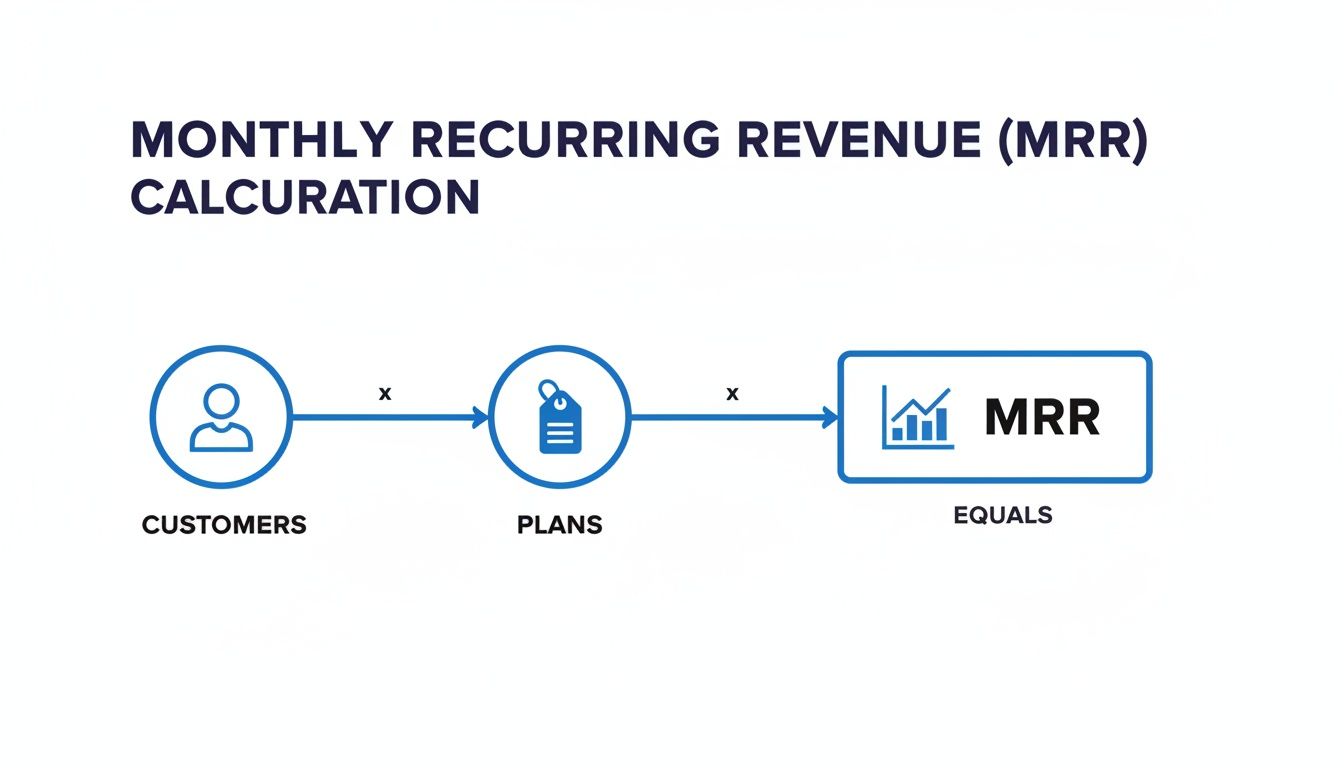
This diagram breaks it down to the basics: your total MRR is simply the sum of all monthly payments from your active customers. Now, let’s dig into the four forces that change this total every single month.
New And Expansion MRR: The Growth Drivers
First, let's look at the two forces that make your MRR grow.
New MRR is the most straightforward of the bunch. This is the fresh, recurring revenue you gain from brand-new customers who signed up in a given month. It’s the clearest signal that your sales and marketing engines are working.
Expansion MRR, on the other hand, is the extra revenue you earn from your existing customers. This is gold. It happens when a happy customer upgrades to a more expensive plan, adds more user seats, or buys a recurring add-on. Many in SaaS refer to this as a component of "negative churn" because it actively cancels out revenue loss from other areas.
A high Expansion MRR is a powerful sign of a healthy business. It proves that customers are finding so much value in your product that they are willing to pay more for it over time.
Contraction And Churned MRR: The Revenue Leaks
Now for the forces that pull your MRR down. These are the leaks you need to plug.
Contraction MRR represents the revenue you lose when existing customers downgrade to a cheaper plan or remove a paid feature. They're still with you, which is good, but they’re contributing less to your total MRR than before. It’s a subtle but important form of revenue leak.
Churned MRR is the gut punch. This is the total monthly revenue you lose for good when customers cancel their subscriptions entirely. This is the most damaging force, as that revenue stream is gone. For a deeper look into this critical topic, you should learn more about how to properly calculate your SaaS churn rate.
To bring all this together, let’s compare these four distinct movements side-by-side.
Comparing The Four Types Of MRR Movement
| MRR Component | What It Is | Impact on Growth | Analogy |
|---|---|---|---|
| New MRR | Revenue from new customers signing up. | Positive | Opening a brand new tap, adding a fresh stream of water to the pool. |
| Expansion MRR | Increased revenue from existing customers upgrading. | Positive | Widening the pipe on an existing tap, increasing its flow. |
| Contraction MRR | Decreased revenue from existing customers downgrading. | Negative | A slow drip from a loose fitting; you're losing pressure but the tap is still on. |
| Churned MRR | Total revenue lost from customers canceling. | Negative | A pipe bursting completely; the entire flow from that source has stopped. |
By tracking these four forces separately, you get a much clearer picture of your business's health. You can see not just if your revenue is changing, but more importantly, why. This is the difference between flying blind and having a real-time dashboard for your company's growth.
Why MRR Is Your Most Important SaaS Metric
Getting the calculation right is step one, but truly understanding what is mrr unlocks its real power. Think of it as your company's North Star—a single, guiding metric that informs almost every strategic decision you'll make, from product roadmaps and hiring plans to fundraising and financial forecasting.
MRR is so much more than just a performance indicator. It’s a forward-looking measure of your business’s health and momentum. Unlike lagging indicators like last year's profit, which only tell you what's already happened, MRR gives you a real-time pulse. You can see the immediate impact of a new pricing strategy, a marketing campaign, or your latest customer retention efforts.
This immediate feedback loop is precisely what makes MRR indispensable for running a subscription business.
A Signal for Investors and a Foundation for Growth
For venture capitalists and potential investors, consistent MRR growth is the ultimate proof that you’ve built a scalable business model. It signals a strong product-market fit and shows you have a predictable, repeatable engine for generating revenue. When you walk into a boardroom, your MRR chart tells a more compelling story about your company's trajectory than any pitch deck ever could.
MRR is the language of SaaS growth. A steady, upward-trending MRR chart communicates health, predictability, and scalability more effectively than any slide deck ever could.
This metric is also the bedrock for other essential SaaS KPIs. Annual Recurring Revenue (ARR), a favorite for enterprise reporting, is simply your MRR multiplied by twelve. And Net Revenue Retention (NRR), which measures how well you grow revenue from your existing customers, is shaped directly by the push and pull of expansion and churn within your MRR.
From Metric to Strategy
The historical role of MRR in investor valuations really highlights its importance. Consistent growth is a key signal of scalability in SaaS, with ARR often anchoring these critical discussions. For example, private B2B SaaS companies under $1M ARR typically show a median growth of 50%, a figure that naturally adjusts as companies mature.
Similarly, NRR, which is built on a healthy MRR foundation, has a median of 106%, with the best-in-class companies hitting 120-130%. You can discover more insights about these SaaS benchmarks to see how your own business stacks up.
Ultimately, tracking MRR isn't just about financial reporting. It’s about making smarter, data-driven decisions every single day. An increase in Expansion MRR might validate that new feature tier you just launched. A sudden spike in Churned MRR could be an urgent alarm bell about a recent product update.
By dissecting its components, you transform a simple number into an actionable roadmap for sustainable growth, ensuring your business isn't just surviving—it's thriving.
Proven Strategies to Grow and Protect Your MRR
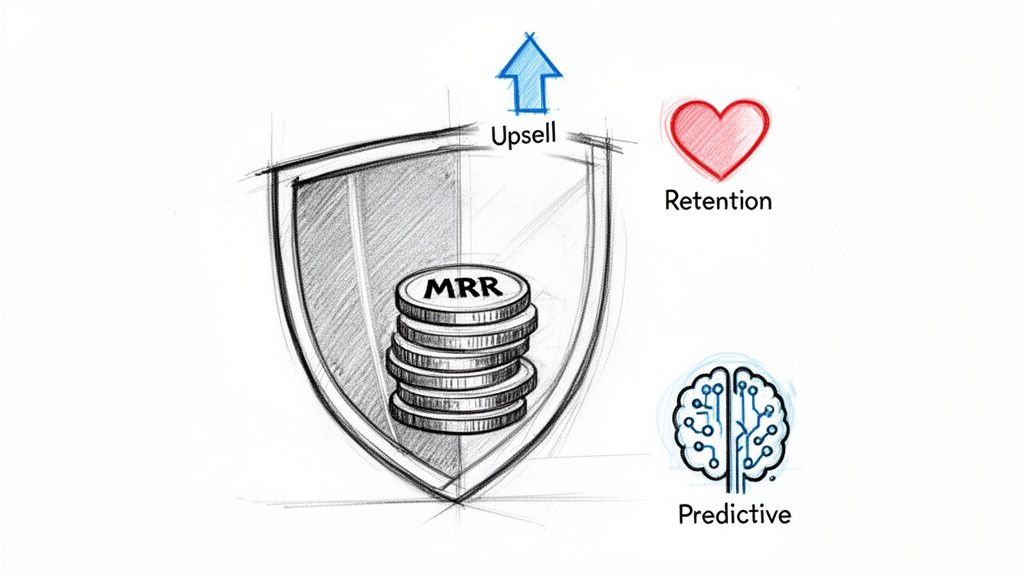
Knowing what moves your MRR is one thing. Actually taking the wheel and steering it is something else entirely. The SaaS companies that truly pull away from the pack don’t just watch their recurring revenue—they have a deliberate system for growing it.
This means looking beyond the endless chase for new logos and focusing on the two most powerful levers you have: boosting Expansion MRR and slashing Churned MRR.
Growing revenue from the customers who already trust you is almost always cheaper than acquiring new ones. It’s also the ultimate proof that you’re delivering real, ongoing value. At the same time, protecting that existing revenue is the bedrock of any sustainable growth plan.
Alongside acquisition, smart customer retention marketing strategies are critical to the long-term health of your MRR. The aim is to create a flywheel where you not only keep the customers you have but also systematically increase their lifetime value.
Increase Expansion MRR with Smart Upsells
Think of Expansion MRR as your growth engine. It's the extra revenue that kicks in when happy customers willingly decide to pay you more. This doesn't happen by chance; it’s the direct result of a well-designed product and pricing strategy.
Here are a few proven ways to drive that expansion:
- Build Value-Based Tiers: Structure your pricing so that as a customer’s business grows and they lean on your product more, upgrading becomes the natural next step. This could be based on user seats, feature usage, or data volume.
- Trigger Timely Upsell Offers: Use product analytics to spot customers bumping up against their current plan's limits. A perfectly timed in-app prompt or email suggesting an upgrade can feel helpful, not pushy.
- Cross-Sell Complementary Features: Do you have add-ons or services that solve adjacent problems for your customers? Identify the segments that would benefit most and create targeted campaigns to show them what they're missing.
Slash Churn with Proactive Retention
Reducing churn is the single most effective way to protect your MRR. Period. Too many companies wait for a cancellation email to hit their inbox, but by then, it’s usually too late. The key is to get ahead of the problem by identifying at-risk customers before they've mentally checked out.
Modern tools can make a huge difference here. You can get a great sense of what’s possible by exploring these powerful SaaS customer retention strategies.
Proactive retention isn't about guesswork. It’s about using data to predict which customers are showing signs of disengagement and intervening with the right message at the right time.
Platforms powered by AI can analyze thousands of signals—like dips in product usage, changes in support ticket frequency, or subscription history—to calculate a “health score” for every customer. This score is essentially a prediction of their likelihood to churn.
This kind of dashboard acts as an early warning system, flagging high-value accounts that need immediate, personal attention from your customer success team.
By making retention a data-driven process, you can systematically lower your churn rate, stabilize your revenue, and turn your existing customer base into your most reliable source of growth. This isn't just about saving revenue; it's about building a healthier, more resilient subscription business.
Your MRR Questions, Answered
Once you get a handle on the basics of MRR, the real-world questions start to surface. Let's tackle some of the most common ones that SaaS founders run into so you can apply these concepts with confidence.
What’s the Difference Between MRR and Revenue?
Think of it like this: MRR is your company's predictable financial heartbeat. It only tracks the recurring subscription revenue you can count on every month from active customers.
"Revenue," on the other hand, is the whole enchilada. It lumps everything together—one-time setup fees, professional services, consulting work, even variable usage charges. For a subscription business, MRR is the true signal of sustainable health, while total revenue can easily be skewed by temporary, non-recurring spikes.
How Do I Handle Annual Contracts When Calculating MRR?
This is a big one, and getting it right is crucial for accurate reporting. You absolutely have to normalize any non-monthly contracts into a monthly equivalent.
It's a simple bit of math: just take the total contract value and divide it by 12. So, if a customer signs a $2,400 annual plan, they contribute $200 to your MRR each month for the duration of that contract ($2,400 / 12). Doing this prevents you from seeing huge, misleading spikes and gives you a real sense of your monthly recurring baseline.
Normalizing all contracts creates an apples-to-apples comparison. It ensures your month-to-month growth reflects actual business momentum, not just the timing of different billing cycles. This consistency is everything for accurate forecasting.
Is a High New MRR Always a Good Sign?
A flood of New MRR is definitely exciting—it means your sales and marketing efforts are paying off. But it only tells part of the story. If your Churned MRR is also high, you’re just running on a treadmill.
This is the classic "leaky bucket" problem. You're pouring new revenue in the top, but it's draining out just as fast from the bottom. A truly healthy business doesn't just have strong New MRR; it combines it with low Churned MRR and, ideally, high Expansion MRR. That's the sign of a company that not only wins new customers but keeps them happy and grows their accounts over time.
Can I Have Negative Net MRR Churn?
Yes, you can—and it’s the holy grail of SaaS growth. Negative net MRR churn happens when the revenue you gain from existing customers (Expansion MRR) is greater than the revenue you lose from downgrades and cancellations (Contraction + Churned MRR).
In other words, your existing customer base is growing on its own, generating more revenue this month than last. It means your business would grow even if you didn't sign a single new customer. Hitting this milestone is a powerful signal that you have a fantastic product and a rock-solid business model.
Ready to stop guessing which customers are at risk? LowChurn uses AI to predict churn before it happens, giving you the insights and tools to protect your MRR. Get started in under a minute and see how much revenue you can save.